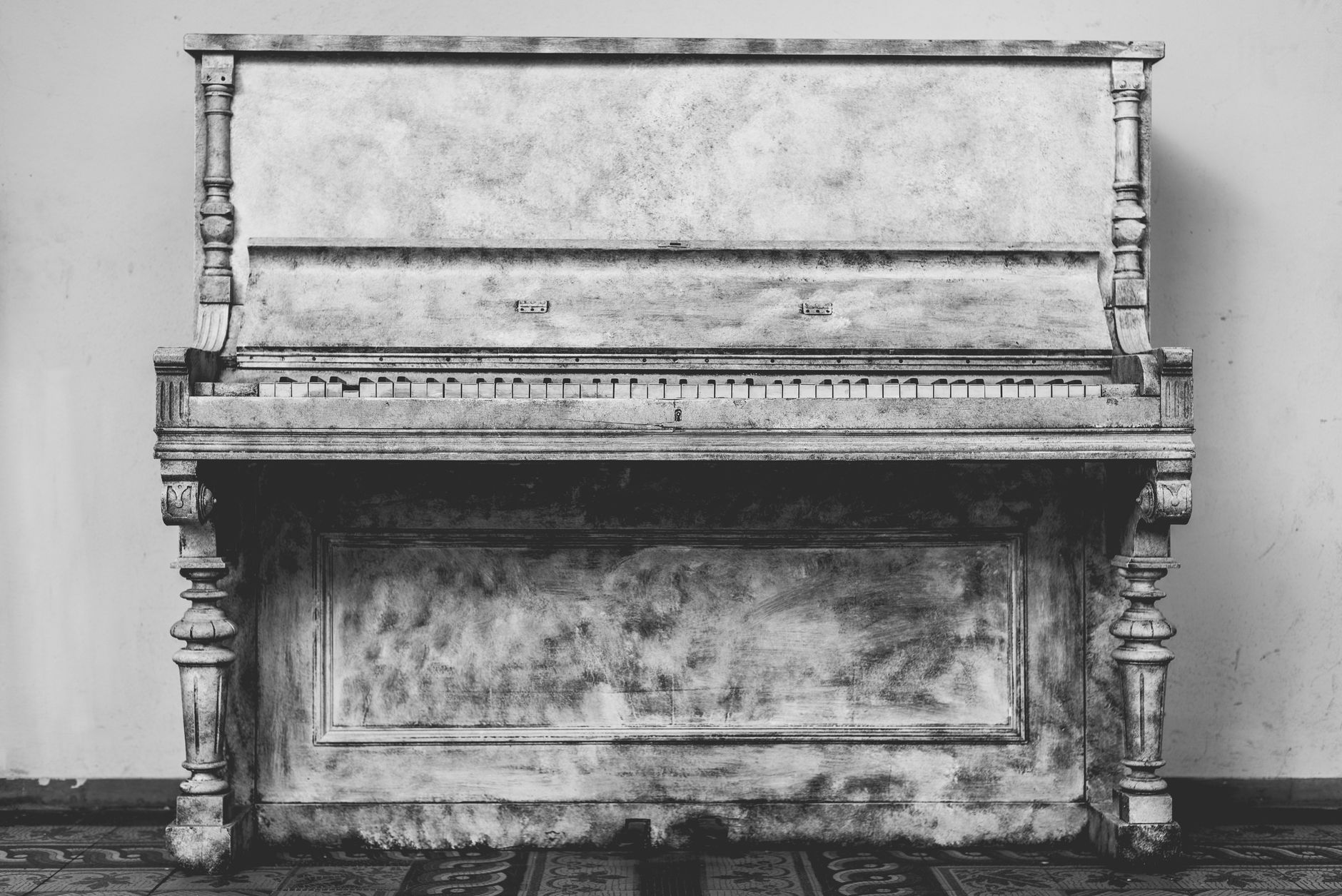
The Piano on the Porch in the Rain
The first Sunday
It was not the next Sunday. He went to a rehab unit in Galesburg for two weeks after he left the hospital, and he worked harder there than I have ever seen a man work. He learned to stand with a walker. He learned to say “water” and “Lily” and “thank you.” He came home the second week of May.
The first Sunday after he came home was Mother’s Day.
Pastor Jim had moved the coffee hour up so it came before the service instead of after, and he had asked if I would play in the fellowship hall instead of the sanctuary, on the old piano, before everybody went up. He did not make an announcement. He did not have to.
The hall was full by nine fifteen. People stood along the back wall by the coffee urns. The Thursday men sat together at the long table nearest the piano, Hal in the middle in his good sport coat, with his cap on the table in front of him.
Ray from Galesburg had come back the week before and tuned it. He had glued the loose ivory down. It sounded better than it had in years.
At nine thirty the side door opened, and Renee pushed my father in.
She was wearing a navy dress I had never seen. Her hands were tight on the wheelchair handles. She did not look at anyone. She pushed him all the way across that room, past the coffee urns and the long tables and the prayer list, and she parked him beside the piano bench where he could see my hands.
Then she went and stood by herself at the very back, by the door.
Nobody said a word to her. Nobody had to. Every person in that room knew where that piano had been three weeks before, and they knew who had put it there. That was enough. That was the whole of it.
I sat down on the bench and lifted the fallboard. Lily sat at the end of the front table, right where I could see her.
I played “In the Garden.”
I played it the way my mother played it, slow, with the little pause at the top of the chorus where she always took a breath. I had her fingering in my head. I did not need the music.
But I had put one of those sheets up on the stand anyway, the one from the top of the box, still a little wavy from the rain, with her pencil numbers on it.
Halfway through the first verse, I heard my father humming. He could not sing the words. He could only hum, low and rough, with his left hand tapping on the arm of the chair. Then Hal started singing beside him, and then Gene, and then the whole room, quietly, the way people sing in a fellowship hall at nine thirty in the morning.
I did not cry. I thought I would, and I did not.
Renee did.
I could see her from the bench, over the top of the piano. She was standing alone at the back with one hand over her mouth. Her shoulders were shaking. She had heard that song every night for eleven years through running water in a kitchen, and now she was hearing it with a room full of people who knew exactly what she had done.
When the last chord was done, I sat still for a moment. Then I got up off the bench, and I walked down the middle of that room, between the long tables, past Hal and the Thursday men and Lily and Pastor Jim, all the way to the back.
People watched me go. I did not care.
I put my arms around my stepmother.
She stiffened at first. Then she leaned into me, and she cried into the shoulder of my good dress, and I let her.
“I’m sorry,” she said. “I’m so sorry, Megan.”
“I know you are,” I said. “I know.”
“I don’t want it back,” she said into my shoulder. “Please don’t make me take it back. It belongs here. Where people can hear it.”
“It can stay here,” I said. “I think Mom would like it here.”
Behind us, at the coffee urns, Linda Gill was crying too, and pretending she was not.