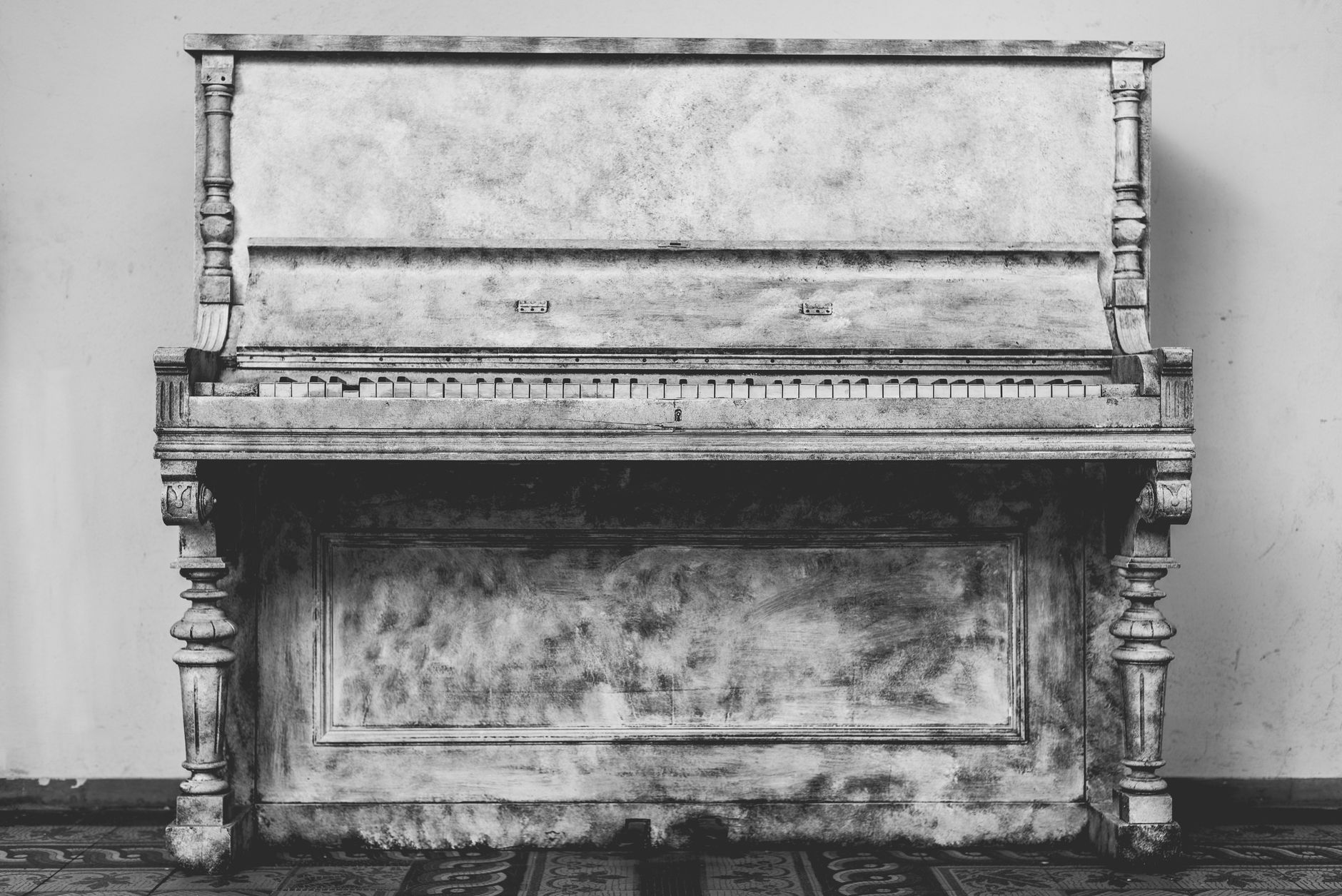
The Piano on the Porch in the Rain
How you move a piano in the rain
I have watched men load cattle and set trusses and pull a calf in a snowstorm, but I had never watched anybody move a piano. It is not a strong man’s job. It is a careful man’s job.
They wrapped it first. Gene and Don threw the moving blankets over it from both sides and taped them down with packing tape, the same roll Renee had used on her sign. Mike laid the tarp over the whole thing and tucked it.
“Keep her standing up,” Hal said. “You lay an upright on its back and you’ll knock the action out of whack. And somebody watch that left leg. She’s got an old dent there already.”
“That was my dad,” I said. “In 1979.”
Hal smiled at me. “Then we’ll try not to match it.”
They tipped it onto the piano board, two men on each end and two at the sides. I heard Steve Pruitt let out a breath. Five hundred pounds is a number until you see six men in their sixties and seventies lean into it together.
They laid the planks down the three porch steps. Then they walked it down, an inch at a time, with Hal backing down in front calling out, “Slow. Slow. Hold it. Now.” Lily stood beside me holding my arm with both hands.
At the bottom, they rolled it across the wet sidewalk on Gene’s dolly to Hal’s Silverado. The tailgate was already down.
They lifted it up into the bed together, Don and the Pruitt brothers on the high side, and slid it forward against the front of the bed. Mike ratcheted two straps across it and hooked them to the tie downs, and Gene threw another blanket over the top for good measure.
“Where to?” Hal asked me.
I had not thought about it. My house is a rental with a narrow back door and a kitchen you can barely turn around in.
“The church,” Lily said. “Grandma Karen played at the church.”
The men looked at each other. Hal put his cap back on.
“Pastor Jim’s got a key,” he said. “And if he doesn’t, I do.”
The fellowship hall
We drove the four blocks to the church at fifteen miles an hour with our flashers on. Six pickups in a line through the middle of town on a Sunday night. People came out on their porches to watch us go by. Somebody honked, and Gene honked back.
Pastor Jim met us at the side door in a flannel shirt. Hal had called him from the driveway. He held the door while they rolled the piano down the hallway and into the fellowship hall, past the coat rack and the bulletin board with the prayer list on it. My father’s name was the third one down.
They set it against the east wall, under the window that looks out on the parking lot. They pulled the blankets off and wiped it down with a stack of dish towels from the kitchen. Don ran the dehumidifier from the church basement up the stairs and plugged it in beside it.
Then they all stood back and looked at me.
I lifted the fallboard. The keys were cold. One of the ivories on the low end had come loose at the corner, the way it had since I was a girl.
I played a C scale, slow, up and back. Two of the keys were sluggish from the damp and came up late. Otherwise it sounded the way it had sounded every evening of my life.
“She’s all right,” Gene said quietly. “She’ll dry out.”
I wanted to say something to them. I wanted to make a speech about my mother and the egg money and the hay wagon. But I could not get a word out, and I think every one of those men was grateful for that.
Instead, Hal put his hand on my shoulder. “Your dad would’ve done it for any of us,” he said. “He did it for my wife’s mother’s sideboard in 1996, and it rained that day too.”
Lily sat down on the bench next to me. She had brought the box of wet music from the porch, and she had laid the sheets out one by one on the long tables to dry. There were thirty or forty of them, curling at the corners. My mother’s handwriting was on almost every one.