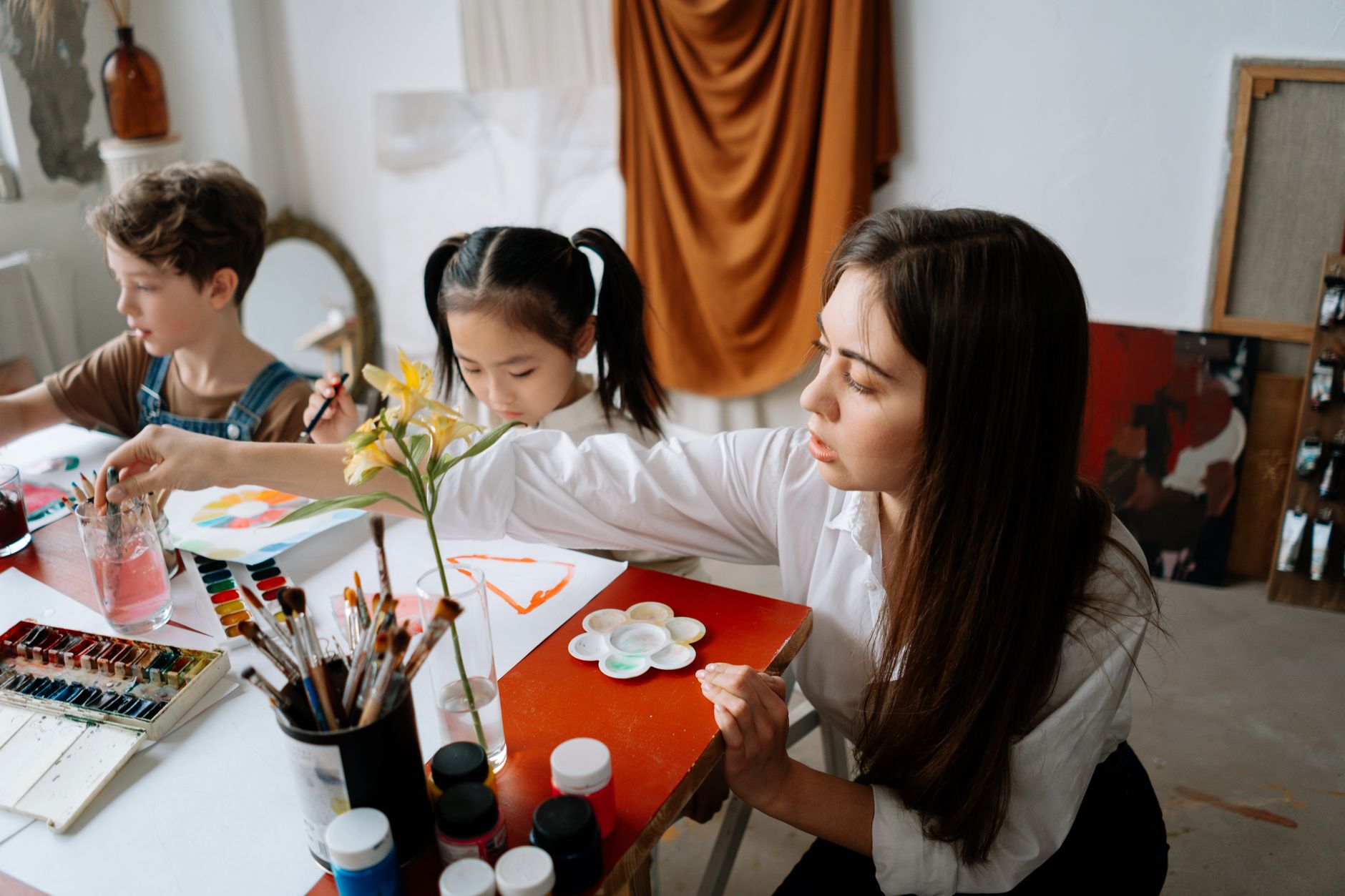
The Art Room in the Old Depot
I watched his face while he did, and I am not going to tell you I did not. Something in it came loose. He put his hand on the back of that boy’s neck and left it there.
“You made this,” he said.
“It leans.”
“I don’t care if it leans.”
He nodded at me across the room. I nodded back. He did not say anything about April and neither did I. He gave Lyle the clipboard, and then he stood by the stove for the better part of half an hour while Darius finished his soup, and I heard Lyle telling him the dishpan of chicken.
That was the nineteenth of September.
The mural was the children’s idea, or near enough. A third grader named Ben asked me why the big bin by the tracks was so plain, and I said I supposed nobody had ever thought to paint it, and by noon I had forty children who had thought to paint it.
The co-op has an old steel grain bin on the track side of the elevator, right across from the depot, thirty-some feet tall and as gray as a bucket. You see it from Main Street. You see it from the highway.
I did not think they would say yes. But Tom has wired that elevator for twenty years, and he walked over on a Monday and talked to the manager, a man named Rich. Rich said he would take it to his board. He came back and said they could have the bottom of it, a stretch forty feet around the curve, facing town. He said it had to be the old bin, away from the scale and the dump pit, and it had to be done before the beans started coming in, because once harvest hit he would have trucks lined up to the highway and he was not having children anywhere near them.
That gave us one Saturday. The twenty-sixth.
The town did the rest, and I mean that. Rich’s men pressure-washed the steel on Tuesday. Tom and Gene and two fathers rolled on a coat of primer made for galvanized metal on Thursday evening, a clean white band eight feet high and forty feet long. The hardware store gave us every can of mistinted exterior paint in the back room, which is how we came by a remarkable amount of a green nobody had wanted for a bathroom. The lumberyard brought a low scaffold with rails, and Tom said nobody under high school age was going up on it, and nobody did.
The children had voted on the picture. It was not close. They wanted a train.
So I chalked it out Friday night by the truck headlights: a long freight coming across the whole forty feet, with the depot at one end, yellow, and the elevator at the other, and fields behind. I chalked the engine big. I left the cab window empty. I had an idea about that window, and so, it turned out, did they.
Saturday morning it was sixty-four degrees and still, with that gold September light. I had every child from the clipboard and then some. I gave the little ones the grass and the ballast along the bottom, where it did not matter if they went outside the lines. The middle grades had the boxcars, one car each, and I told them a boxcar can be any color a person likes. The big kids and the high schoolers who had turned up, my old students, took the sky from the scaffold.