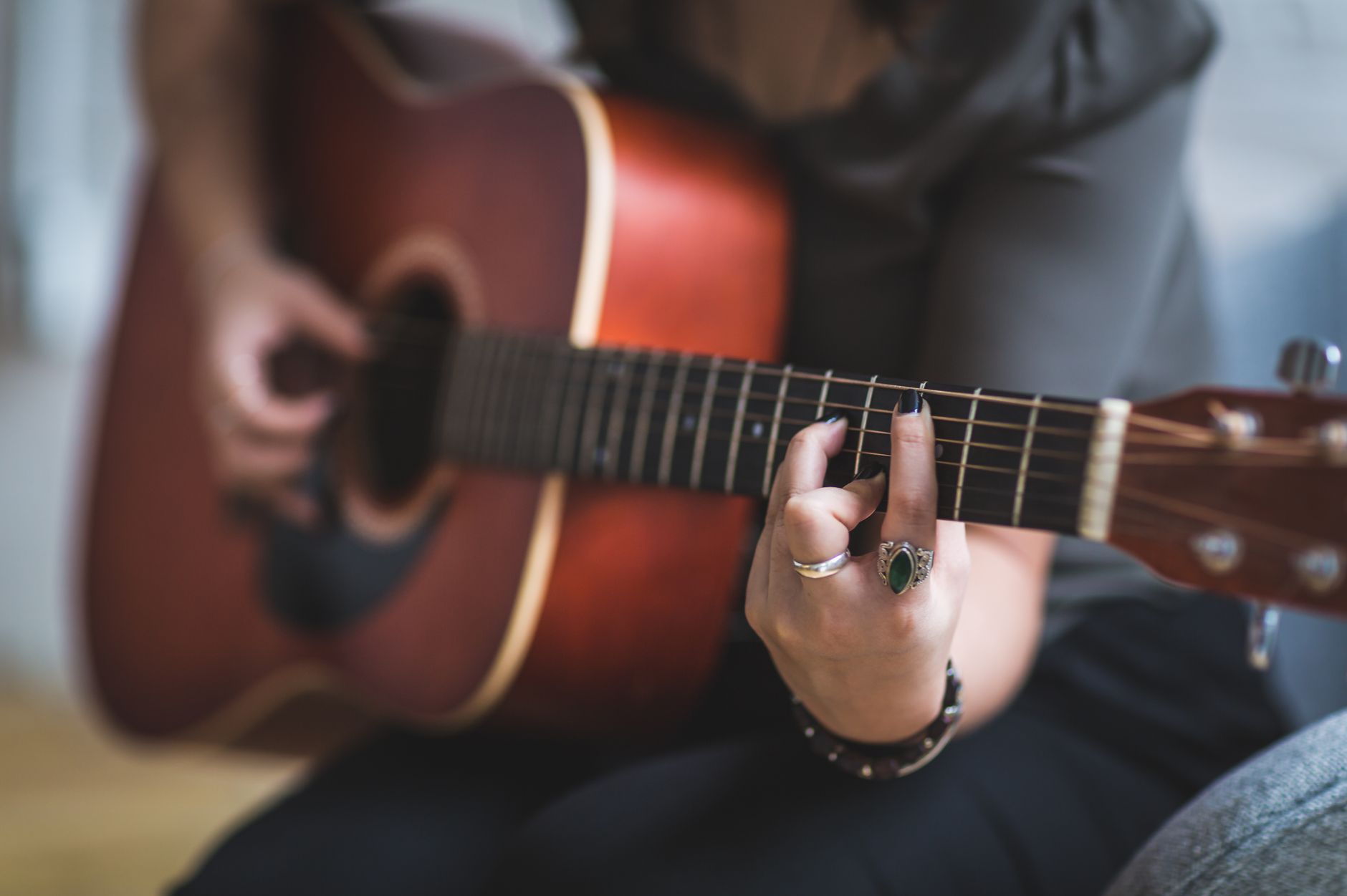
The Guitar They Laughed At
Georgia Stands
Georgia Truett had run the VFW Ladies Auxiliary in this county for as long as I could remember being alive, a woman well into her eighties by then, silver hair set the same way every week at the one salon in town, sharp as a tack behind glasses thick enough to make her eyes look twice their size.
I had known her my whole life the way you know the older women who run every church supper and every funeral luncheon in a small town, present at the edge of every important moment without ever quite being the center of one. I did not know, until that night, that she had once stood at the very center of the moment that mattered most to my whole family.
She rose to her feet three rows back before I had even finished the first verse, one hand pressed flat against her chest, and when she spoke, her voice carried over my guitar the way only an old choir director’s voice can carry in a room built for exactly that kind of carrying.
“That’s Delmar’s hymn,” she said. “I haven’t heard that song sung out loud since the night before he shipped out.”
The whole hall turned to look at her instead of me, and I nearly lost the chord entirely.
“I sang it with him,” Georgia said, to the room now, not just to me, “in this very building, before it was a VFW hall, when it was still just Loyal Creek’s dance hall and half the boys in this county were about to leave for Korea and didn’t know if they’d see this floor again. Delmar wrote that song two nights before he left. He played it once for the whole town and then he wouldn’t touch it again until he came home.”
I finished the last line with tears running straight down my face and did not try to stop them, because some things a person has earned the right to let show.
The hall was silent for one full breath after the last note died out. Then it wasn’t silent at all. People stood up, all through that room, the way a congregation stands for a hymn they all know the words to without being asked, and the sound that followed wasn’t clapping so much as it was two hundred people finally exhaling at once.
What Georgia Knew
After the applause finally settled enough that a person could be heard, Georgia asked if she could come up on that little stage, and I stepped aside so an eighty-something-year-old woman could take the same three steps I’d nearly fallen over walking up myself.
She told the room what Delmar had never told me, not once, in all the years he raised me on that back porch.
He hadn’t just written that song about a friend he lost overseas. The friend was Georgia’s own older brother, a boy from this same county who never came home from Korea, and Delmar had carried a promise made to that dying friend for the rest of his life: that if he made it home, he’d make sure this town never let that boy’s name disappear into a headstone nobody visited.
For thirty years, Georgia said, Delmar hadn’t just led the singing at the Baptist church and the Saturday gospel hour at the post. He’d quietly organized the fund that kept fresh flowers on that boy’s grave every Memorial Day, and the small scholarship the VFW still gave out every spring to a graduating senior, funded almost entirely, Georgia said, out of Delmar’s own pocket and never once put in his own name.
“Your grandfather,” Georgia told the room, with her hand resting light on my shoulder, “spent sixty years making sure other people got remembered, and never once let anybody remember him for it. I expect that’s exactly why he taught his granddaughter to sing his song instead of just telling her the story. Some things aren’t meant to be told. They’re meant to be sung, so they can’t be forgotten by accident.”
I had spent six years thinking I’d inherited a house, some acreage, and a guitar I was too afraid to open. I understood, standing on that stage with Georgia’s hand on my shoulder, that what Delmar had actually left me was a debt of quiet kindness owed to an entire county, and a song built to make sure nobody ever stopped paying it.