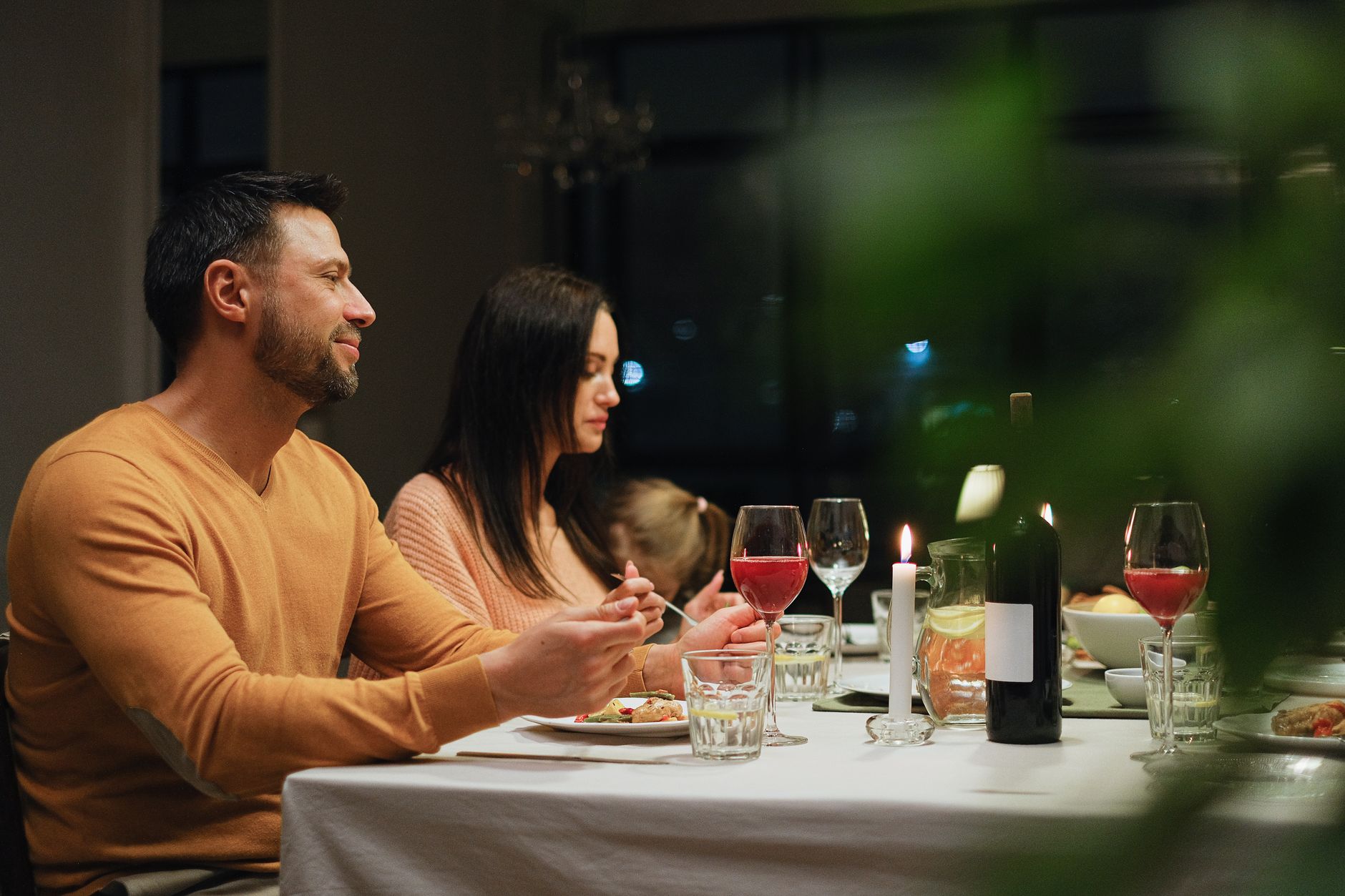
The Boyfriend Who Kept Dropping His Fork
The last supper I thought would be ordinary
My name is Carol Beckett, and I have lived my whole life on the same forty acres outside Millhaven, Missouri, where the blacktop turns to gravel and the gravel turns to the lane my late husband Ray graded himself the spring before he passed. I raised one daughter in this farmhouse. Her name is Hannah, she is twenty-two years old, and for most of her life she was the loudest, brightest thing in any room she walked into.
So when she called me on a Thursday and said she was bringing a young man to Sunday dinner, I did what any mother in this county would do. I got up before the rooster, I pulled the good tablecloth out of the cedar chest, and I made the meal I make when I want somebody to feel welcome. Roast chicken with the skin gone gold and crackling. Mashed potatoes whipped with real butter and a little of the milk from the Hendrickson place down the road. Green beans I had put up myself last August, cooked down slow with bacon ends the way Ray liked them. Yeast rolls. A pitcher of sweet tea sweating on the counter. A rhubarb pie under a dish towel because Hannah has loved rhubarb since she was tall enough to reach the counter and steal the raw stalks.
I want you to understand that I was happy. I stood in my kitchen with flour on my apron and the radio playing the farm report and I was happy the way a mother is happy when her child finally sounds settled. Hannah had been a little far away from me for about a year. Fewer phone calls. Shorter visits. When she did come by she sat closer to the door than she used to, like she had one eye on the clock the whole time. I told myself it was just growing up. I told myself a lot of things that year that I wish now I had not believed.
“His name is Trent, Mom,” she had said on the phone, and there was a hush in her voice I did not recognize. “Please. Please just be nice. Don’t start in on him.”
“When have I ever started in on anybody,” I said, and I laughed, because I thought I was joking.
“Just be nice,” she said again. And then, quieter, almost like she did not mean to say it out loud, “It’s easier when everybody’s nice.”
I did not know what those words meant yet. I do now. I will carry them the rest of my days.
When they pulled up the lane
They came a little after five, which is dinner time out here, none of that eight o’clock business. I heard the tires on the gravel before I saw them, and I wiped my hands and went out onto the porch the way my own mother always did, so a guest never has to knock at a Beckett door.
Hannah got out of the passenger side. She was wearing a soft yellow dress I had never seen before, and her hair was down and curled, and she had on lipstick, and for one second my heart just filled up, because she looked so pretty standing in the low gold light with the soybean field going on green behind her.
Then I looked at her face.
I am going to try to explain this and I know it will sound like a mother reaching. Hannah was smiling. Her mouth was doing everything a smile is supposed to do. But her eyes were somewhere else. Her eyes were checking. She glanced back at the driver’s side before she took a single step toward me, a fast little flick of a look, the way you check a hot stove to see if it will burn you.
He came around the front of the truck. Trent. He was tall, taller than Ray had been, and he was put together in a way that does not come cheap. Pressed shirt, no wrinkle in it after a two hour drive. Nice watch. Boots that had never seen a barn. He was carrying a bouquet of grocery store flowers still in the plastic, and he had a smile so smooth it looked poured on.
“Mrs. Beckett,” he said, and he came up my porch steps and leaned in and hugged me before I had decided whether I wanted to be hugged. He smelled like cologne and mint gum and underneath that something I could not name at the time. I can name it now. It was the smell of a man who is always calculating. “It is an honor, truly. Hannah talks about you constantly.”
“Does she,” I said, and I looked at my daughter, and my daughter looked at the porch floor.
“Come in out of the heat,” I said. Because that is what you say. Because I did not have any words yet for the thing that had already started crawling up the back of my neck.
He answered every question I asked her
We sat down at the table Ray built, the one with the burn mark near the corner where a teenage Hannah once set down a curling iron and about scared me to death. I had it laid out nice. I put Trent across from Hannah and me at the head, in my spot, the spot I have sat in for thirty years.
I said grace. I always say grace. When I lifted my head, Trent was already looking at me, and he had this expression like he found the whole thing charming, like I was an exhibit at the county fair he was being polite about.
“So, Trent,” I said, passing him the potatoes. “Hannah tells me you’re in business up in the city.”
“Several, actually,” he said. He talked easy. He talked well. He said he had a construction outfit and a stake in a couple of properties and he was looking at land down this way, which he said with a little smile at me, like we were going to be family soon and I might as well get used to it. He said a young woman does better with a firm hand and a plan. He said that. A firm hand and a plan. He said Hannah had never really known what she wanted until he came along and gave her some structure.
Structure.
I set down my fork. I remember setting it down. That word landed in me wrong, the way a wrong note in a hymn will make the whole congregation wince at once. Structure is a thing you put on a barn. It is not a thing you put on a person.
“Hannah always knew what she wanted,” I said. “She wanted to be a large animal vet when she was nine. Wrote it on the wall in the mudroom in crayon and I never painted over it.”
I looked at my daughter to share the memory, the way you do. I wanted her to laugh. I wanted to see her roll her eyes at me the way she used to.
Trent laughed instead.
“She’s got a lot of ideas,” he said warmly, and he reached over and patted the back of Hannah’s hand where it lay on the table. “We’re working on which ones are realistic.”
I asked Hannah how her job was going. Trent said she’d left it, it wasn’t a good fit. I asked Hannah if she still saw her friend Becca from high school. Trent said Becca was a bad influence and they’d drifted. I asked Hannah if she wanted more chicken. Trent said she was watching what she ate.
Every single question I put to my own child, that man answered before her lips could even part. And every single time, Hannah just lowered her eyes back down to her plate, and I watched her cut her food into smaller and smaller pieces without lifting a bite to her mouth.
Thirty years I have fed people at this table. I have never once watched somebody sit in front of my chicken and my beans and my rhubarb pie and eat nothing at all. My daughter, who used to lick the beaters, sat there and starved politely and let a stranger speak in her voice.
The first time the fork fell
We were maybe twenty minutes in when Trent dropped his fork.
It hit the floor with a bright little clink against the hardwood.
“Oh, how clumsy of me,” he said, and he gave a small laugh, and he bent down under the table to get it.
He was down there a beat too long. Not much. A half second past what it takes a grown man to pick a fork up off the floor. And when he came back up, he was not looking at his plate, and he was not looking at Hannah.
He was looking at me.
Right at me. A long, level, pleasant look with nothing pleasant behind it at all. He held it for a moment, then he smiled, and he went back to talking about a subdivision he was going to build.
I did not think much of it. I want to be honest with you about that. In the moment I did not think, that man is doing something evil under my table. I thought, he’s a little smug, I don’t much care for him, Hannah could do better. That is all I let myself think, because the other thoughts were too big to have while passing the rolls.
But I noticed Hannah had gone very still. Stiller than a person sits on purpose. And there was a shine of water in her eyes that she blinked back down fast, like she had a lot of practice blinking things back down.
The second time
A few minutes later, it happened again.
Clink.
The fork went down, and this time it went down on Hannah’s side of the table, and Trent leaned that direction to fetch it, and I saw my daughter’s whole body flinch. Just a small flinch. A tightening. The kind you’d miss if you weren’t her mother, if you hadn’t watched her sleep as a baby and learned every twitch her body makes.
“Sweetheart,” I said, and I kept my voice easy, easy as I could make it. “You all right? You’ve hardly touched a thing.”
“I’m fine, Mom,” she said.
But it was not fine. I have heard my daughter say fine a thousand times in twenty-two years and I know the difference between the fine that means fine and the fine that is a small animal holding still so the hawk will pass over. This was the second kind. This was fear that has learned how to keep its manners.
Trent came back up with his fork. He set it down. He smiled at me again. And he said, in the smoothest voice you ever heard, “Your mother makes you nervous, sweetheart. You should relax.”
And Hannah said, “I’m relaxed.”
And I thought: no. No, you are not. And it is not me you are afraid of.
My hands had started to shake, so I put them in my lap and folded my napkin over them so nobody would see. I have prayed over a lot of tables in this house. Under my breath at that one, I prayed a short one. Lord, show me what I’m looking at. Because I could feel it now, all around the room, thick as August air before a storm. Something was wrong in my own dining room and I could not yet see the shape of it.
The third time, and what I saw when I bent down
The third time, the fork fell on my side of the table.
I do not think that was an accident either. Nothing that man did that night was an accident. I believe he wanted me to reach for it. I believe he wanted to see what I would do. But whatever his reason was, God turned it, the way He does, because when that fork skidded toward my chair, I bent down to get it before Trent could stand up.
And under my own table, in the last gold light coming sideways through the west window, I saw everything.
I saw Trent’s boot. It was set down flat and hard over the top of Hannah’s bare foot, pinning it against the floorboards. Not resting. Pressing. His whole weight leaning into it, holding my daughter’s foot to the ground like you’d pin a snake with a hoe.
I saw her leg. Above the ankle, along the calf, there were bruises. Old ones and newer ones, yellow going green going that deep plum color, a whole calendar of them going up under the hem of that pretty yellow dress. There was a bandage, too, taped near her knee, the kind you use when a wound is more than a scrape.
And taped flat against the inside of her leg, low, where the tablecloth would hide it from him but where a mother bending for a fork might just see it, there was a small folded square of paper.
She had put it there for me. My girl had figured out, somehow, in the middle of the worst thing that ever happened to her, that the only way she was going to reach me was to make him keep dropping her guard and hope I would look down. She could not talk. He had taken her voice at the door and put it in his own mouth. So she gave me the one thing she had left. A note, and a place to find it, and the patience of the hunted.
That is when I finally understood what he was really doing with that fork.
He was not clumsy. He dropped it on purpose, every time, so he could go down under that table and press his boot on her foot and remind her, silent as a threat can be, that he was down there, that he had her, that she had better keep smiling and keep saying fine. The fork was his leash. Three times he yanked it, and three times my daughter sat up straighter and lied to my face because a man had his weight on her foot and God knows what else held over her head.
And the third time, without ever meaning to, he handed me the note instead.
My hand was already reaching for that paper when Trent’s hand came down too.
“I’ll get that, Mrs. Beckett,” he said, and his voice was warm, and his eyes, down there in the dark under the table where only I could see them, were not warm at all. His eyes told me plain as print not to touch anything.
I touched it anyway.
I have buried a husband. I have pulled a breech calf at two in the morning with the vet an hour away. I have sat in a pew and sung when I did not have a note of song left in me. Do not tell a farm woman from Millhaven, Missouri, not to touch something under her own table.
I got two fingers on that paper and I peeled it loose from her skin, gentle as I could, and I closed it up tight in my fist, and I came up with the fork in my other hand and a smile on my face that I do not know where I found.
“There it is,” I said, and set the fork by his plate. “Butterfingers.”
Reading six words at my own kitchen sink
“I’m going to go get us some more napkins,” I said, and I stood up.
I did not stand up fast. I want you to know that. Every part of me wanted to grab my child and run out that door and never stop running. But I have lived long enough and lost enough to know something in my bones: if I ran, he would know. If I let my face fall, he would know. If Hannah saw me panic, she would panic, and whatever that man had planned for her later would be worse. So I stood up slow, the way you stand up from any table, and I gathered a couple of plates like a hostess does, and I walked to my kitchen at the pace of a woman with nothing on her mind but napkins.
It is maybe fifteen steps from that table to my kitchen sink. It was the longest walk of my life.
At the sink I turned the faucet on. Not to wash anything. To make noise, to cover the sound of my own breath, which had gone ragged and loud in my ears. And under the running water I opened up that little square of paper my daughter had taped to her leg.
Six words. Written shaky, in something dark. I found out later it was her eyeliner, because he did not let her have a pen, if you can believe that, a grown woman not allowed a pen. Six words in smeared black.
Mom dont argue he has a gun.
I have to tell you the truth about that moment, because I promised myself when I started telling this that I would tell it true. For a second, maybe two, the whole kitchen went away. The faucet, the window, the field out past the glass, all of it just slid off to the side and there was nothing in the world but those six words and the sound of my own heart trying to climb out of my chest.
Then, from the dining room, easy as anything, Trent called out.
“Everything all right in there, Mrs. Beckett?”
Too calm. His voice was too calm. It was the calm of a man who is very used to being obeyed and very unbothered by the idea that he might not be.
“Just fine,” I called back, and I was proud of how ordinary it came out. “Can’t find where I put the good napkins. You know how it is.”
And I opened the drawer by the sink. Not the napkin drawer. The junk drawer, the one every kitchen in this county has, full of takeout menus from the one Chinese place in Delmore and rubber bands and the twist ties off bread bags. And underneath a stack of church bulletins I had been meaning to throw out, I found my phone.
The call I made with the water running
My hands were shaking so hard it took me three tries to dial. Three numbers. Nine, one, one. Numbers I had dialed exactly twice before in my life, both times for Ray, at the end, and both times too late to matter.
I did not put the phone to my ear. I could not. If Trent came in and saw me with a phone to my ear it was over. So I set it face down on the counter next to a drinking glass, the way you might set down a phone you’re done with, and I turned the faucet up a little higher, and I leaned down close to it and I whispered.
“Nine one one, what’s your emergency,” a woman’s voice said, small and far away.
“Please don’t hang up and please stay quiet,” I whispered. “My name is Carol Beckett. I’m at forty-one hundred Bracken Road outside Millhaven. My daughter’s boyfriend is in my house and he has a gun and I think he’s been hurting her. She passed me a note. Please. Please send somebody but tell them no lights and no sirens up the lane, he’ll know.”
I heard her typing. God bless that woman, she did not make me repeat myself, she did not tell me to calm down, she just typed and talked low and steady. She told me a deputy was close, out on the county road already, ten minutes maybe less. She asked me to keep the line open if I could and to get somewhere safe.
Somewhere safe. In my own house. With my daughter twenty feet away with a boot on her foot.
I was not going anywhere safe without Hannah, and I could not get Hannah without going back in that room. So I picked up a stack of napkins with the hand that wasn’t shaking and I left the phone right there by the glass with the line open and the water running over it, and I turned around to go back and sit down at my own table and pretend for ten more minutes that the world had not just cracked in half.
Trent was standing in the kitchen doorway.
The doorway
I do not know how long he had been there. Long enough. The smile was gone off his face and what was underneath it was the thing I had smelled on him at the door, the thing I could not name. It was contempt. Cold, bottomless contempt, for me, for Hannah, for anybody who was not him.
“Who were you talking to, Carol,” he said. He used my first name now. He said it slow, like he owned it.
“Nobody,” I said. “Talking to myself. Old woman thing. You’ll do it too someday.”
“You’re a bad liar,” he said, and he took a step into my kitchen.
Behind him, in the dining room, I saw Hannah rise up out of her chair, and her face was wet, and she said, “Mom,” just that, just my name, in a voice like she was six years old and had woken from a nightmare.
Trent did not turn around. He kept those flat eyes on me. And he reached up, slow, and pulled back the left side of his jacket, and I saw the dark shape of it against his belt, black and ugly, exactly where a man wears a thing he wants you to know he has.
“Sit down,” he said. “Both of you. We are going to finish dinner, and then Hannah and I are going to drive home, and you are going to smile and wave off the porch like a nice lady, and everybody is going to be fine. Or.” He let the or hang there. “Or it won’t go like that.”
I have never in my life been as afraid as I was in that half a minute. And I have never in my life felt as clear.
Because here is the thing that man did not know. He was a city man. He built subdivisions. He had never spent one hour of his soft life out here where the nearest neighbor is a half mile off and the nearest deputy is ten minutes on a good day and you learn young that when trouble comes up your lane, you have got about that same ten minutes to be your own help. He thought a gun on his belt made him the most dangerous thing in that house.
He had never met a mother.
Ten minutes is a long time on Bracken Road
“All right,” I said, and I made my voice go small and shaky, which was not hard, because it was. “All right. We’ll finish dinner. Just don’t hurt her. Please. She’s all I’ve got.”
“Smart,” he said, and something ugly and pleased moved across his face, because men like that love nothing on this earth more than the sound of a woman begging. “Sit down.”
I sat. Hannah sat. Trent took his time coming back around to his side of the table, and he sat down last, and he made a show of picking up his napkin and settling in, like he’d won, like it was over.
And I started talking.
I talked about the rhubarb pie. I asked him if he liked rhubarb, and before Hannah could get pinned again I said didn’t matter, everybody likes it my way, and I got up and I cut it, slow, and I talked the whole time. I talked about the drought two years back and the price of beans and Ray’s people coming up from Arkansas after the war. I talked the way you talk to keep a scared animal calm, except the animal was a man with a gun and I was keeping him calm so he would not do the math on how long a woman was in her kitchen with the water running.
I set a piece of pie in front of him. I set one in front of Hannah. I caught my daughter’s eye for just one second when his head was down over the plate, and I did the thing we used to do when she was little and shy at church and wanted to go home, the thing that was our secret, I pressed two fingers flat on the table and then lifted them. It meant wait. It meant I’ve got you. It meant hold on.
She saw it. Something changed in her face. Not much. But she stopped shaking quite so bad, and she picked up her own fork, the first bite of food she’d taken all night, and I understood she was telling me back: okay. I’ll hold on.
We ate rhubarb pie, the three of us, in a quiet you could have cut, for what felt like an hour and was probably four minutes.
Then, from outside, from down at the end of the lane where the gravel meets Bracken Road, I heard tires. Slow. No siren. Just the crunch of a heavy vehicle coming up my lane at walking speed with its lights off, the way I had asked.
Trent heard it too. His head came up.
“Who’s that,” he said.
“Out here,” I said, and I kept cutting my pie, “that’ll be the Hendrickson boy bringing my milk. Comes every Sunday about now.” Which was a lie. There is no milk boy. But it is exactly the kind of thing that is true out here, and he did not know any better, and it bought me ten more seconds while his hand hovered near his jacket and his eyes went to the window.
And in those ten seconds, everything happened at once.
The knock, and the end of it
The knock came hard on my front door. Three heavy raps, a fist, not a neighbor’s knock. And a voice, deep and flat and used to being obeyed in a way that made Trent’s whole act look like the child’s play it was.
“Sheriff’s department. Mrs. Beckett, you in there?”
Trent moved. He came up out of that chair and his hand went inside his jacket and he grabbed Hannah’s wrist with his other hand and yanked her half up out of hers, and for one white second I thought, this is it, this is the thing I was afraid of.
But my Hannah. My girl.
She had been holding on, like I told her. And she had been getting ready, because she is my daughter and there is more Beckett in her than that man ever knew. When he grabbed her wrist and turned toward the window, she did not pull away from him.
She grabbed the pitcher of sweet tea off the table with her free hand and she swung it into the side of his head with everything she had left in her.
Glass and tea and ice went everywhere. He staggered. He let go of her. And I was already up, I was around that table faster than I have moved in twenty years, and I had my daughter by the arm and we were both going for the kitchen and the back door, and behind us I heard my front door come off its hinges, and I heard men shouting the words you pray to hear, get down, hands, get on the ground, and I heard a chair go over and a body hit my floor.
I did not look back. I got Hannah out the back door and onto the porch and down into the yard, into the last of the daylight, into the good clean air off the field, and I put my arms around my child and I held on and I did not let go, and she shook and she cried and she said I’m sorry, Mom, over and over, I’m sorry, I couldn’t tell you, he said he’d hurt you, he said if I told anybody he’d come here first.
“You did tell me,” I said into her hair. “You told me. You are the smartest, bravest girl God ever made and you told me and I heard you. It’s over. I’ve got you. It’s over.”
What the note really told me
They took Trent Mercer out of my house in handcuffs with tea still dripping off his ruined shirt, and I have never in my life been so glad to see anybody so humiliated. The deputy, a young man named Hollis whose mama I have known forty years, found the gun on him, loaded. He found other things too, later, when they went through Trent’s truck and his phone and his so-called businesses. It turned out my daughter was not the first girl he had gotten his boot on. Two others in two other towns had tried to leave him.
It turned out the bruises on Hannah’s leg were the smallest part of it. It turned out he had taken her paycheck and her car keys and her phone, one at a time, so slow she said she never noticed the cage going up around her until she was already inside it. It turned out that when she told him she wanted to come see her mother, he said fine, they’d go together, and he told her exactly what she was allowed to say, and he told her that if she stepped out of line one time he would make sure I never saw either of them again.
That is why she could not just tell me at the door. That is why she smiled that smile that was not a smile. That is why she let him speak in her voice and cut her food into pieces she could not eat. She was not weak. My daughter is not weak. She was surrounded, and outgunned, and she was protecting me the whole time, keeping herself between that man and her mother the only way she had left.
And when she ran out of every other thing, she did the bravest thing I have ever seen a person do. She waited for him to drop that fork. She figured out that he would keep dropping it, keep going down there to press his boot on her and warn her, and she gambled that on the third time or the fourth or the tenth, her fool of a mother would bend down too. She taped six words to her own leg in eyeliner in a locked bathroom where he thought she was fixing her hair, and she bet her life that I would look.
I finally understood what he was really doing with that fork. But I understood something bigger too, standing in my yard with my crying daughter in my arms and the sheriff’s radio crackling behind me. I understood what she was really doing. Every one of those three times he tried to use that fork to break her down, she was using it right back, turning his own cruelty into the one thin channel she had to reach me. He thought the fork was his. It was hers all along. He just never once looked down and saw that the woman he’d pinned to the floor was passing a note past his boot to the only person on earth who would tear the house apart to get to her.
What the kitchen table looks like now
That was a year and a half ago. Trent Mercer is in the state penitentiary and will be for a good while yet, on Hannah’s testimony and those two other girls’ and a stack of evidence a mile high. Hannah stood up in that courtroom in a plain gray dress and she looked right at him and she told the whole thing in her own voice, her real one, the loud bright one, and when she was done she walked back down the aisle and sat next to me and took my hand and did not shake at all.
She lives here now, with me, in the farmhouse, at least for a while. She got a job at the vet clinic in Delmore, answering phones and holding dogs, which is not being a large animal vet but is closer than she has been in years, and last month Dr. Abbott told her she ought to think about going back to school for it. I found her crying happy in the mudroom after that, next to where her crayon dream is still on the wall because I never once painted over it.
She is not all the way healed. I do not want to tell you a fairy tale. There are nights she does not sleep and mornings she is quiet and days a truck door slamming too hard makes her go still in a way I recognize now and hate. Healing is not a straight road. Out here we know that. You plant, you lose a crop, you plant again. You just keep at it.
But here is what I wanted to tell you, all of you, and it is the only reason I have said any of this out loud. If you are a mother, and your child gets a little far away from you, and the phone calls get short and the visits get shorter and something in the back of your neck starts crawling and you cannot say why, do not tell yourself the things I told myself. Do not say it’s just growing up. Do not say I’m reaching. Do not wait for a fork to fall.
Look at your child’s eyes when they smile. If the smile is doing all its work but the eyes are somewhere else, checking, watching a door, watching a man, then something is wrong, and you already know it, the way I already knew it out on that porch and would not let myself believe. Trust the crawl on the back of your neck. God put it there. It is older than words and it does not lie.
And if you are the one who is caged right now, the one cutting your food into pieces you cannot eat while somebody speaks in your voice, I want you to know that your people are looking for a note. We are. We are bending down. We are looking under every table for the six words you have not figured out how to say yet. You are not weak and you are not alone and there is a whole world of mothers out here who would tear a house off its hinges to get to you.
I set that table for a stranger I wanted to like. I ended the night with my daughter back. Sunday dinners are loud again in this house. Hannah eats now, God, does she eat, three helpings and the beaters after. And every single time somebody drops a fork at my table, the whole room goes quiet for just a second, and then my daughter laughs, and picks it up herself, and says the same thing every time.
“I’ve got it, Mom.”
She does. She has got it. And I have got her. And nobody is ever going to put a boot on my girl again.