The Degree I Finished at Seventy
The gown they gave me was too long. I noticed that before I noticed anything else, standing in the gymnasium hallway at Magnolia Ridge University with sixty other graduates half my height and a third my age, feeling the hem pool around my ankles like I was a little girl playing dress up in her mother’s church clothes. Somebody’s mother, one of the young ones fixing her daughter’s cap in the mirror, caught me tugging at the fabric and said, “Ma’am, you need me to pin that for you?”
“Ma’am” still catches me some days. I was Wanetta for so long, plain Wanetta, before I became somebody’s ma’am and then somebody’s grandmother and then, eventually, somebody’s great grandmother. But that morning, the ninth of May, in a gymnasium that smelled like floor wax and cut grass drifting in through the propped doors, I was about to become something I had been chasing since 1975. A graduate. Fifty one years late, and I do mean chasing, because for half a century that word, graduate, ran ahead of me down every hallway of my life and I never once caught up to it. Until that morning I did.
I want to tell you how a nineteen year old girl who left Bellhaven State College owing the bursar’s office two hundred eighty six dollars and forty cents became a seventy year old woman crossing a stage in Piney Bluff, Georgia, with her son, her daughter, four grandchildren, and two great grandbabies in the bleachers screaming her name. But to tell it right, I have to go back to the girl first, because she is the one who never let this go, even when I tried to make her.
The girl who left in October
I was born in 1956 in a clapboard house two miles outside Bellhaven, the kind of small Georgia town where everybody’s business gets discussed at the Piggly Wiggly before it gets discussed at home. My daddy worked the cotton gin and my mother took in sewing, and I was the oldest of five, which meant I was raising children from the time I was seven years old, whether they were mine yet or not.
I was a good student. I want to say that plainly, because for a long time I let people’s assumptions about a Black girl from a cotton town erase what I actually was, which was sharp. I read everything in the Bellhaven library twice over by the time I was fourteen. My English teacher, Miss Odalys Freeman, God rest her, used to keep me after class just to talk about books, and it was Miss Freeman who filled out my application to Bellhaven State College without even asking me first. She just handed it to me one day and said, “Sign at the bottom, Wanetta. You are not staying in this county your whole life doing other people’s arithmetic for free.”
I got in. I got a partial work study scholarship that covered tuition and half my dorm fee, and in September of 1975, at nineteen years old, I moved four hours away to Bellhaven State College to study elementary education. I wanted to be a teacher. I wanted to stand in front of a classroom the way Miss Freeman had stood in front of mine, and hand some other cotton county girl a book that would crack her whole world open.
I made it eight weeks.
In late October, my mother collapsed at the sewing machine. Her heart, the doctors said, weakened by years of hard work and high blood pressure nobody had caught in time. My father was already laid up himself from an accident at the gin that had taken two fingers off his right hand that spring, and between the two of them, there was no one left standing to run the house and mind my four younger brothers and sisters, the youngest of them, Pearline, just five years old.
So I came home. I did not think of it as a sacrifice at the time. I thought of it as Tuesday. That is simply what a daughter did, in a family like mine, in a town like Bellhaven, in 1975. You did not sit in a lecture hall in another county while your mother’s heart gave out and your baby sister needed somebody to plait her hair for school. I packed one suitcase, left the rest of my things in a footlocker in my dorm room because I told myself, told my roommate Carletha, told everybody, that I would be back for spring semester.
I never went back for the footlocker. And I never went back for spring semester, either, though it took me another two years to admit to myself that I would not.
What I did not know when I left in October of 1975 was that I still owed the college two hundred eighty six dollars and forty cents. My work study checks had covered part of my dorm fee automatically, but the second installment, due at the start of November, simply never got paid, because by November I was three counties away boiling grits for five people and had not thought about a bursar’s office in weeks. It was not a large sum. It would not have bankrupted my family. But it was a number I did not have, in a season when I did not have anything to spare, and so it sat there, unpaid, attached to my name in a filing cabinet in an office I would not walk into again for fifty one years.
Forty seven years of Tuesdays
I am not going to pretend the next five decades were a tragedy, because they were not. They were a life, a full one, and I do not regret one hour of it, even the hard hours, maybe especially the hard hours.
I married Verlon Coleman in the spring of 1977. He drove a delivery route for the feed and seed store and later for a produce distributor out of Macon, and he had the kind of steady, unhurried patience that a young widowed schoolteacher’s daughter, still grieving the classroom she never got to stand in, needed badly. We had our son Orval in 1978 and our daughter Vada two years after that. I went to work at the textile mill outside Bellhaven when Vada was still in diapers, running a loom on the second shift so I could be home mornings to get the children off to school, and I did that for eleven years until the mill closed in 1991 and half the county lost their jobs inside of a month.
After the mill, I worked the cafeteria line at Bellhaven Elementary, the very school Orval and Vada attended, for twenty two years. I want you to sit with that a moment, because it sat with me plenty over the years. I spent twenty two years ladling green beans and pushing trays for children in the same building where I once imagined myself teaching them long division and how to sound out hard words. I was fifteen feet from a classroom, every single day, for more than two decades, and never once stood inside one as anything but the lady with the hairnet.
There was a teacher at Bellhaven Elementary my first few years there, a Mrs. Pruitt, who taught third grade reading, and some mornings she would walk her line of children past the serving window on the way to the cafeteria doors, and I would watch her crouch down to help some little boy sound out a word on a paper he was carrying, patient as anything, and I would feel something in my chest pull tight like a stitch snagging. I never said a word about it to anyone, not even Verlon. I just went back to the steam table and served the next tray. There were mornings I told myself I had made the right choice going home in 1975, and there were mornings, watching Mrs. Pruitt crouch down to that boy’s eye level, that I was not so sure, and I learned over the years to simply not let myself linger too long on either answer. A woman raising two children and burying her own parents does not have room in her days to keep relitigating a choice made when she was nineteen. She has trays to push, and beans to serve, and a household to keep standing.
I am not telling you that to make you sad for me. I am telling you because for a long time, if you had asked me, I would have said I made my peace with it. And mostly I had. Verlon and I raised two good children. Orval became a supervisor at the county water department. Vada moved to Macon and became a licensed practical nurse, which always felt like it carried a piece of what I never got to do, in it. We buried my mother in 1988 and my father in 1994. We watched our grandchildren come along, Malik and Zora on Vada’s side, two more on Orval’s, and then, eight years ago, we buried Verlon too, quick and cruel, a stroke on a Tuesday morning while he was out on the porch with his coffee, gone before the ambulance made it out from town.
I tell people now that grief either shrinks you or it clears something out of you. For the first year after Verlon passed, it shrank me. I stopped going to the Wednesday quilting circle at First Zion Baptist. I stopped much of anything. My daughter Vada started driving up from Macon every other weekend just to make sure I was eating proper meals and not just crackers and church coffee.
It was Vada’s girl, my granddaughter Zora, who cleared something out of me instead.
What Zora asked me
Zora was seventeen the spring she asked me the question that started all of this, a senior at Bellhaven High, sharp as a tack the same way I had been at her age, and scared to death about college applications. She wanted to study nursing like her mother, but she had gotten it into her head, from somewhere, that she was not smart enough, not disciplined enough, that girls from our family did not really finish those kinds of things.
I remember exactly where we were sitting. My kitchen table, a Sunday after church, a plate of her grandmother Wanetta’s smothered pork chops between us that she had barely touched because she was too worked up about a financial aid form.
“Grandma,” she said, “did you ever go to college?”
I had told my grandchildren pieces of it over the years, but never the whole shape of it, never the number two hundred eighty six dollars and forty cents, because by the time they were old enough to ask real questions about it, it had scarred over into something I did not pick at anymore. So I told her, that Sunday, the short version. Bellhaven State, eight weeks, my mother’s heart, the footlocker I left behind.
Zora sat with that a long moment, and then she asked me something nobody had asked me in fifty years.
“Would you go back? If you could?”
I laughed at her. I actually laughed, because the question seemed so far outside the realm of a real answer that it struck me as almost silly, a seventy year old woman with bad knees and cafeteria retirement checks sitting in a lecture hall with children Malik’s age. I told her that was a young woman’s question, not an old woman’s answer.
But Zora did not let it go. Neither, as it turned out, did the rest of them.
What Malik found
My grandson Malik, Vada’s boy, was twenty five that year, working in IT support down in Macon, good with computers the way I had been good with books, and every bit as stubborn as his grandfather. About a month after that Sunday dinner, Malik showed up unannounced with his laptop and said he had been doing some research.
Bellhaven State College, it turned out, no longer existed under that name. In 1994, the state had consolidated three small colleges in the region, including Bellhaven, into a single institution called Magnolia Ridge University, headquartered forty minutes from my house in Piney Bluff. Magnolia Ridge, Malik told me, ran an adult degree completion program specifically built for people exactly like me: students who had left decades ago with real credits on the books and never come back to use them.
“You’ve got a whole semester of real college credit sitting in a computer somewhere, Grandma,” Malik said. “Eight weeks of it, but it’s real. It counts. You wouldn’t be starting from zero.”
I told him I appreciated it, and I meant it, and then I told him no, the same way I had told Zora no, because at seventy, sitting in a classroom with strangers Malik’s age felt less like an opportunity and more like an exposure, like everyone would look at me and see exactly what I had spent fifty years trying not to see myself: a woman who had run out of time for the thing she wanted most.
It took my whole family, working on me in shifts over the better part of a year, to wear that no down to a maybe. Orval reminded me that I had never in my life quit anything I actually started, that the leaving in 1975 was not quitting, it was a daughter doing right by her mother, and that going back now was not some late correction, it was just me finishing a sentence that got interrupted. Vada sat with me one Saturday and filled out the online inquiry form on Magnolia Ridge’s website herself, then handed me the laptop and said, “All you have to do is press send, Mama.”
I pressed send.
The number that followed me fifty one years
The admissions office called back within a week, warmer than I expected, a young man named Trevor in the registrar’s department who pulled my old file without any trouble at all, my full name, Wanetta Louise Coleman, born Wanetta Louise Marsh, still sitting in a system that had migrated through at least three different computers since 1975.
Trevor was the one who told me about the hold.
There was, he explained, an unresolved balance on my student account from the fall semester of 1975. Two hundred eighty six dollars and forty cents. It had never accrued interest, he was quick to say, state policy did not allow that on that class of account, but it had sat there as an administrative hold for fifty one years, and it meant the university could not release an official transcript, could not formally re-enroll me, could not do one single thing to move me forward, until that balance was cleared.
I sat in my kitchen with the phone against my ear and felt nineteen years old again, felt the exact shame of October 1975 come up in my chest fresh as the day it happened, that I had left owing somebody money and never made it right. I told Trevor I understood, and I told him I would find a way to pay it, and I meant that too. I was not going to ask my children for two hundred eighty six dollars. I had spent my whole life being the one who covered things for other people, not the other way around.
So I did what I knew how to do. I picked up extra shifts, three mornings a week, helping out at the church nursery for a small stipend, and I sold preserves at the Saturday farmers market the way I had done off and on for years, and I told myself that by the end of the summer, before the fall term started, I would walk into that bursar’s office with cash in an envelope and clear my own name.
What I did not know, what none of them told me until the day it mattered most, was that I was not the only one working on that number.
The fall term
I started classes in August, two courses at first, an online composition class and a Tuesday evening education seminar that met in person at the Piney Bluff campus, forty minutes each way. Trevor’s office had gotten my old credits transferred over, twenty one hours from that long ago fall, which put me further along than I had let myself believe. I was not starting from nothing. I was starting from a woman who had already done the hardest eight weeks of it once before, at nineteen, grieving and half asleep on her feet, and had still passed every course she was in.
I will not tell you it was easy the second time either, just easier in a different shape. The technology nearly broke me the first month. I had never turned in an assignment through a computer screen in my life, and the learning management system, they called it, might as well have been a foreign language. Zora, God bless that child, sat with me three evenings a week teaching me to upload a document, to find the discussion board, to stop accidentally closing the browser and losing forty five minutes of typed work, which I did more than once, loud enough that my neighbor Miss Corrine came over from next door to check if I was all right.
The Tuesday evening seminar was its own kind of trial, walking into a room of eighteen students, seventeen of them under twenty five, and taking the seat closest to the door out of some old instinct to leave quickly if I needed to. Nobody made me feel unwelcome. I want to say that clearly, because I had braced myself for something harder than what I got. If anything, those young people treated me like a kind of unofficial grandmother of the class within three weeks, asking my opinion in discussions, walking with me to my car in the dark parking lot without being asked. A young man named Devontae, studying to be a high school history teacher, told me one night that his own grandmother had died before she got the chance to see him finish anything, and that watching me push through those chapters made him feel like she was somewhere in the room too.
I kept working on my two hundred eighty six dollars and forty cents on the side, a little at a time, a jar on top of my refrigerator that I added to every week. By March I had counted out two hundred and twelve dollars in cash and coin, sealed it in an envelope, and started planning the drive to the bursar’s office to finish the job myself before graduation, proud that I had done it on my own the way I had promised myself I would.
What they did without telling me
Here is the part of this story I did not learn until the morning of my graduation, and I am still, weeks later, not sure I have fully gotten over it.
In early April, Malik called Trevor’s office directly, without telling me, and asked how the balance could be settled and by whom. Trevor explained that any party could pay a student account balance on a graduate’s behalf. Malik did not have much extra himself, twenty five years old with his own rent and his own car note, but he called his mother Vada, and his uncle Orval, and his cousin Zora, who had been babysitting for extra cash all spring for this exact reason without telling a soul either, and the four of them put together two hundred eighty six dollars and forty cents between them inside of a week and mailed a cashier’s check straight to the Magnolia Ridge bursar’s office, marked paid in full, with a note asking the office not to mention who had sent it.
They did not want me spending my last semester scraping coins into a jar when I should have been studying. They wanted, Vada told me later, for that fifty one year old number to simply disappear, quietly, the way debts are supposed to disappear when a family decides together that they are done carrying a piece of the past that never should have followed their mother this long in the first place.
I never noticed the balance clear, because I was not checking my account that closely in the final weeks before finals, buried in a capstone paper on early literacy instruction that took me eleven drafts to get right. I finished that paper at one in the morning on a Thursday in April, hit submit, and cried at my own kitchen table the way I had not cried since Verlon’s funeral, not from sadness this time, from something closer to relief so large it did not have anywhere else to go.
The ninth of May
Which brings me back to that gymnasium hallway, the gown too long, the young mother pinning up my hem while I fussed at her not to trouble herself.
My family filled almost an entire row of the bleachers. Orval and his wife. Vada, who had taken a full week off work to be there, not just the day. Malik in a shirt and tie he clearly was not used to wearing. Zora, who would be starting her own freshman year at Magnolia Ridge that fall, nursing program and all, sitting on the edge of her seat the whole ceremony like she could not decide whether to watch me or film me on her phone, so she did both. And in the front row, held on Vada’s lap and then Orval’s and then passed down the line until everyone had a turn, my great grandbaby Aaliyah, eleven months old, and beside her, my great grandson TJ, five years old, who I am told stood the entire ceremony because his mother told him to watch for me and he took the job seriously.
They called names alphabetically, by degree program, so I sat through most of an hour of other people’s proudest moments before they got to the education graduates. When the dean, a woman named Dr. Patrice Aldridge who I had emailed exactly twice all year and never met in person, stepped up to the microphone before my name was called, she said she wanted to take a moment out of the normal order of things.
She told the whole gymnasium that among that year’s graduating class was a woman who had first enrolled at this institution, under its old name, in the fall of 1975, fifty one years earlier, and who was completing, that morning, the degree she had begun as a nineteen year old freshman. She said Magnolia Ridge Univeristy had record of exactly one other student in its consolidated history who had returned after a gap that long, and that student had not been present to walk, had accepted the degree by mail. I would be the first, she said, to walk the stage.
I did not know she was going to say any of that. I found out later that Trevor, the young man from the registrar’s office, had asked my family’s permission weeks before, wanting to mark the moment properly, and my children had said yes and kept it from me, one more secret in a spring that turned out to be full of them.
Dr. Aldridge asked if my family was present, and would they please stand. My whole row came up out of the bleachers at once, Orval, Vada, Malik, Zora, TJ standing up on the bench itself so he could be seen, Vada holding Aaliyah high like she was showing her off to the whole gymnasium. And it was Zora, seventeen and about to be a freshman herself, who I am told screamed the loudest and longest of anybody in that building, my name, over and over, until Dr. Aldridge had to wait her out before she could keep talking.
Then Dr. Aldridge said one more thing, the thing I still had not been told. She said that this graduate’s balance from 1975, a balance that had sat on the books for fifty one years, had been settled in full this spring, not by the graduate herself, but by her son, her daughter, and two of her grandchildren, who had pooled their own money together without her knowledge to clear it before she crossed this stage. She asked, since they were already standing, whether the family would like to say why.
Malik took the microphone they passed down the row. My grandson, twenty five years old, a little shaky, said into it, “My grandmother spent her whole life paying for the rest of us. We just wanted her to walk across that stage without owing this school one more dime. That’s it. That’s the whole reason.”
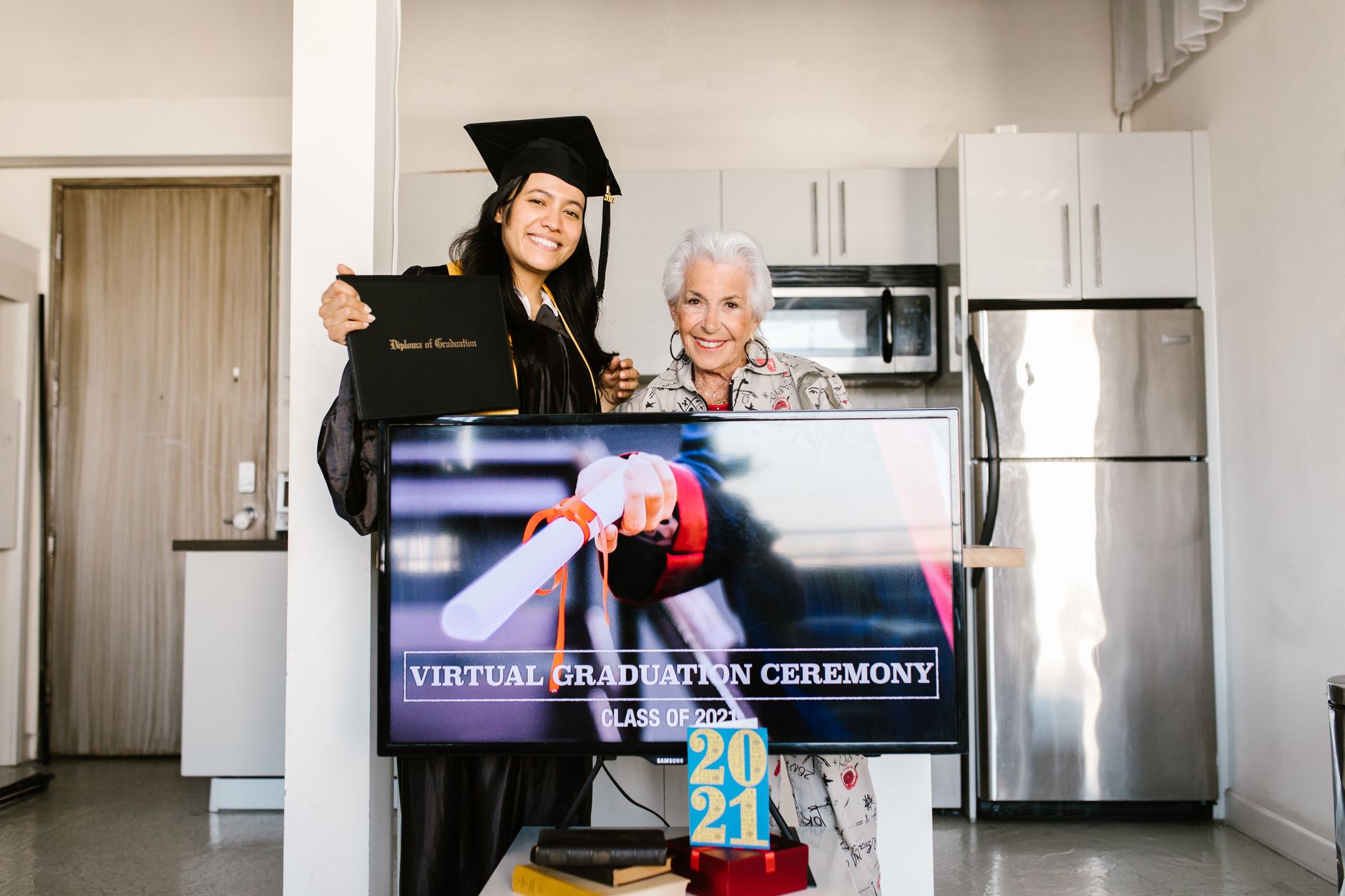
I do not fully remember the walk to the stage after that. I remember Dr. Aldridge’s hand, warm and steady, shaking mine. I remember the weight of the diploma folder, heavier than I expected a piece of paper to feel. I remember turning to find my family in the bleachers and seeing all of them, Orval, Vada, Malik, Zora, TJ on his feet, Aaliyah’s little fist waving, and I remember thinking, clear as anything, that Miss Odalys Freeman, wherever she was, had finally gotten her way. Fifty one years late, but she got it.
What I tell people now
I get asked a lot, since that morning, whether I am going to do anything with the degree, whether seventy is too old to start a career, and I understand the question, but it misunderstands what this was for. I am not looking to stand in front of a classroom forty hours a week. My knees have opinions about that plan, and they are not quiet about them.
I think about Mrs. Pruitt sometimes, the third grade reading teacher I used to watch through the serving window all those years, crouched down at some child’s eye level while I pushed trays fifteen feet away. I ran into her at the Piggly Wiggly not long after graduation, retired herself now, silver haired and slower on her feet, and when I told her what I had done, that I had finally finished the degree, she set her basket down right there in the cereal aisle and hugged me so hard my cap would have fallen off if I had still been wearing it. She told me she used to notice me watching her line of children pass the window, and that she had wondered, more than once over the years, what I would have done with a classroom of my own. I told her I supposed I was about to find out, forty years later than either of us expected.
What I am doing, starting this fall, is volunteering two mornings a week at Bellhaven Elementary, the same school where I once pushed a cafeteria tray cart past classroom doors I was not allowed to stand inside of, working with a reading intervention program for third graders who are behind grade level. The principal, when I called to ask, did not blink twice at my age. She just asked when I could start.
Zora begins her own freshman year at Magnolia Ridge in August, nursing program, financial aid handled, no jar of coins required this time, because her grandmother already showed the whole family exactly how long a debt can wait for you and exactly how short the distance is, in the end, once your people decide to close it together.
I kept the envelope. Not the money, that went to the bursar’s office months ago and is long since spent by the university on whatever universities spend two hundred eighty six dollars and forty cents on. I kept the paper receipt Trevor mailed me afterward, the one marked PAID IN FULL, and I have it framed now, hanging in my front hallway right beside my diploma, so that everyone who walks through my door sees both at once: the thing I finished, and the four people who would not let me finish it alone.
Fifty one years is a long time to owe somebody something. It is also, I have learned, exactly long enough for the right people to grow up around you and pay it off before you even know they were counting.
This story is a dramatization. Names, characters, and details are invented, and any resemblance to real people or events is coincidental.