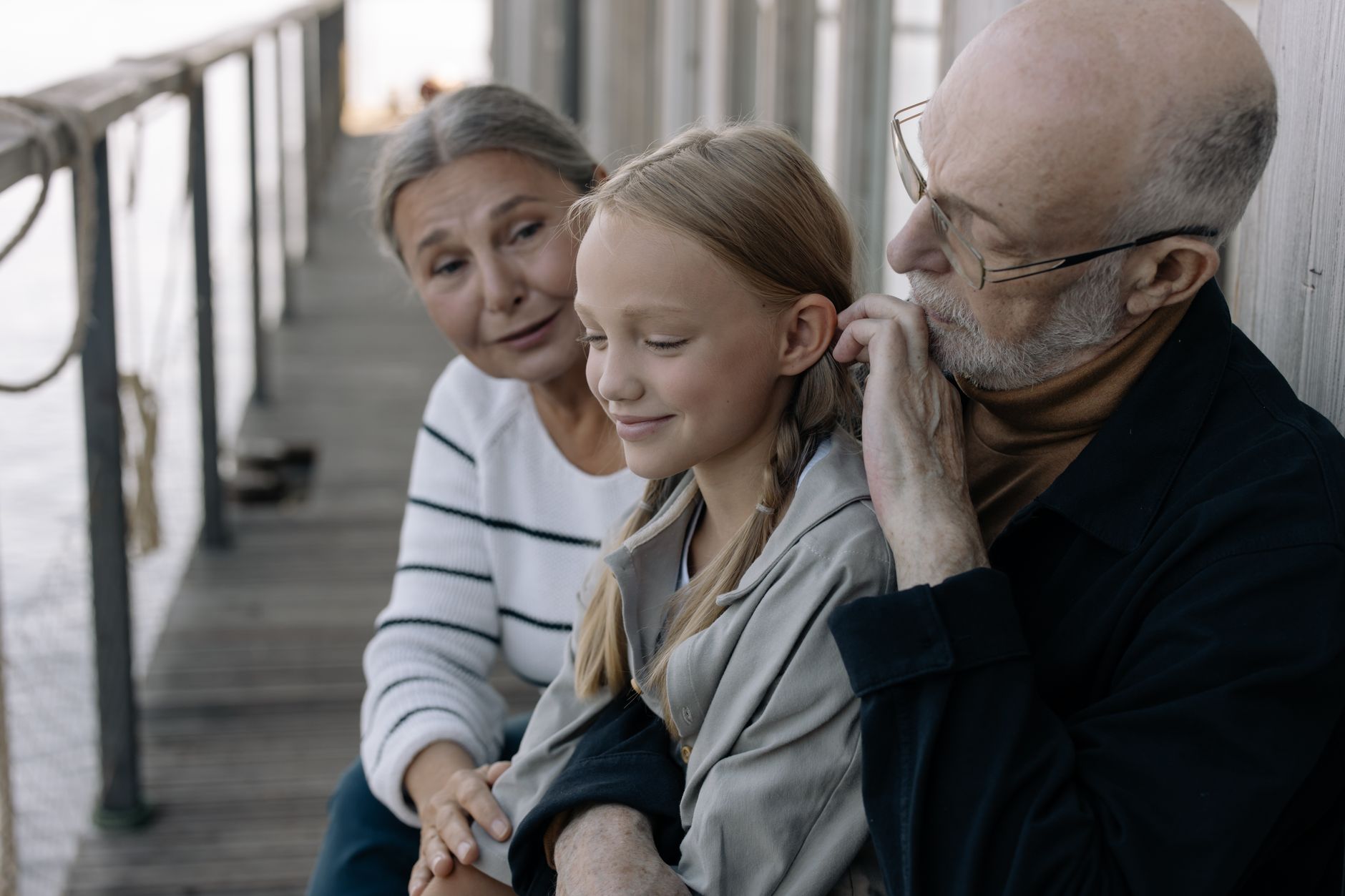
A Granddaughter Ended Our Twenty Year Silence
The knock came at four in the afternoon on a Tuesday in October, and I almost didn’t answer it, because nobody knocks on my door anymore except the mail carrier and the man who reads the electric meter, and neither of them knock twice.
This one knocked twice. Soft, then firmer, like whoever it was had thought better of leaving after the first try.
I set down the dish towel and looked through the front curtain the way I’ve looked through that curtain for forty six years, and I saw a girl standing on my porch in a denim jacket two sizes too big for her, a backpack slung over one shoulder, and a face that stopped my heart in my chest so hard I had to put my hand flat on the wall.
She had Wesley’s eyes. My son’s eyes, the exact gray green of them, set in a face I had never once seen in my life.
I opened the door because my hands were moving before my head had caught up to them.
“Mrs. Hartwell?” she said. “Estella Hartwell?”
“That’s me,” I said, and my voice came out thinner than I meant it to.
“I’m Piper,” she said. “Piper Hartwell. I think I’m your granddaughter.”
I am seventy two years old and I have buried a husband and I have sat through more funerals than I can count on both hands, and I did not cry at any of them the way I cried standing in my own doorway on that Tuesday, looking at a sixteen year old girl I had never met, never held as a baby, never sent a birthday card to, because I did not know her name existed until the moment she said it to my face.
My son Wesley and I had not spoken one word to each other in twenty years.
I should tell you about Harmon’s Ford first, because you can’t understand what happened between my son and me without understanding the town we come from.
Harmon’s Ford is a stitch of a place in southern Indiana, the kind of town where the water tower still says HOME OF THE 1987 STATE CHAMPION WILDCATS in letters that have gone the color of weak coffee, where the Fillmore Feed and Grain has been on the same corner since before my mother was born, and where you cannot buy a gallon of milk at the Marsh grocery without running into somebody who knew your husband, your father, and your husband’s father, all three.
I have lived in this same white farmhouse on County Road 9 since 1979, the year Frank and I married. Frank Hartwell farmed three hundred and ten acres of corn and soybeans that had been in his family since his great grandfather cleared it, and I taught second grade at Harmon’s Ford Elementary for thirty one years, and between the two of us we raised one son in that house, in that town, under that water tower.
Wesley was easy when he was small. Quiet, watchful, the kind of boy who would rather sit under the porch with a stack of library books than run wild with the Cutler boys down the road. He grew into a tall, serious young man who worked the farm alongside his father every summer from the time he could reach the tractor pedals, and by the time he graduated Harmon’s Ford High in 1998 I believed, the way you believe things you have never had reason to doubt, that I knew exactly who my son was and exactly what kind of life he was going to have.
I was wrong about a good deal of that, as it turns out. But I did not know it yet.
Frank died in February of 2006. A heart that gave out on him in the milking parlor on a Tuesday morning, the same kind of ordinary Tuesday this all started on, twenty years later almost to the week, though I did not notice that until I sat down to write this. He was fifty eight years old. We had been married twenty seven years.
I will not pretend to you that I handled that grief well. I did not. I had been half of something for twenty seven years, and then I was standing alone at a graveside in a February wind that cut through my good black coat like it wasn’t there, and Wesley, twenty six years old, stood next to me with his hand on my shoulder, and I remember thinking, clear as anything, that he was all I had left in the entire world.
Eight months later he told me he was getting married.
Her name was Nona Calder, and she had grown up two counties over, and she worked as a receptionist at the John Deere dealership out on Route 9 where Wesley had gone to buy a part for the combine and stayed forty five minutes talking to her instead. He had been seeing her for a little over a year by the time Frank died, and I had met her exactly twice, both times at church suppers, both times for less than twenty minutes.
I liked her fine, those first two times. She was quick and funny and she teased Wesley in a way that made him laugh with his whole chest, which not many people could do.
But eight months after I buried my husband, my son sat across my kitchen table and told me he was marrying her in the spring, and something in me that had been holding on by its fingernails simply let go.
I want to be honest with you about what happened next, because I have spent twenty years telling myself a softer version of this story, and I am done doing that now.
The rehearsal dinner was at the VFW hall on the last Friday in April, folding tables pushed together and covered in butcher paper, a sheet cake from the Marsh bakery, forty some people from Harmon’s Ford who had known Wesley since he was in diapers. I had had two glasses of wine, which for me in those years was one and a half more than I was used to, and Nona stood up to make a little toast to Wesley, sweet and simple, something about how he’d walked into that dealership and never walked back out of her life, and everybody laughed.
And I stood up right after her, before I had decided to, before I had let myself think about what I was going to say, and I said, in front of forty people, that I hoped Nona knew what she was getting, marrying a man whose mother had buried his father eight months ago and whose grief she was clearly in an awful hurry to replace.
I said the words “in an awful hurry.” I remember them exactly, because I have turned them over in my mind roughly four thousand times since.
The hall went silent the particular way a room goes silent when everyone in it understands, all at once, that something has broken that cannot be unbroken by an apology alone.
Nona’s face did something I still see when I close my eyes some nights, twenty years later. Not anger. Something worse than anger. A kind of quiet folding inward, like a woman deciding, right there in front of me, that she was not going to let me see her cry.
Wesley stood up. He did not raise his voice. That was almost the worst part, that he never once raised his voice at me, not that night and not in all the years after.
He said, “Mom, you need to leave.”
I said something back, I honestly could not tell you what, some brittle, wounded thing meant to hurt him the way I had just hurt her, and he said it again, quieter the second time, which somehow landed harder than shouting would have.
“You need to leave, and I don’t think you should come to the wedding.”
I left. I drove home in the dark on roads I have driven ten thousand times, and I sat in my kitchen, the same kitchen where he’d told me the news eight months before, and I did not cry, because some stubborn, wrongheaded part of me was still certain I had said something true, even if I had said it cruelly, even if I had said it at the worst possible moment in front of the worst possible people.
I did not go to the wedding on the second Saturday in June. Wesley did not call to make sure I’d changed my mind, and I did not call to ask if the invitation still stood, and that, more than the words at the VFW hall, is the part of this story I am the most ashamed of. The words were said in one bad, wine soaked minute. The twenty years of silence after them, both of us built brick by brick, one stubborn day at a time.
Here is what twenty years of silence actually looks like, in case you have never lived through one. It does not look like a single dramatic door slamming shut. It looks like a thousand small doors, closing one at a time, so quietly that you can almost convince yourself each one didn’t matter on its own.
The first Christmas, I bought a card. I sat at this same kitchen table and wrote three different drafts of what to say inside it, and I threw all three away, and I did not send a fourth. I told myself I would call instead, in the new year, once things had settled.
Things did not settle. They calcified.
I heard, through my cousin Ruthann who ran into Nona’s mother at the pharmacy, that they’d had a baby girl in March of 2010. A granddaughter. I did not learn her name for another four years, until Ruthann happened to mention it in passing, the way you’d mention the weather. Piper. A pretty name. I wrote it on a slip of paper and kept it in my Bible, tucked into the book of Maude, for reasons I could not have explained to you even then.
I moved through Harmon’s Ford like a woman carrying a stone in her chest that nobody else could see. I taught my second graders. I went to church on Sundays and sat four pews back from where Frank and I used to sit together, because the old pew felt like it belonged to a life I’d forfeited the right to. I heard, in scraps, the way you hear things in a small town, that Wesley and Nona had moved forty minutes away to Bristol Falls, that he’d gone to work managing the parts counter at a farm equipment dealership up there, that they seemed happy, that Piper was a bright little thing who liked horses.
Every scrap of news came to me secondhand, filtered through somebody else’s casual mention, because I had made myself unreachable by anyone who might have carried news to me directly. I had, without ever quite deciding to, made myself the kind of mother whose own son’s friends were instructed, gently, not to bring her up.
I wrote him letters I never sent. Thirty seven of them, by the count I found in the cedar chest when Piper made me go looking three weeks ago. Thirty seven letters over twenty years, some of them just a few lines, some of them four pages front and back, every one of them ending the same unfinished way, with me setting down the pen because I could not make myself write the words I am sorry and mean them the way they needed to be meant, not the wounded, self justifying way I kept almost meaning them.
Pride is a strange, patient animal. It does not roar at you. It just sits in the room with you every single day, very quietly, making sure you never quite pick up the phone.
I retired from teaching in 2015. Frank’s brother helped me lease out the farm ground to the Kessler family down the road, since I could not work it myself and would not sell it, not with Frank in every fence post and fold of soil. I kept the house. I kept the porch light on every night out of a habit I could not have named even to myself, some part of me still leaving the light on for a boy who was not lost, who knew exactly where I lived, who simply was not coming.
Twenty years is seven thousand three hundred nights, roughly, if you want the number of it, which I do not recommend counting unless you have a very good reason to punish yourself. I had counted it exactly once, the week before Piper knocked, sitting up late unable to sleep, doing the arithmetic like it might tell me something useful. It did not. It just told me how long I had let one bad minute at a VFW hall cost me my only child.
Piper found me the way sixteen year olds find things now, which is to say she found me on the internet, though it took her considerably more legwork than that makes it sound.
She sat at my kitchen table three weeks ago, the same table, drinking the sweet tea I’d made without asking whether she liked it, and told me the whole thing in pieces, the way a nervous person tells a story they’ve rehearsed but still can’t quite believe they’re finally getting to say out loud.
It started with a school project, of all things. A sophomore family history assignment for her English class, due the second week of September, build a family tree, four generations back, with at least one interview from a living relative. Piper had asked her father about his side of the family, about his parents, and Wesley had gone quiet in the particular way, she told me, that she had learned meant a subject was closed.
“He said his mother passed away when he was young,” Piper told me, and watched my face very carefully when she said it, the way you watch someone’s face when you already suspect the ground under a story is not solid. “That’s what he’s always told me. That you died before I was born.”
I did not know what to say to that. I still do not, fully, though I have had three weeks to sit with it. My son had told his own daughter I was dead rather than tell her the truth, which was smaller and sadder and, in its own way, harder to explain to a child, that her grandmother was alive and well forty minutes up the road and simply was not in their lives because of something that had happened at a wedding rehearsal before Piper was even born.
Piper did not believe him. Not exactly disbelieve, she said, just a small persistent itch of a feeling, the kind you get when a story is told a little too smoothly, a little too closed for further questions. She’d gone looking, first through an old shoebox of photographs in the hall closet that her father did not know she’d found, and in it were four pictures of a wedding, a June wedding at what was clearly the Harmon’s Ford VFW hall, her mother Nona twenty six years old in a simple ivory dress, and in exactly one photograph, off to the side, partially cropped, a tall dark haired young man who was unmistakably her father, and no grandmother anywhere in any of the four pictures at all.
That absence, she told me, bothered her more than anything present would have.
She’d searched an ancestry website with a free trial, typed in her father’s name, her grandfather’s name from the one thing she did know, that his father Frank Hartwell had died before she was born. Frank Hartwell, Harmon’s Ford, Indiana, led her within twenty minutes to an old obituary from 2006, survived by his wife Estella Hartwell and his son Wesley Hartwell. Wife. Present tense as of the obituary’s writing, not deceased.
“I looked you up,” she said. “You still had your name in the phone book thing online. The white pages site. I found your address in maybe ten minutes.”
Ten minutes, after twenty years, to find a woman her father had told her was dead.
She did not tell her parents what she’d found. She thought about it, she said, turned it over for the better part of two weeks, drafted and deleted a text to her father probably a dozen times. But something in her, something I recognize now as the same stubborn Hartwell backbone that runs through Wesley and, I suppose, through me, decided that if the grownups in this story had spent twenty years being too proud to fix it themselves, she was not going to ask permission to try.
She told her mother she was going to a school friend’s house in Bristol Falls to work on a group project, which was, she admitted to me with the particular shame of a good kid telling her first real lie, mostly untrue. She took the county bus from Bristol Falls to Harmon’s Ford, a trip of about forty minutes that costs three dollars and fifty cents each way, and she walked the last mile from the bus stop to County Road 9 because she did not want to call anyone for a ride and have to explain where she was going.
A sixteen year old girl, walking a mile down a county road in southern Indiana on a Tuesday afternoon, to knock on the door of a grandmother she had been told did not exist.
We sat at my kitchen table for three hours that first afternoon, and I told her everything. Not the softened version I’d told myself for twenty years. The real one. The wine, the VFW hall, the words in an awful hurry, Wesley standing up so calm and so final, the wedding I did not attend and was not invited back to, the thirty seven letters I never sent.
She listened to all of it without interrupting, this girl I had known for two hours, and when I finished she asked me the question that undid twenty years of silence in about four seconds flat.
“Do you still love him?”
Not why did you say it. Not was mom right to be hurt, or don’t you think you should have apologized sooner, any of the questions I had been bracing myself for and rehearsing careful answers to. Just that. Do you still love him.
“Every single day of my life,” I told her, and I was crying before I finished the sentence, the kind of crying that comes up from somewhere below your ribs and takes your whole body with it. “Every day for twenty years.”
Piper reached across my kitchen table, the same table, and took my hand, and she said, “Then I think you should tell him that yourself. I think I can help.”
What Piper did next took more nerve than I have managed to summon in the whole twenty years since 2006, and she was sixteen years old doing it.
She did not simply hand her father my address and my apology secondhand. She understood, better than I gave her credit for at first, that this could not be fixed by a messenger. It had to be Wesley and me, in a room, finally saying out loud the things that had calcified into silence.
So she went home that evening and she told her parents the truth, all of it, the school project, the shoebox of photographs, the obituary, the bus ride, the afternoon at my kitchen table. She told me later that her father sat very still through the whole telling, at the kitchen table in Bristol Falls, and did not say a single word until she was finished.
Then he asked her one question. “Is she all right? Is she doing okay?”
Twenty years, and that was the first thing out of his mouth. Not anger that his daughter had gone behind his back to find the mother he’d spent two decades not speaking of. Not defending the story he’d told her. Just, is she all right.
He called me that same night, a little after nine o’clock. I did not recognize the number, forty minutes away, Bristol Falls exchange, and I almost let it go to the machine the way I let most unfamiliar numbers go, and then some old animal instinct in me picked it up on the fourth ring instead.
“Mom,” he said, and it was the first time I had heard my son say that word to me in seven thousand three hundred and some nights, and I had to sit down on the kitchen floor right where I was standing, my back against the cabinet, phone pressed so hard to my ear it hurt.
We did not solve twenty years in that phone call. I want to be honest about that too, because I think stories like this one sometimes make it sound easier than it is, like the right words arrive and everything mends itself in a single scene. It was not like that. We talked for forty minutes, most of it halting, both of us circling around the actual apology neither of us had ever managed to say out loud, both of us crying in the particular quiet way two proud people cry on a phone call, trying not to let the other one hear it and both knowing exactly what they were hearing anyway.
But near the end of it, he said, “I’m sorry I told Piper you were dead. I told myself it was easier than explaining the truth to a kid. It wasn’t easier. It was just a coward’s way of not having to explain myself to her, or to me.”
And I said, “I’m sorry for what I said to Nona at that dinner. I have rewritten that toast in my head every single day for twenty years, and every version of it is you and her getting the mother in law you deserved instead of the one you got.”
Neither one of those sentences fixed anything by itself. But they were the first two true things either of us had said to each other since April of 2006, and something about saying them out loud, finally, after all those unsent letters, felt like setting down a stone I had been carrying so long I had half forgotten it was a stone and not simply part of my own body.
Wesley drove up to Harmon’s Ford that Saturday, four days after Piper’s first visit, and he brought Nona with him.
I will tell you honestly that I did not expect that. I thought, if he came at all, he might come alone first, test the water, the way a person tests a bridge they are not sure will hold their weight. But Nona got out of the passenger side of that truck in my own driveway, forty six years old now, a woman I had last spoken to at a rehearsal dinner where I had said one of the cruelest things I have ever said to another human being, and she walked up my porch steps ahead of Wesley, not behind him, and she hugged me first.
“I forgave you a long time ago, Estella,” she said into my shoulder, before I had said one word to her. “I just didn’t know how to tell you that with nobody carrying the message back and forth.”
I do not have adequate words for what that forgiveness did to something that had been clenched shut in my chest for two decades. I have thought about it many times since, and the closest I can come is that it felt like a hand had been holding a fist closed inside me for twenty years, and it simply, finally, opened.
Wesley and I stood on that porch afterward, just the two of us, while Nona went inside to find Piper, who had ridden up front in the truck the whole way and been unusually quiet about it, she told me later, because she was terrified the whole reunion might somehow fall apart if she said the wrong thing at the wrong moment.
My son is forty six years old now. There is gray coming into his hair at the temples, the same place Frank’s went gray first. He stood on my porch, taller than his father ever was, and he did not say anything clever or rehearsed. He just opened his arms the way he used to when he was small and wanted picking up, and I walked into them, and we stood there on that porch for what felt like a very long time and was probably closer to two minutes, not saying anything at all, because there was nothing left that needed saying out loud that we had not already said on the phone four nights before.
I want to tell you what my life looks like now, three weeks later, because I think the after matters as much as the apology does.
Piper comes to Harmon’s Ford most Saturdays. She is teaching me, very patiently, how to text with actual words instead of the two fingered hunt and peck I’ve been doing on my phone since Frank’s brother talked me into getting a smart one four years ago. I am teaching her, in exchange, how to make her great grandmother’s dumplings, the recipe I taught to exactly nobody for twenty years because there was nobody left in the family to teach it to.
She finished that school project, by the way. Four generations, with an interview from a living relative. She got an A, and her teacher wrote a note on the last page asking whether she’d consider turning the family history into something longer for the county paper’s youth writing contest. I told her I thought her great grandmother would have liked that idea very much.
Wesley and Nona had Sunday dinner at my table two weeks ago, the first meal any of us have shared at that table in twenty years, and I made the pot roast Frank used to request on his birthday every year without fail, and nobody at that table mentioned the VFW hall or the wedding or the twenty years at all, because we had already said what needed saying, out on that porch and on that phone call, and some things, once they are finally said, do not need saying again.
I think about the thirty seven letters sometimes, sitting in that cedar chest, all the versions of I’m sorry I could not make myself send. I have not thrown them away. Piper asked to read them, and I let her, and she said something to me that Saturday afternoon that I have turned over in my mind more than once since.
She said, “I’m glad you never sent them. If you had, I don’t think I would have gone looking. I think some part of me needed to be the one who finally knocked.”
I do not know if that is true, exactly, or if it is just the kind, generous thing a sixteen year old says to make an old woman feel less foolish about twenty wasted years. But I have decided to believe it anyway, because it turns thirty seven unsent letters and seven thousand three hundred silent nights into something other than pure regret. It turns them into the space my granddaughter walked a mile down a county road to fill.
The porch light is still on every night at my house on County Road 9. It has been on every night for twenty years, out of a habit I could never quite explain to myself.
I know exactly who it’s for now.
I have a family again, sitting at my kitchen table on Sunday afternoons, my son across from me with gray coming in at his temples, his wife who forgave me before I ever thought to ask, and a granddaughter who did what neither of the two proud adults who raised her father could manage to do for twenty years. She knocked. She asked the question. She waited for the answer.
I am seventy two years old, and I have learned, later than I would like to admit, that pride will let you sit alone in a quiet house for as long as you let it, keeping the porch light on for nobody, unless somebody braver than you finally walks up the driveway and knocks.
I hope, if you are reading this and there is a door in your own life you have been too proud to knock on, that you do not wait twenty years and a sixteen year old’s courage to finally open it. But if you have, if there is still time, if the porch light is still on somewhere for you the way mine was on for Wesley all those years, I am telling you it is not too late.
It was not too late for us. It is very likely not too late for you either.
This story is a dramatization. Names, characters, and details are invented, and any resemblance to real people or events is coincidental.