The Manager Who Mocked My Husband’s Cap
My husband Harmon has worn the same faded cap into Tanner’s Hardware every Saturday morning for as long as I can remember, and until three weeks ago I would have told you that store was the one place in Colquitt County where nobody ever made him feel small for it.
I am Norma. I am seventy-six years old. I have been married to Harmon Whitfield for fifty-four of those years, and for forty of them, longer than some marriages last altogether, he has walked through the same front door of the same hardware store on the same corner of Main Street in our little town, bought whatever screws or washers or fence wire he needed that week, and walked back out with a ten percent discount and a handshake from whoever was working the register. That was just how it went. Everybody in town knew Harmon. Everybody knew the cap.
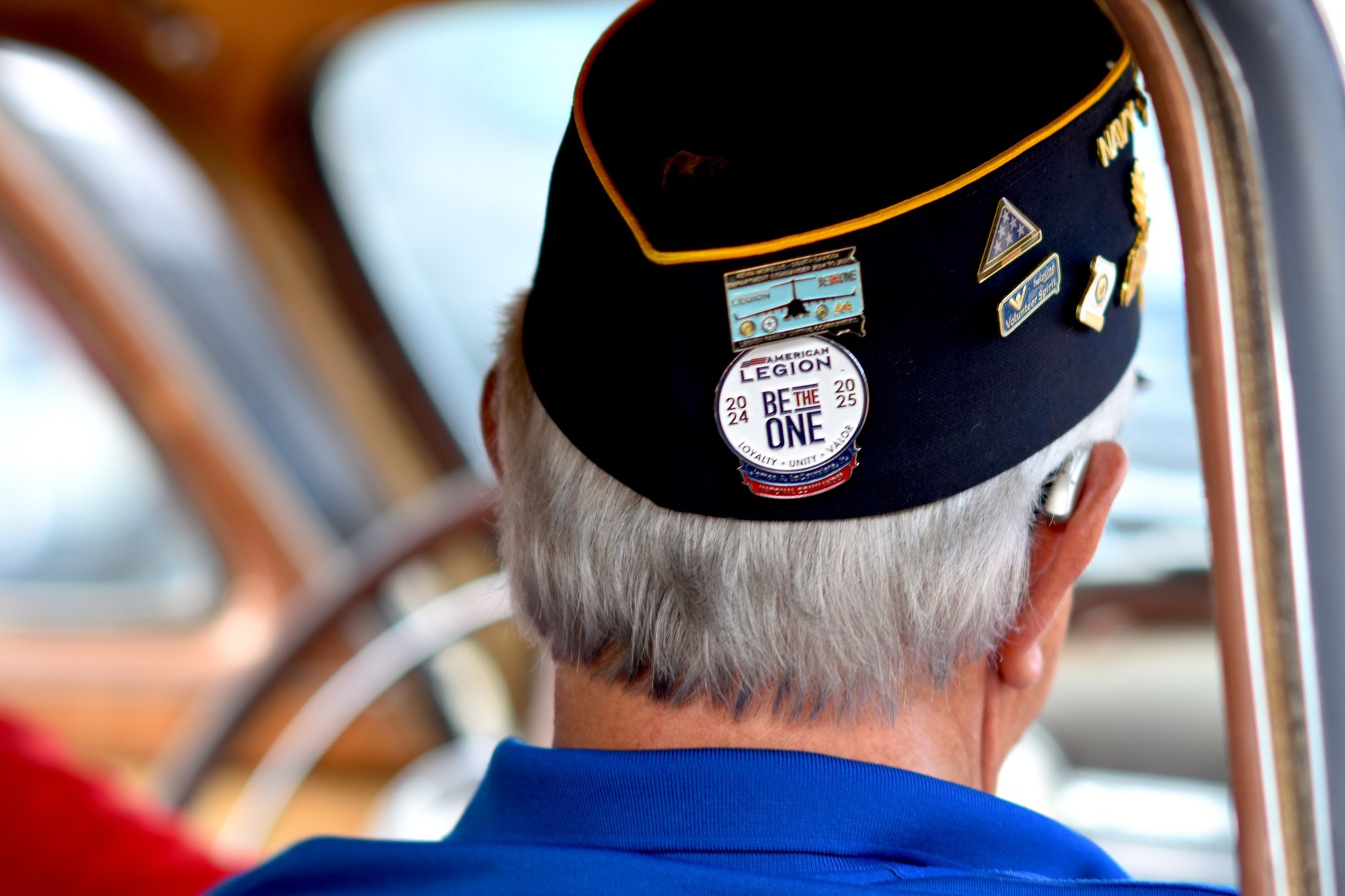
It is not a fancy cap. It is navy blue, sun-faded to something closer to gray-blue now, with gold thread stitching that reads KOREA VETERAN across the front in letters that have gone soft and fuzzy at the edges from forty years of washing and wearing and hanging on the hook by our back door. There is no unit patch on it, no rank, nothing sharp or official-looking. Just those two words and a small embroidered ribbon bar, worn thin. Harmon bought it at a VFW fundraiser in 1986 and he has not gone a week without wearing it since, not to church, not to town, and certainly not to Tanner’s.
He was a corporal in the United States Army. He was drafted at nineteen, trained at Fort Jackson, and shipped out to Korea in the spring of 1952, where he spent fourteen months in weather he still will not fully describe, doing work he mostly will not fully describe either, except for the parts he tells our grandchildren on the Fourth of July when he has had one beer and the fireworks have not started yet. He came home in 1953 with a Good Conduct Medal, a National Defense Service Medal, a Korean Service Medal with two campaign stars, and a hearing loss in his left ear that the VA finally acknowledged forty years later. He does not call himself a hero. He gets uncomfortable when anyone else does either. What he says, when he says anything at all, is, “I did my job and I came home. A lot of boys I served with did not get to say that.”
That is the whole of what Harmon has ever asked from the world for what he did in Korea. Not applause. Not a parade. Just to be let alone to wear his cap into the hardware store on a Saturday morning and buy his fence wire in peace.
I did not meet Harmon until 1970, seventeen years after he came home, at a church picnic where he was standing off by the fence line alone with a paper plate of potato salad he was not eating, and I asked him why he was not dancing with the rest of the young men his age. He told me he did not much care for crowds anymore. I did not understand what he meant by that for a long time. It took two years of courting, and one long night on my parents’ porch after we were engaged, before he told me about Perce Pruitt.
Perce was from three counties over, a farm boy like Harmon, and they trained together at Fort Jackson and shipped out on the same transport. Perce was the one who taught Harmon how to keep his feet dry in wet boots, a small thing that Harmon swears kept him from losing toes the winter frostbite took two men in his own platoon. Perce did not come home. Harmon was twenty feet from him when it happened, in February of 1953, and he has told me the details exactly once in fifty-four years, on that porch, and never again, and I have never asked him to. What he told me instead, every year since, is that he wears the cap partly for himself and partly for Perce, because Perce does not get to wear one, and somebody in this world ought to remember that a boy from three counties over went to Korea at nineteen and did not get to grow old the way Harmon has been allowed to.
That is what was standing behind that faded cap when Brody Kessler told my husband it did not get him a deal. It was never really about ten percent off a coil of fence wire. It was Perce Pruitt, and the two men in Harmon’s platoon who lost toes to frostbite, and every Saturday for forty years that Harmon walked into that store carrying all of it quietly on his head, asking nothing of anyone except to be treated like a man whose service still counted for something.
Tanner’s Hardware has had that same ten percent veteran discount posted by the register since before I can remember, a little laminated sign taped to the counter, curling at the corners, that says WE HONOR OUR VETERANS 10% OFF WITH ID OR VISIBLE SERVICE. Old Mr. Tanner put it there decades ago, back when his own father, who founded the store in 1961, was still alive to insist on it. Every clerk who ever worked that register in forty years knew Harmon by name, knew the cap, and rang him up without a second thought. It was never about the ten percent, not really, though on a fixed income every little bit helps. It was about the store treating him like a man whose service still meant something in this town, decades on.
Old Mr. Tanner’s father built that store from a single tin-roofed shed in 1961, back when Colquitt was barely more than a crossroads and a cotton gin, and he grew it out of pure stubbornness and neighborliness into the two-aisle-wide building it is today, the kind of store where the same families have bought their nails and their seed and their fencing for three generations. Harmon’s own father traded there before Harmon was ever born, and there is a black and white photograph still tacked up behind the register, curling at the edges same as that discount sign, of the store’s grand opening with a line of farmers out front in their Sunday hats. Harmon is in that photograph too, a boy of about six standing at his father’s knee, though you would have to know to look for him to pick him out. That is the kind of history that store carried. That is what forty years of a ten percent discount actually meant, in a town where the hardware store had watched three generations of the same families grow up and grow old.
That changed on a Tuesday afternoon three weeks ago, and it changed because of a twenty-nine-year-old named Brody Kessler.
Brody came up from Valdosta in the spring to manage the store after old Mr. Tanner’s health finally forced him to step back and hand the daily running of the place to somebody younger. Nobody in town knew him yet. He wore a name tag that said STORE MANAGER in bold letters like he wanted you to notice the title before you noticed the man, and from what I understand he had spent his first month reorganizing shelves nobody asked him to reorganize and cutting hours nobody asked him to cut, trying to make the place look leaner and sharper on some spreadsheet somewhere. He was not from here. He did not know what forty years meant in a town like this.
I was not there for the first part of it. Harmon went into town that Tuesday alone, same as always, list in hand, cap on his head, to buy a length of chain and a padlock for the gate on our back pasture. He picked out what he needed, walked it up to the register, and set his items down the way he had a thousand times before.
The young man at the register, not Brody, just a part-time cashier named Denny who has worked there maybe a year, rang up the total and then, out of habit, reached for the little laminated discount sign and knocked ten percent off without even being asked, the way it had always been done for Harmon. Harmon told him thank you, same as always.
That was when Brody came around the end of the aisle carrying a clipboard, saw the discount ring through on the register screen behind Denny’s shoulder, and stopped.
“What is that ten percent for,” Brody asked, not really asking Denny so much as announcing that he had caught something.
Denny, flustered, said it was the veteran discount, that the gentleman was a veteran, gestured at Harmon’s cap.
And Brody looked at my husband, at the faded blue cap with the soft gold letters, and he said, loud enough that three other customers in the store turned their heads, loud enough that I heard about it from two different neighbors before Harmon even finished telling me himself that evening, “That war was before my time, old timer. The cap does not get you a deal here.”
Harmon did not raise his voice. He has never in fifty-four years raised his voice at a man half his age in a public place, and he was not about to start at seventy-eight in the middle of a hardware store. He told me later he just stood there for a second, one hand still resting on the chain he had come to buy, and said, quiet, “I’ve been getting that discount here for forty years, son.”
And Brody, still not lowering his own voice, said something that landed harder than the first line, something Harmon repeated to me twice that night like he was still trying to make sense of it himself: “Forty years of somebody giving away free money doesn’t make it store policy. I run the numbers here now, not the old man.” Then he reached past Denny, voided the discount on the register himself, and told Harmon the full total, six dollars and forty cents more than what he had walked up expecting to pay.
Harmon paid it. Of course he paid it. He is a man who does not make scenes, who has spent his whole life keeping his head down and doing the next right thing quietly, and he took his chain and his padlock and his six dollars and forty cents worth of pride swallowed and walked out to the truck.
He did not tell me right away. He came home, put the chain in the shed, hung the padlock on its hook, and made himself a glass of tea like it was any other Tuesday. It was not until I asked him at supper why he was so quiet that it came out of him, slow, in pieces, the way things do when a man is more hurt than angry and does not have the words sorted out yet for which one he is.
I sat across the table from my husband of fifty-four years and watched him try to decide whether being made small in front of strangers in a store he had trusted for forty years was worth being upset about, or whether, the way he has done his whole life, he should just let it go.
“It’s six dollars, Norma,” he said. “It isn’t the money.”
I knew that. I have known that man since we were eighteen years old at a church picnic in 1972, and I know exactly what it is not about. It has never once, in fifty-four years, been about the money with Harmon Whitfield. It is about being seen. It is about a cap that says KOREA VETERAN meaning something to the people standing in front of it, in the town he has lived in his whole life, in the store his own father used to buy fencing supplies from before Harmon was even born.
I did not sleep well that night. I lay there next to a man who had frozen through a Korean winter at nineteen years old and come home to bury three friends he never talks about by name, and I thought about a twenty-nine-year-old with a clipboard telling him his war did not count for a ten percent discount, and something in me that had been quiet and patient for a very long time started to feel less patient.
I did not know yet what was going to happen four days later, when Harmon and I went back into that store together on a Saturday morning, the same as every Saturday for forty years, and Brody Kessler was standing at that same register when we walked in.
I did not know that a man neither of us had ever met before was going to be standing three feet behind us in that checkout line. I did not know what he was going to say, or what it was going to do to the whole room, or that by the time we walked back out of Tanner’s Hardware that Saturday, Brody Kessler was not going to be the manager of that store anymore, and that the reason would have almost nothing to do with the six dollars and forty cents, and everything to do with what happens when you insult a room full of people who have all, in their own way, paid a price you cannot see just by looking at them.
We went back on Saturday because Harmon insisted. I wanted to drive the extra fifteen minutes to the Ace Hardware over in the next county, and I told him so in the truck on the way there. He shook his head. “Forty years, Norma. I am not letting one fool run me out of a store my daddy used to trade in.” That is Harmon. He does not run from things. He never has, not in Korea and not at a hardware store register.
We walked in at half past nine that morning, and the bell over the door rang the same as it always has. Denny was not working. Brody was up at the front, going over something on a clipboard again, and when he saw Harmon’s cap come through the door, I watched something flicker across his face, not quite recognition, more like irritation, the look of a man who thought a problem had been settled and was annoyed to see it walk back in wearing the same hat.
We gathered our list, a bag of deer corn, a coil of garden hose, a box of mason jar lids for my canning, and made our way up to the register. There was a man already in line ahead of the register area, off to the side sorting through a bin of hose fittings, and behind us, a stocky man in his late thirties with a gray Colquitt County Guard unit T-shirt and a ball cap of his own, waiting his turn with a bag of deer corn under one arm.
Brody rang up our items himself this time. When he got to the total, I saw him glance at Harmon’s cap again, and I felt my whole body go tight, bracing.
“That’ll be thirty-one eighty,” Brody said, flat, no discount applied, no mention of it at all, like the sign taped to the counter did not exist.
Harmon reached for his wallet without a word. I could not stay quiet, not this time. “There’s a veteran discount posted right there,” I said, and I pointed at the laminated sign, curled at the corner, still taped where it had been for decades.
Brody looked at the sign like it personally offended him, and then he looked at Harmon, and he said it again, almost the exact same words as before, like he had decided this was simply his position and he intended to hold it in front of an audience this time. “Ma’am, that war was before my time. I told him already, the cap doesn’t get him a deal here. I’m not running a charity off my margins for something that happened seventy years ago.”
The store went quiet in the particular way a room goes quiet right before something happens.
That is when the man behind us in line, the one in the Guard T-shirt, set his bag of deer corn down on the floor, slow and deliberate, and stepped up beside Harmon.
“I’ll take that discount off my bill instead, then,” he said to Brody. “Since you don’t want to give it to a Korean War vet.” He pulled his own wallet ID from his back pocket and set it on the counter, not aggressive, just plain. “Staff Sergeant, Georgia Army National Guard. Two deployments. I’ve got twelve years in and I’m telling you right now, son, that man standing next to me is the reason people like me got a country left to serve in. You want to explain to me why his war doesn’t count.”
Brody opened his mouth and nothing useful came out of it. He said something about margins again, about corporate policy, about how he did not make the rules on discounts, all of it tangled together and none of it landing the way he wanted it to.
The man from the hose fitting bin had stopped sorting and turned to watch. Two more customers who had come in behind us stayed by the door instead of shopping. And then the back office door at the rear of the store opened, and out walked a heavyset man in his seventies I did not recognize at first, moving slower than he used to, leaning slightly on a cane I had never seen him carry before. It took me a second to place him as Mr. Tanner himself, the owner, Old Mr. Tanner, whom none of us had seen behind that counter in almost a year on account of his health.
He had heard the raised voices from the back office, and he had come out to see what was happening in his own store.
“Brody,” he said, and his voice, though quieter than the young man’s had been, carried through that whole front room like a door slamming. “Is that Harmon Whitfield you’re telling doesn’t get his discount?”
Brody straightened up. “Mr. Tanner, I was just explaining our margins don’t really support”
“My daddy put that sign up in nineteen sixty-eight,” Mr. Tanner said, cutting him off, and he was not looking at Brody anymore, he was looking at Harmon, and there was something in his face, some old debt being paid, that told me this was not about margins to him either, and never had been. “Harmon Whitfield has been walking through that door since before you were born, son. His discount is not a suggestion. It is the one rule in this store I told you not to touch when I handed you the keys.”
The room was so quiet I could hear the ice machine humming in the back.
“I did not know,” Brody started, and Mr. Tanner held up a hand, and that was as far as Brody Kessler got, standing behind that register, in front of a room that had gone entirely still to watch what happened next.
I will tell you what happened next, because it is the part of this story that changed something in me too, not just in Harmon, and not just in that store. But I need you to understand first what those next thirty seconds cost a twenty-nine-year-old man who thought he could stand behind a cash register and decide, on his own authority, that a war he never had to fight did not count for anything anymore.
Mr. Tanner did not raise his voice again. He did not need to. He reached across the counter, past Brody, and he rang the ten percent off our total himself, his hand shaking slightly with age but sure of what it was doing. Then he looked at the staff sergeant standing beside us with his ID still on the counter and said, “Yours too, son. And anybody in uniform or with a service cap on their head in this store, today and every day after, same as it has always been.” He looked back at Brody. “We are going to have a conversation in my office. Right now.”
Harmon did not say anything through any of it. That is the part that stays with me the most, even now, three weeks later. My husband, who fought at nineteen and buried friends at twenty and has spent fifty-four years since not asking anybody for anything more than to be left in peace, stood at that counter in his faded cap and let two other men, a stranger in a Guard shirt and an old man leaning on a cane, say out loud what he has never once said about himself in all the years I have loved him.
When it was over, when Mr. Tanner had walked Brody back toward the office and the staff sergeant had shaken Harmon’s hand, hard and long, and told him, “Thank you for your service, sir, I mean that,” Harmon picked up our bags off the counter, and I watched his jaw working the way it does when he is holding something back.
We got out to the truck before he let it go. He sat in the driver’s seat, keys in the ignition, not turning them yet, and he looked straight ahead through the windshield and said, “I did not need him to say all that.” Then, quieter, after a minute, “But I am glad he did.”
I do not know exactly what was said in that back office between Mr. Tanner and Brody Kessler. What I do know is that within the week, there was a new manager behind that register, a woman named Lorraine who has lived in Colquitt County her whole life and whose own father served two tours in Vietnam, and the laminated sign by the register has been replaced with a new one, printed clean and official this time, still saying the same thing it always said: WE HONOR OUR VETERANS.
Word traveled fast in a town our size. By Sunday evening, two neighbors had already called our house to ask if it was true, and by Monday the woman who runs the register at the diner on Main Street told me she had heard the story from four different customers before noon, each version a little bigger than the last, one of them insisting Harmon had won a Purple Heart and thrown it on the counter, which he has never had and never would have done if he did. I had to correct that one twice at church. But the shape of the true story traveled just as fast as the exaggerated one, and by the following Saturday, when we walked back into Tanner’s for the second time since it happened, there were two other veterans in the store who had come in that same morning, I am convinced now, just to shake Harmon’s hand and let him know they had heard.
One of them was a man named Alton Reese, ninety-one years old, who Harmon has known since grade school and who served in the Navy during the same war, aboard a destroyer off the Korean coast. Alton does not get out much anymore, his daughter drives him most places these days, but he had her bring him to the hardware store that Saturday for no reason except to find Harmon in the aisle and grip his hand and say, “Heard what that fool tried to pull on you. Glad Tanner set him straight.” The local weekly paper, the Colquitt Courier, ran four paragraphs about it the following Thursday, no names attached to Brody beyond “a former store employee,” which I appreciated, because as angry as I was at that young man for what he said to my husband, I did not want to see him dragged through the mud in print. Some corrections a person can make quietly, if given the chance, and I hope Brody Kessler finds wherever he lands next and treats an old man’s cap with more sense than he treated Harmon’s.
Harmon still walks into that store every Saturday morning in his faded blue cap. Lorraine rings him up herself most weeks now, ten percent off before he even has to ask, and always with a word or two about his week, the way it used to be, the way it was supposed to be all along.
I think about that Saturday morning often. I think about how close it came to being just another quiet insult my husband absorbed and never spoke of again, the way he has absorbed so many things in his life without complaint, because that is the generation he comes from and that is the man he is. I think about how it took a stranger’s voice, a man who did not owe Harmon anything except the simple decency of recognizing what a faded cap actually stands for, to say out loud what should never have needed saying in the first place.
I think, too, about the staff sergeant, whose name I learned afterward was Emory Cummins, and who told Harmon, before he left the store that day, that he had grown up hearing his own grandfather talk about Korea, about the cold, about the friends who did not make it home, and that standing next to my husband at that register was the closest he had ever come to saying thank you to a man from that particular war in person. Emory did not know Harmon from Adam before that Saturday morning. He simply heard a young man tell an old veteran his war did not count, and he could not let it stand. That is the thing about a small town, when it is working the way it is supposed to work. Strangers still step in for each other. Somebody is always watching, and every so often, somebody decides to say something.
Harmon does not talk much about Korea, even now. He did not talk much about that Saturday either, not after that first night. But two weeks later, on a Sunday afternoon, I found him out on the back porch polishing that old cap with a soft cloth, working gently at the gold thread letters that have gone thin with age, and when he saw me watching he just said, “Still fits,” and put it back on his head, and went out to check the fence line, same as he has done every week for forty years, in a town that, for one bad afternoon, forgot what that cap was worth, and then, because a few good people would not let it stand, remembered.