
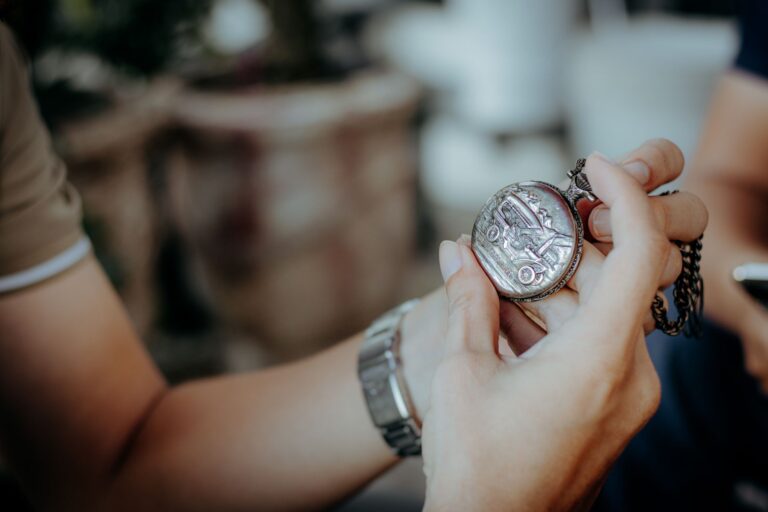
My sister Tamra let herself into our father’s house at seven in the morning, the day after we buried him, and by the time I got there with a box of trash bags and a thermos of coffee, the pocket watch was already gone from his dresser.
I didn’t know it yet. I walked in through the kitchen door Dad never locked, set the coffee down on the counter he’d wiped clean every night of his life whether it needed it or not, and called out for her. She was in his bedroom, standing at the foot of the bed with her purse already on her shoulder, like a woman who had somewhere else to be.
“I couldn’t sleep,” she said. “Figured I’d get a head start.”
I should have looked at the dresser right then. I didn’t. I was seventy-five years old and I had just put my father in the ground next to my mother, and I did not have it in me yet to be suspicious of my own sister in the house where we both grew up. That came later, around noon, when my son Denny walked in from the barn where he’d been helping our cousin Roland load Dad’s old tractor implements onto a trailer, and the first thing he did, the very first thing, was walk straight to that dresser like he’d been thinking about it the whole drive down from Springfield.
The velvet box was still there. It was empty.
The man who kept time
My father was Earl Whitfield, and for thirty-eight years he worked the rails out of the yard in Springfield, Missouri, first for the St. Louis-San Francisco Railway, the Frisco, and then for Burlington Northern after the Frisco got folded into it in 1980. He hired on in 1949 at nineteen years old, a brakeman first, then a conductor, riding freight and passenger runs across the Ozarks and out onto the plains toward Tulsa and Kansas City. He retired in 1987 with a pension, a bad knee, and a pocket watch that had belonged to his own father before him.
That watch was a Hamilton, a 992B, the kind the railroads required back when a train’s schedule and a man’s watch had to agree to the second or somebody could get killed. My grandfather, James Whitfield, bought it new in 1919 when he hired on with the Frisco himself, and he wore it on a leather strap that ran from a buttonhole on his vest down into the little pocket sewn for exactly that purpose, the way railroad men did for a hundred years before anybody thought a watch belonged on a wrist. When my grandfather died in 1961, the watch passed to my father, who carried it every working day for the next twenty-six years, and then kept it wound and ticking on his dresser for the thirty-seven years after that, long past the point when he needed it to catch a train.
I grew up understanding that watch the way you understand a piece of furniture that’s always been in a room. It was just there. Dad wound it every Sunday night, sitting in his chair by the radio, and he’d hold it up to his ear first, listening, before he ever looked at the face. I asked him once, I must have been ten, why he listened to it instead of just reading the time off it. He said a watch will lie to you with its hands long before it tells the truth with its heart, and the only way to know if a watch is honest is to listen to what it’s doing when nobody’s looking at the numbers.
I didn’t understand what he meant until I was much older. I think about it every day now.
The watch itself was nothing fancy to look at, not the kind of thing you’d notice in a jewelry case. It had a plain nickel case, worn to a soft silver-gray at the edges where a hundred years of thumbs had rubbed the plating thin, and a white porcelain face with railroad numerals, big and bold, the kind a man had to be able to read at a glance from across a moving platform in bad light. Dad kept the crystal spotless. He used to say a railroad man who let his watch face get scratched or fogged was a railroad man who was going to get somebody killed someday, and he never once, in all the years I knew him, treated that as an exaggeration.
He told stories about that watch the way other men told stories about cars or ballgames. He’d talk about the winter of 1958, when a blizzard shut down half the yard in Springfield and he walked two miles through drifted snow rather than risk being late for a shift, because a Frisco conductor who couldn’t be trusted to be on time couldn’t be trusted with anything else either. He’d talk about my grandfather James, dead before I was born, a big quiet man by every account who’d hired on with the Frisco the same year the railroad ran its first diesel test engine through the Ozarks, and who wore that watch through two world wars’ worth of freight schedules without ever once, as far as anyone in the family knows, showing up late.
By the time I was grown and had children of my own, the watch had become something closer to a family altar piece than a timepiece. Dad still wound it every Sunday, still listened before he looked, but it lived on the dresser in its velvet box more than it lived in anyone’s pocket, and that felt right too, the way certain things earn their retirement.
Our mother, Corinne, died in 2016, and after that Dad lived alone in the farmhouse outside Coldwater, on eighty acres of pasture and timber that had been in the family since before either of us was born. Tamra lives two hours north, up in St. Louis, with her husband Gary, in a subdivision with a name like a golf resort. I live twenty-two minutes away, out past the county line, with my husband Elton, close enough that for the last four years of Dad’s life I was the one who drove out three, sometimes four times a week to check on him, to sit with him through doctor’s appointments in Rolla, to manage the little plastic pill organizer that told us both what day of the week it was better than any calendar could.
The sister I grew up with
Tamra is seventy-two, three years younger than me, and she has spent most of her adult life telling anyone who’ll stand still long enough that she’s the practical one in our family and I’m the one who cries at commercials. It’s a joke she’s made at every holiday table for forty years, and I used to laugh along with it, because it wasn’t entirely false. I do cry at commercials. I kept every birthday card my children ever gave me, every school photo, every ticket stub from every ballgame Denny ever played, in shoeboxes stacked in a closet that Elton has offered, more than once, gently, to help me thin out.
But practical and sentimental were never opposites in this family, not the way Tamra likes to frame it. Tamra was the one who sold our mother’s china within four months of the funeral, before any of us had even finished grieving, because she said it was “just sitting there depreciating.” She was the one who split our aunt Verna’s estate down the middle to the dollar, refusing to let anyone keep a single item without an appraisal first, calling it fairness. She calls this being practical. I have another word for it, but I try not to use it out loud, because we are sisters, and because our father spent the last year of his life asking me, more than once, to keep the peace between us after he was gone.
Get a new story in your inbox every morning.
Facebook doesn’t show you every story we post. Our free newsletter does. Join 2,500+ readers.
I kept it. Right up until the morning after the funeral.
I remember one Thanksgiving, maybe fifteen years ago, when Tamra stood in Mom’s kitchen holding a hand-crocheted potholder our grandmother had made, turning it over like she was assessing scrap fabric, and said, loud enough for the whole kitchen to hear, “Somebody in this family has to be able to look at an object and see what it actually is instead of what it used to mean.” She meant it as a dig at me. I was standing three feet away, drying dishes, and I didn’t say anything, because that was the pattern we’d settled into by then. Tamra decided what things were worth. I was allowed to feel whatever I wanted about it privately, as long as I didn’t slow anything down.
It never once seemed to occur to her that a person could hold both things at the same time, that I could understand exactly what a Hamilton railroad watch was worth on an open market and still understand that a market price was the least important fact about it.
The promise
Here is what makes this different from the china, from Aunt Verna’s estate, from every other argument Tamra and I have had over what belongs to whom. Dad didn’t leave the watch up for interpretation. He said, out loud, in front of witnesses, exactly who it was going to.
It was at Denny’s hiring dinner, in the fall of 2015, at the Coldwater Family Diner on Route 32, the same booth we’d sat in for every birthday since Denny was six. Denny had just been hired on with BNSF Railway out of the Springfield yard, the same yard his great-grandfather had walked into in 1919 and his grandfather had walked into in 1949. Dad was eighty-five years old that year, sharp as a tack, and when the waitress brought out the pie, he reached into his jacket pocket and set the Hamilton down on the table between the plates.
“This watch has ridden the Frisco line for ninety-six years,” he said, “and it’s about to ride it for a third generation.” He looked right at Denny, not at me, not at Tamra, not at Gary or at Elton or at anybody else at that table. “When I’m gone, this belongs to you. You’re the one still out there keeping the schedule.”
Tamra was at that dinner. She heard him say it. Her exact words back to him, I remember, because I remember thinking at the time how odd they sounded, were, “Well, that’s sweet, Daddy,” and then she changed the subject to a cruise she and Gary were booking, and nobody thought another thing about it, because why would we. Our father had just stood up, in front of his whole family, and said a sentence with no ambiguity in it whatsoever.
He said it again, twice more that I know of. Once at Christmas in 2019, when he was showing Denny how to open the case and oil the movement the way his own father had taught him, the two of them bent over the kitchen table with a jeweler’s cloth spread out between them like a surgeon’s tray, Dad narrating every step in the same patient voice he must have used forty years earlier training brakemen half his age. Once more, the last time, in February of this year, six weeks before he died, sitting in his recliner with the watch in his lap while I sat across from him doing his crossword because his eyes were too tired that week to read the small print himself.
“Denny gets the watch,” he told me that afternoon, apropos of nothing, like he was making sure the thought had a witness. “I want you to see to it. Your sister will try to make it complicated. Don’t let her.”
I told him I wouldn’t. I meant it.
Denny and the yard
My son is forty-six years old, and he’d spent almost two decades doing warehouse work before BNSF hired him on in 2015. I don’t think I understood, until I watched him get that job, how much it would mean to my father, who by then had been off the rails for nearly thirty years but still drove out to watch the freight trains cross the county line every few weeks, parking his truck on the shoulder of Route 32 just to sit and listen to them go by.
When Denny called to tell him he’d passed his conductor’s exam, Dad drove straight to my house without calling first, something he never did, and stood in my driveway grinning in a way I hadn’t seen since before Mom died. He kept saying the same thing over and over. Kept in the family. Third generation. Like he needed to say the words out loud a few times before he could trust that they were true.
Denny took to the work the way Dad always said a man either does or doesn’t. He learned the Springfield yard’s every siding and switch inside of a year. He started coming out to the farmhouse on his days off just to sit with his grandfather and talk schedules and couplers and air brakes, two men forty-eight years apart in age speaking a language nobody else in the family fully understood, and Dad’s eyes would light up in a way that had nothing to do with sentiment and everything to do with recognition. He saw himself continuing in a way that had nothing to do with looks or last names. He saw it in the work.
The last year
I want to tell you what that last year looked like, because it matters to what happened after, and because I think people who haven’t done it don’t always understand what caregiving actually costs, in hours and in something harder to name than hours.
Dad’s heart had been failing slowly since 2023, and by early this year he couldn’t manage the farmhouse alone anymore, not safely. I drove out most mornings before Elton left for the feed store, made sure Dad had taken his morning pills, checked that the space heater in the hallway was working right, because he refused, flatly, to leave that house for assisted living, and none of us had the heart or the standing to force him. I learned to read the particular quality of silence that meant he’d fallen asleep in his chair versus something worse. I learned the names of every nurse on the cardiology floor in Rolla, because I sat with him through eleven appointments in fourteen months.
Some of those mornings were hard in ways that are difficult to describe to anyone who hasn’t lived them. There was a night in January when his blood pressure dropped so low that I sat on the floor of his bathroom holding his head up while we waited for the ambulance, both of us too scared to talk, me counting his breaths out loud because it was the only thing I could think to do with my hands and my voice at the same time. There were mornings I found him sitting in his recliner in the dark because he hadn’t had the strength to get up and turn on a lamp, and I’d flip the switch and find him blinking up at me, embarrassed, trying to make a joke of it before I could say anything. There were good mornings too, plenty of them, mornings he’d have coffee ready when I walked in and want to talk my ear off about the price of cattle or something he’d read in the Rolla paper, and those mornings were worth every hard one, because they meant I still had him.
I am not telling you this so you’ll feel sorry for me. Caregiving is not a competition and I don’t keep a ledger of it, not really. I’m telling you because when I stood on that back porch weeks later and heard my own sister explain to me what our father’s wishes were actually worth, I understood, all at once and very clearly, that she and I had spent his last year of life in two entirely different families. Mine involved blood pressure cuffs and 2 a.m. phone calls. Hers involved a card in October.
Tamra came down for Easter. She came down for his birthday in August, and stayed forty minutes. She sent flowers once, in October, after a hospital stay I called her about, and the card said “Thinking of you, hope you’re better soon,” which struck me as an odd thing to write to a man of ninety-four who everyone in the family, including her, understood was not going to get better.
I don’t say this to score points. I say it because on the morning I found that empty velvet box, it was the first thing that rose up in me, hot and immediate, before I even had words for it. Not “how could she.” Something older and quieter than that. Something closer to, of course. Of course it was her, and of course it was the one thing, out of an entire houseful of things, that Dad had put a name on.
The morning after
Dad died on a Tuesday in March, quietly, in his own bed, with me holding his hand and Elton standing in the doorway because there wasn’t room in that small bedroom for a third chair. The funeral was Friday, at Coldwater Baptist, the church he’d attended for sixty years, and we buried him Saturday morning next to Corinne, under the same red maple that shades both their headstones now.
Sunday was the day we’d all agreed on, as a family, to start going through the house. Tamra had asked for an early start, said she wanted to “beat the heat,” which struck none of us as strange at the time, because Tamra likes mornings and always has. I got there at nine. She’d been there since seven.
By the time I noticed the empty velvet box on the dresser, it was almost one in the afternoon, and half the family had already come and gone, carrying out boxes of tools, photo albums, Dad’s old railroad lantern that my nephew wanted for his den. Denny found the empty box. He came and got me from the kitchen, where I was wrapping Corinne’s good dishes in newspaper, and he didn’t say anything at first, just held the box open in his palm the way you’d hold something dead.
“It was right here,” he said. “He kept it right here.”
I knew before I asked. I asked anyway, because some part of me needed to hear it said out loud before I’d let myself believe it. I found Tamra out on the back porch, drinking sweet tea out of one of Mom’s old jelly-jar glasses, looking out over the pasture like she was appraising it for sale.
“Where’s the watch,” I said. Not a question. I didn’t have the energy left that day to make it sound like one.
She didn’t even pretend to look confused. That’s the part I keep coming back to, weeks later. She didn’t say “what watch” or “I don’t know what you’re talking about.” She reached into her cardigan pocket, pulled it out, and held it up between two fingers like she was showing me a receipt.
“I took it this morning,” she said. “Somebody responsible needed to. You know how Denny is with things, he’ll wear it to work and lose it in a coupler somewhere. This needs to go to an appraiser. It’s worth real money, Maxine, and it should be handled properly, not handed to the first person Daddy got sentimental about at a dinner nine years ago.”
“He didn’t get sentimental,” I said. “He told you. He told all of us. Three separate times.”
That’s when she said it. I want to put it down exactly the way it came out of her mouth, because I have turned it over so many times since that I could recite it in my sleep.
“You were never the sentimental one in this family, Maxine. I am. Which means I’m the one who actually understands what this watch is worth, and what it means, and you don’t get to lecture me about honoring Daddy’s wishes when you’re the one who wants to hand a ninety-year-old railroad heirloom to a man who’ll wear it into a train yard.”
I stood on that porch and I did not raise my voice, though I wanted to. I told her the watch wasn’t hers to appraise, hers to hold, or hers to decide the meaning of, because our father had already decided all three of those things himself, out loud, in front of witnesses who were still alive to say so. She told me I could say whatever I wanted, but a spoken wish at a diner table wasn’t a will, and until somebody produced something in writing, the watch was staying in her purse, “somewhere safe,” until the family could “discuss it like adults.”
Then she got up, thanked me for the tea, and drove back to St. Louis with our father’s watch in her handbag, one day after we put him in the ground.
What I remembered that night
I didn’t sleep that night. Elton sat up with me at the kitchen table until nearly two in the morning, and somewhere around midnight, staring at the wall, I remembered something I hadn’t thought about in years.
Dad kept a Bible on his nightstand his whole life, a King James with a cracked black leather cover that had been rebound once, sometime in the eighties, by a shop in Rolla. He read from it every night before bed, a habit he never broke, not once in ninety-four years that any of us ever knew of. And I remembered, from some visit years back, watching him tuck a folded piece of paper into the back of it, into Revelation, and slide the Bible back onto the nightstand without a word, the way a man puts something away when he doesn’t intend for anyone to find it before he’s ready.
I hadn’t thought about that folded paper in probably eight years. That night, at the kitchen table, it came back to me whole, like it had been waiting.
I called Denny at six in the morning. He met me at the farmhouse by seven, and we found Dad’s Bible right where it always sat, and in the back of it, folded twice, was a single sheet of the yellow legal paper Dad had always kept in the kitchen junk drawer for grocery lists and to-do notes. His handwriting had gotten shakier over the last few years, but it was unmistakably his, the same slanted print he’d used on every birthday card I ever got from him.
The letter was dated November 3, 2015, one week after Denny’s hiring dinner at the diner. It said, in full, that the Hamilton pocket watch, the one that had belonged to his own father James, was to go to his grandson Denny Ford upon his death, “because he is the one still keeping the line, and a watch belongs to whoever’s still walking the schedule, not whoever’s still living in the house.” It said he was writing it down because he knew his younger daughter would want it “settled properly,” his words, and because he wanted no confusion after he was gone about a decision he had already made with his whole chest, nine years before he ever got sick.
Denny read it twice, standing in the kitchen, and then he sat down at the table and didn’t say anything for a long time.
The engraving
There was one more thing in that letter, one line near the bottom that neither of us understood at first. Dad had written: “Tell the jeweler in Rolla to open the case if anybody argues. He’ll know what I mean. He did the work himself, back in 2016.”
We drove to Rolla that afternoon, Denny and I, and found the jeweler Dad meant, a man named Cletus Granger who’d had a little shop on the courthouse square for almost forty years and who remembered my father immediately when we described him, “the old Frisco conductor with the Hamilton,” he said, like it was a fact everybody in three counties knew.
Cletus explained something neither of us had understood about that watch in all the years we’d looked at it. It’s what’s called a hunter case, the kind with a hinged front cover that snaps shut over the crystal, and inside that front cover, facing inward where you’d never see it just glancing at the time, there’s a second, smaller panel, a dust cover, meant to protect the movement. My grandfather’s original engraving, from 1919, was on the outer case back, plain and worn smooth by a hundred years of handling: J.W., FRISCO, 1919. Anybody could see that one. Tamra had certainly seen it, plenty of times, on Dad’s dresser, over the years.
What she’d never seen, because it required popping the dust cover open with a jeweler’s tool most people don’t own and wouldn’t know to use, was what Dad had asked Cletus to add underneath, in 2016, the year after that hiring dinner. Cletus pulled out his own service ledger, going back decades, and found the entry himself, dated and signed. Engraved on the inside of that dust cover, in letters small enough that Cletus had needed his loupe to do the work in the first place, were seven words: FOR DENNY. THIRD GENERATION. KEEP HONEST TIME.
Cletus opened the case right there at his counter and showed us. Denny put his hand flat on the glass case between them and didn’t say a word for almost a full minute.
What we did with it
I called a family meeting, not a confrontation, a meeting, for the following Sunday at the farmhouse, and I asked everyone to come, Tamra and Gary included. I didn’t tell her why over the phone. I only said we’d found something of Dad’s she needed to see.
She came in already defensive, the watch still in her purse, and I laid two things on Dad’s kitchen table in front of her: the letter from the Bible, and a photograph Cletus had let us take of the open dust cover with its seven words catching the light from his shop window. I didn’t say a single word about the porch, about “sentimental,” about any of it. I let our father’s own handwriting and our grandfather’s own jeweler do the talking.
Tamra read the letter twice. She looked at the photograph for a long time, longer than she needed to, long enough that I understood she was doing the same thing I’d done at that kitchen table two nights before, turning over a piece of evidence that closed a door she’d been standing in.
She didn’t apologize, not in so many words, not that day. What she did was reach into her purse, take out the watch, and set it on the table in front of Denny without meeting his eyes. “I still think it’s worth more with somebody who’ll keep it in a drawer,” she said, quiet, the fight mostly gone out of her voice. “But it was never mine to keep from him. I knew that on the porch. I said what I said anyway.”
That was as close to an apology as my sister has ever come, in seventy-two years, about anything. I have decided to take it.
Denny’s watch now
My son carries that Hamilton in his vest pocket every shift he works out of the Springfield yard, on a leather strap our great-grandfather would recognize, winding it every Sunday night the way his grandfather did, holding it up to his ear first before he ever checks the face. He had Cletus add one more line to that inner dust cover this past May, small enough that you’d need a loupe to read it, the same way the others are: D.F., FOURTH GENERATION, 2025.
He told me he’s already decided who gets it after him, if his own daughter, my granddaughter Lily, who’s eleven and asks to hold it every time she visits, grows up wanting to keep time honest too. He hasn’t told her yet. He’s waiting, he says, for the right dinner.
I go out to the farmhouse most Sundays still, even though there’s no one left to check on there, just to sit on that back porch where my sister once stood telling me I was never the sentimental one in our family. I think about that sentence often, and I’ve come to understand it wasn’t really about me at all. It was about a woman trying to convince herself, one more time, that taking something and keeping something were the same act, if you just said the right words fast enough and confident enough while you did it.
They’re not the same act. My father knew that his whole life, every time he wound that watch on a Sunday night and listened before he looked. A watch will tell you the truth eventually, whether or not anybody’s watching. So will a family.
I keep the empty velvet box in my own dresser now, next to my jewelry. Not because I need reminding of what my sister did. Because I want to remember, every single day, what it looked like the morning my father’s last promise almost got lost, and didn’t.