
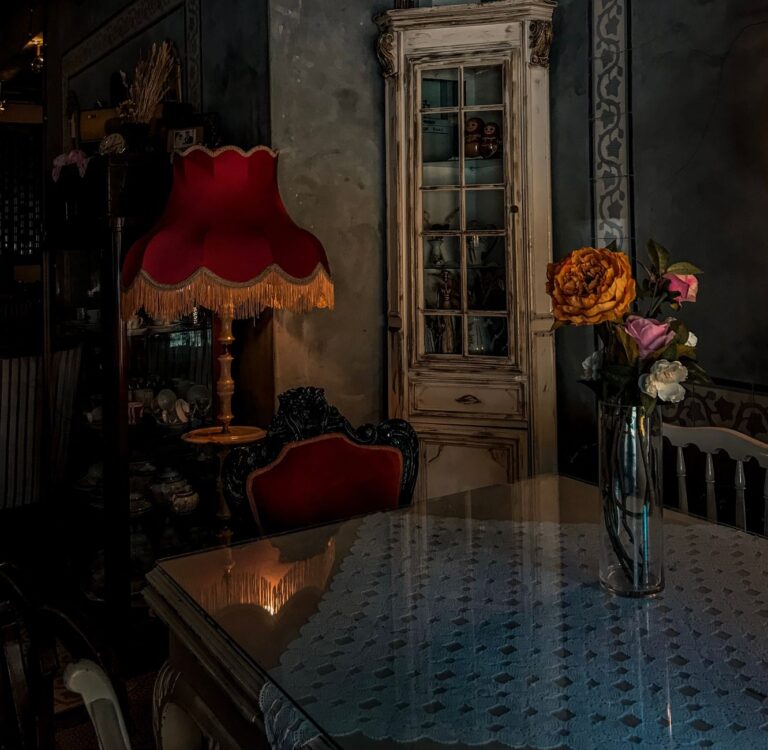
The first thing I did when the home health aide finally left me alone in my own kitchen, eight weeks after my hip replacement, was walk to the china cabinet in the dining room, slow and careful on my cane, because I wanted to see the roses. I do that more than people would guess for a woman my age. I open the glass doors, I look at the plates stacked the way my mother stacked them, gold rim to gold rim, and for a minute I am not seventy two years old with a titanium joint and a walker folded up in the hall closet. I am eight years old at my mother’s elbow in a kitchen in Kentucky, watching her wash those same plates by hand and dry them with a flour sack towel because she would not trust them to a dish rack.
The cabinet doors were unlocked, which was the first wrong thing, because I always kept them locked and the key on the ribbon behind the sugar bowl. The second wrong thing took a moment longer to register, because grief and shock have a way of making your eyes lie to you before your mind catches up. I stood there looking at empty glass shelves, at a thin gray film of dust where sixty eight pieces of hand painted rose china had sat for the better part of my adult life, and I told myself I was confused. I told myself Rhonda had moved it somewhere safe while the house was being cleaned. I told myself a version of the story that let me keep standing.
It took me four days to learn the truth, and one Tuesday afternoon knock on my front door to see all of it laid out plain, in cardboard boxes, on my own porch.
My name is Geneva. I live in a white frame house on Coventry Road outside Rushville, Indiana, the same county my mother arrived in as a bride in 1951, off a train from Kentucky with a steamer trunk and a hope chest and a set of wedding china wrapped in dish towels and newspaper so nothing would chip on the long ride north. I have lived in this town my whole married life. I raised one son here, buried one husband here, and until eight weeks ago I would have told you that nothing left in that house could still surprise me. I was wrong about that, and the person who proved me wrong was my son’s wife, Rhonda, who has been part of this family for sixteen years and who sold my mother’s wedding china at a yard sale in my own front yard while I was lying in a rehabilitation bed forty minutes away, unable to walk to my own mailbox, let alone stop her.
She sold it for two dollars a box.
I need to go back and tell this the right way, the way my mother would have wanted it told, with the china’s whole story first, because what got carried out to a folding table on my lawn was never just dishes. It was the one thing that survived the trip north. It was the one thing that made it.
My mother’s name was Opal. She grew up on a tobacco farm in Bourbon County, Kentucky, the third of six children, and she met my father when he came through on a threshing crew the summer she turned nineteen. He was from Rush County, Indiana, a Hoosier farm boy with a shy smile and a habit of taking off his hat before he said a single word to a woman, and my mother used to say she married him for the hat business alone, though I know that was never the real reason. They wrote letters for a year while he went back to Indiana and she finished out on the farm, and when he finally sent for her in the spring of 1951, her mother, my grandmother, gave her two things to carry north on the train: a Bible with the family names written in the front in fountain pen, and a full set of hand painted china, service for twelve, roses in soft pink and moss green with a thin band of gold around every rim.
My grandmother had bought that china one piece at a time over almost twenty years, a cup here, a saucer there, whatever she could manage out of egg money and the little bit left over after the crop was sold, because a full set all at once was more than a tobacco farm could spare in the middle of a depression and then a war. By the time my mother left for Indiana, the set was complete, every piece bought and paid for and packed with more care than the trunk holding her own clothes. My mother rode two days on that train with a wooden crate on her lap through half of it because she did not trust the baggage car with something her mother had spent two decades building for her, one piece at a time, so that her daughter would arrive in a strange state with at least one thing from home that was entirely, unmistakably hers.
She used to tell me that story every single time she set the table with it, which in our house meant Christmas, Easter, and any Sunday when the preacher came for dinner. She was not a woman who used her good things sparingly out of fear of breaking them. She said china that never gets used might as well be rocks in a box, and she used to run her thumb along the gold rim of a teacup and tell me, “Geneva, your grandmother worked twenty years for this. The least I can do is let it hold real food.”
She died in 1998, in the front bedroom of this same house, and in her last clear week she took my hand and told me the china was mine, that she wanted it used, not put away, and that when the day came I should hand it down the same way, one generation carrying it a little further than the last. I have held to that for twenty eight years. I brought it out every Thanksgiving. I brought it out the year my husband Alvin and I celebrated forty years married, and again the year we buried him, because his sister said the wake ought to have something warm in it and I could not think of anything warmer than my mother’s roses.
I have one son, Linden. He is forty six now, a good man in most of the ways that matter, an electrician with his own small crew out of Rushville who I raised largely on my own the last decade of his childhood, because Alvin worked two jobs a long stretch of years to keep this house paid for and there were plenty of nights it was just Linden and me at that kitchen table, eating off the everyday plates because the good china was for company and holidays, the way my mother had raised me to think of it.
Linden married Rhonda sixteen years ago. She was twenty six then, a hairdresser from over in Connersville with a quick laugh and a way of complimenting a room the second she walked into it that I took, at the time, for warmth. It took me a few years of Thanksgivings and Christmases to understand that Rhonda’s compliments were mostly aimed at whatever she wanted, and that once she had it, or once she had decided she did not want it after all, the warmth went with it. I am not going to pretend the sixteen years were all conflict. There were good years, especially when my granddaughter Mackenzie was small and Rhonda would bring her over on Saturday mornings so I could braid her hair the way my mother once braided mine. But there was always an undercurrent with Rhonda that I could never quite name until this spring, a sense that she was keeping a ledger on this family that the rest of us were not allowed to see, and that somewhere on that ledger, my mother’s china had a dollar value and nothing else.
The trouble that led to the yard sale started with a fall, not with Rhonda at all, which I think is part of why it caught me so unprepared. I fell in my own bathroom on the second Sunday in May, reaching for a bottle of aspirin on too high a shelf, and I broke my hip clean enough that the surgeon at the hospital in Rushville said he had seen worse breaks in people half my age. I had a full hip replacement three days later, and the recovery plan the hospital laid out for me was six weeks in a skilled nursing and rehabilitation facility in Connersville, twenty five minutes from my own house, followed by home health visits once I could manage stairs again.
Get a new story in your inbox every morning.
Facebook doesn’t show you every story we post. Our free newsletter does. Join 2,500+ readers.
I was frightened in a way I have not been frightened since Alvin’s diagnosis. Not of the surgery, which the doctors made sound almost routine, but of the house sitting empty that long, of pipes and mice and mail piling up in a box that anyone driving by could see was not being emptied. Linden came to me the second night in the hospital, before the surgery, and told me not to worry about any of it. He said he and Rhonda would take care of the house while I was in rehab. He said Rhonda had already offered to go over and “get things organized” so that when I came home I would have an easier time getting around with the walker, fewer things to trip over, a clearer path room to room.
I want to be honest about something here, because it matters to how the rest of this happened. I said yes gladly. I was on pain medication, frightened about my own body for the first time in my life, and truly grateful, deeply grateful, that my daughter in law was offering to take something off my plate. I told her, from a hospital bed with an IV in my arm, that she had my blessing to go through the house and clear a path, move the ottoman that always caught my foot, take up the throw rug in the hallway that the physical therapist had already warned me about. I did not, at any point, tell her to touch the china cabinet. I did not think I needed to. Some things, in my mind, did not require saying out loud.
I spent six weeks in that rehabilitation facility learning to walk again on a joint made of titanium and plastic, doing exercises in a hallway with handrails while a physical therapist named Trish counted my steps out loud like I was a toddler, which some days I might as well have been. Linden visited most weekends. Rhonda visited exactly twice, both times for under twenty minutes, both times with some version of the same line, that the house was “coming along,” that I would “hardly recognize it,” that she was “handling everything” so I did not need to worry about a single thing.
I found out later that the handling had included a full weekend yard sale on my front lawn, held on the second Saturday I was in rehab, while I was three miles away doing leg lifts in a hallway that smelled like disinfectant and instant coffee.
I did not find out from Rhonda. I found out because of a knock on my own front door, eight days after I finally came home, from a woman two houses down named Arlene Kessler.
Arlene and I have been neighbors for eleven years. We are not close in the way some neighbors are, no standing coffee dates, but we wave at each other over fences and she brought a casserole the week Alvin died and I have always thought well of her. She is a widow herself, seventy four, sharp as anyone I know, and she has an eye for china because her own mother collected it, different pattern, different story, but the same soft place in her heart for old rose patterned porcelain that mine has.
She told me later that she almost did not go to the yard sale at all. She saw the handmade sign at the end of my driveway on that Saturday in June, GENEVA’S ESTATE CLEAROUT, EVERYTHING MUST GO, and she said her first thought, standing in her own kitchen window, was that I had died and nobody had told her. She walked over to check, half expecting to find out the worst, and instead found Rhonda behind a folding table with a metal cash box, selling off the contents of my house to strangers out of pickup trucks and minivans, four dollars for a lamp, a dollar a book, and on a card table near the garage, six cardboard boxes marked CHINA, $2 PER BOX in Rhonda’s own handwriting.
Arlene said she opened the first box, saw the gold rim and the pink roses, and felt her stomach drop, because she had sat at my table more than once over the years and she knew exactly whose china that was.
She asked Rhonda, straight out, whether Geneva knew this was being sold.
I have this part secondhand, from Arlene, and I believe every word of it because I have known Rhonda sixteen years and I can hear the exact register her voice drops into when she has decided a thing is settled and does not want to discuss it further. Arlene says Rhonda barely looked up from the cash box. She said, “It’s fine, it was just gathering dust in her cabinets anyway. She’s not even going to notice.”
Arlene did not argue with her. She told me later she did not trust herself to keep her voice level if she opened her mouth right then, standing in my own driveway looking at eleven years of Thanksgiving dinners boxed up at two dollars a box. Instead she did something else. She went home, she came back with her purse, and over the next three hours, while that sale ran, she bought back every single box of that china herself, twelve dollars total for sixty eight pieces her own mother would have called a crime to price that low, and she carried each box home to her own house one at a time so Rhonda would not think anything of an old woman making several trips.
She did not tell Rhonda why she wanted it. She did not tell Rhonda anything at all. She paid her twelve dollars, she said thank you, and she carried my mother’s whole life’s inheritance two houses down and set it carefully on her own dining room table, where it sat, safe, for the eight days it took me to get home and for the four more days it took Arlene to work up the nerve to knock on my door.
I remember opening that door and seeing her standing there with the first of the boxes in her arms, and I remember thinking, in the half second before she said anything, that she had brought me a casserole again, that something must be wrong in her own family, because that is usually what a box on a neighbor’s porch means in a town like this. Then she said my name, and something in the way she said it, careful, apologetic, like she was about to tell me a piece of very bad news, made me go still.
“Geneva,” she said, “I need you to sit down before I show you what’s in this box.”
I did not sit down. I stood in my own doorway on a cane, and Arlene Kessler opened a cardboard box on my porch railing and lifted out a dinner plate with a thin gold rim and a wreath of pink roses, and I felt my whole chest go hollow in a way I have only felt twice before in my life, once when the doctor told me about Alvin’s heart, and once, twenty eight years ago, in a front bedroom, holding my mother’s hand while she stopped breathing.
“There’s five more boxes at my house,” Arlene said. “I bought it all back at the yard sale. I didn’t know what else to do. I’m so sorry, Geneva. I should have called you at the rehab place. I didn’t know if it would upset you more, not being able to do anything about it from there.”
I asked her, standing on that porch, whether she was certain it had been Rhonda selling it.
She said she was certain. She said Rhonda had been there the whole three hours, that Rhonda had made change out of the same metal box her own mother used for church rummage sales, that Rhonda had told at least two other customers, within Arlene’s hearing, that “the mother in law’s downsizing, we’re just helping clear things out.”
I had never once used the word downsizing. I had never had a single conversation with Rhonda, or with Linden, about giving up my home, my furniture, or any single piece of that china.
I want to tell you I confronted Rhonda that same hour, china still in boxes on my porch, but that is not what happened, because I am seventy two years old and I have learned that the things that hurt worst deserve more care than a hot temper gives them, not less. I thanked Arlene. I hugged her for longer than either of us probably expected. I told her I would pay her back the twelve dollars and she would not hear of it, and then I closed the door, sat down at my own kitchen table, and cried for the better part of an hour with my hand flat on a cardboard box, the way you might sit with your hand on a coffin.
Then I called my son.
I did not tell Linden on the phone. I asked him to come by after work, alone, and something in my voice must have told him this was not a small thing, because he showed up forty minutes later still in his work boots, dust on his forearms, looking like a man bracing for bad medical news. I walked him to the dining room. I showed him the empty cabinet, the dust outline on the glass shelves, and then I walked him to the kitchen table where six boxes sat, and I told him where they had been for the last twelve days and what it had cost to get them back.
I have never in forty six years seen my son’s face do what it did in that kitchen. He went white, then red, and then he sat down hard in a chair like his legs had simply stopped agreeing to hold him. He told me he had no idea. He told me Rhonda had said the house cleanup was going “great,” that she had sold “some old junk from the garage” for gas money, that he had specifically pictured broken tools and a rusted lawn mower, not his own grandmother’s wedding china. I believed him, and I still believe him, because whatever else is true about my son’s marriage, Linden has never once in his life been able to lie to me with his eyes open, and he was not lying to me in that kitchen.
He called Rhonda from my dining room, in front of me, and I heard both sides of that conversation because he had her on speaker without seeming to notice, his hands were shaking too badly to think about it. He asked her what she had sold out of the garage.
She listed things off casual as you please, an old grill, some paint cans, a broken weed eater.
He asked her about the china cabinet.
There was a pause on that call I will remember the rest of my life, three or four full seconds of dead air, and then Rhonda’s voice came through smaller than I had ever heard it, and she said, “It was just sitting there, Linden. She never even used it. I figured she’d rather have the cabinet space when she got home, easier to get around.”
“She’s standing right here,” Linden said. “She can hear you.”
Another silence. Then, quieter still: “I didn’t think anyone would even notice it was gone.”
I picked up the phone myself at that point, because I had twenty eight years of things I needed to say and I was not going to say them through my son. I told Rhonda that I had noticed. I told her that china had ridden two days on a train in 1951 balanced on my mother’s lap because her own mother had spent twenty years buying it one piece at a time out of egg money on a Depression era tobacco farm, and that it had outlived a war, a marriage, a funeral, and forty years of Sunday dinners, and that it had taken Rhonda eleven days and a folding table to sell it for less than the cost of the gas it took Arlene Kessler to drive it two houses down and give it back to me for free.
Rhonda cried on the phone. I will give her that much, the tears were not performance, Linden told me later he could hear that too. But crying is not the same as understanding, and what she said next told me she still did not understand what she had actually done. She said she was sorry I was upset. She said she had been under a lot of stress managing the house cleanup by herself. She said she never would have touched it if she had known it “meant that much” to me.
That was the sentence that told me exactly how wide the gap between us really was. Sixteen years, and she had never once understood that it meant that much to me, despite every Thanksgiving, every Christmas, every time I had told the train story at that very table while pouring coffee into one of those cups. She had watched me use it for a decade and a half and had somehow filed it away as clutter, as something old that a woman on a walker would not miss, as two dollars a box.
The days after that were hard in a way that is difficult to explain to anyone who has not lived it. Linden did not speak to Rhonda for the better part of a week, staying most nights at my house instead of his own, which worried me more than it satisfied me, because I did not want to be the reason my son’s marriage came apart, even as angry as I was. Mackenzie, my granddaughter, who is fourteen and old enough to understand exactly what had happened, stopped speaking to her own mother almost entirely for those same days, which I think frightened Rhonda more than anything Linden or I said to her directly.
What I did not expect was what happened next in the neighborhood, because Arlene Kessler is not the sort of woman who keeps a story like that to herself, not out of gossip, but out of something closer to outrage on my behalf. She mentioned it to her sister, who mentioned it at church, and within a week I had three more knocks on my door from women I barely knew, each one holding a plate or a cup or a gravy boat they had bought at that same yard sale for a dollar or two, each one apologizing for not knowing at the time whose kitchen it had come out of, each one handing it back without wanting a cent in return. A woman named Doris from two streets over brought back the gravy boat and the sugar bowl together, wrapped in a dish towel, and told me she had almost put the sugar bowl on her own shelf that same week before something made her ask around first. By the end of that month, I was missing only four pieces from the original sixty eight, two saucers and two teacups that had gone home with strangers from out of town, license plates nobody recognized, and I have made my peace with those four. My mother taught me that things are meant to be used and sometimes things are meant to be let go of, and I choose to believe those two strangers are drinking their coffee out of something with a story behind it, even if they never learn what the story is.
Rhonda came to my house alone on a Sunday afternoon three weeks after the phone call in my kitchen, without Linden, which I think took more courage than anything else she did in that whole stretch of time. She stood on my porch, the same porch Arlene had stood on with the first box, and she asked if she could come in and talk, just the two of us.
I let her in. I made coffee, in the everyday cups, because I was not ready yet to hand her one of my mother’s, and some part of me wanted her to notice that and understand why.
She told me she had spent three weeks trying to understand why she had done it, really understand it, not just apologize for getting caught, and what she landed on was not comfortable for either of us to sit with, but I respected her for saying it out loud instead of around it. She told me that growing up, her own family had never kept anything, that her mother sold or pawned whatever needed selling to get through a hard month, birthday presents included, and that somewhere along the way Rhonda had absorbed the idea that objects, even sentimental ones, were only ever worth what someone would pay for them on a given Saturday. She said watching me lie in a hospital bed, frightened and in pain, had made her want to fix something, control something, and clearing out a house had felt like the one thing she actually had power over. She said she told herself the china was mine to lose because I could not use it while I was recovering anyway, a piece of logic she said out loud in my kitchen and then heard, for what she said was the first time, exactly how thin it was.
I am not going to tell you the apology fixed sixteen years of an undercurrent I had never quite been able to name. It did not. Trust, once you have watched someone sell your mother’s whole life’s work for the price of a fast food meal, does not simply reset because the person finally says the right words in your kitchen. What it did do was give me and Linden and Rhonda a place to actually start, instead of a wound we all just quietly stepped around at every future holiday. We set new terms, plainly, out loud, the way I think we should have years before. Rhonda does not have a key to my house any longer, not out of spite, but because some trust has to be rebuilt in small pieces before it is handed back whole, the same slow way my grandmother built that china set one cup at a time. I changed my will that same month, not out of anger, but out of plain sense, and left the china directly to Mackenzie, in writing, with a letter for her to read when she is old enough to understand what it took to get it to her, four generations and one yard sale and an old woman two doors down who would not let it go for two dollars.
The china is back in its cabinet now, cleaned, counted, sixty four of the original sixty eight pieces, locked behind glass doors with the key back on its ribbon behind the sugar bowl where it belongs. Two Sundays ago, I had Linden and Rhonda and Mackenzie over for dinner, and I took it out. I set the table the way my mother set it, gold rim to gold rim, and I told Mackenzie the whole story while we ate, the tobacco farm, the two days on the train, the crate on my grandmother’s lap.
Rhonda helped me wash it afterward, standing at my sink, and she was careful with it in a way I noticed and did not mention out loud, turning each piece over gently, drying it slow, setting it back in the cabinet herself, one plate at a time, like she understood now exactly what it had cost to get it there.
I still keep Arlene Kessler’s number taped inside my kitchen cabinet, next to the emergency numbers, though thank the Lord I have not needed to use it for anything since. Some nights I still think about those five days it sat on her dining room table, safe, while I did not even know it was gone, and I think about how close this family came to losing the one thing that made it two days on a train, and I think about how it was a neighbor, not a daughter in law, who understood without being told what sixty eight pieces of old rose china were actually worth.