The Stonemason Who Remembered My Mother
My mother, Helen Pruitt, lived on Larkin Street in Millbrook for fifty six years. It is a small house, white with green shutters, the kind of house nobody looks at twice driving through town, and it is where she raised the three of us alone after my father died in a combine accident when I was nine years old.
Millbrook sits in the southern part of the state, a little under fifteen hundred people, one blinking light where County Road 9 meets Main Street, a diner called the Wagon Wheel where the same six men have had coffee at the same table every morning for as long as I can remember, and a cemetery on the north edge of town called Fairview, where my mother is buried now, next to my father, under a headstone I paid for myself and a man named Gus Ostrander refused to let me pay for at all.
I want to tell this story in order, because the order is the whole reason it means what it means to me. It started the way most of these stories do. Small. With a phone call about money.
*My mother*
Helen was eighty one when she died. She went in her sleep, in her own bed, in the house she’d lived in since 1970, and the coroner told us it was her heart, quiet, no suffering, which is the kind of mercy you cling to when someone you love is gone.
She had raised three kids on a school cafeteria paycheck and whatever cleaning work she could pick up on weekends, and later, once we were grown, on a small widow’s pension and whatever she made doing alterations for half the women in Millbrook on her old Singer machine in the back room. She never remarried. She said once, and only once, that she’d loved my father enough for one lifetime and didn’t see the point in trying to split that kind of love a second way.
What people in this town remember about my mother is not the sewing or the cafeteria job. It is the casseroles. If someone in Millbrook lost a husband, lost a job, lost a child, had a baby, had a surgery, had a bad month, Helen Pruitt showed up on their porch within a day or two with a dish covered in foil and never once asked to be thanked for it. She did this for forty, fifty years. She did it when we were kids and there wasn’t much extra in our own kitchen to spare, and she kept doing it into her seventies, driving herself to deliver food to people twenty years younger than her who were having a harder week than she was.
I did not know, until the day I am about to tell you about, that this was not a small habit of my mother’s. It was the whole shape of who she was, and it had reached further than any of us, including her own children, ever understood.
She was not a woman with much to spare. Our house growing up had one window unit for the whole summer and a woodstove that had to be fed by hand every winter morning before school. She sewed our clothes past the point most mothers would have given up and bought new. And still, somehow, there was always enough in her to give away. I used to think that was just her nature, the way some people are naturally tall or naturally quiet. I did not understand, until Gus Ostrander sat me down on a stone bench in Fairview Cemetery, that her generosity had a history to it, specific acts with specific dates and specific people who were still alive because of them, and that the town around her had simply learned, over fifty years, to expect it without ever asking where it came from.
*The three of us*
I am the middle child. My older brother is Carl, forty nine, a foreman on a construction crew two counties over, married, no kids, drives a truck he bought new two years ago. My younger brother is Roy, forty four, works at the co-op, married with two teenagers, likes to hunt, likes to fish, likes to disappear for a long weekend at least once a season if the money is there for it.
I am forty six. I work as a teacher’s aide at the elementary school in Millbrook, and I raise my son mostly on my own since his father and I split six years ago. Money in my house gets planned two and three weeks ahead. I keep an envelope in the kitchen drawer for my son’s dental work, because he needs braces and the orthodontist in the next county over wants a chunk of it up front before they’ll even start.
I am telling you all of this because I want you to understand exactly what eleven hundred dollars meant to me the week my mother died, and exactly what it did not mean to my brothers, and why the difference between those two things is the reason I am writing any of this down at all.
*The funeral home*
The funeral home in Millbrook, Kastner and Sons, has handled every death in this town for three generations. They were kind to us. They walked us through the service, the visitation, the burial plot next to my father, all of it handled with the gentleness you hope for when you are too tired and too sad to make good decisions.
What they explained to us, gently, on the second day, is that the service and the burial were one cost, and the headstone was a separate one entirely, because most families don’t order the stone until weeks or months after the burial, once the ground has settled and there’s been time to decide on the wording.
A plain granite marker, upright, with my mother’s name, her dates, and one line of scripture or verse underneath, came to eleven hundred dollars through Ostrander Monument Works, the shop that has done nearly every headstone in Fairview Cemetery for as long as anyone in Millbrook can remember.
Eleven hundred dollars. I remember sitting in the funeral home’s little side office with that number written on a slip of paper, thinking about the three hundred and sixty seven dollars it would come to if my brothers and I split it evenly, and thinking that was a number all three of us could manage without it hurting too badly.
I was wrong about that.
*The phone call*
I called Carl first, two days after the funeral. I told him what the marker would cost and asked if we could split it three ways, sooner rather than later, because I didn’t like the idea of our mother lying under bare dirt with no name on it any longer than it had to be.
Carl was quiet for a second. Then he said he’d just put a deposit down on a new truck bed cover and things were tight. He said maybe in a month or two.
I told him I understood things were tight for everybody, that’s exactly why I was asking for a third and not the whole amount, three hundred and sixty seven dollars, and I asked if he could manage that much sooner.
That is when he said it. I have turned it over in my head so many times since that I can hear the exact flatness in his voice when he said it, no anger in it, no hesitation, just a fact he was stating out loud like he was reading a weather report.
“She’s gone,” Carl said. “She won’t know the difference.”
I didn’t say anything for a second. I thought I’d misheard him. I asked him to say it again, and he did, word for word, and then he added that he didn’t see why we needed a fancy stone anyway when a flat marker would do the job for less, and that I was being sentimental about it the way I always was.
I called Roy after that, mostly out of some stubborn hope that he’d feel differently. He didn’t say the cruel thing Carl said. He just said he was tight right now, he’d just gotten back from a week hunting elk in Colorado with two buddies from the co-op, and could I front it for a bit and he’d pay me back when things evened out.
I hung up the phone in my kitchen and sat down at the table where my mother used to sit with us for supper every night of my childhood, and I cried harder than I had cried at the funeral itself. Not because of the money. Because of what my brothers had just told me, without meaning to, about how little our mother’s memory weighed against a truck bed cover and a hunting trip.
*What I did*
I did not call either of them back to argue about it. I have learned, in forty six years, that arguing with a man who has already decided a thing doesn’t change the decision, it only gives him a story afterward about how unreasonable you were being.
I went to the drawer where I keep the envelope for my son’s braces. There was eleven hundred and forty dollars in it, money I had been setting aside eighty and a hundred dollars at a time for almost a year, money that meant I was going to have to start that saving over almost from scratch and hope the orthodontist would work with a payment plan when the time came.
I took it to Ostrander Monument Works myself, on a Tuesday afternoon, and I ordered my mother’s headstone.
*The shop*
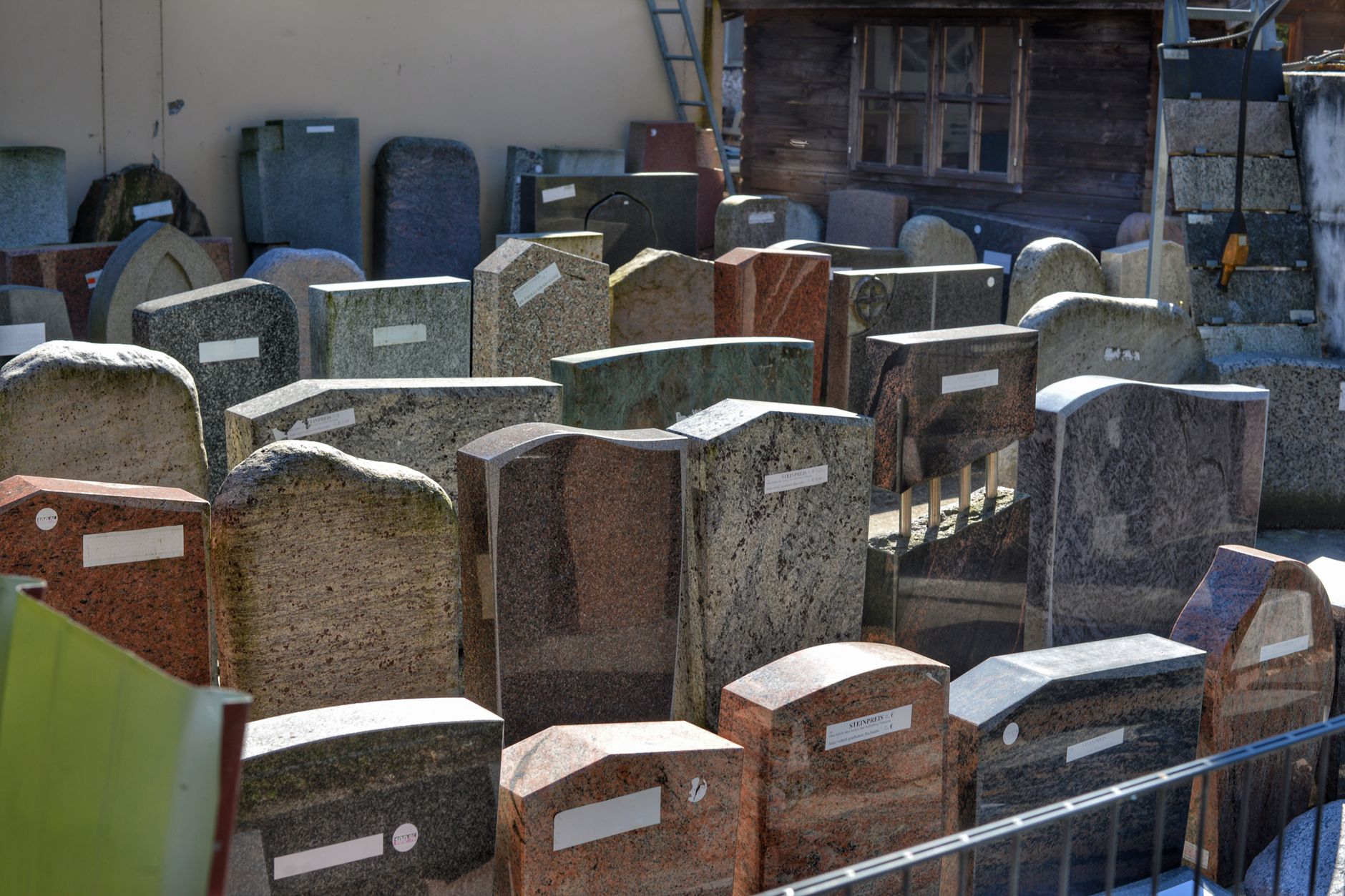
Ostrander Monument Works sits at the edge of town on County Road 9, a low stone building with a gravel lot and a yard full of unfinished granite slabs standing on end like a small silent congregation. It has been there since before my mother was born. The sign out front is hand painted, faded from decades of sun, and it has never once, in my whole life, said anything different.
Gus Ostrander runs it. He is somewhere north of eighty, tall and stooped, with hands that look like they’ve been working stone since before stone was fashionable to work by hand instead of machine. He still does the lettering himself, every letter, with a chisel and a mallet, the way his father taught him, the way, I would learn, someone else had once made sure he had the chance to be taught at all.
He was kind to me that first visit. He walked me through the granite options, dark gray or the lighter speckled stone, upright or flat, and when I told him I wanted a verse under her name, he asked what she’d have wanted, not what I thought would look nice, and I appreciated that more than I could say at the time.
I told him she used to say, whenever any of us kids were scared or grieving something, “the Lord keeps what we cannot carry.” It was the closest thing my mother had to a personal scripture, something she’d say quietly, almost to herself, at every funeral she ever attended in this town, which by the time she died had to number close to a hundred.
Gus wrote it down carefully on a work order. He asked my mother’s full name. I told him. Helen Pruitt.
He looked up at me for a second when I said it, longer than I would have expected, and then he looked back down at his paper and finished writing, and I thought nothing of it. I had no reason to.
*The morning at the cemetery*
Three weeks later he called to tell me the stone was set. He asked if I wanted to come out to Fairview and see it before I settled the balance, and I told him I’d come that Thursday morning on my way to work.
It was a clear morning, the kind of bright, ordinary blue sky that feels almost disrespectful when you’re grieving, because the world has no idea it’s supposed to be sadder that day. The grass at Fairview was still wet from an overnight rain, and I could see Gus’s truck already parked near the north gate when I pulled in.
He was standing over my mother’s grave when I walked up, his chisel case sitting closed on the grass beside him, and the headstone was in the ground, polished granite catching the morning sun, HELEN PRUITT carved across the top in his careful, even hand, her dates beneath it, and underneath that, the line I had asked for. The Lord keeps what we cannot carry.
It was beautiful. Simple and beautiful, exactly what she would have wanted, no more and no less.
I had my checkbook in my coat pocket. I wrote the check for the balance right there, standing in the wet grass, and I held it out to him.
He looked at it. Then he looked at the headstone. Then he looked back at me, and something in his face had changed from the polite, businesslike man I’d met three weeks earlier. His eyes were wet, and his jaw was working like he was chewing on something he’d been carrying a long time and finally had to let go of.
He set his chisel case down on the grass, slowly, the way an old man sets down anything heavy. And then he took my hand, the one holding the check, and he folded my fingers back over it, gentle, the way you’d close a child’s hand around a coin they’d dropped rather than let them lose it in the grass.
“Ma’am,” he said, “I have owed your mother a headstone for forty years. I am not about to send her daughter a bill for it now.”
*What Gus told me*
I stood there in that cemetery not understanding a single word of what he’d just said. My mother had never once, in forty six years of being her daughter, mentioned Gus Ostrander’s name to me. Not at supper, not in passing, not in any of the hundred small stories she told us over the years about people in this town she’d helped.
Gus asked if I had a few minutes. I did. I called the school and told them I’d be in late, and I sat down on the low stone bench near the cemetery’s oak tree, and Gus Ostrander, eighty two years old, told me a story about the winter of 1986 that I have not been able to stop thinking about since.
His father, Everett Ostrander, had built the monument shop in 1951 and run it for thirty five years. In the fall of 1986, Everett died suddenly of a stroke, right there in the shop, mid-way through carving a name into a stone that was still, unfinished, sitting on the workbench when Gus walked in and found him.
Gus was twenty six years old. He had grown up around the shop but had never really learned the trade the way his father wanted him to, because Gus, by his own account, had spent most of his twenties drinking more than he should have and drifting between odd jobs, a disappointment to a father who’d hoped his only son would carry the business forward.
When Everett died, the shop passed to Gus by default, because there was no one else to take it. What Gus inherited along with it was almost eleven thousand dollars in back taxes and an overdue mortgage his father had quietly taken out against the shop two years earlier to cover a bad stretch, debts Gus hadn’t known existed until the bank started calling.
He told me he spent that whole winter drinking worse than he ever had before, watching the shop slide toward foreclosure, telling himself he’d never wanted to be a stonemason anyway and it wouldn’t be the worst thing in the world to let the bank have it. He said there were nights that winter he didn’t eat for two, three days at a stretch, not because there was no food, but because he’d stopped caring whether there was.
*The woman who showed up*
Helen Pruitt was thirty nine years old that winter, four years widowed herself, raising three kids on a cafeteria paycheck in a house not far from the shop. Gus said he barely knew her before that year. She wasn’t family, wasn’t close friends with his mother, had no reason at all to notice a young man falling apart at the edge of town.
But she noticed. Gus said she showed up at the shop one evening in November with a casserole dish covered in foil, the way she showed up at half the houses in this town over the years, and found him sitting in the dark, unwashed, three days behind on eating, staring at his father’s unfinished workbench like it was a wound he couldn’t stop touching.
She didn’t lecture him. Gus was very clear about that. She set the dish down, found two plates in the back room kitchenette, and sat with him while he ate, and she came back the next night, and the night after that, for weeks, sometimes with food, sometimes just to sit with him so he wouldn’t be drinking alone in an empty shop with his dead father’s tools still laid out on the bench.
Somewhere in those weeks, Gus told her about the bank, about the back taxes, about the mortgage he hadn’t known his father had taken out, about how he’d decided he was just going to let the whole thing go and take whatever the bank gave him for the property.
Helen told him no. Gus said she said it plainly, the way she apparently said most things, that his father had built something in this town that mattered to more people than Gus understood yet, and that she wasn’t going to sit by and watch him hand it to a bank because he was too tired and too sad to fight for it.
*What she did*
What Helen did next, Gus said, was something he did not fully understand himself until years later, when the pieces of it finally came together for him one at a time.
She started, quietly, going door to door in Millbrook, not asking for money in Gus’s name, because she knew a proud, drunk, grieving twenty six year old would never accept charity handed to him directly. Instead she told people the church needed help with a special project for a family going through a hard time, which was true in every sense that mattered, and she collected what people could give, five dollars here, twenty there, sometimes just a promise of labor.
She organized the ladies from the Methodist church to hold a bake sale and a rummage sale over two consecutive Saturdays outside the Wagon Wheel diner, and she got half the town’s men, through her own quiet asking, to come out one Saturday and help clean up the shop’s overgrown lot and fix the sagging roofline on the storage shed out back, work that made the property look cared for again right as the bank’s inspector was scheduled to come assess it.
She took the cash she’d collected, along with whatever she could add from her own thin cafeteria paycheck, straight to the bank herself, and paid down enough of the overdue mortgage balance that the bank agreed to restructure the remaining debt into payments Gus could actually make from the shop’s income going forward, instead of calling the whole note due at once.
She never told Gus any of this while she was doing it. He found out, piece by piece, over the following year, from a church lady who let it slip, from the bank teller who mentioned it once without thinking, from his own mother, near the end of her life, who had known the whole time and had never said a word out of respect for Helen’s wish that it stay quiet.
*What it cost her*
I asked Gus, sitting on that stone bench, whether he knew how much of it had come out of my mother’s own pocket, on top of everything she’d organized from other people. He said he didn’t know an exact figure, but he knew it wasn’t small, not for a widow raising three kids on a school cafeteria wage, and he knew she’d gone without things that winter so that he wouldn’t have to lose everything his father built.
He said the year she died, he had done the arithmetic in his head more than once, what it would have cost her in today’s dollars to give what she gave in 1986, and it came to more than she likely had free to give at all, which meant she had found a way regardless.
“She never asked me for a single thing back,” Gus told me. “Not once, in forty years. I tried, more than once, to pay her for what she’d fronted the bank out of her own money. She wouldn’t hear of it. Said watching the shop still standing was payment enough.”
He said the only thing he ever managed to give her in return, over the decades, was that whenever anyone in her family needed stonework, whenever any small favor came up that a monument shop could quietly do, headstone repairs for my father’s grave over the years, resetting a marker that had shifted in the frost, cleaning lichen off old family stones before Memorial Day, he did it without ever billing her, and she never once questioned why.
*Why he never told her children*
I asked him why, in forty six years, none of us had ever heard a word about this from our own mother. He said that was Helen through and through. She never wanted credit for anything she did for anyone, not even from her own kids, because in her mind the moment you told people what you’d done for them, it stopped being a gift and started being a transaction, something owed back to you, and she never wanted anyone, including her own children, walking through life feeling indebted to her.
“She raised you not knowing,” Gus said, “because she wanted you to be kind the same way, without keeping score. I think that’s the only regret I have in all this. That you three never got to see, while she was alive, just how far that kindness of hers actually reached.”
I sat on that bench for a long time after he finished talking. I thought about Carl, telling me she was gone and wouldn’t know the difference, and I thought about the fact that an eighty two year old man who was not her son, not her family at all, had just spent the better part of an hour proving, with his own trembling voice, that the difference she made in this world was still standing on County Road 9 four decades later, still cutting stone, still carrying her kindness forward one headstone at a time without ever once sending her a bill.
*Telling my brothers*
I did not call Carl and Roy right away. I sat with it for almost a week, partly because I needed the time myself, and partly because I wasn’t sure I wanted to hand either of them something that felt this precious to me, not after how they’d talked about her.
I told Roy first, over coffee at his kitchen table. He went quiet for a long time, and then he said he was ashamed, plainly, no excuses, and he asked if he could still give me his share of the eleven hundred dollars even though Gus had refused it. I told him to put it toward something in her memory instead, and he ended up donating it to the church’s benevolence fund she used to draw from herself for the families she helped over the years.
Carl was harder. I told him the whole story, standing in his driveway, and he was quiet in a different way than Roy had been, a stiffer, more closed off kind of quiet. He didn’t apologize outright. He said, “I didn’t know any of that,” like the not knowing excused the flatness of what he’d said on the phone. I told him it wasn’t really about the money at all, it never had been. It was about hearing your own brother say your mother wouldn’t know the difference, three days after burying her.
He didn’t have a good answer for that. I don’t know that there is one.
But two weeks later, Carl showed up at Fairview Cemetery on a Saturday morning without telling me he was coming. I found out because Gus called me that afternoon and told me my brother had stopped by the shop first, asked him quietly whether there was any stonework or cleanup around the cemetery that needed doing that a strong back could help with for free, no charge to anyone, and Gus had put him to work resetting two old veteran markers that had sunk crooked in the frost near the cemetery’s east fence.
Carl has been back three Saturdays since, Gus tells me, working quietly, not saying much, not asking for thanks. The two veteran markers he reset that first Saturday belong to men neither of us had ever heard of before, a Korean War corporal and a World War Two private, both buried at Fairview since before any of us were born, both left leaning in the frost-heaved ground for longer than anyone in town had noticed. Gus told me Carl came back the following week and asked, on his own, whether there were other stones in that same shape, sunk or leaning or forgotten, and Gus walked him through six more that afternoon.
I don’t know if straightening old veterans’ headstones is an apology for what my brother said about our mother. I don’t think Carl would call it that himself, not out loud, not yet. But I know he has not missed a Saturday since, and I know that is not nothing, coming from a man who once told me, without blinking, that a dead woman would not know the difference.
*The stone itself*
My mother’s headstone stands in Fairview Cemetery now, granite catching the morning light the way it did that Thursday I stood there with a check Gus Ostrander wouldn’t take. HELEN PRUITT, her dates, and underneath, the line she said at every funeral in this town for fifty years. The Lord keeps what we cannot carry.
I go out there most Sundays after church now, sometimes with my son, and I always stop by the shop first if Gus’s truck is in the lot, because he likes company, and because I have come to think of him, in the strange way grief sometimes rearranges a family, as something close to another brother, one who actually knew what our mother was worth the whole time the rest of us were too close to see it.
I think about Carl’s words less than I thought I would. She’s gone, she won’t know the difference. I understand now that he was wrong in a way none of us could have guessed that week. There is a shop on County Road 9 still standing because of what my mother did forty years before either of us ever needed a headstone from it, still standing because a young man who’d given up on himself decided, because of her, that he was worth saving after all.
She never told a soul. She let a whole town, including her own children, believe the casseroles and the quiet kindnesses were the whole of who she was, when really they were only the visible part of something far deeper, something that had reached all the way into a grieving stonemason’s shop in 1986 and was still holding it up, quietly, forty years later, the day her own family needed a stone of her own.
My mother would know the difference, Carl. She always did. She just never once asked any of us to notice.