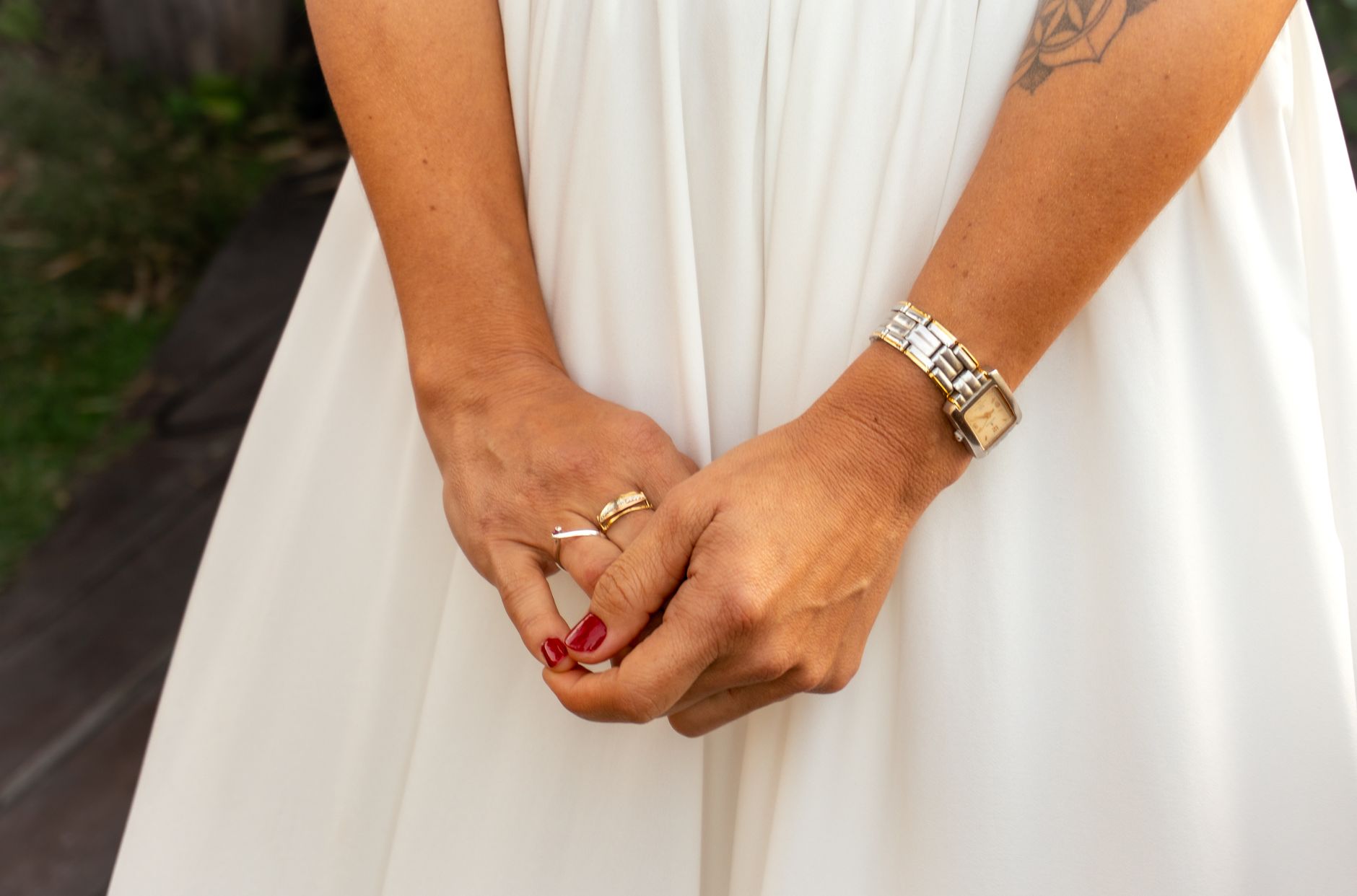
The Ring My Sister Called Junk
I have lived in Millhaven my whole life, two streets over from the farmhouse where I grew up, and I thought I understood every last thing about my mother, Dorothy Whitfield. I was wrong, and it took a fifteen-dollar garage sale ring to prove it.
My mother was not a complicated woman on the surface. She hemmed dresses and let out prom gowns at the fabric shop on Main Street for thirty-one years, right up until her hands got too shaky to trust with pins. She kept a vegetable garden along the south fence that my father built for her the summer they married. She sang alto in the choir at Grace Lutheran and never missed a Sunday unless she was in the hospital, and even then she asked the pastor to bring her the bulletin so she could follow along from the bed.
She raised two daughters, my older sister Marlene and me, in a two-bedroom farmhouse off County Road 9, the kind of house where you could hear the gravel trucks rumble past on their way to the quarry and where the porch light stayed on for anybody who might need it. She packed our lunches with a note folded inside the napkin every single day of grade school. She never once, in fifty-six years of marriage to my father, took her wedding ring off her finger. Not to do dishes, not to garden, not even the year her hands swelled so badly from arthritis that Dad had to soap her finger to work the band loose so the doctor could check the swelling underneath.
She died in April, eighty-one years old, in the same bedroom where she’d slept for over half a century. Marlene and I sat with her the last three days, taking shifts, and when it was over we did what daughters do. We planned a funeral. We picked hymns she loved. We stood in that same sanctuary where she’d married our father and said goodbye to her.
And then, because the house had to be dealt with eventually, we started clearing it out.
I want to be fair to my sister here, because for most of this story she is not going to come off well, and she deserves at least this much context first. Marlene is sixty-one. She is the practical one, the one who organized Dad’s medical paperwork when his heart started failing eight years ago, the one who found the nursing consult when Mom’s memory started slipping in her last year, the one who always, always got things done. I loved that about her growing up. I leaned on it hard the last decade, especially after Dad died and it was just the three of us women trying to keep Mom steady in that house alone.
But Marlene has never been sentimental, not the way I am, and where I see meaning in an object, Marlene sees clutter. It is a real difference between us, one that never mattered much until the week we had to decide what to do with everything our mother owned.
Marlene wanted to move fast. She said it herself, more than once, in the weeks after the funeral. “The longer we sit in that house with her things, the harder this gets.” I understood the logic even as it bruised me a little every time she said it. So when she offered to organize an estate sale, price the furniture, set up the folding tables in the driveway, I said yes. I told her I trusted her.
I should have been there. That is the plain truth of it, and I have turned it over in my head more times than I can count since. But my husband, Gary, had a cardiology follow-up scheduled that same Saturday in Cedar Rapids, two hours each way, and it had been on the calendar for months, and stents do not reschedule themselves around estate sales. So I drove him instead, and Marlene ran the sale alone with our cousin Patty helping at the cash box, and by the time I got home that evening the yard sale signs were already coming down off the mailbox post.
Marlene was still in the driveway when I pulled in, folding the plastic tablecloths that had covered the card tables, looking pleased with herself in the particular way she gets when a job is finished and finished well.
“We cleared almost four hundred dollars,” she told me before I’d even gotten out of the car. “The dresser went for sixty. Somebody from over in Elston bought the whole set of Grandma’s canning jars.”
I asked what happened to the jewelry box. The little wooden one our father built the winter before they married, with a hand-carved ballerina glued to the lid that used to spin to a tinny version of a waltz, though the mechanism had seized up years before I was born and none of us had ever heard it play.
Marlene didn’t look up from the tablecloth she was folding into smaller and smaller squares. “Sold most of it. Nobody wants old costume stuff, Sylvia. You know that.”
Something tightened in my stomach, the way it does when you already suspect an answer you don’t want. “Even the wedding ring?”
“Especially the wedding ring.” She said it flatly, the way you’d report the weather. “It was just costume junk anyway, Mom never had any taste. Some girl gave me fifteen dollars for it and looked thrilled to get it. Honestly I think I overcharged her.”
Fifteen dollars.
I have replayed that moment more times than I want to admit. I did not yell. I did not cry in front of her, though I badly wanted to do both. I stood there on the gravel with the porch light coming on automatically behind us, the same porch light that had burned every evening of my childhood, and I felt something crack quietly down the center of my chest. Not the loud kind of break. The kind you feel more than hear, like ice giving way under snow you can’t see.
That ring was not costume anything. I had watched my father slide it onto my mother’s finger in June of 1970 in the sanctuary of Grace Lutheran Church, the same sanctuary where we had buried her not two months before. I had watched her twist it absently while she prayed at the dinner table, while she sat on hold for forty minutes with the electric company trying to sort out a billing error, while she held my father’s hand in the hospital the week before he passed eight years ago. That ring had been on her hand through two daughters, four grandchildren, one heart attack, one hip replacement, and fifty-six years of a marriage that, as far as I ever saw, never had a single loud fight in it.
“Marlene,” I said, and my voice came out smaller than I wanted it to. “That was her wedding ring.”
“It was a plain gold band, Sylvia. It’s not like it had a diamond in it. I looked it up, that kind of thing goes for scrap gold price at best, and I didn’t have time to drive to a jeweler and get it appraised. I had forty other things on those tables.”
I didn’t have an answer for that. What was there to say? The sale was over. The girl who bought it was gone, into a Saturday afternoon full of strangers, with no name and no number and no way for me to find her. I went inside that night, into the house that no longer smelled like my mother because two months of empty rooms had already started erasing her from it, and I sat at her kitchen table and I let myself cry the way I hadn’t let myself in the driveway.
For three days I told myself the same thing everyone tells themselves after a loss like that. Let it go. It was a ring. Your mother is gone either way, and no piece of gold was going to bring her back, and grief makes us cling to objects because objects are easier to hold onto than the people themselves. I believed it, mostly. I tried to believe it fully.
Then, on the Tuesday evening, my phone rang from a number I didn’t recognize, a local area code but not one saved in my contacts. I almost let it go to voicemail. I am glad, more glad than I can properly explain, that I didn’t.
“Hi, I’m so sorry to bother you,” a young woman’s voice said, a little breathless, like she’d been rehearsing the opening line the whole drive. “Is this someone connected with the Whitfield estate sale, the one on County Road 9 this past Saturday?”
I said yes, cautiously, my heart already picking up for reasons I couldn’t name yet.
“My name is Emily Doyle,” she said. “I bought a ring from the sale. A gold band, real simple, from the woman at the cash box. I paid fifteen dollars for it.”
I sat down at the kitchen table, the same one I’d cried at three nights before, and I told her I remembered, that it had belonged to my mother.
“I bought it for my grandmother’s birthday,” Emily said. “It was her eighty-fourth on Tuesday, today, and I’m a nursing student, I don’t have a lot of money for gifts, and it just looked like something she’d wear. Simple, no big stone, the kind of ring she already has three of. I wrapped it up in tissue paper and gave it to her tonight at a little party we had in her kitchen.”
I asked what happened next, though some part of me already sensed the shape of it before she said a word.
“She turned it over in the lamp light, the way she does with jewelry, checking the craftsmanship, and then she just went still. Completely still, Mrs. Whitfield. I thought something was wrong, I thought maybe she was having a spell. Then she started crying, and she asked me to read her the words engraved on the inside of the band, because her eyes aren’t what they used to be and she couldn’t make out the small print.”
My hand had gone cold around the phone. “What did it say?”
“I’ll tell you when I see you, if that’s all right,” Emily said, gently, and there was something in her voice, some careful kindness, that told me this was not a conversation to finish over the phone. “My grandmother asked me to drive her out to that address first thing tomorrow morning. She wouldn’t tell me why, not fully. She just kept saying, over and over, ‘I have been looking for this woman for fifty-seven years, and I never thought I’d hold her ring in my own hand.'”
I did not sleep that night. I lay awake running through every story my mother had ever told me, every anecdote from before I was born, searching for anything that might explain what a stranger, a woman named Ruth I had never heard of in my life, could possibly be looking for across nearly six decades. I came up with nothing. My mother had grown up two counties over, married my father in 1970, and as far as I knew had never lived anywhere else but Millhaven and the small town where she was raised. There was no scandal in the family that I’d ever heard whispered about, no old secret, nothing.
I called Marlene that night too, mostly out of some instinct that she should know, though a part of me, I’ll admit, wanted her to feel the weight of what she’d almost thrown away. She was quiet on the phone in a way that wasn’t like her.
“A woman is coming tomorrow because of the ring you sold for fifteen dollars,” I told her. “Something’s engraved inside it. She says she’s been looking for Mom for fifty-seven years.”
“That doesn’t make any sense,” Marlene said. “Mom never left Millhaven except to visit your kids in Des Moines.”
“I know.”
“Are you sure it’s the right ring?”
“How many gold wedding bands do you think went through that cash box for fifteen dollars, Marlene?”
She didn’t have an answer for that either.
The next morning I was in the driveway before eight, coffee going cold in my hand, watching the road the way you watch for a school bus that’s running late. Marlene arrived a few minutes after me, and for once in her life she looked unsettled, standing there in her cardigan with her arms crossed, waiting on something she couldn’t predict or organize her way through.
At eight-fifteen a small blue sedan turned off County Road 9 and came up the gravel drive slowly, the way you drive when you’re not entirely sure of the address. A young woman got out first, dark haired, maybe twenty-three, and came around to open the passenger door. An older woman stepped out carefully, leaning on a cane, wearing a good navy blue coat that looked like it belonged in a church pew rather than a farmhouse driveway.
She was small, this woman, Ruth, with white hair pinned back neatly and eyes that were sharp despite everything Emily had said about them not being what they used to be. She looked at the house first, a long slow look, taking it in like she was matching it against a memory. Then she looked at Marlene and me standing near the porch, and something in her face steadied, the way a person’s face does when a hard thing finally has to be said out loud after a long time of only being carried silently.
“Which one of you is Dorothy’s daughter?” she asked.
“Both of us,” I said. “I’m Sylvia. This is my sister, Marlene.”
Ruth nodded slowly, like she was filing that away. Then she held up her right hand, and there on her finger, next to a wedding band of her own, was my mother’s ring.
“Do either of you know what this says inside?” she asked.
Neither of us did. Neither of us had ever taken the ring off our mother’s finger to look, and why would we have. It was just her ring. It was just always there.
Ruth slid it off carefully, her hands unsteady but determined, and held it out toward me in her open palm.
“Read it,” she said. “Out loud, so your sister hears it too.”
I took the ring. It was warm from her hand, lighter than I remembered it looking on my mother’s finger all those years, and when I tilted it toward the morning light I could see the engraving, small capital letters worn thin from decades against skin.
R.A. . 6.14.69 . YOU FOUND YOUR COURAGE
I read it out loud, my voice cracking somewhere in the middle of it, and I looked up at Ruth, not understanding, and she was already crying, quietly, with the particular dignity of a person who has waited a very long time to cry about something.
“June fourteenth, nineteen sixty-nine,” Ruth said. “I was twenty-seven years old. My husband Frank was working the night shift out at the grain elevator when the levee broke on Willow Creek, and I was alone in our house on Second Street with my baby girl, Debra, six months old, asleep in her bassinet in the kitchen because it was the warmest room in the house.”
She told the story slowly, the way you tell something you’ve told yourself in your own head a thousand times but rarely out loud. The water had come up fast that night, faster than anyone in town had expected, faster than the sirens could really warn people for. By the time Ruth heard the water hit the porch steps it was already too late to simply walk out the front door. It was rising in the kitchen within minutes, cold and brown and full of debris, and she was standing on a chair holding her baby, screaming for help into a night that seemed to swallow every sound she made.
“And then this young woman came through my kitchen window,” Ruth said. “Waist deep in that water, in her nightclothes, hair soaked flat to her head, and she didn’t say a word to calm me down first, she just said, ‘Give her to me, I’ve got her, I’ve got you both,’ and she took Debra out of my arms like it was the most natural thing in the world, held her up over the water, and told me to hold onto her shoulder and not let go no matter what.”
Ruth stopped there, pressed a handkerchief to her eyes, and Emily put a hand on her grandmother’s back, steadying her the way you’d steady anyone carrying something that heavy.
“She got us both out through that window and up onto the Detweiler’s roof next door, where three other families were already huddled, and then, before I could even properly thank her, she went right back down into that water. I heard a man’s voice calling out over the current, ‘Dorothy, there’s more of them, the Hendricks boys are trapped in the attic,’ and she went. Waist deep, chest deep in places, and she went back in.”
I felt Marlene go very still beside me. Neither of us said a word. We just listened.
“I never learned her name that night,” Ruth continued. “Everything was chaos, people being pulled onto roofs and into boats, the National Guard trucks finally arriving past midnight, and by the time the water started to recede and people were being sorted into the high school gymnasium for cots and blankets, I had lost track of which young woman had come through my window. I only had that one word the man called out into the dark. Dorothy.”
She looked at me then, directly, and I understood before she said it.
“I spent years trying to find her, Sylvia. Frank and I asked around town. We asked at the churches, at the feed store, at the VFW hall where the volunteer response had been organized out of that night. Nobody could tell us for certain which Dorothy it had been, because there were at least three Dorothys living in this county back then, and the young woman who’d carried my baby through that window had never come forward to take any credit for it. She’d just gone home afterward, the way I later learned she always did with everything good she ever did in this world.”
My mother never mentioned the flood. Not once, not in fifty-eight years of raising me, not in any story she ever told at Thanksgiving or any conversation I ever had with her about her younger years. I had heard, vaguely, growing up, that there had been a bad flood the year before she married my father, the kind of half-remembered small-town history that gets mentioned once and never explained. I had no idea she’d been in it. I had no idea she had ever done anything more dramatic in her life than hem a wedding dress.
“How did you know it was her?” I asked. “How did you know the ring was connected at all?”
Ruth held up the band again, turning it in the light. “Because of this. R.A. Those are my initials, Sylvia. Ruth Anderson. And six fourteen sixty-nine is the date of the flood, the exact date, I would know it anywhere, it is carved into me the same as it’s carved into that gold. When Emily read those words to me last night, I knew immediately, in a way that went straight through my whole body, that I was finally holding something connected to the woman who saved my daughter’s life and mine.”
I turned to Marlene, who had not said a single word this entire time, and found her with tears running freely down her face, her arms no longer crossed but hanging loose at her sides, like whatever had been holding her together in that practical, efficient posture of hers had simply given out.
“But why would Dad engrave your initials on Mom’s wedding ring?” I asked, still not understanding the last piece of it. “Why would he put your name in Mom’s ring at all?”
Ruth smiled then, a small, sad, knowing smile. “Because your father was there that night too, dear. He was one of the volunteers who’d been out sandbagging the levee since sundown, trying to hold it before it broke. He was the one who called her name across the water when the Hendricks boys were trapped. Vernon. I remember that much, because I heard him shout it more than once in the chaos, and it stuck with me the same way Dorothy did.”
I sat down on the porch step, right there, because my legs had stopped feeling entirely trustworthy under me.
“He told me all of this himself, years later,” Ruth went on. “Frank and I finally tracked him down in the mid-eighties, once we’d more or less given up hope of ever finding the young woman herself, because someone at the feed store finally remembered that Vernon Whitfield had been out on the water that night too, working alongside her. Vernon told us the whole story, sitting right there at his own kitchen table, your mother out at choir practice that evening so she never even knew we’d come. He said he’d fallen in love with Dorothy that very night, watching her go back into that current a second time for children she’d never even met, when every ounce of sense said to stay on the roof where it was safe.”
She paused, gathering herself.
“He proposed to her about a year later, in the spring of 1970, and he told me that when he picked out her wedding band, he had the jeweler engrave those words inside it in secret, so that Dorothy would carry that night with her every single day for the rest of her life, whether anyone else ever knew the story or not. He said she cried when she finally noticed the engraving on their wedding day, right there at the altar, and made him promise never to tell a single soul, because she said anybody would have done the same thing, and she didn’t want to be treated any different for it.”
“Anybody would have done the same thing,” I repeated. It sounded exactly like something my mother would say. It sounded like the whole shape of her, compressed into eight words.
“Your father kept that promise for the rest of his life,” Ruth said. “Frank and I kept it too, out of respect, though it near about killed me sometimes, sitting in that church a few pews back from a woman I owed my daughter’s whole life to, and never once being able to properly thank her the way I wanted to. I sent her an anonymous card every June fourteenth for over forty years. I never knew if she understood who it was from. I like to think, now, that she did.”
Marlene made a sound then, something between a laugh and a sob, and when I looked at her she was staring at the ring in Ruth’s palm like it had rearranged something fundamental in how she understood our mother, our whole family, the house we’d grown up in.
“I called her costume junk,” Marlene said, mostly to herself, mostly to the gravel at her feet. “I sold her for fifteen dollars.”
“You didn’t know,” I said, and I meant it, though three days earlier I don’t know if I could have said it so gently.
“I should have looked,” Marlene said. “I should have looked closer at everything in that box before I just sold it off because it was faster.”
Ruth stepped forward then, slowly, leaning on her cane, and put a hand on Marlene’s arm. “You didn’t know what you were holding, dear. Most of us never do, with the people closest to us. Your mother kept this from her own daughters for fifty-six years. It is not a failure on your part that a secret she guarded that carefully slipped past you in a Saturday afternoon.”
It was, I think, the kindest thing anyone could have said to my sister in that moment, and it undid her completely. Marlene cried harder than I had seen her cry since our father’s funeral, and Ruth simply stood there and let her, the way you let someone finally set down something they’ve been carrying without quite knowing the weight of it.
We spent the rest of that morning in Mom’s kitchen, all four of us, along with Emily, drinking coffee and going through the whole story again, slower this time, filling in every detail Ruth could remember. She told us about Debra, the baby from that night, now sixty-one years old herself, living two towns over, who would be coming by that weekend once she heard the news, desperate to finally meet the family of the woman who had carried her out of a flooding kitchen as an infant. She told us about her husband Frank, gone now eleven years, who had spent his whole life wishing he could shake Vernon Whitfield’s hand properly, man to man, for what he and Dorothy had done that night, rather than just the quiet, awkward gratitude of two families who knew a story neither could fully discuss.
Ruth tried, at one point, to give the ring back. She held it out toward me across the kitchen table, insisting it belonged with the family, that she’d only meant to wear it a day or two before understanding what she was actually holding.
I told her no. I meant it as fully as I have ever meant anything.
“That ring found exactly where it was supposed to go,” I told her. “My father put your initials in it fifty-six years ago because he wanted you honored, whether you ever knew it or not. I think it’s supposed to stay on your hand now. I think that’s the whole point of how it got there.”
She cried again at that, and so did I, and Marlene went and got the little wooden jewelry box, the one with the ballerina on the lid, and pulled out a second ring from the bottom of it, a plain silver band our mother had worn on her right hand for as long as I could remember, a confirmation gift from her own mother back in the 1950s.
“Take this one too,” Marlene said, pressing it into Ruth’s palm. “Please. I want you to have something else of hers. I have to make up for what I almost let walk out of this family for fifteen dollars.”
Ruth wouldn’t take it, not that day, but she came back for it two weeks later, at a small gathering the town put together once the story got around. It did get around, the way anything does in a town the size of Millhaven, and within a month the Millhaven Gazette ran a short piece about the flood of 1969 and the quiet heroism nobody had known about for fifty-seven years. The volunteer fire department, whose predecessors had organized that night’s rescue effort, asked our family for a photograph of my mother to hang in their hall alongside a small plaque, and at a potluck in the church basement that June, on the fourteenth, the whole town gathered to eat casseroles and green bean bundles and to hear Ruth tell the story out loud, publicly, for the first time in fifty-seven years.
Debra came, Ruth’s daughter, the baby from that kitchen, now a grandmother herself, and she hugged Marlene and me both so tightly I thought she might not let go. “You gave me my whole life,” she told us, though of course it wasn’t us, it was our mother, and our father, two young people out in the dark and the cold water doing what needed doing without ever once expecting a single word of thanks for it.
Marlene spoke that night too, standing up in the church basement with her voice shaking, and told the room what she’d said to me in the driveway three weeks before that, the cruel careless thing about costume junk and no taste. She didn’t have to say it. Nobody there would have known if she’d left it out. But she said it anyway, in front of the whole town, because she wanted people to understand exactly how close we had come to losing that ring, and that story, forever, and because I think she needed to say it out loud to finally forgive herself for it.
I have that ring’s story in me now the way I never had it before, and I think about my mother differently because of it. Not as a woman who spent her whole life quietly hemming dresses and singing alto and never raising her voice, though she was all of that too. But as a twenty-four-year-old who went through a stranger’s kitchen window into flood water in the dark, twice, without a single thought for her own safety, and who never once, in fifty-six years afterward, felt the need to tell anyone about it.
Marlene and I split what was left of the four hundred dollars from that estate sale and quietly donated it to the volunteer fire department, the same one that organized the rescue back in 1969. It felt like the only fitting place for it. My sister has since gone through every remaining box from that house herself, twice over, by hand, refusing to let anything else leave that family without both of us looking at it first.
We visit Ruth most Sundays now. She sits two pews back from where our mother used to sit, same as she has for fifty-six years, and after the service we usually walk over to the diner on Main together, four generations of two families that were bound to each other the whole time and never fully knew it, until a fifteen-dollar ring and a granddaughter’s birthday gift finally brought it home.
My mother used to say that anybody would have done the same thing she did that night. I don’t believe that anymore, if I ever did. I believe some people simply go back into the water when everyone else has the good sense to stay on the roof, and they never say a word about it afterward, and they carry the whole story quietly on their hand for the rest of their lives, waiting, whether they know it or not, for the day it finally gets read out loud.