
My husband Harold and I built our house on County Road 14 in the spring of 1981. We were both twenty six. We did not have much money, so we did a lot of it ourselves, and what we could not do ourselves we bartered for with neighbors who had the skill we lacked. Harold framed the roof with his brother over one long August weekend, and I remember standing in the yard handing up nails in a coffee can, watching the two of them balance on the rafters against a sky so blue it looked painted on.
That roof lasted twenty eight years before Harold tore it off and did it again himself in 2009, a little slower that time, a little more careful with his knees, but just as proud when it was finished. He stood in the same spot in the yard where I’d handed him nails as a young man and looked up at the new shingles and said, “That’ll outlive me.”
He was right. Harold passed two years ago this March, of a heart that had been tired for longer than either of us wanted to admit. Since then it has just been me in that house, on County Road 14, outside a town called Prairie Bend that most people driving through on Highway 30 don’t even notice long enough to remember the name.
I am telling you all of this because I want you to understand what that roof meant before I tell you what almost happened to it, and to me, this past spring.
*The storm*
It came through just after midnight on a Thursday in April, a long line of thunderstorms that the radio said had already dropped a tornado two counties west of us. I did not sleep much that night. I sat in Harold’s recliner in the front room with the dog, an old beagle named Scout who has never once in his life liked thunder, and listened to the wind get up under the eaves and howl in a way I had not heard it howl in years.
By morning the wind had died down to nothing, the sun was out like it was embarrassed by what it had done overnight, and I walked out into the yard in my robe to look up at the roof Harold had built with his own hands.
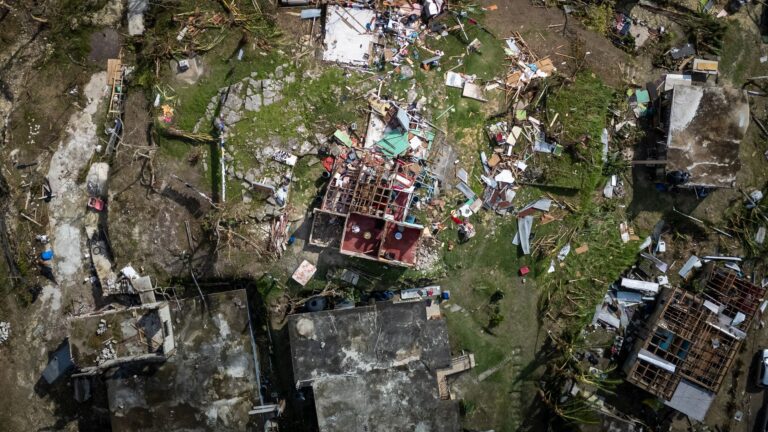
The whole north slope was gone. Not damaged. Gone. Bare decking showed through in a long strip maybe eighteen feet across, torn felt paper flapping at the edges, and when I went back inside and up to the spare bedroom I could see a dark stain already spreading across the ceiling where the rain had gotten in overnight.
I stood in that spare bedroom and cried for a minute, not for the roof exactly, but because Harold wasn’t there to see it and know what to do about it, the way he’d known what to do about everything for forty six years.
Then I called Heartland Assurance, because that is what you do, and because Harold and I had paid that company a premium every single month since 1988 without ever once filing a claim. We used to joke about it. Harold would say we were the best customer they had and the worst customer they had at the same time, because we paid every month and never asked for a thing back.
I figured that history counted for something. I want to be honest that I believed that, all the way up until the day it didn’t.
*The wait*
Heartland scheduled an adjuster to come look at the damage, but not for nine days. Nine days of a tarp I paid a neighbor’s grandson forty dollars to help me stretch and staple over the bare decking, nine days of listening to it snap in every gust of wind, nine days of checking the spare bedroom ceiling every morning to see if the water stain had grown.
Those nine days were harder than I let on to anyone, even Arlene when she called to check on me. I am not a woman who likes to be a bother, and I had spent forty six years being half of a couple that solved its own problems, so it did not come naturally to admit how much it frightened me to lie awake at two in the morning listening to a plastic tarp fight a Nebraska wind. Twice I got up in the dark, put on Harold’s old barn coat over my nightgown, and went out with a flashlight to check the cinder blocks weighting down the edges, because in my head I kept picturing the whole thing peeling loose in the middle of the night and the rain finally getting in for real. Scout would follow me out both times, staying close against my leg the way he never used to before Harold died, like he had appointed himself the one who kept watch now.
I called my daughter Karen in Omaha and told her it was nothing, just a little roof damage, the insurance would handle it. I did not want her driving three hours on a work week over a tarp. I have thought since about how many of us do that, tell our children it is nothing so they will not worry, and end up facing the actual thing alone because of it.
In the meantime I called a roofing contractor out of North Platte, a company called Vandermeer Roofing that had done work for half the county at one time or another and had a good name for it. A man named Doug came out, walked the whole roof, took photographs, and gave me a written estimate. Full tear off of both slopes, since the south side was original from 2009 and would need to be matched anyway for the insurance to make sense on a whole-roof claim, new felt underlayment, new flashing around the chimney and both vent stacks, new ridge cap. Nineteen thousand dollars, in writing, itemized down to the pound of nails.
I put that estimate in a folder on the kitchen table and waited for Heartland’s adjuster to come confirm it, because that is how I understood insurance was supposed to work. You pay in. Something happens. They make it right.
*The offer*
The adjuster’s name was Bradley Voss. He pulled into my driveway on a Wednesday morning in a white pickup with the Heartland Assurance logo on the door, wearing a green polo shirt with the same logo stitched over his heart, carrying a clipboard and a tape measure and a phone he checked twice while he was still getting out of the truck.
He was younger than I expected, maybe thirty five, with the kind of easy, practiced friendliness that I have learned, since, to be suspicious of. He shook my hand, told me he was sorry about the storm, and then spent about eleven minutes on my roof. I know it was eleven minutes because I looked at the clock when he climbed the ladder and looked at it again when he climbed back down.
Get a new story in your inbox every morning.
Facebook doesn’t show you every story we post. Our free newsletter does. Join 2,500+ readers.
I showed him Doug’s estimate from Vandermeer Roofing while we stood in the driveway. Nineteen thousand dollars, itemized, in writing.
He barely glanced at it. He tapped something into a tablet, turned it around to show me a number, and said, “Based on our assessment and the depreciated value of the existing materials, we can authorize four thousand dollars.”
I asked him how four thousand dollars was supposed to cover a nineteen thousand dollar roof. He said the depreciation schedule accounted for the age of the shingles, that Heartland only paid actual cash value on a policy like mine rather than full replacement cost, and that four thousand was, in his words, “a fair number for a roof that’s had fifteen years of life out of it already.”
I told him the roof was not fifteen years old on both slopes, that the north slope Harold rebuilt in 2009 was the part that failed, and that the south slope was original from 1981 and needed replacing anyway if they were going to match materials. He said that was not really relevant to the depreciation calculation and that four thousand was the number.
I told him I could not fix a roof for four thousand dollars. I told him I had a written estimate for nineteen thousand sitting right there in his hand.
He looked at me for a second, and something in his face changed, the friendly part sliding off like it had never really been there at all, and he said the sentence that I have not been able to stop hearing since.
“Ma’am, I can write you a check for four thousand today. Or you can hire a lawyer and fight us for two years. Take it or spend two years fighting us, your choice, ma’am.”
He said it flat. Almost bored. Like a man reading a line he had read a hundred times before to a hundred other people standing exactly where I was standing.
I am sixty eight years old. I had buried my husband two years earlier. I did not have two years of fight left in me, or at least I did not think I did, standing in that driveway with a tarp snapping over my head and a stranger telling me my choice was four thousand dollars now or nothing for two years.
I very nearly told him to write the check.
*Raymond*
What I did not know, standing in that driveway, was that my neighbor across the road, Raymond Higgins, had his front window open.
Raymond is seventy four. He is a widower too, his wife Dorothy passed six years ago, and he lives alone in the brick house directly across County Road 14 from mine, close enough that on a still morning you can hear a truck door slam in either driveway from the other one. He keeps an office in that front room, a habit left over from a career he only half retired from, and that window was open because it was the first truly warm morning of the spring and he liked the air.
Raymond spent thirty years as an attorney representing policyholders against insurance companies. Not big class action work, mostly, but real people, mostly older people, mostly in small towns across three counties, who had been offered far less than their policies actually owed them after a fire or a hailstorm or a roof exactly like mine. He knew the industry from the inside, because before he switched sides in his forties, he had spent his first eight years out of law school defending companies like Heartland, learning exactly how the adjusters were trained to talk, exactly which phrases were meant to sound official and exactly which ones were meant to make a frightened person feel like fighting back was hopeless.
He told me later that he heard the whole exchange, word for word, from his desk. He heard Bradley say four thousand dollars. He heard me say nineteen thousand. And he heard, clear as anything, “take it or spend two years fighting us, your choice, ma’am.”
He did not come outside while Bradley was still in my driveway. He told me afterward he almost did, that he had to sit with his hands flat on his desk for a minute to keep himself from marching across the road in his slippers and saying something he’d regret the wording of later. Instead he waited until Bradley’s truck pulled out onto County Road 14 and disappeared toward town.
Then he walked across, in his slippers, and knocked on my door.
“Linda,” he said, when I opened it, “I need you to not sign anything that man leaves with you. Not yet. Can we sit down for a few minutes?”
*What Raymond knew*
We sat at my kitchen table, the same table where Doug’s nineteen thousand dollar estimate was still sitting in its folder, and Raymond asked to see everything. The estimate. My policy. The notes I’d scribbled on the back of an envelope while Bradley talked.
He read through my policy slowly, the way I imagine he used to read contracts for a living, and he explained things to me that Bradley had never once explained, not because they were complicated, but because explaining them clearly would not have gotten Heartland to a four thousand dollar number.
My policy, Raymond showed me, had an endorsement, purchased years earlier and paid for every month since, for full replacement cost coverage on the roof specifically, not actual cash value. Harold had added it in 2010, the year after he redid the roof himself, because he’d wanted to make sure that if anything ever happened to it again, we would not be stuck paying depreciated value out of pocket for a job he’d done right the first time. I remembered him mentioning it at the time. I had forgotten, in the years since, that it was even there.
Bradley had quoted me actual cash value pricing on a policy that specifically, by its own language, entitled me to full replacement cost. Raymond said that was either an honest mistake, which happened sometimes with adjusters juggling too many files, or it was not a mistake at all.
“In my experience,” he told me, “when the same kind of mistake always happens to fall in the company’s favor, it stops being a coincidence.”
He also explained the phrase Bradley had used, “take it or spend two years fighting us.” He said it was a version of a line he had heard, almost word for word, dozens of times over thirty years of practice, always aimed at people the adjuster believed would not push back. Older policyholders. Widows and widowers. People living alone, tired, grieving, without a lawyer in the family and without the energy for a fight they’d been told up front would take two years to win.
“It works,” Raymond said, “because most people believe it. And because most people, understandably, don’t have two years of fight in them after they’ve just lost a spouse and half their roof in the same season.”
I asked him if I had two years of fight in me. He said that was the wrong question.
“The question,” he said, “is whether Bradley Voss has two years of fight in him. Because in my experience, men who say that sentence for a living are usually counting on nobody ever finding out how little fight is actually behind it.”
*Building the file*
Over the next three weeks, Raymond helped me build what he called a proper claim file, something I would never have known how to put together on my own. Photographs of the damage from every angle, dated. Doug’s estimate from Vandermeer Roofing, itemized. The specific policy language on the replacement cost endorsement, highlighted and copied. A written timeline of every call, every visit, every number Bradley had given me, with dates and times.
Raymond drafted a letter, not to Bradley directly, but to Heartland’s regional claims office, laying out the discrepancy between the depreciated offer and the policy’s actual language, and requesting a formal re-inspection with a licensed public adjuster present. He signed it as a courtesy consultant, not as my attorney, because he told me plainly he was retired and did not want to charge me a dollar for helping a neighbor across the road do something she had every right to do herself.
“I’m not doing anything you couldn’t learn to do,” he told me. “I’m just doing it faster because I’ve seen the pattern before.”
He was right that the pattern kept showing up. Because it was during those same three weeks, while Raymond and I were putting the file together at my kitchen table, that I found out I was not the only one on County Road 14, or even in Prairie Bend, who had heard that sentence.
I want to say plainly that finding this out did not feel like a victory at the time. It felt sick, honestly, the way it feels to learn that something you thought was bad luck was actually a pattern aimed on purpose. I remember sitting at my own kitchen table after the call with Arlene, staring at the folder with Doug’s estimate in it, and feeling less like a woman fighting for her roof and more like one piece of a much bigger, much colder machine that had been running quietly through this county for longer than any of us knew.
*Arlene, and then the others*
It started with Arlene Fitch, who lives two miles down the road and who I have known since our kids were in 4-H together thirty years ago. I mentioned to her at the grocery store, almost in passing, what had happened with the roof and the adjuster and the number he’d offered me, and I watched her face go very still.
“Take it or fight us for two years,” she said, before I’d even finished the sentence. “Your choice, ma’am.”
Arlene had heard the exact same words, from the exact same man, the previous October, after a hailstorm had taken out her siding. She had taken the four thousand dollars Bradley offered her, against a repair that had ended up costing her son in law nearly eleven thousand dollars out of his own pocket, because she had not had anyone across the road with an open window and thirty years of claims experience to tell her otherwise.
Once I knew to ask, I found two more. Otis Grable, eighty one, whose barn roof Bradley had lowballed the year before at three thousand against a real cost closer to fourteen. And Ruth Deming, a widow like me, out past the grain elevator, who had been offered thirty five hundred dollars on wind damage that her contractor said would run twelve thousand, and who had, like Arlene, simply taken the check because she did not think she had it in her to argue with a man holding a clipboard and a company logo.
Ruth Deming’s story was the one that stayed with me longest. She told it to me sitting on my own porch, holding a glass of iced tea she never drank, twisting her wedding ring the whole time she talked. Her husband Carl had died the winter before mine did, and the wind damage on her place had happened not four months into her being alone in that house, in the exact season when she said she felt least like herself, least able to argue with anybody about anything. She told Bradley, she remembered, that thirty five hundred dollars did not sound right. She remembered him sighing, actually sighing, into the phone, before he said the sentence, and she remembered signing the release the next morning at her kitchen table because she could not think of one more thing to say back to him.
“I kept thinking, what would Carl have said,” she told me. “And then I thought, Carl’s not here to say it, so I guess nobody is.”
That is the sentence of hers I have not been able to stop thinking about since. Carl’s not here to say it, so I guess nobody is. I understood exactly what she meant, because I had thought some version of the same thing standing in my own driveway with Bradley’s clipboard in front of me.
Four of us. All of us over sixty five. Three of us widows. All of us told, in some version of the same flat, bored voice, that our choice was a lowball number today or two years of fighting a company none of us had the energy to fight.
Raymond listened to all of it at my kitchen table with his jaw set in a way I had not seen from him before. He said the pattern was not a coincidence anymore. He said it had a name in the industry, an informal one, but a real one: targeting claimants an adjuster believes are unlikely to push back, and pricing accordingly.
“He’s not choosing numbers based on the damage,” Raymond said. “He’s choosing numbers based on who he thinks won’t argue with him. And for a long time, he’s been right.”
*The meeting*
Raymond’s letter to Heartland’s regional claims office got a response within a week, which he told me was itself telling, since claims like this usually take a month or more to even acknowledge. They scheduled a meeting at the regional office in Grand Island, an hour and a half away, with Bradley’s supervisor, a claims manager named Deborah Ostrander.
Raymond came with me. So did Arlene, and Otis’s daughter on his behalf since his hip made the drive hard on him, and Ruth Deming, who drove herself in a truck that still had her late husband’s fishing decals on the back window.
We sat around a long conference table with our folders in front of us, four claims, four dates, four almost identical numbers, and one sentence that four different people in that room had heard from the same man’s mouth in the same flat, bored voice.
Bradley was there too, called in by Deborah Ostrander to answer for the files, and I watched something happen to his face over the course of that meeting that I will remember for a long time. It started confident, almost annoyed at being pulled into a room over what he clearly still saw as ordinary claims disputes. It ended somewhere else entirely.
Raymond laid it out plainly, one file at a time. My roof, with the replacement cost endorsement Bradley had never mentioned. Arlene’s siding. Otis’s barn. Ruth’s wind damage. Four claims, four lowball numbers, and the exact same sentence attached to every single one of them, which Raymond had written out, word for word, four times, in four different columns on a single page, and slid across the table.
“Take it or spend two years fighting us, your choice, ma’am,” Raymond read aloud. “Mr. Voss, would you like to tell Ms. Ostrander how many times you’ve said that sentence, and to how many people, and whether it has ever once been true?”
Bradley did not have an answer. He said something about standard settlement language, about depreciation being company policy, about not remembering the specific conversations well enough to comment. Otis’s daughter, a quiet woman named Peggy who had not said a word through most of the meeting, finally spoke up and asked him directly whether he remembered telling her eighty one year old father, a man who had farmed that same ground his whole life, that he could fight the company for two years or take three thousand dollars for a barn roof that cost fourteen thousand to replace. Bradley looked at his own folder instead of at her when he answered that he could not recall the specifics of every claim he processed.
“You remembered it well enough to say it word for word four separate times,” Raymond said, quiet, not raising his voice at all, which somehow landed harder than if he had.
But Deborah Ostrander was reading through the four files while he talked, and I watched her stop on the page with my policy’s replacement cost endorsement highlighted in yellow, the one Bradley’s own initial assessment had never once mentioned.
“This endorsement was active on the date of loss,” she said, not really to Bradley, more like she was confirming it to herself. “This should have been quoted at replacement cost from the first estimate.”
She asked Bradley, directly, whether he had reviewed the full policy or only run a standard depreciation calculation. He said he ran it the way he ran most claims, which was, Raymond told me afterward, exactly the wrong answer to give in a room where three other elderly claimants were sitting with nearly identical stories.
*What happened after*
Heartland re-inspected all four claims within two weeks, this time with a senior adjuster and, in my case, the public adjuster Raymond had insisted on having present. My claim was recalculated at full replacement cost under the endorsement Harold had bought fifteen years earlier without either of us fully understanding, at the time, how much it would matter. The final settlement came to eighteen thousand six hundred dollars, close enough to Doug’s original estimate that Vandermeer Roofing was able to do the full job, both slopes, matched materials, exactly as it should have been done from the start.
Arlene’s siding claim was reopened and settled for an additional sixty two hundred dollars on top of what she’d already received, which did not cover everything her son in law had spent out of pocket the year before, but came close, and came with a formal letter of apology from the company that Arlene keeps folded in her Bible to this day. Otis and Ruth’s claims were similarly recalculated, both coming in several thousand dollars higher than the original lowball numbers.
Bradley Voss no longer works for Heartland Assurance. I do not know the exact circumstances of his departure, and Deborah Ostrander was careful, appropriately careful, not to discuss personnel matters with any of us. What I do know is that within a month of that meeting in Grand Island, Heartland’s regional office sent a written notice to every policyholder whose claim Bradley had handled in the previous two years, inviting them to request a free re-review of their settlement. Raymond told me that alone was as close to an admission as a company like that would ever put on paper.
*The roof, and the porch*
Doug’s crew from Vandermeer Roofing finished my roof in the first week of June. Both slopes, matched shingles, new flashing, a ridge cap that will, if it holds up the way Harold’s original work did, outlive me the way he said it would back in 2009.
I sat in Harold’s recliner, pulled out onto the front porch for the occasion, and watched them work, the same way I watched Harold and his brother work in 1981, handing up nails from a coffee can. I did not have a coffee can this time. I had a pitcher of sweet tea, and Raymond sitting beside me in the porch swing Harold built, and we talked for most of two days while my roof came back together over our heads.
Raymond and I have become close since that spring, in the plain, easy way that neighbors become close when one of them shows up at the exact moment the other needs someone to. He still keeps his office window open on warm mornings. I tell him, sometimes, only half joking, that I am glad he does.
*What I think about now*
I think about how close I came to signing that four thousand dollar check right there in the driveway, tired and grieving and certain I did not have two years of fight left in me. I think about Arlene, who did sign, and who paid the difference out of a family already stretched thin, because there was no window open across her road that day.
I think about how many widows, in how many small towns along how many county roads, are hearing that same flat, bored sentence right now, from Bradley Voss or from someone exactly like him, and signing because they believe, the way I nearly believed, that the fight in front of them is bigger than the fight they have left.
My roof is whole again. It is, if anything, a better roof than the one the storm took, built the way it should have been built the first time, on Harold’s endorsement that he thought to buy fifteen years ago and that neither of us ever expected to need.
But what I think about most, when people ask me about that spring, is not the shingles. It is Raymond walking across County Road 14 in his slippers, and the sentence he read back to Bradley Voss across a conference table in Grand Island, in a voice that was calm and even and absolutely certain.
Take it or spend two years fighting us, your choice, ma’am.
It turned out Bradley did not have two years of fight in him at all. He had eleven minutes on a ladder and one sentence he’d said so many times he’d stopped hearing how cruel it was. And it took a seventy four year old man with his window open on a warm morning to make sure, once and for all, that somebody finally heard it back.