The Pool The HOA Said I Couldn’t Have
My name is Rebecca. I am forty-four years old, I live in a subdivision outside Marietta, Georgia called Ashford Chase, and for about four months last year I thought the hardest part of my life was already behind me. I was wrong about that, but I want to start further back, because if you do not understand what my husband survived, you will not understand what it cost me to sit at my own kitchen table and read a one-paragraph letter telling him no.
Mark and I met when I was twenty-six, at a wedding of all places, both of us standing near the same drinks table pretending we knew people we did not know. He was already in the Army by then, National Guard, and he had that particular calm some soldiers have, the kind that is not the absence of feeling but the management of it. We married two years later in my parents’ backyard in Kennesaw. He deployed twice. The first tour was hard the way all of it is hard, long silences on the phone, a version of my husband who came home a little more guarded than the one who left. The second tour is the one that changed the shape of our whole life.
I will not walk through every detail of that day, because Mark does not like it retold in full and I respect that. What I will say is that his vehicle struck an IED outside a town whose name I still cannot pronounce correctly, that two men in that vehicle did not come home to their own kitchen tables, and that Mark did, but not the way he left. The blast shattered his left hip, cracked two vertebrae in his lower back, and did enough nerve damage that on his best days he crosses a room using forearm crutches, slow and deliberate, and on his worst days he cannot get from our bed to the bathroom eight feet away without holding onto my shoulder. He was thirty-one when it happened. He is forty-six now. Fifteen years is a long time to live inside a body that renegotiates its terms with you every single morning before you even know what kind of day it is going to be.
I tell people Mark came home and I did not lose my husband, because I did not, not the way some wives do, and I am grateful for that every day of my life. But I want to be honest about what those fifteen years have actually looked like, because it matters for what happened later. There were two years of surgeries. There was a period where he could not work at all, and a longer period after that where he worked from a chair in our home office doing contract logistics consulting, good at it, proud of the paycheck, exhausted by five in the afternoon in a way that has nothing to do with laziness and everything to do with a body running on backup systems. There was a wheelchair for the bad stretches and crutches for the better ones and a cane he truly hates for days in between. And there was, always, physical therapy, because physical therapy is not something you finish. It is something you maintain, like a levee.
For the last several years that maintenance has meant water. Mark’s physical therapist at the VA, a patient, plainspoken woman who has worked with him longer than almost anyone outside our family, explained it to me once in terms I have never forgotten. On land, gravity is fighting Mark every single step. In water, warm water, chest deep, gravity mostly lets go, and Mark can move his hip and his spine through ranges of motion that would otherwise cause him real pain, can build the small stabilizing muscles back up slowly, without a single hard impact on the joints the blast already ruined. Aquatic therapy is not a luxury for a body like his. It is closer to medicine.
The problem was access. The VA pool nearest us is a forty-minute drive each way, more in traffic, and it is only open for supervised aquatic sessions three mornings a week, mornings that do not always line up with Mark’s pain levels or his work calls or my own job managing billing for a pediatric dental practice. We paid out of pocket for a private aquatic therapy clinic for a while, and the co-pay there, even with insurance, ran us close to sixty dollars a session. Do that three times a week for a year and you understand why, when Mark’s physical therapist sat us down in February and said the words “have you ever thought about a small therapy pool at home,” both of us went quiet for a different reason than you might expect. We went quiet because we had thought about it, for years, and always assumed it was out of reach.
It was not, actually, as far out of reach as we thought. A twelve-by-twenty-four therapy pool, the compact kind built for exercise and rehabilitation rather than diving and parties, with a variable current system so Mark could walk against resistance, came in at just under twenty thousand dollars installed, with a cover and a small heater to keep the water at the temperature his joints needed. It was not nothing. It was close to every dollar we had managed to set aside since his second deployment. But it was ours to spend, and Mark’s physical therapist wrote us a formal letter explaining the medical necessity in language a building committee could understand, and our contractor, a good, steady man who has done work for half of Ashford Chase over the years, drew up a full site plan showing exactly where it would sit.
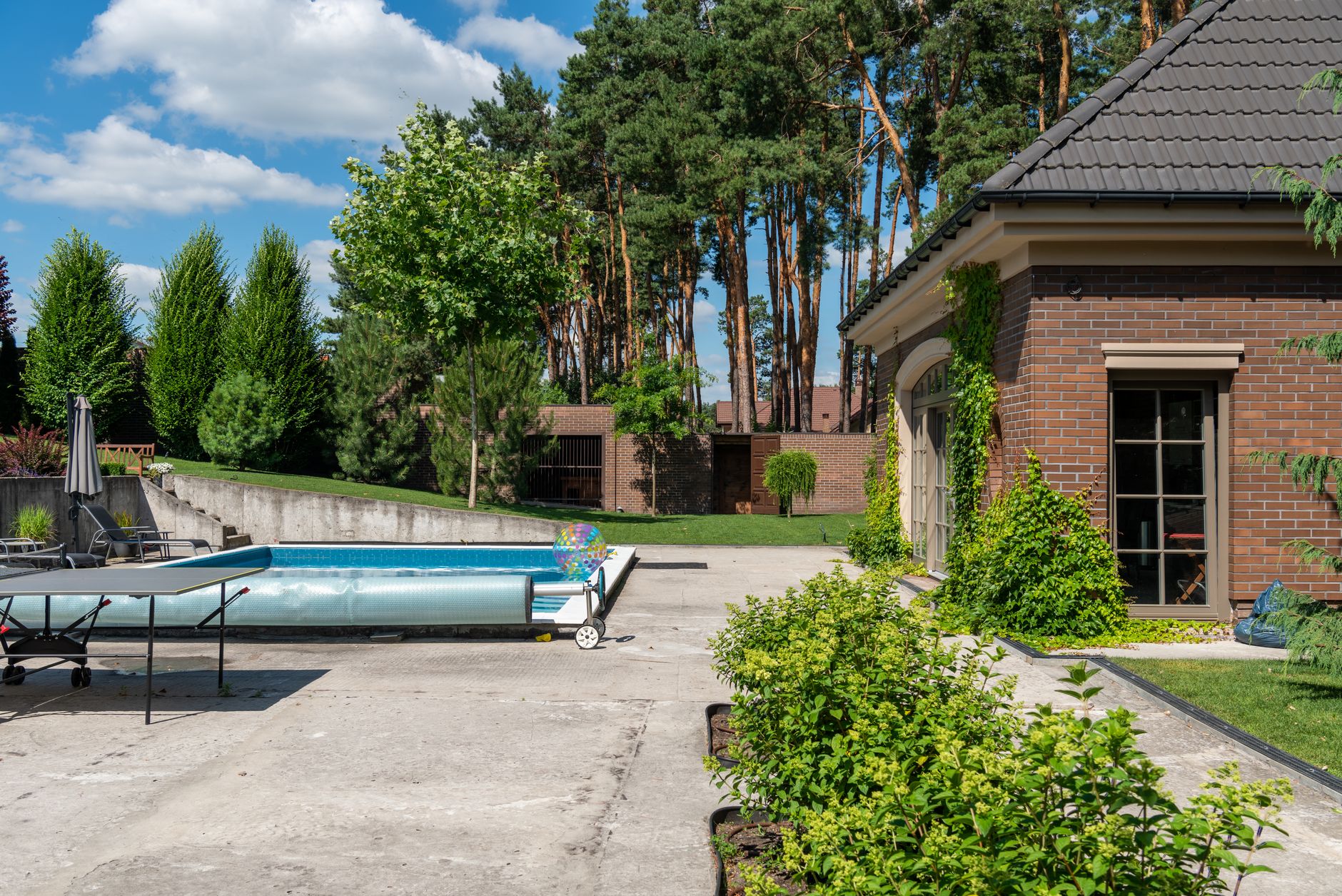
Where it would sit mattered more than almost anything else in this story, so I want you to picture our yard the way I pictured it while we were planning this. Our house backs up to a six-foot cedar privacy fence Mark built himself the summer before his second deployment, back when his back could still do that kind of work. The pool would sit entirely inside that fence line, tucked against the side yard, invisible from the street, invisible from the sidewalk, visible only from our own back porch and from directly above, which nobody in Ashford Chase is. We were not asking to change the character of the neighborhood. We were asking to put a piece of my husband’s medical care somewhere no one but us would ever have to look at it.
We filed the application with the Ashford Chase Homeowners Association architectural review committee on the fourteenth of March. The packet was thorough because I made it thorough, because I have spent enough years dealing with insurance denials to know that a thin file gives a bureaucrat somewhere permission to say no. Contractor’s license and insurance certificate. Full site plan with setbacks measured and labeled. The physical therapist’s letter on VA letterhead. A cover page I wrote myself explaining, plainly, that this was a medical accommodation for a combat-injured veteran, not a recreational addition.
The committee chair, and the president of our entire homeowners association, is a man named Steven. I want to describe him fairly, because it would be easy to make him a cartoon and he is not one, he is a person, which somehow makes what he did worse rather than better. Steven is in his mid-fifties, retired early from something in commercial real estate, and he has run Ashford Chase’s HOA for going on four years with the particular energy of a man who found, later in life than most, a kingdom exactly his own size. He drives around the neighborhood slowly in a clean black SUV. He knows the paint code for every approved shutter color. He had already had one prior run-in with Mark, a year earlier, over Mark’s adapted van, which has a small lift on the back and had to be parked in our driveway rather than the garage on physical therapy mornings because of the equipment inside it. Steven sent a letter about that too, about “commercial-appearing vehicles,” before backing down once I explained, in writing, exactly what the vehicle was and why. I did not think much of it at the time. I think about it constantly now.
Six weeks passed. Six weeks of nothing, no acknowledgment beyond an automated email confirming receipt, while Mark kept driving forty minutes each way to a pool that was not always available when his body actually needed it. On the twenty-ninth of April, the letter came. One paragraph, Association letterhead, Steven’s signature at the bottom in blue ink like he had personally taken a pen to something that mattered that much to sign it by hand. It cited Article 9, Section 3 of the Ashford Chase covenants, the “aesthetic guidelines” governing exterior improvements, and it stated that the proposed pool structure did not conform to “the uniform character of the community” and was denied. It suggested, and I am quoting this from memory because I have read that sentence more times than I can count, that “alternative arrangements for physical therapy needs may be more appropriate given the residential nature of the neighborhood.”
I read that sentence standing at my own kitchen counter and I felt something in my chest that I can only describe as a very quiet, very total kind of fury. Not loud. Not the kind that makes you raise your voice. The kind that just sits down across the table from you and stays.
Mark took it harder than he let on, in the way he takes most things harder than he lets on. He did not rage about it. He got quiet for two days, and on the second night I found him sitting on the edge of our bed with his crutches leaned against the wall, looking at his own hip like it was something that had betrayed him personally rather than something a stranger’s bomb had broken on the other side of the world. He said, “I fought for this country and I can’t get a pool behind my own fence to fix what it cost me,” and then he asked me not to make a thing out of it, because he did not want to be the disabled veteran making a scene about a pool. That request, more than anything Steven ever wrote, is what made me decide to fight. My husband has spent fifteen years being careful not to be a burden, not to be dramatic, not to ask for more than he has to. I was not going to let him swallow this one too.
I called the HOA’s management office and asked, politely, for an explanation beyond the letter. I was told the committee’s decision was final and that appeals could be submitted in writing for consideration at the next quarterly meeting, three months away. Three months. His physical therapist told us plainly that three months of Mark going without consistent aquatic therapy access was not a small delay, it was a real setback, the kind that shows up in strength measurements and pain scales, not just paperwork.
I want to tell you exactly how I found out about the other pool, because I have replayed that moment more than any other in this whole story. It was a Saturday morning in late May, three weeks after our denial letter, and I was walking our dog past the house two doors down, which had sold the previous fall to a couple I did not know well, a family who had moved down from Charlotte, the husband something senior in finance, the kind of family whose landscaping crew shows up in a fleet of matching trucks. There was a survey crew in their backyard, orange stakes marking out an area that, even walking past at a glance, looked considerably larger than a twelve-by-twenty-four therapy pool. I did not think much of it that morning. Pools are not unusual in Ashford Chase. I thought about it a great deal more by the middle of June, when the excavation started and I could see, from the sidewalk, without even trying to look, a hole in the ground the size of a small pond, with grading marked for what would clearly become a raised spa, a waterfall feature, and a separate poured pad for what turned out to be an outdoor kitchen with a built-in pizza oven.
I am not proud of how many evenings I spent, over the following weeks, quietly doing math I had no real right to do. Public permit records in our county, which anyone can look up, listed the estimated project value on that pool at a hundred and forty-five thousand dollars. Ours had been twenty thousand. Theirs was visible from the street. Ours would have been invisible behind a fence Mark built with his own hands before a bomb took the strength to build anything that way again.
I did what I think most people would do. I called Steven directly. I kept my voice level, because I had learned by then that Steven responded to composure with more of his own smooth, unbothered composure, and I was not going to hand him the satisfaction of an angry veteran’s wife. I asked him how a hundred-and-forty-five-thousand-dollar pool, complete with a waterfall and an outdoor kitchen, fully visible from the road, had cleared architectural review in what public county permit filings showed as eleven days, when Mark’s fence-hidden therapy pool had taken six weeks and been denied outright for violating the community’s aesthetic character.
Steven’s answer, and I remember it word for word, was that “every application is evaluated on its own individual merits, Rebecca, and I’m not able to discuss another homeowner’s private file with you.” He said it the way you would explain something to a child who had asked why the sky is blue, patient, a little tired, entirely unmoved. I asked whether the committee had a written standard defining what did or did not conform to “uniform community character,” since a waterfall and a pizza oven seemed, on their face, to be a considerably larger departure from uniform character than a small pool hidden behind six feet of cedar fencing. He told me the guidelines allowed for committee discretion and that he trusted the committee’s judgment, which, I would later learn, was very nearly a joke, because by that point the committee’s judgment on most matters had narrowed down to whatever Steven personally decided over morning coffee.
I would like to tell you I had some brilliant plan at that point. I did not. What I had was a folder full of denied paperwork, a husband trying very hard not to let me see how much this had gotten to him, and a growing, quiet certainty that something in that six-week versus eleven-day gap did not have an innocent explanation. What I did not have, yet, was proof, or standing, or any real way to get either one, because homeowners associations are designed, whether by accident or on purpose, to make an ordinary resident’s complaint disappear into a management office’s inbox.
What changed everything was a phone call I did not make. It came from a man named Kevin, who lives four houses down from us and has served on the Ashford Chase HOA board for going on two years, elected on a mild platform of wanting the newsletter to actually get sent out on time. Kevin is an engineer by trade, retired from a career doing structural inspections for a state transportation department, a careful, methodical man who reads documents the way some people read novels, all the way through, twice. He called me on a Tuesday evening in June and said he had heard, through his wife, who is friendly with mine at church, about the pool situation, and he wanted to ask me a few questions, off the record, before he decided whether it was worth raising formally.
I told him everything. The denial letter. The six weeks. The eleven days two doors down. The hundred and forty-five thousand dollars. The physical therapist’s letter that Steven’s committee had apparently not weighed as heavily as an outdoor pizza oven’s compliance with community aesthetics. Kevin listened without interrupting, the way careful people do, and when I finished he was quiet for a moment and then said something I will remember for the rest of my life. He said, “Rebecca, I’ve had a feeling about how Steven runs that committee for about a year now, and I never had a clean enough reason to say something out loud. I think you might have just handed me one.”
Kevin explained that he had noticed, in a general and unfocused way, that certain applications seemed to move through the architectural review committee remarkably fast, always the same handful of homeowners, always with minimal documentation on file, while other applications, from homeowners with less social standing in the neighborhood’s informal hierarchy, sat for weeks and came back denied or heavily modified over comparatively minor issues. He had never had a concrete enough example to build a case around. A twenty-thousand-dollar medically necessary therapy pool for a disabled combat veteran, denied in six weeks for aesthetic reasons, against a hundred-and-forty-five-thousand-dollar recreational pool approved in eleven days for a new homeowner Steven had been seen playing golf with twice that spring, was about as concrete as it gets.
Kevin did not go around Steven, and he did not go around the board’s own process either, which I respected, because it meant that whatever came of this would hold up to Steven’s own standards rather than looking like a personal vendetta. At the next regularly scheduled board meeting, on the second Thursday of July, held in the clubhouse’s small meeting room with its bad fluorescent lighting and its usual crowd of maybe seven residents, Kevin stood up during new business and made a formal motion. He proposed that the board retain an independent, outside records auditor, someone with no personal or social connection to any homeowner or board member in Ashford Chase, to conduct a full review of every architectural modification application the committee had processed over the preceding eighteen months. Approvals and denials both. Timelines from submission to decision. Documentation required of each applicant. He framed it, carefully, as a matter of good governance and liability protection for the association as a whole, not as an accusation against any one person, though everyone in that room understood exactly what he was really asking.
Steven, to his credit or his very great discredit depending on how you look at it, did not try to talk the motion to death or bury it in a committee of his own. He simply argued against it directly, said it was an unnecessary expense, said the committee’s judgment had served the community well for years, said he did not appreciate the implication that anything improper had occurred. Then the board voted. Kevin voted yes. Two other board members, both of whom I later learned had their own quiet frustrations with how Steven ran things, voted yes as well. Steven voted no, on the review of his own committee’s conduct, which is a thing I still find almost funny in a bleak sort of way. The motion passed four to one.
The auditor the board retained was a certified community association manager from outside our county with no ties to Ashford Chase at all, hired specifically because she had never met a single one of us. She spent three weeks going through eighteen months of architectural committee records: applications, supporting documentation, internal email correspondence, meeting minutes, and the county’s own public permit filings cross-referenced against every one of them. I did not see her report before the board did. None of us did. But I sat in that clubhouse meeting room on the last Thursday of July, packed for the first time in Ashford Chase history, every folding chair full and residents standing along the back wall because word had gotten around that something real was about to happen, and I watched the auditor stand at a small podium and read her findings out loud, plainly, without editorializing, letting the timeline speak for itself.
What she found was this. Over the eighteen months reviewed, the great majority of architectural applications, including several from homeowners with no particular social connection to Steven, had gone through the full committee process exactly as the covenants describe it: submission, a review period of two to four weeks, and a decision issued by the committee as a body, with meeting minutes reflecting some level of discussion. But a small number of applications, five in total, had bypassed that process almost entirely. They had been approved by Steven alone, through personal email correspondence, under a provision in the covenants meant for emergency repairs, roof damage, storm cleanup, structural safety issues requiring immediate action. The provision existed to let the president act quickly when waiting for a full committee meeting would put a homeowner’s property at real risk. Steven had used it, the auditor’s report showed, to approve a hot tub for one homeowner, a detached garage conversion for another, and the hundred-and-forty-five-thousand-dollar pool, waterfall, spa, and outdoor kitchen for our new neighbors, none of which involved anything resembling an emergency, all approved within days rather than weeks, all documented in email chains with a warmth and familiarity of tone that read nothing like official business.
Our own application, by contrast, the auditor’s report noted, was one of only three in the eighteen-month period that had been required to submit supplemental documentation beyond the standard packet, was one of only two that had been denied outright rather than approved with modifications, and was the only one in the entire eighteen months explicitly denied on aesthetic grounds despite being, per the submitted site plan, entirely non-visible from any public right of way. Her report used a phrase I will never forget, because it was so measured and so devastating at the same time. She wrote that the application from our own residence “does not appear, based on the documentation reviewed, to have been evaluated under the same standard applied to comparable applications processed during the same period.”
The room, when she read that sentence, went completely silent, and then it did not stay silent very long.
Kevin stood up and asked Steven, directly, in front of everyone, to explain the discrepancy between an eleven-day emergency approval for a discretionary luxury pool and a six-week denial for a documented medical accommodation. Steven’s composure, the smooth unbothered tone he had used with me on the phone in May, did not survive that room. He said the emergency provision was a matter of committee discretion. He said he had used his judgment. He said, and this is the part that undid whatever sympathy might have remained for him, that the new family’s project had come with “a completed, professional set of engineering drawings that made review simple,” as though a wealthier family’s ability to pay for glossier paperwork was itself a legitimate reason to fast-track their approval while a combat veteran’s signed physical therapist’s letter sat six weeks in a drawer.
A woman I did not know well, an older resident who has lived in Ashford Chase since it was built, stood up from the back wall and said, loud enough for the whole room to hear, that she had been denied a small ramp modification to her own front steps two years earlier, cited for the exact same aesthetic guideline language, and had simply given up and paid out of pocket to modify her interior instead, because she did not think she had any recourse. Another man stood and said something similar about a fence height variance. It was not pitchforks. Nobody raised their voice beyond that first moment. But it was, unmistakably, a room full of people quietly recalculating everything they had assumed about how fairly that committee had been treating them for years.
The board did not wait for the next quarterly meeting. Kevin made a motion, seconded immediately, to overturn the denial of our therapy pool application in full, to approve it retroactively under the standard the audit had shown was actually being applied to comparable projects, and to formally reprimand Steven, stripping him of unilateral emergency-approval authority going forward, requiring every future use of that provision to be ratified by the full board within seventy-two hours. All three motions passed, this time five to nothing, because even the board member who had occasionally sided with Steven on smaller matters was not willing to vote against a combat veteran’s pool in the same meeting a records audit had just read his own emails out loud.
Steven did not resign that night, though he stepped down as committee chair, and as HOA president entirely, six weeks later, citing personal reasons in a short letter that most of us understood well enough not to need translated. I do not know exactly what became of the neighbors with the resort pool. It is still there, waterfall and all, and I do not begrudge them the pool itself. I begrudge only the process that got it there faster and easier than my husband’s medically necessary one, and that process has since been fixed, which is the part that actually matters.
I want to tell you about the morning we finally broke ground, because it is the part of this whole story I think about the most now, more than the denial letter, more than the audit findings read out loud in that clubhouse. Our contractor’s crew showed up on a Saturday in early September to start excavation. I expected it to be the contractor’s men and Mark and me watching from the porch, the way I had pictured this project back in February when it was still just a plan on paper. Instead there were eleven of our neighbors in our backyard by eight that morning. Kevin was one of them, in work gloves, helping stake out the exact footprint from the site plan he had, by then, read as carefully as anyone. The older resident who had spoken up at the meeting was there with a cooler of water and sandwiches for the crew. The couple from three houses over whose son plays baseball with the boy across the street showed up with a wheelbarrow. The contractor’s men did the technical work, the excavation, the plumbing, the electrical, all the parts that require licenses and insurance and real skill. But the fence staining, the paver walkway from the back porch to the pool’s edge, the small ramp the contractor’s crew designed so Mark could get from the porch to the pool deck without a single step, all of that got built, over two Saturdays, by neighbors who had never spoken more than a wave to Mark before that summer, working alongside a man they now understood, in a way they had not before, had earned every bit of the help he was finally getting.
Mark cried on the second Saturday, quietly, standing at the edge of what would become his pool deck, watching a neighbor he had exchanged maybe ten words with in three years of living on the same street sand down a fence post with the same care he would have given his own. Mark does not cry easily. Fifteen years of learning to manage what a bomb took from him taught him to keep most of that locked down tight. But he stood there that Saturday and let it happen in front of people, and nobody looked away or made it uncomfortable for him, which I think, in the end, mattered to him almost as much as the water itself eventually would.
The pool was finished in October. Mark got in the water for the first time on a Tuesday afternoon, walking down the small ramp the contractor’s crew built into the design without either of us ever having to ask, and his physical therapist came out to our house herself that first week to watch him move through the resistance current, adjusting the settings, making the small clinical notes physical therapists make, and telling us both, plainly, that this was exactly the kind of consistent access she had been recommending for years and had never quite believed we would actually get. Mark does his sessions three mornings a week now, behind our own fence, on his own schedule, without the forty-minute drive or the sixty-dollar co-pay, and his physical therapist says his strength measurements this fall are the best they have been in three years.
I think about Steven sometimes, not with the hatred I might have expected to still be carrying, but with a kind of tired clarity. I do not think he woke up any morning of his four years as president deciding to be cruel to a disabled veteran specifically. I think he woke up every morning as a man who had found a small kingdom exactly his own size, and who had gotten comfortable enough inside it to stop asking himself whether he was applying his own rules evenly, because nobody with less social standing than him had ever had the means to prove that he was not. It took an engineer with a careful mind, an auditor with no stake in any of it, and a room full of neighbors willing to sit through an uncomfortable Thursday evening meeting to finally make him answer for it.
What I keep coming back to, more than the anger, more even than the relief, is the eleven people in my backyard on two Saturdays in September. Nobody organized that. Nobody put out a sign-up sheet. Kevin mentioned to a few people that the ground would be broken that weekend, and they simply came, because by then the whole neighborhood understood what that pool actually was, not a luxury, not an aesthetic violation, but a piece of medical equipment for a man who had already given more to this country than any of us could easily repay, and once they understood that, showing up with a wheelbarrow was not generosity. It was just what you do for your neighbor.
Mark swims now three mornings a week, and some evenings too when the pain is bad and he cannot sleep, and I sit on the back porch behind our own fence and watch him move through water that gravity has mostly let go of, in a pool that almost did not exist because one man decided, quietly and for a long time, that the rules applied differently depending on who was asking. They do not, not anymore, not in Ashford Chase, and I think that is worth almost as much to me as the water itself.
This story is a dramatization. Names, characters, and details are invented, and any resemblance to real people or events is coincidental.