The Mailbox They Replaced Without Asking
The first thing I saw when my husband turned onto Thistlewood Lane was the empty rectangle of bare dirt where a wooden post used to stand, and the second thing I saw was the mailbox that had replaced it: a flat black metal box on a straight metal pole, identical to eleven others now marching down our street like a row of filing cabinets somebody had set out for the trash.
I am forty six years old. My name is Emma, and I have lived on this street since I was ten, in the same house, behind the same mailbox, for thirty six years. Five weeks earlier I had slipped on our rain-slick back porch steps and shattered my hip in three places, and between the first surgery, the infection that followed it, the second surgery, and the rehab unit that came after that, I had not laid eyes on my own front yard in over a month. I came home from that hospital bed expecting a slow recovery and a quiet homecoming. I did not expect to sit in my husband’s car in our own driveway, unable to make myself go inside, because the one thing on this street that still looked like my father was gone, and in its place was a box that looked like every other box on every other street in America.
This is the story of what the HOA’s own compliance committee did to my house while I could not defend it, what its chairman, a man named Bruce, told me when I finally reached him by phone, and what I found three weeks later in a three ring binder that the HOA is required by its own bylaws to show any homeowner who asks. It is also the story of what my father’s oldest friend built in his workshop once this street found out, and what it finally took to make a board that had never once said the word “sorry” to me say it in front of forty of our neighbors.
***
My father built that mailbox the summer we moved onto Thistlewood Lane, thirty six years ago. I was ten years old, and I remember it in the particular, useless detail that only a child’s memory keeps: the smell of sawdust in our new garage before we had even unpacked the kitchen boxes, the transistor radio he kept tuned to a country station on a shelf above the workbench, the overturned five gallon bucket he set out for me to sit on so I could hand him screws and feel useful. He was not a man who talked about his feelings. He showed you what he felt about something by how carefully he built it.
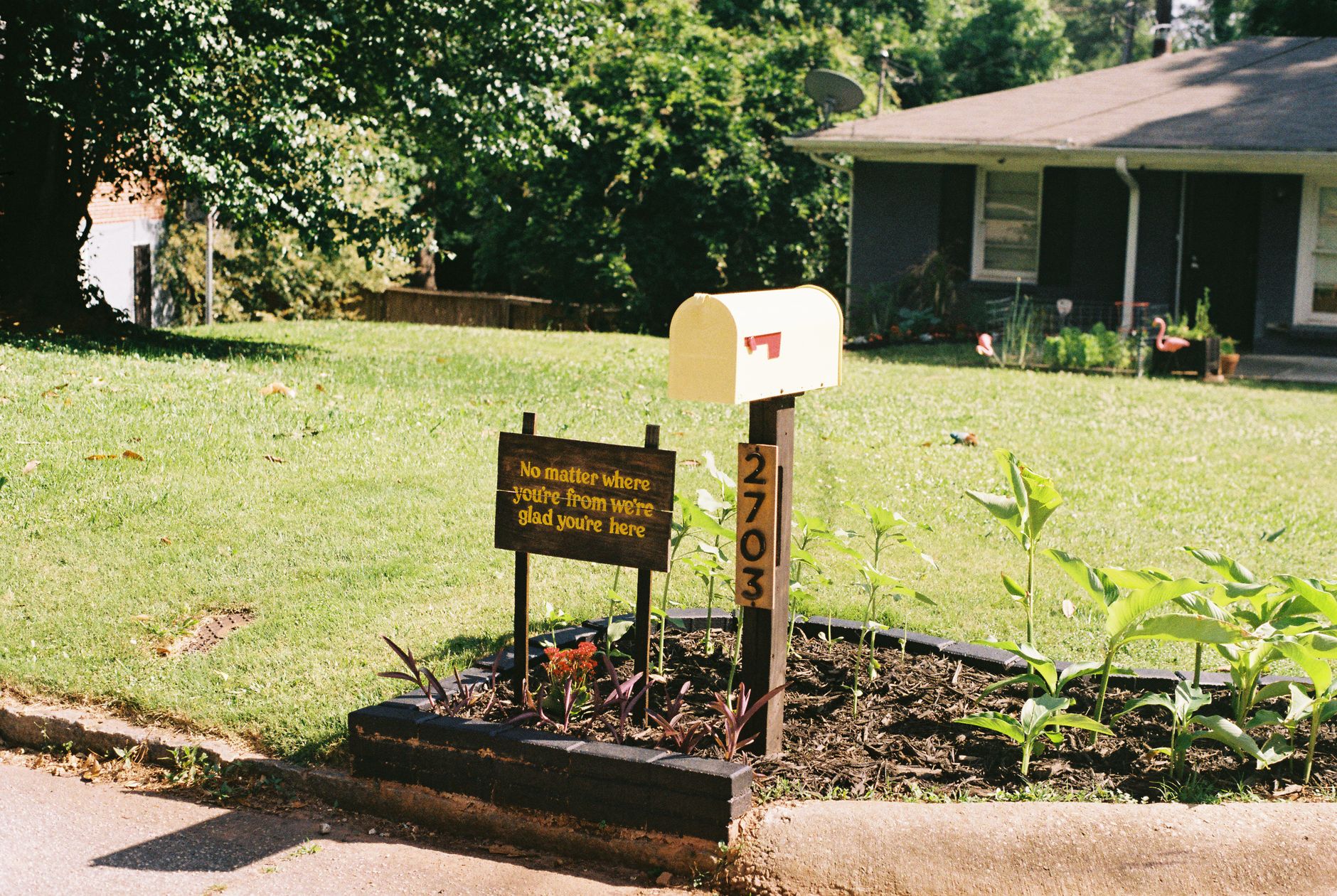
He built that mailbox post out of a single piece of cedar, thick enough that it never once wobbled in thirty six years of Indiana wind, and he capped it with a little carved chickadee, wings folded, head turned slightly, because he said chickadees were the only bird stubborn enough to stay through a whole Indiana winter instead of flying off somewhere easier, and he liked that about them more than he liked any of the showier birds that only showed up in June. He gave the mailbox itself a small tin roof, hand bent and soldered at the seams, so the mail would stay dry even in a sideways rain. He repainted the post barn red every three or four springs for the rest of his life, a particular shade he mixed himself because the hardware store’s closest match was, in his words, “too orange to be red and too red to be orange.”
That mailbox became a landmark on our street before I was out of middle school. New families who moved in years after us learned to give directions by it. “Turn left at the house with the little wooden bird.” A man two doors down, who has lived on this street even longer than we have, told me once that he set his own mailbox post at an angle specifically so it would not compete with the view of ours from the corner, which I did not understand until I was old enough to understand what it meant for a grown man to quietly defer to another man’s craftsmanship without ever saying so out loud.
The school bus driver who ran our route for eleven straight years used to slow down at our corner even on mornings when nobody was waiting, just to look at it, and told my mother once at a spring open house that she counted on that chickadee the way other drivers counted on a stop sign, an unofficial marker that told her exactly where she was on a route she drove in the dark half the year. A woman who has since moved away used to walk her dogs past our house every evening specifically because her route home felt incomplete without passing it, and she mailed me a card the week my father died just to say so, which surprised me at the time and does not surprise me anymore.
My father died seven years ago, at his workbench, with a birdhouse half sanded in front of him and the radio still playing. He was seventy four. It was fast, the doctors told us afterward, a heart attack that gave him no time to be frightened, which is the only mercy I have ever been able to find in it. I inherited the house not long after, once my mother, who had been gone herself for over a decade by then, was no longer in the picture to inherit it instead, and my husband and I moved in to raise our own kids in the same rooms I grew up in.
I kept the mailbox exactly as he built it. I found his particular red paint mix written on an index card in his handwriting, tucked into a coffee can of brushes on the garage shelf, and every three or four springs since he died, I have mixed that same color and repainted that post myself, using the same brush he kept for the job, because some habits are simply how you keep talking to somebody who cannot answer you back anymore. The chickadee on top had weathered to a soft gray over the years, its carved wing edges rounded by decades of rain, and I loved it more for the weathering, not less.
The fall itself happened on an ordinary Sunday evening, the kind of thing you replay afterward looking for a warning sign that was never actually there. It had rained most of the afternoon, and I went out to bring in a flowerpot before the wind knocked it over, and my foot caught the second step from the bottom, the one that has always held water a little longer than the others. I remember the specific, useless clarity of knowing I was falling before I actually hit the ground, and then a sound I still cannot fully describe, somewhere between a snap and a thud, and my husband’s voice from the kitchen window asking if I was all right before he had even seen me yet. The emergency room called it a three part fracture of the hip. The surgeon who set it told us it was as clean a break as this kind of injury gets, which was small comfort at the time and has become smaller since, given what came after.
***
Our HOA has existed in some form since before my parents ever moved onto this street, but for most of that history it concerned itself with the ordinary things HOAs concern themselves with: grass height, trash can placement, the occasional dispute over a fence line. Mailboxes were never part of it. Half the street had something a little different, a little personal, because the neighborhood was old enough that it predated the newer subdivisions where every mailbox comes stamped from the same builder’s catalog before the first family even moves in.
That changed this past winter, when a man named Bruce, who had lived on Thistlewood Lane for about six years and had been elected to the HOA’s architectural compliance committee the year before, proposed what the board’s own newsletter called the Mailbox Modernization Initiative. The pitch, on paper, was reasonable enough: a uniform, HOA-approved black powder coated mailbox model across the whole street, meant to present a cleaner, more consistent look to prospective buyers and, in theory, protect everyone’s resale values. I did not love the idea, but I did not fight it either, because the initiative came with what looked like a real, fair safeguard built into it. Every non-conforming mailbox would receive a physical orange tag, zip tied directly to the post, along with a certified letter, giving the homeowner a full thirty days to either bring their own mailbox into compliance or arrange the swap themselves before the HOA’s contracted crew would do it for them and bill the cost back to the property.
I want to be clear about something, because it matters to everything that follows: I do not actually object to the idea that a neighborhood might want some consistency. What I object to is what happened to my house specifically, and what did not happen to any other house on this street.
Every other flagged mailbox on Thistlewood Lane got its orange tag in the second week of April. I know this now because I went and asked, one house at a time, once I was well enough to walk that far on a healing hip. The man two doors down who used to angle his own post out of respect for my father’s showed me a photo he’d taken of his tag the day it appeared, timestamped April the ninth. A young couple across the street, newer to the neighborhood, still had their compliance letter in a kitchen drawer, dated the same week, informing them they had until May the ninth to comply. Every single one of the eleven flagged mailboxes on our street has that same paper trail: a tag in April, a letter in April, thirty days, and only then, for the handful of homeowners who did not act, a scheduled and documented removal sometime in May.
Mine has no tag in any photograph anyone can produce. Mine has no letter in any drawer. What mine has is a removal date in June, while I was three days out of a second surgery, unconscious more hours of the day than I was awake, and utterly unable to notice a tag on a post I could not see, take a call about a letter that may or may not have ever come, or arrange anything at all.
***
When my neighbor called me at the hospital to tell me what had happened, I made her repeat it, twice, because I could not make the sentence fit together in my head no matter how many times I turned it over. An HOA crew, she said, had come through the neighborhood that Tuesday morning working down a list, and when they reached my house, two men had pulled my father’s mailbox straight up out of the ground, cedar post and all, carried it to a flatbed already half loaded with other people’s discarded mailboxes and fence sections, and set a plain black metal box on a plain metal pole in its place. She said it was gone before lunch. By the time anyone thought to call me, it had almost certainly already been dumped at the county transfer station along with everything else on that flatbed, which meant that somewhere in a landfill outside our county, my father’s carved chickadee was sitting under a layer of somebody else’s yard waste, and there was no getting it back.
I did not cry in the hospital. I want to say that plainly, because I have thought about it a great deal since, and I think the reason I did not cry is that grief, the real kind, the kind that has already once taken everything it can take from you, does not always announce itself with tears the first time. Sometimes it just sits on your chest like a stone and waits for you to have enough strength left to feel the whole weight of it, and I did not have that strength yet, not with a healing hip and a body still fighting off the last of an infection.
I cried three days later, in my husband’s car, in our own driveway, looking at that black metal box standing where my father’s chickadee used to watch the street. My husband had tried, gently, in the hospital, to warn me it would be different, but there is a wide gap between hearing that something has changed and standing in front of the space where it used to be. I sat in that car until I could make myself go inside, and I remember thinking, with a clarity that surprised even me in the moment, that I had lost my father twice now, seven years apart, and the second time had come with no warning at all.
***
I called Bruce myself, once I felt steady enough to do it without falling apart on the phone. He answered on the second ring, pleasant, almost bored, the voice of a man expecting a routine call about a routine matter.
I told him who I was. I told him what I had come home to. I asked him, as calmly as I could manage, why my house had received no tag and no letter, when every other affected homeowner on the street had received both in April.
He told me the crew was “working through a backlog” from the spring, and that he had “assumed someone had notified” me before I went into the hospital, since my situation, in his words, “wasn’t exactly a secret on the street.” He did not apologize. He told me, in a tone I can only describe as gentle in the way that condescension sometimes dresses itself up as gentleness, that “these things happen when a property sits unattended for a while,” as though a homeowner recovering from major surgery were the same category of problem as an overgrown lawn or an unmowed easement.
It was that word, unattended, that changed something in me. Not because it hurt, though it did. Because it told me Bruce had already decided, somewhere in his own head, what kind of homeowner I had been while I was in that hospital bed: negligent, absent, a problem to be tidied up rather than a person recovering from something that could have killed her. I did not argue with him on that call. I thanked him for his time, hung up, and went looking for paper, because I have learned over the years that a feeling, no matter how justified, does not move a board of directors. Documentation does.
***
Our HOA’s governing documents, like most HOAs’, require the compliance committee to maintain a written log of every architectural violation notice issued, including the date the notice was posted, the date any corrective letter was mailed, and the date and method of any subsequent enforcement action, along with the signatures or initials of the board members authorizing that action. These documents also state, in language I had never once read closely before that week, that any homeowner in good standing is entitled to inspect that log upon written request.
I put in that written request the following Monday. It took the property manager, a woman who had clearly not expected anyone to actually invoke this particular bylaw, eleven days to produce the binder, which I understood later was because Bruce had asked her twice to “hold off” until he had a chance to “review it himself first.” She told me this apologetically, once the whole matter was already out in the open, and I believed her, because she had no reason left to lie to me by then.
What that binder showed, laid out in a spreadsheet with one row per flagged mailbox on the street, was this: every single one of the eleven other properties had two dates recorded next to it, a Notice Posted date in the second week of April, and a Compliance or Removal date thirty or more days later, exactly as the bylaws required. Nine of those rows also carried the initials of two separate board members, because our own governing documents specify that any physical enforcement action, meaning any removal carried out by the HOA’s own crew rather than by the homeowner, requires sign off from two board members, not one, specifically to prevent exactly the kind of unilateral decision I was about to find evidence of.
My row had one date. A removal date in June. The Notice Posted column, for my house alone, was blank. The two-signature requirement, for my house alone, showed a single set of initials: B.M. Bruce Merrick. No second signature. No notice ever posted. Ten other homes on my street had thirty full days, a physical tag, a certified letter, and two board members’ sign off before a single tool touched their property. My home, the one home on the street where the owner was lying in a hospital bed and could not possibly object, notice, or fight back, had none of it.
I sat at my kitchen table with that binder open in front of me for a long time. I want to say I felt vindicated, and in some small, cold way I did, but mostly what I felt was a kind of grief I had not expected: not just for the mailbox, which I already knew I would never get back, but for the plain, ugly fact that somebody had looked at my situation, my absence, my inability to defend anything, and had seen not a neighbor in crisis but an opportunity.
***
I did not go public with any of this out of anger alone, though the anger was real. I went public because I had spent a week quietly asking my own neighbors whether they had known, before that flatbed truck ever showed up, that my house had been the only one on the street with no paperwork behind it, and I discovered that almost nobody had known, and that almost everybody, once they did know, was furious on my behalf in a way that surprised me.
The man two doors down, the one who used to angle his own mailbox out of deference to my father’s, was the first to say the word “petition” out loud, standing on my porch with the photo of his own April tag still pulled up on his phone. A woman across the street, who had watched my father repaint that post from her own front window every spring for over a decade before she ever spoke a word to either of us, told me she had cried a little when she first saw the black metal box standing there, and had assumed, wrongly, that I had simply given in and chosen to replace it myself while I was away. She had not known it had been taken from me. Once she did know, she was the one who drew up the actual petition language, sitting at my kitchen table two nights later with the compliance binder open between us, asking for three things: a formal written apology from the board, a policy change requiring notice to be posted and confirmed, not merely assumed, before any enforcement action, and a carve out in the architectural guidelines for what she called “legacy fixtures,” anything hand built or original to a property for more than twenty years, exempting them from the modernization requirement entirely going forward.
Within four days, that petition had thirty one signatures out of the roughly forty occupied households on our street. People I had exchanged little more than a wave with for years stopped by to sign it in person, several of them telling me some version of the same story: they remembered my father, or they remembered the mailbox, or both, and they were not going to let a board member’s paperwork shortcut be the last word on either.
***
The person who did the most, though, was a man named Larry, who had been my father’s closest friend for over thirty years before my father died, and who still runs a small woodworking shop out of a converted barn on the edge of town. Larry had been at our house more times than I could count when I was growing up, usually standing at that same garage workbench beside my father with sawdust on his forearms, and he was one of maybe four people on this entire earth who could have told you, without looking at a single photograph, the exact proportions of that chickadee’s wings or the particular curve my father liked to leave in the tin roof’s overhang.
Larry came to see me about a week after the petition started circulating, not with sympathy exactly, but with a question. He asked whether I had any old photographs of the original mailbox, the kind taken decades ago rather than recently, because he wanted to build it back the way my father had actually made it the first time, weathering and all, not some idealized version of it. I found three. One from the year it was built, my father crouched beside it with his hand resting on the chickadee’s head like he was blessing it. One from my own wedding, the mailbox visible in the background of a photo of the whole street lined up to watch the car leave. And one, taken only a few months before he died, that I had never really looked at closely until that week, showing the post’s paint already starting to go a little dull the way it always did between his repaintings.
Larry took those three photographs into his shop and did not let me see anything for eleven days. When he finally called me out to the barn, he had rebuilt the entire thing from a single piece of cedar he said he’d been saving for “something that mattered,” carved the chickadee freehand from memory and photograph both, bent and soldered the tin roof by hand the same way my father had taught him decades earlier when they built a matching one for Larry’s own long gone farmhouse, and mixed a red that he swore, and that I believed the moment I saw it, matched the index card recipe in my father’s own handwriting, because Larry had helped him mix that exact color more than once, standing at that same workbench, thirty some years ago.
I put my hand flat against that post the way my father used to put his hand on the chickadee’s head in the old photograph, and for the first time since that phone call in the hospital, I let myself cry the way I had needed to for weeks.
***
The board meeting where all of this finally came to a head was scheduled, by ordinary rotation, for the third Thursday of the following month, and word had traveled far enough by then that the community clubhouse, which usually hosts maybe six or seven people for these meetings, was standing room only, close to forty of our neighbors filling folding chairs and lining the back wall.
I did not raise my voice. I have never been a woman who raises her voice, even when I probably should. I stood up during the open comment period with the compliance binder open to the page with my own name on it, and I read the two columns aloud, slowly, side by side: eleven properties with a Notice Posted date and a thirty day gap and two board members’ initials, and one property, mine, with a blank where that notice date should have been and a single set of initials where two were required. I did not accuse anyone of anything beyond what the paperwork itself already said. I let the blank column do the talking, because the blank column said more than I ever could have, standing there with a healing hip and a father’s chickadee sitting in a landfill somewhere outside the county.
Bruce tried, at first, to characterize it as an administrative oversight, a paperwork gap rather than a deliberate choice, and for one uncomfortable moment I watched several board members nod along with him, the way people nod along with an explanation they would like to be true. It was the property manager, of all people, who ended that moment, standing up from her own seat near the door to confirm, plainly and without being asked, that Bruce had personally instructed her twice to delay releasing the compliance binder to me, and that the two board member sign off requirement existed precisely because a single member should never be able to authorize enforcement action alone.
After that, there was very little left for Bruce to say. The board voted that same night, six to one, Bruce himself casting the lone no, to adopt all three items from our street’s petition: a written apology to be issued to me directly and read into the minutes at the next general meeting, a hard requirement that any future enforcement action carry documented, confirmed notice rather than an assumed one, and a permanent legacy fixture exemption for anything hand built or original to a property for over twenty years, which as it happens, covers not only my mailbox but three other original features on our street that had quietly been sitting in the same gray area for decades.
***
The apology came the following month, read aloud at the general meeting by the board’s president rather than by Bruce, who I am told requested not to be the one to deliver it, and I will admit I did not need it the way I thought I would. By the time it came, the thing I had actually needed most was already sitting in my front yard: a hand carved chickadee, weathered on purpose to match the one I had lost, standing on a cedar post painted the exact red my father mixed himself, built by the one man alive who remembered how to make it exactly the way he had.
Larry and I set it in the ground together on a Saturday morning, the same overturned bucket from my father’s garage sitting nearby out of habit more than necessity, though I did sit on it for a while afterward anyway, the way I used to as a girl. A dozen or so neighbors came out to watch, the same way they used to slow their cars for the original thirty six years ago, and the woman across the street who had once mistaken my grief for a choice brought over a pot of coffee and stayed the whole morning.
I think about my father every single day, the way you do when you have loved somebody your whole life and lost them anyway. But I think about him a little differently now than I did before any of this happened. I used to think the mailbox mattered because it was the last thing his hands had made that I could still touch every day. I understand now that it mattered just as much because of what it asked of everyone who passed it: to notice a small, careful, handmade thing standing quietly among a street full of ordinary boxes, and to decide, on their own, without being told, that it was worth protecting.
A board member with a clipboard and a policy decided it was not. Thirty one of my neighbors, a woodworker who never stopped grieving his oldest friend, and a paper trail that could not lie for anyone, decided otherwise. My father’s chickadee is back on its post at the corner of Thistlewood Lane tonight, watching the street the way it always did, and for the first time in the seven years since I lost him, I do not think anyone is ever getting it taken away from me again.
My hip still complains on rainy days, and I imagine it always will now, a small permanent reminder of the week that started all of this. But most mornings I walk out to that mailbox anyway, slower than I used to, leaning a little more on the railing than I would like to admit, just to stand there for a minute with my coffee before the day gets started. The man two doors down still angles his own post so it does not compete with the view of ours, without either of us ever discussing it, exactly the way he did with my father for thirty years before me. The woman across the street waves from her kitchen window most mornings now, the same window she used to watch my father paint from, and some mornings I wave back before I have even had my coffee, which is not something I did much before any of this happened.
Larry still comes by every few months to check the joints on the post, the way he says my father would have wanted somebody to, and I have started sitting with him in his shop on Saturday afternoons sometimes, not building anything in particular, just handing him screws off a shelf the way I did when I was ten years old on an overturned bucket, feeling useful in a way I had forgotten I missed. He tells me, every time, that my father would have liked knowing the street pulled together the way it did, and I believe him, because I think my father built that mailbox in the first place hoping somebody, someday, would care enough to notice if it ever went missing. He just never imagined it would take a hospital bed, a blank line in a compliance binder, and thirty one of his neighbors to prove he was right.
This story is a dramatization. Names, characters, and details are invented, and any resemblance to real people or events is coincidental.