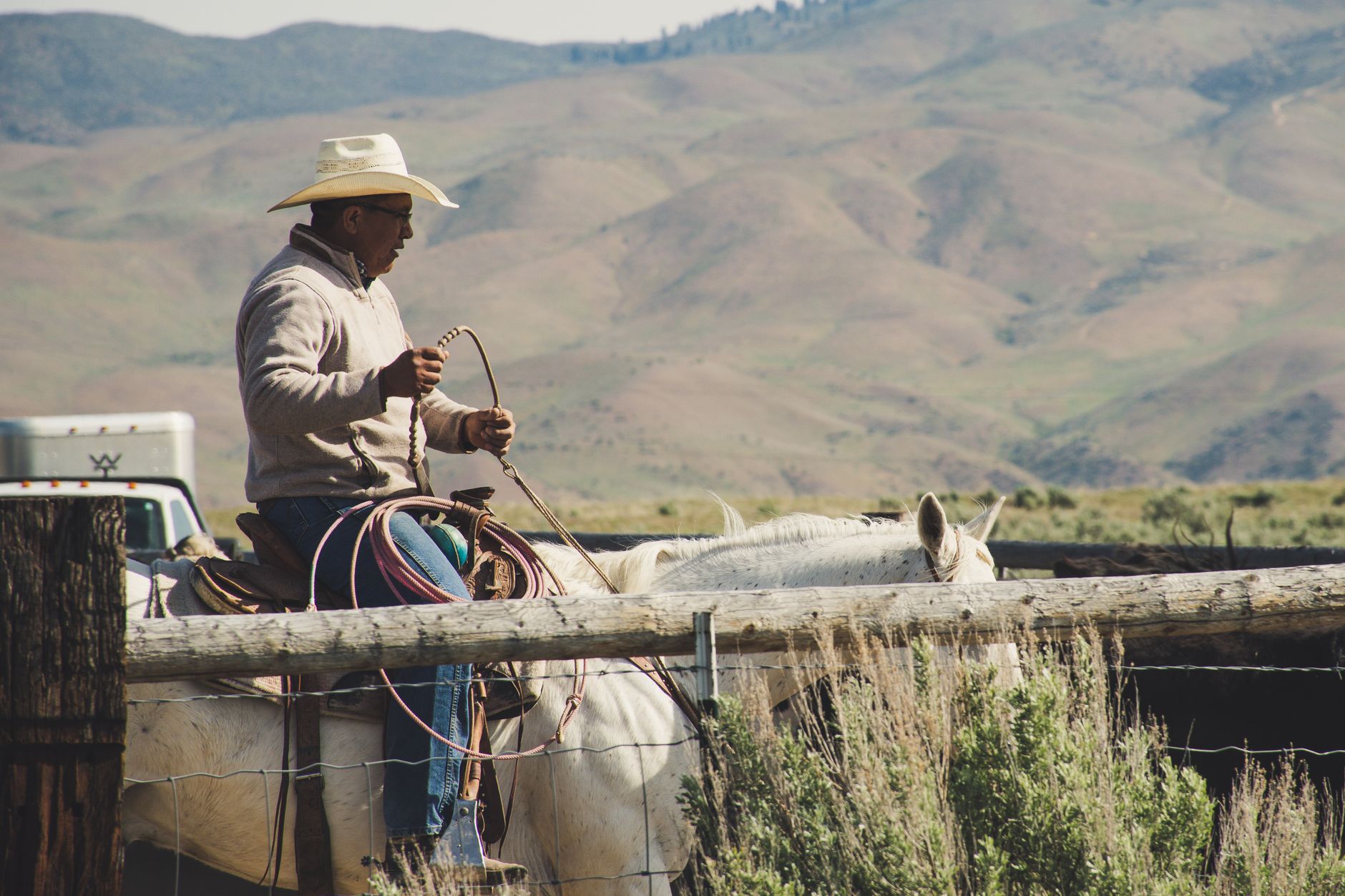
The Fence Line He Swore Was Always There
My name is John. I am fifty-four years old, and I have run cattle on this ground in rural Tennessee for twenty-six years, since my father signed the place over to me the spring I turned twenty-eight. Before that it was his, and before that it was his father’s, three generations of the same family walking the same fence lines, cussing the same washouts, and pulling the same cedar posts out of the same red clay every time a storm took one down. I am not a man who talks much. I have spent my whole life around cattle and hay and weather, which do not care whether you have anything clever to say about them, and it has made me plain. So I will tell this plain.
I run about ninety head of commercial beef cattle across two hundred and ten acres, split between bottom pasture along the branch and hill ground higher up where the fescue holds through the dry months. It is not a big operation by the standards of the ranches you see on television, but it is a whole operation, mine alone, and every acre of it earns its keep or gets sold off, because I do not have room in the budget for ground that does not pull its weight. The bottom pasture along the branch is the best of it. It greens up two to three weeks ahead of the hill ground every spring, which matters more than people who have never run cattle would guess, because those extra weeks of grazing on good bottom grass are the difference between buying hay in April or not buying it at all. I graze that ground hard and early every year, then rest it and move the herd up the hill by June so it can recover. It is not sentimental to me. It is the calendar my whole operation runs on.
The fence between my place and Donald’s has run the same line since before either of us was born. It is an old four-strand barbed wire fence, cedar posts gone silver and split with age, the kind of fence that has been mended so many times it is really a hundred small fences pretending to be one long one. I know every low spot in it. I know where the deer jump it and where the posts lean and where my grandfather, by his own account, once shot a copperhead off the third strand with a .22 pistol from horseback, which I never fully believed until I was old enough to understand that some stories get better and truer at the same time.
Donald bought the place next to mine about twelve years ago. He is not from here. He came from somewhere with more money in it, retired early from something in insurance, and built a house on his side of the line that looks like it was ordered out of a catalog for people who like the idea of the country more than the reality of it. I do not say that to be unkind. I say it because it matters to what happened. Donald likes the country in the way a man likes a photograph of the country. He does not like fixing fence. He does not like the smell of a truck full of cattle in August. He likes looking at my pasture from his back porch with a glass of something in his hand, and for twelve years that arrangement worked fine, because I stayed on my side and he stayed on his and neither of us asked much of the other beyond a wave at the mailbox.
I want to be fair to what those twelve years actually looked like, because it makes what came after harder to explain and not easier. Donald was not a bad neighbor in any way I could have named before that April. When his water line froze one January and split underground, I let him run a hose off my spigot for three days while his own well man got out to him. When a windstorm dropped a hickory across his driveway at two in the morning, I was the one who showed up with a chainsaw before he had even finished calling around for help. He brought me a bottle of something decent every Christmas, always with a card, always signed the same way, Donald and family. None of that was nothing. That is exactly why the fence hit as hard as it did. A stranger stealing six feet of ground is one kind of wrong. A neighbor you have handed a running hose to in a January freeze, looking you in the eye afterward and calling you confused, is a different kind of wrong entirely.
That arrangement ended on a Saturday morning in April.
I was headed out before sunup to check on a first-calf heifer who had been acting like she might go into labor overnight, driving the fence line the way I do most mornings, more out of habit than need, and something looked wrong before I could even say what it was. The line was in the wrong place. Not wrong the way a fallen post is wrong. Wrong the way a room looks wrong when someone has moved the furniture while you slept, and you cannot say exactly what changed but your whole body knows something has.
I got out of the truck and walked it, and it did not take long to understand. The fence had moved. Not fallen, not been knocked over by a storm or a bull working a low wire. Moved. Deliberately, and recently, and about six feet onto my side of what had always been the line.
The posts were new. Bright unweathered cedar, the cut ends still pale and sappy, driven into dirt that had clearly been disturbed within the last few days and had not yet had rain on it to settle it back down. New wire, too, four strands stretched tight and true between the new posts, running parallel to my old fence line the whole visible length of the shared boundary, six feet inside of it. My good bottom pasture, the low ground along the branch where the grass comes in first every spring and where I turn the herd out before I move them up to the hill pasture in June, now sat on Donald’s side of a fence that had not existed in that position four days earlier.
I walked the whole eleven hundred feet of it that morning before I did anything else, boots soaking through with dew, and the wrongness of it did not fade the longer I looked, it sharpened. At the far end, near the branch, I found where the crew had worked hardest to hide what they were doing, packing the disturbed dirt down and scattering loose grass clippings over the fresh ground around each new post, the way you would if you wanted a week’s worth of rain and sun to make it look settled before anybody thought to check it closely. Somebody had planned this. Somebody had measured it out ahead of time, ordered the posts, hired or borrowed a post driver quiet enough not to wake a man a quarter mile away, and picked a night with no moon.
I want to be precise about what six feet means, because six feet does not sound like much until you multiply it out. The disputed stretch of shared fence line runs a little over eleven hundred feet, following the natural fall of the land down toward the branch. Six feet times eleven hundred feet works out to roughly a sixth of an acre, not a huge parcel by the standards of a cattle operation, but it was my sixth of an acre, on my best ground, and it had been taken without so much as a knock at my door.
I did not go find Donald that morning. I had a heifer to watch, and she calved out fine around noon, a healthy bull calf on wobbly legs within the hour, which under different circumstances would have made it a good day. Instead I spent the whole time she was in labor with my mind on that fence line, running through every version of how six feet of new fence gets built in the dark without a neighbor hearing a single post driven.
I called Donald that afternoon. He answered on the second ring, easy and unbothered, and I told him I had walked the fence and found it moved. There was a pause on the line, short but noticeable, the kind of pause a man takes when he is deciding which version of the truth to give you.
“That fence has always been right where it is,” he said.
I told him I had walked that line my whole life, that my father had walked it before me, that I knew exactly where it sat because I had restrung it more times than I could count, most recently four years ago after a summer storm took down eighty feet of it near the branch, and I had put every post back in the same holes.
“I think you’re misremembering,” Donald said. “It’s been an emotional year for you, hasn’t it. The passing of your father’s old bull, all that.”
My father’s bull had nothing to do with any of this, and Donald knew it, and the fact that he reached for something soft and sad about my family to explain away what he had done told me more about the kind of fight I was in than anything else he said that day. He went on, calm as a man discussing the weather, and told me his family had surveyed that boundary years ago, long before my father ever purchased the adjoining property, and that if anything the fence had always run a little onto my side of the true line, and he had simply corrected it.
“So somebody rebuilt eleven hundred feet of fence overnight and nobody heard a thing,” I said.
“Fences get replaced in sections all the time, John,” he said. “Maybe it was done in pieces over a few weeks and you only noticed it all at once. I couldn’t tell you the exact night. I don’t keep a calendar on my own fence.”
I told him six feet across eleven hundred feet was not a rounding error, that it was the best grass on my side of the branch, ground I had grazed every spring of my life. He was quiet for a second, then said, gently, like he was doing me a kindness, “You’ve got two hundred acres, John. I don’t think a sixth of one is worth what this is turning into.” That was the moment I understood we were no longer talking about a fence. We were talking about whether I was the kind of man who would let a thing go because pushing back on it looked petty over grass, and Donald had made a bet, correctly for twelve years running, that I was exactly that kind of man.
I drove over to the fence that evening, and Donald met me at the line in his truck. I want you to understand what it is to stand on ground you have grazed cattle on since before you were old enough to drive, and have a man who has owned the place next door for twelve years look you dead in the eye and tell you that you do not know your own property. He was not angry. That was the strange part. He was patient with me, in the exact tone people use with someone they believe to be confused, and that patience made my neck hot in a way real anger never would have.
“I’m not going to argue with you about a fence line, John,” he said. “It is where it is. It’s always been where it is.”
I told him I would be checking the old plat records at the county courthouse on Monday. He shrugged, and there was something in that shrug, a kind of confidence, that told me he already had an answer ready for whatever paper I found, because he understood something I did not fully understand yet myself. A survey plat drawn up in 1961 is a line on paper. It tells you where a boundary is supposed to be, in theory, according to a courthouse file. It does not, by itself, tell you where the actual, physical, undisputed corner of two properties sits in the dirt. And paper, unlike ground, can always be argued with. A man confident enough, and calm enough, can stand in front of a plat map and say the surveyor made an error, the scale is off, the reference point has shifted with a hundred years of fence-building. I did not know that yet on that Saturday evening. I would learn it soon enough.
I went to the courthouse that Monday anyway. The plat was old, hand-drawn, the ink gone brown, the kind of document that gives you a general shape of two properties and a set of bearings and distances that meant something exact to a surveyor in 1961 and mean almost nothing to a rancher trying to settle an argument sixty-five years later without hiring an expert of his own. It supported my memory of where the line ran, roughly, but roughly was not going to be enough against a neighbor who had already decided to be confident rather than honest.
The clerk who pulled the file for me, a woman who had worked in that office long enough to know most of the county’s old boundary disputes by name, told me something I have not been able to shake since. She said plats from that era almost never stand alone as proof of anything, because the surveyors who drew them worked off chains and compasses and a level of precision that would not hold up against a modern instrument, and because the paper itself gets lost or water-damaged or filed under the wrong parcel number over sixty-five years. What settles these arguments, she said, when they actually get settled, is an original monument still in the ground. A pin, a stone, an iron rod a long-dead surveyor drove in and recorded. Paper describes where a monument used to be. A monument found in place is the boundary itself. I did not know it yet, standing at her counter, but she had just told me exactly how I was going to win this.
That night I could not sleep. I lay in bed running the whole thing over, and somewhere past midnight I found myself thinking about my father, and something he used to say, always in the same half-joking tone, usually after a beer, usually while looking down that same stretch of fence toward the branch. He would say that somewhere under the old corner post, right where the original line met the creek bank, the very first surveyor who ever ran that boundary, back before either of our families owned an acre of this county, had driven an iron marker into the ground. Not a fence post. A survey marker. The real corner, the one everything else in both our deeds was supposed to trace back to. My father mentioned it maybe three or four times across my whole life, and every time he said it the same way: somewhere under there is the real answer, if it ever comes to that.
I thought too about the day he taught me to read a plat map at our own kitchen table, the winter I was maybe fifteen, tracing bearings with a pencil while he explained that a boundary line was not really the fence at all, the fence was just a fence, a convenience two neighbors agreed to build somewhere close to the truth. The real line, he told me, was whatever the original survey said it was, whether or not anybody alive still remembered where that survey had been run from. I had filed that away as one more piece of my father’s plainspoken philosophy and never once thought I would need it as a plan of action.
I had never once needed the real answer before. I needed it now.
I called a man three farms over who I knew hunted old battlefields and homesteads on weekends with a metal detector, a hobby he had taken up after he retired from the county road department, and I asked if he would lend me his machine and show me how to run it. He did better than lend it. He drove over Sunday morning with the detector in the bed of his truck and a look on his face like he had been waiting his whole retirement for somebody to ask him to help find something that actually mattered.
We started at the far end of the disputed stretch, down near the branch, where my father always said the true corner sat, in ground that had not been disturbed in decades because nobody had ever needed to disturb it. The grass there was rough and unmowed, thick with the kind of tangled fescue that only grows where cattle do not graze often, and we swept in slow, overlapping rows the way he showed me, the machine murmuring its steady tone in our ears.
The first hour gave us nothing but false hope. We dug up a rusted horseshoe eight inches down that made my friend laugh out loud, and a little further on, a corroded fence staple so old it crumbled when he touched it with a trowel, proof only that people had been losing small pieces of iron in this dirt for a very long time. I started to wonder whether my father’s half-joking story was exactly that, a joke, dressed up over the years into something that sounded like memory but was really just a good line he liked to say while looking at a fence he was proud of.
It took the better part of two hours before the tone changed. A sharp, clean signal, right where the old fence corner and the branch bank came together, in a spot that had sat quiet and undisturbed under matted grass for longer than either Donald or I had been alive.
We dug carefully, an inch at a time once we got close, the way my friend showed me so as not to damage whatever was down there. Eighteen inches down, in packed red Tennessee clay that had clearly not been turned since it was first driven into the ground, we found it. An iron pin, capped, corroded to a dark reddish black, with a worn but still legible surveyor’s mark stamped into the cap, along with a set of numbers that meant nothing to me in the moment but that I photographed from every angle before I so much as touched it with a bare hand.
It was not modern. It was not something either family had put in the ground in living memory. It was old the way a fence post from 1961 is not old, buried well below the depth any fence-building would have disturbed, sitting exactly where an original survey corner from long before either of our deeds was drawn would sit, if my father’s half-joking story had been the plain truth all along.
I did not touch it further, did not move it, did not do anything but photograph it from every angle and cover it back over loosely to protect it, and drove straight to town to hire a licensed surveyor.
His name was Douglas, a careful, unhurried man who had been running property lines in this county for close to thirty years, long enough to have surveyed half the farms within twenty miles of mine at one point or another. I told him the whole story, the moved fence, Donald’s insistence it had always been there, my father’s old story about a buried corner marker, the machine, the pin. He did not get excited. He told me that is exactly the kind of case where an original monument, if it is real and if it is undisturbed, settles an argument that paper alone never could, because courts and county records both give more weight to an original survey monument found in place than to a hand-drawn plat from sixty years ago or to two neighbors’ competing memories.
Douglas brought his own crew and his own instruments out within the week. He confirmed first that the iron pin was in fact an original government-standard survey monument, the kind used by licensed surveyors of that era, still bearing a partially legible stamp that matched county survey records from the original platting of both properties, decades before either my father or Donald’s family had purchased an acre of this ground. He ran his instruments from that monument along the recorded bearings and distances in the old plat, out across the disputed stretch, all the way to the second corner marker at the far end, which his crew located, still buried, still undisturbed, in less than an hour once they knew where to look. Two original monuments, both intact, both consistent with each other and with the 1961 plat’s bearings.
Douglas explained it to me in plain terms while his crew packed up their instruments, because he could tell I wanted to understand it and not just be told it. A survey, he said, is only as good as what it is tied to. Most fence disputes never get resolved cleanly because nobody can find the original monuments anymore, they were plowed under, paved over, or simply never recorded precisely enough to relocate decades later, and in those cases a surveyor is left interpreting old bearings against modern reference points, which leaves room for exactly the kind of argument Donald had been counting on. What we had, he said, setting his hand flat on the hood of his truck like he was laying down a winning card, was the rare case where both original monuments survived, undisturbed, in a straight and internally consistent line with each other and with the historic plat. That almost never happens. When it does, he said, there is no honest argument left to make.
The true, historic boundary line, the one that had existed since before either family owned this land, ran exactly where my old fence had always stood. Donald’s new fence, the bright cedar posts and tight new wire, sat precisely six feet onto my side of that true line, the entire eleven-hundred-foot length of it, an error too consistent and too deliberate to be any kind of honest mistake in the placement of a single post.
Douglas put all of it into a formal, signed and sealed survey report: the location of both original monuments, the bearings run between them, the recorded plat they matched, and a clear statement that the current fence encroached onto my property by six feet across the full disputed stretch.
I brought that report to Donald myself. I did not send a lawyer first. I drove over to his catalog-perfect house with the report in a folder on my truck seat, and I asked him to walk the fence line with me one more time.
He did not want to come outside at first. I stood on his porch and told him I was not there to argue, only to show him what a licensed surveyor had found under eighteen inches of clay, sitting right where my father always said it would be. Something in the word monument, or maybe in the word sealed, or maybe just in the fact that I was calm and had a folder instead of a raised voice, got him moving.
I walked him down to the branch corner myself and showed him the pin still sitting in the shallow hole where we had uncovered it, capped and marked, older than either of our families’ claim to this dirt. I showed him Douglas’s report, the bearings, the second monument at the far corner, the plain conclusion at the bottom of the last page. He read it standing in the grass with his jaw working, the same patient, confident look from that first Saturday evening now gone entirely from his face.
He did not confess to anything grand. Donald was never a man built for grand confessions. What he said, standing there with the report shaking slightly in his hands, was smaller and truer than anything he had said to me before. He said he had been trying to square off an odd notch in his own property line, a small irregular bite that had bothered him for years and made his lot line look, in his words, unfinished on the survey he had commissioned when he first bought the place, a survey that, it turned out, had never actually located either original monument and had simply guessed at the line based on the existing fence, six feet in the wrong direction from where his own hired surveyor had eyeballed it. He said once he decided in his own mind that the fence was wrong, he had convinced himself it was an honest correction rather than a theft, and once he had told me it had always been there, he found it easier to keep saying it than to admit he had moved a fence in the dark to fix a problem that only existed in his own head.
“I should have just asked you,” he said, still standing over the report. “I told myself you’d never notice six feet on two hundred acres, and if you did, I could talk you out of it. I didn’t think you’d go dig up the ground itself.”
“My father always said the ground doesn’t lie,” I told him. “People do. I just never had cause to test which one of you I believed more.”
I did not raise my voice. I want that understood, because I think it matters more than anything else in this story. I did not need to. I had an iron pin driven into the ground before either of our families existed, a licensed surveyor’s sealed report built on it, and eleven hundred feet of new fence sitting exactly six feet on the wrong side of the truth. Donald had a story that had already collapsed the moment he read the same report I was holding.
He moved the fence back within three weeks, hiring the same crew that had built it wrong the first time to tear it out and reset every post along the true line Douglas had marked with fresh stakes. He paid for the entire survey himself, close to four thousand dollars once Douglas’s crew, instruments, and sealed report were all accounted for, without me having to ask twice or mention a lawyer. And he paid to reseed and repair the strip of bottom pasture his cattle had grazed down to bare dirt during the months it sat wrongly on his side, the good early grass along the branch that my herd had missed an entire spring of grazing. That came to another sixteen hundred dollars in seed, lime, and a custom fertilizer blend the county extension agent recommended to bring the ground back faster, plus eleven round bales of hay delivered to my barn that same fall, hauled in on his own dime, to make up for the grazing my herd had missed while that ground sat on the wrong side of a fence. He never once complained about the total, and he never once asked me to split it.
We are not close now, Donald and I. I do not think we ever will be, not after a man stood on my land and told me I did not know my own property. But he waves at the mailbox still, and I wave back, and when I walk that fence line these mornings, the way I have my whole life, I walk past a corner marker that has been sitting quiet under that grass since long before either of our families ever laid claim to an acre of this county, doing the one job it was ever built to do. Telling the truth, whether or not anybody is confident enough to argue with it.
My father was right, in the end, the way he so often was about the things he only ever said half joking. Somewhere under there was the real answer. It just took a Saturday morning, a borrowed metal detector, and a man patient enough to lie to my face for it to finally come to that.
This story is a dramatization. Names, characters, and details are invented, and any resemblance to real people or events is coincidental.