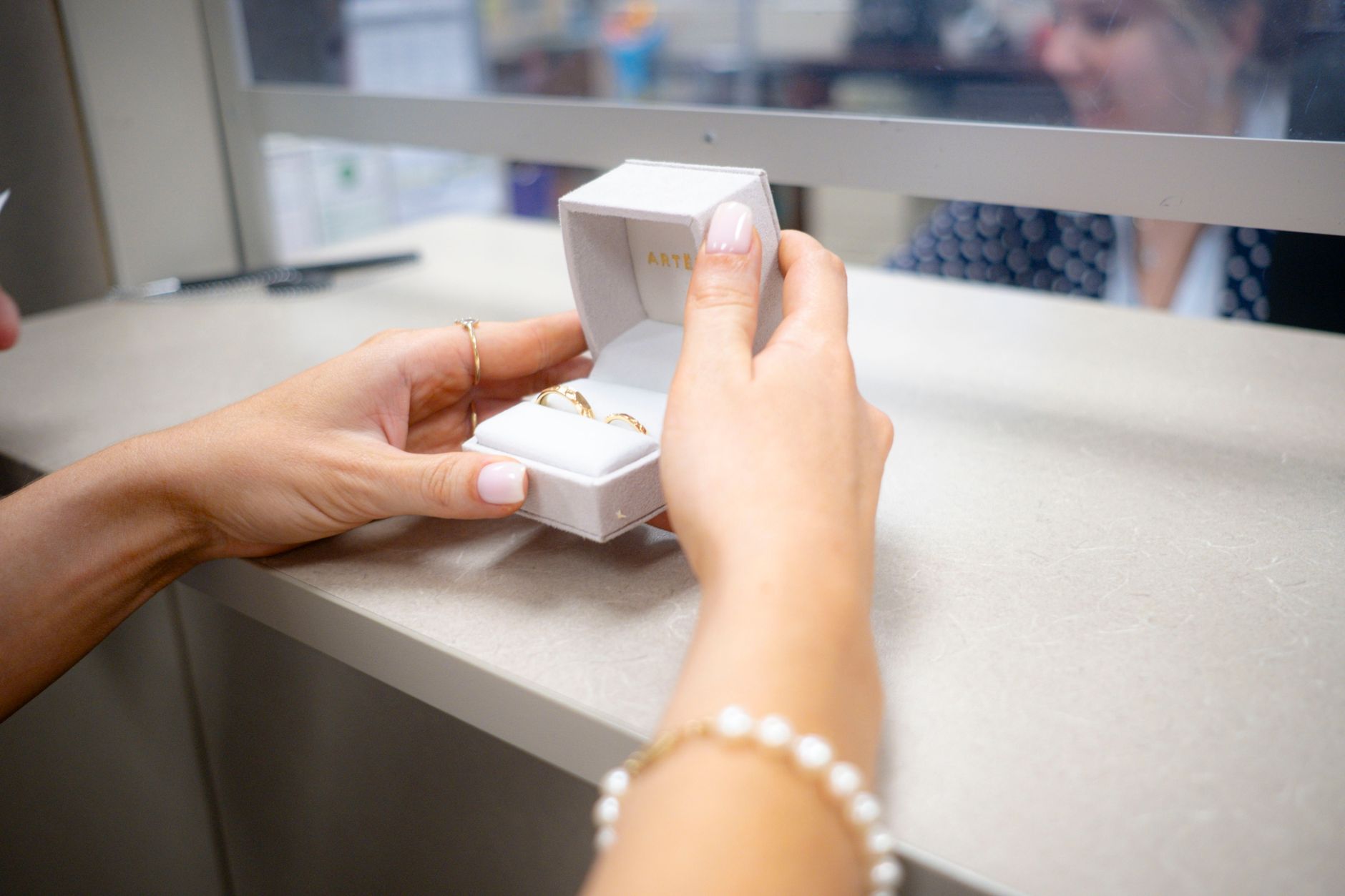
The Ring She Pawned For Gas Money
I stood in my own kitchen in Chillicothe, Missouri, holding a pink carbon-copy pawn ticket with my daughter-in-law’s name typed across the top of it, and Shantelle looked at me the way you’d look at somebody making a fuss over a broken coffee mug.
“It was just sitting in a drawer doing nothing,” she said.
My name is Verla. I am forty four years old. I have lived in this house on Erie Street my whole adult life, the same house I brought my son home to as a baby, the same house my mother sat in every Sunday afternoon until the year she died. That ring in the pawn shop case forty minutes from here was the only thing of hers I had left that you could hold in your hand. Not a photograph. Not a story. A ring.
I want to tell you how it got from my dresser drawer to a glass case with a little paper tag rubber-banded to the band, because the getting there is the whole story, and because by the time I am done telling it, I think you will understand why I have not spoken more than ten words to my daughter-in-law since that afternoon.
My mother wore that ring for fifty three years. My father bought it the winter he came home from the Army, on a payment plan through a jeweler in town that has not existed since I was a girl, twelve dollars down and the rest over a year, and he used to tell it like a joke, that he paid on that ring longer than some men pay on a truck. It is not a fancy ring. A thin gold band, worn down smooth on one side from five decades of dish soap and garden dirt, with a small square-cut diamond set low so it would not catch on anything. My mother wore it every day of her married life and every day of her widowhood after, twenty two years of it, because she said taking it off would have felt like telling my father goodbye a second time.
When she died, six years ago this coming October, the ring came to me. I am her only daughter. I have a brother in Springfield who did not ask for it and would not have known what to do with it if he’d gotten it, and that is not a unkind thing to say about him, it is just the truth of our family. The ring came to me, and I did not put it on.
I want to explain that, because I think it is the part of this story people misunderstand first, including, as it turned out, the person who took it.
My mother used to sit in the recliner by the front window every evening after supper, and she had a way of holding her hands up in the lamplight while she watched her programs, turning that ring slowly with her thumb the way some women turn a rosary, not even looking at it half the time, just doing it because her hands had gotten used to the motion over so many decades that I do not think she could have stopped if she had tried. I used to sit on the floor by her chair as a girl and ask her to let me wear it a minute, and she would slide it off and let me hold it while she painted my fingernails with clear polish at the kitchen table, and then she would hold her hand out, palm up, without a word, and I would give it back, because even at seven years old I understood that some things you get to borrow and some things you do not get to keep, and the difference mattered.
I did not wear my mother’s ring because my hands are not my mother’s hands. I work at the co-op counter five days a week, ringing up feed and fence wire and the same twenty regulars who have been coming through that door since before I started, and my hands by the end of a shift are rough enough that I did not want to catch that thin old band on a fifty pound sack of dog food and bend it, or lose the stone somewhere in a grain bin the way my aunt lost hers years back sorting canning jars. So I kept it the way my mother kept her own mother’s things, wrapped in a good handkerchief, inside a small velvet box that used to hold a watch, at the back of my dresser’s top drawer, underneath a folded stack of slips I never wear either. I took it out twice a year. Once on my mother’s birthday, and once on the anniversary of the day she died, and both times I put it on for the day, went to church, and put it back that same evening, because some things you do not wear down to nothing just because you are allowed to.
That is the drawer Shantelle meant when she said it was just sitting there doing nothing.
My son’s name is Alcorn. He is twenty six, my only child, born the same year my husband and I bought this house, and he has been the best part of my life since the day they put him in my arms in the hospital over in Trenton. He married Shantelle three years ago this spring, a small wedding at her family’s church out past the fairgrounds, and I stood up there and cried the way mothers do, happy tears, real ones, because my son looked at that girl like she’d hung the moon and I wanted to believe the moon deserved it.
I am not going to sit here and tell you Shantelle was ever cruel to me before this. She was not. She called me by my first name from the start, which some daughters-in-law never manage, and she remembered my birthday, and at Thanksgiving she always made a point of asking after the co-op, whether the same cranky regular was still coming in every Tuesday to complain about propane prices to anybody who’d listen. I liked her. I want that on the record, because I think it matters to how confused I was, standing in my kitchen with that pawn ticket, that the person who had done this to me was someone I had truly liked for three years, not someone I had ever once been braced against.
What I did not know, because Alcorn is proud in the particular way his father was proud, and Shantelle is proud in her own separate way, is that the two of them had been in trouble for longer than either one of them ever let on to me.
Alcorn works at the grain elevator outside town, decent hours, decent pay for around here, but the truck he drives to get there is fourteen years old and eats gas the way a teenager eats groceries, and last winter it needed a transmission repair that ran them close to two thousand dollars they did not have sitting anywhere. Shantelle works the second shift at the nursing home in town, and her own car, a little sedan with more rust than paint left on the rocker panels, had been running on the very edge of empty more days than not, because the two of them had made a private decision, one I did not learn about until much later, to pay the transmission repair off the credit card and just white-knuckle the gas money week to week until it was paid down.
I would have helped. I want to say that plainly, right here, before I go any further into this story, because it is the thing that has sat heaviest on me since. If Alcorn had called me and said, Mom, we are short forty dollars for gas this week, I would have had two twenties in his hand inside the hour, and I would not have thought twice about it, and I would not have held it over him for one single day afterward. I have done it before. I did it the month after their wedding when Shantelle’s car needed a battery, and neither one of them ever heard a word about it from me again. That is not a boast. That is just what a mother does when she has it to give, and I have never had much, but I have always had enough to keep my own child from running dry.
Nobody asked me that week in June.
I did not know any of this was happening. I want to be honest about how ordinary that week was for me, because I think it matters, later, that I was doing nothing more dramatic than working my regular shift and watering my tomatoes, while forty minutes away in a pawn shop on the edge of a town I only pass through, something of my mother’s was changing hands for less money than I spend on groceries in a week.
The anniversary of my mother’s death falls on the ninth of October, and every year, the week before, I get a particular kind of restless. I do not sleep well that week. I find myself standing in the kitchen at odd hours doing nothing in particular, and I have learned over six years not to fight it, just to let the week be what it is. Part of what settles me, every single year, is taking that ring out of the drawer three or four days early, just to hold it, just to turn it in the light the way my mother used to turn it while she watched television in the evenings, out of a habit so old she probably did not know she was doing it anymore.
I went to that drawer on a Tuesday evening in late September, earlier than usual this year because the restlessness had come on early, and I moved the folded slips aside, and the little velvet box was gone.
I want to tell you exactly what that felt like, because I think anybody reading this who has ever reached for something precious and closed their hand around empty air will know it already. My first thought was not that anybody had taken it. My first thought was that I had moved it myself and forgotten, because that is the kinder thought, the one your mind reaches for before it lets you feel the worse one. I pulled that drawer all the way out and set it on my bed and went through every slip, every scarf, every old church bulletin I use as a bookmark and never throw away. I checked the drawer below it. I checked my jewelry box on the dresser top, where I do not keep it but checked anyway, the way you check a place you already know is wrong. I got down on my knees and looked under the dresser with a flashlight, in case the box had somehow fallen and rolled, though a velvet box does not roll, and some part of me knew that even as I was doing it.
Nothing else in that house was touched. That is the detail that kept me up half that night, lying in bed running it over and over. If someone had broken in, they would have taken the television, or the little bit of cash I keep in a coffee can for emergencies, sitting in plain sight in my kitchen the whole time. They would not have walked past all of that, gone straight to a drawer in my bedroom, and taken one small velvet box and left everything else exactly as it was.
Only three people besides me had been in my house that month. My friend from church who waters my tomatoes when I work a double. Alcorn, who stops by most Sundays. And Shantelle, who had come by twice, once with Alcorn and once alone, the second time to drop off a casserole dish I’d sent food home in, and to use my bathroom, and, she told me at the time, to fold a basket of laundry while she waited on Alcorn to finish a project in the garage, because her own dryer was down and mine was free.
I did not suspect her. I want to be honest about that too. I did not suspect anybody. I told myself the box had been misplaced somewhere in my own house, that I would find it eventually behind something, the way you always eventually find the thing you have given up on finding. I did not call the police over an empty drawer with no forced entry and no other evidence of anything. I just carried a low, constant unease around with me for the better part of two weeks, the anniversary came and went without the ring on my hand for the first time in six years, and I cried harder in church that Sunday than I had in a long while, and told myself it was only the grief catching up, nothing more.
My daughter is the one who found it. Rumer is twenty three, two years older than the space between her and Alcorn that our family jokes about, and she has always been the one in this family who notices things the rest of us walk right past. She works part time at the library and part time helping me at the co-op on Saturdays, and she is close with Shantelle in her own way, closer maybe than I ever was, the two of them texting back and forth about television shows and splitting a manicure appointment now and again.
In the middle of October, Rumer went over to Alcorn and Shantelle’s place on a Saturday afternoon to sit with their dog while the two of them drove to Kansas City for a cousin’s baby shower, an overnight trip. She let herself in with the spare key they keep for her, and she told me later that she went looking through the front closet for an extra leash because the dog had chewed through the one on the hook, and in doing that she went through the pockets of three or four coats hanging there, the way you do when you are looking for something small in a house full of somebody else’s things.
In the pocket of Shantelle’s barn coat, the canvas one she wears to walk the dog in bad weather, Rumer found a torn pink slip of paper, folded in quarters, soft at the creases the way paper gets when it has been carried a while.
She almost put it right back. She told me that plainly, later, when she was crying about it at my kitchen table, that her first instinct was to fold it back up and leave it exactly where she found it, because it is none of your business what is in your sister-in-law’s coat pocket. But something about the shape of the word CHILLICOTHE PAWN & LOAN printed across the top of it caught her eye before she’d even decided to look, and underneath that, in the blocky print of a stamped date, a Tuesday in late September. The same week the drawer went empty. And under the description line, in handwriting she recognized because Shantelle had written her a check for the manicure just that spring, four words: gold band, small diamond.
At the bottom, where the shop has you print your name for the record, it said Shantelle, plain as anything, her own name in her own hand, because she had used her own driver’s license to pawn it, the way you have to at a shop like that, and had not thought, or had not cared, that it would ever find its way into a coat pocket her sister-in-law would go digging through for a dog leash three weeks later.
Rumer called me from the porch of that house, dog leash forgotten, and read me the ticket word for word with her voice shaking, and I sat down hard on my own kitchen chair four hundred yards from where she stood, because I already knew, before she finished reading it, whose ring that description was.
I drove out to that pawn shop the next morning before my shift, alone, because I did not trust my own voice yet to call Alcorn or Shantelle first, and I needed to see it with my own eyes before I said one word to either one of them.
The shop smelled like gun oil and old carpet, and a ceiling fan turned slow overhead without doing much against the October chill that had already settled into the concrete floor. A row of guitars hung along one wall, a case of hunting rifles behind the counter under a hand lettered sign about background checks, and along the front, under glass, tray after tray of other people’s hard months laid out in rows. Class rings. Chains gone thin at the clasp. A christening bracelet still in its little box. I stood there longer than I meant to before I said a word, because some part of me had never once in my life had a reason to walk into a place like that, and another part of me was doing the math on how many other families had stood exactly where I was standing, looking at exactly this kind of glass case, wondering if the thing they loved was still behind it or already gone to somebody else’s pocket.
The man behind the counter was polite in the particular careful way people are polite when they can tell you are barely holding it together. I described the ring, and he did not need to look far, because a plain gold band with a low-set small diamond is not the kind of piece that gets much interest in a case full of gold chains and hunting rifles and one electric guitar with a cracked neck. He pulled the tray, and there it was, my mother’s ring, tagged with a little paper ticket rubber-banded to the band, sitting three inches from a class ring that was not anybody’s I knew and a pair of gold hoop earrings somebody else had needed money badly enough to part with too. I put one finger against the glass, not touching the ring, just marking the spot, the way you touch a headstone through a fence you are not allowed past.
I asked him straight out if I could just pay whatever was owed and take it home right then, and he was gentle about it, but the answer was no. The account was in Shantelle’s name, tied to her ID, and without the ticket itself, or without her standing there in person to release it, his hands were tied by the paperwork the state makes them keep. What he did tell me, because I asked, and because I think he could see how close I was to coming apart in his shop, was the date. Pawned on a Tuesday in late September. Thirty days from that date, to the day, was the deadline. If nobody paid the loan and the fees by then, the ring stopped being anybody’s loan collateral and became the shop’s property, free and clear, to sell to whoever walked in next and had the cash for it.
I did the math standing right there at that counter. Twelve days. I had twelve days left before my mother’s wedding ring became a stranger’s to buy off a tray for whatever this man decided to price it at.
I did not go home and wait politely for an explanation. I drove straight from that pawn shop to my son’s house, the pink ticket Rumer had photographed on her phone pulled up and shaking in my hand, and I do not remember most of the drive, only that I was gripping the wheel hard enough that my knuckles ached by the time I pulled in.
Shantelle answered the door. Alcorn was still at work. She saw my face before I said a single word, and something in her own face went careful, the way a person’s face goes careful when they already suspect what is coming and are deciding, right there in the doorway, how they are going to play it.
I held my phone up with the photo of that ticket on the screen and I asked her one question. Is this my mother’s ring.
She did not lie to me. I will give her that much, and only that much. She stood in her own doorway with her arms crossed and she told me yes, she had taken it, and yes, she had pawned it, because the truck’s transmission bill had eaten the last of their savings and her own car had been running on fumes for two weeks and Alcorn’s paycheck was still four days out and she had needed gas money to get to a shift at the nursing home she could not afford to miss.
I asked her why she did not simply call me.
And that is when she said it, standing there in her own doorway with her arms still crossed, in a voice that had no shame in it at all, not one thread of it that I could find.
“It was just sitting in a drawer doing nothing,” she said. “I figured you’d rather I use it than have it sit there useless while we couldn’t even get to work.”
I want to try to explain what that sentence did to me, because I have turned it over more times in the weeks since than I can count. It was not only that she had taken something of mine without asking. People make desperate choices under real pressure, and I have made a few of my own in my life that I am not proud of, and I understand, more than she probably credits me for, what it is to stand in a kitchen doing math on gas money and rent and coming up short. What broke something in me was that phrase, sitting there doing nothing, because it told me she had looked at the last physical piece of my mother I had in this world, worn smooth by fifty three years of a marriage, saved twice a year for a woman who has been gone six years, and had seen nothing there at all. Not a person. Not a history. An object with no job to do, and therefore fair to take.
I told her the ring was worth nothing to a pawn shop and everything to me, and she said, and I remember this exactly, that she did not see the difference between an old ring gathering dust and ninety dollars that kept the lights on and got her to a job that fed my son.
Ninety dollars. That is what she got for it. Ninety dollars, for a ring my father paid twelve dollars down on the winter he came home from the Army and spent a year paying off besides, for a ring my mother wore through fifty three years and a war and a hip replacement and every hard winter this county ever handed her.
I did not raise my voice. I want that understood, because I have thought since about whether I should have, whether a bigger reaction from me might have landed differently, but what came out of me instead was quiet, and I think quiet frightened her more than shouting would have, because shouting she could have argued with.
I told her I was going to get that ring back inside those twelve days, one way or another, and that she was going to be the one to hand me that pawn ticket before I left her porch that afternoon, because I was done finding out what had happened to my own mother’s things from a torn slip of paper my daughter found in a coat pocket while looking for a dog leash.
She went inside and got it. She did not argue me on that part. I think some small part of her, even standing there defending what she’d done, knew that handing over the ticket was the one thing left she could do that cost her nothing and might buy back some small piece of what she’d already spent.
Alcorn called me that night, after Shantelle had told him her own version of it, and I could hear in his voice that he was standing in the hallway of his own house trying to figure out which woman in his life he was supposed to be angry at. He did not defend what she’d done. I want to say that plainly, because it is the one mercy in this whole story that I was grateful for from the very first minute. My son did not tell me I was overreacting. He told me he was sick over it, that he had not known, that if he’d known what she was even considering he would have called me himself before letting her walk one foot toward that pawn shop.
But he also asked me, carefully, gently, whether I had known how bad things had gotten for the two of them these last few months. And the honest answer was no, because neither one of them had told me, and I told him that plainly too. I told him that pride is a poor substitute for a phone call, and that I would rather my son ask me for help and owe me nothing but a thank you than find out six weeks later that his wife had sold his grandmother’s ring for gas money because neither one of them could bring themselves to say the word broke out loud to me.
I drove to that pawn shop again three days later, on a Friday, with the pink ticket in my purse and ninety three dollars and forty cents in an envelope, the ninety Shantelle had gotten plus the interest the shop was owed for the month it had sat there. The same man was behind the counter. He recognized me, I think, from the visit the week before, and he did not make me explain myself twice. He pulled the tray, found the ticket number, and set my mother’s ring down on a little square of black velvet on the countertop between us, the way you’d set down something you understood mattered to the person standing across from you, whatever the paperwork said about who it legally belonged to that week.
I did not cry in that shop. I had done all my crying already, at my own kitchen table, in the days between finding out and getting it back. I just picked it up, turned it once in the fluorescent light the way my mother used to turn it in her own living room lamp, and put it on my right hand, because my left has never worn a ring since my own husband passed, and I have not found a reason to change that, and I did not need one for this.
I have not told this whole story to Shantelle, the part I am about to tell you now, because I am not sure yet whether telling her would help either one of us, but I will tell it here, because I think it is the piece that makes the rest of it make sense.
I had been planning, quietly, for over a year, to give that ring to Shantelle myself. Not to wear every day. Not even soon. I had decided, sometime after their first anniversary, watching the two of them dance badly at somebody’s backyard cookout, that when Alcorn and Shantelle had a child, when I became a grandmother for the first time, I was going to sit her down at this same kitchen table and put my mother’s ring in her hand and tell her that it belonged to the family now in a way that had nothing to do with blood, that it was hers to keep for whatever daughter or granddaughter came along after her, the same way it had come to me.
I never got the chance to give it to her that way. She took it instead, in a version that had nothing to do with love or family or the slow earned trust I had been quietly building toward, and turned it into ninety dollars and a paper ticket in a coat pocket. And I think that is the real reason this has sat on me the way it has, heavier some days than I let on even to Rumer. It is not only that she took a ring. She took the chance I was saving to give her something that mattered on my own terms, in my own time, and she never even knew the chance existed.
I have not decided, six weeks out from that Friday at the pawn shop counter, exactly where Shantelle and I stand now. We are civil. She apologized again, a real apology this time, sitting across from me at Thanksgiving with Alcorn’s hand on her shoulder, and she has started, on her own, setting aside twenty dollars from every paycheck toward paying me back the ninety three dollars and forty cents I spent getting my mother’s ring out of that shop, though I have told her twice now she does not owe me that money and she keeps bringing the envelope anyway.
What I have told both of them, plainly, is that nothing of mine sits unattended in that house again, not a drawer, not a closet, not a coat pocket’s worth of trust, until I have watched long enough to believe it will be treated like it belongs to somebody. That is not punishment. That is just what happens after you learn, the hard way, what a person is willing to call nothing.
I wear my mother’s ring on my right hand most days now, not just twice a year. I decided that the week I got it back. Some things, once you have nearly lost them for ninety dollars and thirty days, you stop saving for the anniversary and start wearing while you still have hands to wear them on.
I still have the pink pawn ticket. I keep it folded in the same velvet box the ring used to live in, underneath it now instead of holding it, a reminder of exactly how close nothing at all came to being the truth of what happened to the last thing I have left of my mother. Some mornings I take it out and read the date on it, thirty days, the same thirty days that once felt like all the time in the world and turned out, when it mattered, to be hardly any time at all.
I think about my mother more than usual these days, turning that ring in the light the way she used to, and I have found myself remembering things about her I had not thought of in years. The way she hummed hymns off key doing dishes. The way she kept a coffee can of bacon grease on the stove her whole life and never once explained why, because in her mind it did not require explaining. The way she used to tell me, whenever I got worked up over something small, that people show you what they think a thing is worth by how careful they are with it, and that you could learn everything you needed to know about a person that way, faster than they’d ever tell you with words.
I did not understand that saying fully until I was standing in my own doorway listening to my son’s wife explain, without a flicker of shame in her voice, exactly how little she had thought a fifty three year old wedding ring was worth. My mother was right, the way she was right about most things. Shantelle showed me what she thought that ring was worth the day she carried it out of my house in her coat pocket, and I have been careful, since, to remember that lesson without letting it turn me hard, because my mother was not a hard woman, and I would rather honor her ring by forgiving carefully than by keeping a grudge polished up like it was something else of hers I decided to save.
This story is a dramatization. Names, characters, and details are invented, and any resemblance to real people or events is coincidental.