The Tackle Box My Father Left Behind
By Ellen Marsh
The tackle box sat in the corner of my living room for three weeks before I could open it.
It was green. Metal. Army-surplus green, the kind of green that has faded to something between sage and rust, with a latch that my father had repaired twice with wire and once with a strip of electrical tape that had turned brittle and brown. I knew that tackle box better than I knew my own hands. I had watched my father carry it out to his truck a hundred times when I was a boy. I had watched him carry it out a hundred more times when my sons were boys.
I just had never been in the truck when he did.
The box came to me after Arlo died in March. He went in his sleep, which was the only thing about it that was merciful. Eighty-one years old, and the last thing he did was set out two coffee mugs on the counter, one for him and one for whoever came by in the morning. Nobody came by in the morning. I found the mugs three days later, when my younger son Bram drove out to check on him and called me at work.
I left the shop. I drove the hundred and forty miles to my father’s house on the reservation-adjacent stretch of land where he had lived his whole adult life, the same small town outside the Standing Rock corridor, the same house with the same cracked porch step my mother had told him to fix in 1987. He never fixed it. I never fixed it either. Some things you let stand because if you fix them, you have to admit the person who asked you to fix them is really gone.
I took what the lawyer said was mine and I brought it back to my house in Bismarck, where I work as a maintenance supervisor for a commercial property management company and have worked for thirty-one years.
The tackle box was on the list.
I did not open it for three weeks.
—
You have to understand something about me before the rest of this makes sense. I am a man who worked. That is not a defense. It is a description. I am fifty-seven years old, Lakota on my father’s side and my mother’s side both, raised in a household where you kept your word and showed up when you said you would, and the way I translated that, for most of my adult life, was into hours. Into shifts. Into overtime.
Irene, my ex-wife, could tell you the specifics better than I can. She kept a calendar. She kept everything. When we were still married, she used to put the boys’ school events on a whiteboard in the kitchen, and sometimes she would circle one in red and say, “Wade, this one.” And I would say I would be there. And sometimes I was, and sometimes I was not.
What I remember about those years is that they did not feel like neglect from the inside. From the inside, they felt like responsibility. I was the person who drove through a January ice storm to get to a furnace that had gone out in a twelve-unit building at three in the morning, because if I did not, thirty-six people would wake up cold. I was the person who took the phone call on Christmas Eve about a water main break and drove two hours in the dark. I told myself that was the job. That was character. That was the thing my own father had modeled for me, showing up when called, doing what was asked. I took the wrong lesson from a good man and I built a life around it.
Irene saw it more clearly than I did. She did not leave because I worked too much, or not only for that reason. She left because after fifteen years she had stopped believing I would ever make the list I kept promising to make, the one where the family was at the top and the job was somewhere below it. She was right. She was not cruel about it. She sat down with me at the kitchen table with the whiteboard still on the wall behind her, the boys’ events in her handwriting, and she said, “Wade, I have been waiting for you to come home for ten years and I think you think you are already here.” And I did not have an answer because she was right and I knew it and I still did not know how to change it.
We divorced when Cody was fifteen and Bram was thirteen. We were civil. We are still civil. She remarried a few years later, a man named Garrett who coaches high school baseball and comes to every game and is, by all accounts, a good stepfather to my boys in the ways that I was a working father. I do not resent him. I cannot afford to resent him.
The fishing trips, I was never there for.
It started when Cody was six and Bram was four. My father drove from his place to our place in Bismarck on a Saturday in June, which was already a long drive for a man in his sixties, and he put the tackle box in the bed of his truck and he said, “I’m taking the boys to the lake.” And I said I had to work a double. Which was true. It was true every time. I was building something, I told myself. I was providing. The boys needed shoes and backpacks and eventually they needed braces and eventually they needed help with car insurance and college applications, and all of that costs money, and money comes from work, and work comes from showing up, and showing up means you cannot always be at the lake.
My father took them anyway.
He took them the first summer, and then the second, and then it became the thing that happened: Arlo would call, and Irene would pack the boys’ things, and they would drive out with my father to the lake south of his house, the same lake where his own father had taken him as a boy. I knew it existed. I had been there once or twice as a child, before my grandfather died. The water there is not dramatic. It is not a postcard lake. It is flat and wide and ringed with cottonwoods and the wind off the Northern Plains makes the surface move in long slow shudders even on still days, and in the early morning the light does something to the water that I cannot describe except to say that it looks ancient. Like the land has been there longer than anything and the water knows it.
My boys went there every summer for twelve years.
I did not.
—
Cody is thirty now. He lives in Rapid City, works in IT, has a girlfriend named Petra and a dog named something I can never remember. He is careful with me the way grown children are careful with a parent they have complicated feelings about. He is kind. He does not use the word “absent” directly. He uses phrases like “you were really busy then” and “it was different back then” and I know what he is not saying, and I know that he knows that I know, and we move around it the way you move around a piece of furniture that has always been in the way.
Bram is twenty-eight. He lives closer, just outside of Mandan, works construction, and is more direct than his brother in the way younger children sometimes are. He told me once, when he was about twenty-three and we had been arguing about something else entirely, that the fishing trips with Grandpa Arlo were the best thing about his childhood. He did not say it to hurt me. I know that now. He said it the way you say a true thing when you have run out of patience for the polite version.
I heard it as an accusation because it was also a fact.
—
After Arlo died, I called both boys separately and then I called them together on a video call that felt strange and hollow the way grief makes ordinary things feel strange and hollow. We talked about the arrangements. We talked about the land and the house and what would happen to them. We talked about Arlo and the things we each remembered.
Neither of my sons cried on those calls, which surprised me until Bram said, “We already cried. We cried when he got sick last year.” And I realized I had not known my father was sick. Or rather, I had known in the abstract way you know something when someone tells you it in an email: I knew, but I had not gone, and I had not adjusted anything, and so I had not witnessed any of it, and now there was nothing left to witness.
That is the part that stays with me. Not that I missed the fishing trips. The fishing trips were thirty years ago and my sons are grown and whatever harm that did is already done and is not undoable. What stays with me is that my father spent months dying and I had been too far away, in every sense, to sit with him.
—
I opened the tackle box on a Sunday in April.
I sat at my kitchen table with a cup of coffee that had gone cold and I lifted the latch, the one with the electrical tape, and I pulled the lid open.
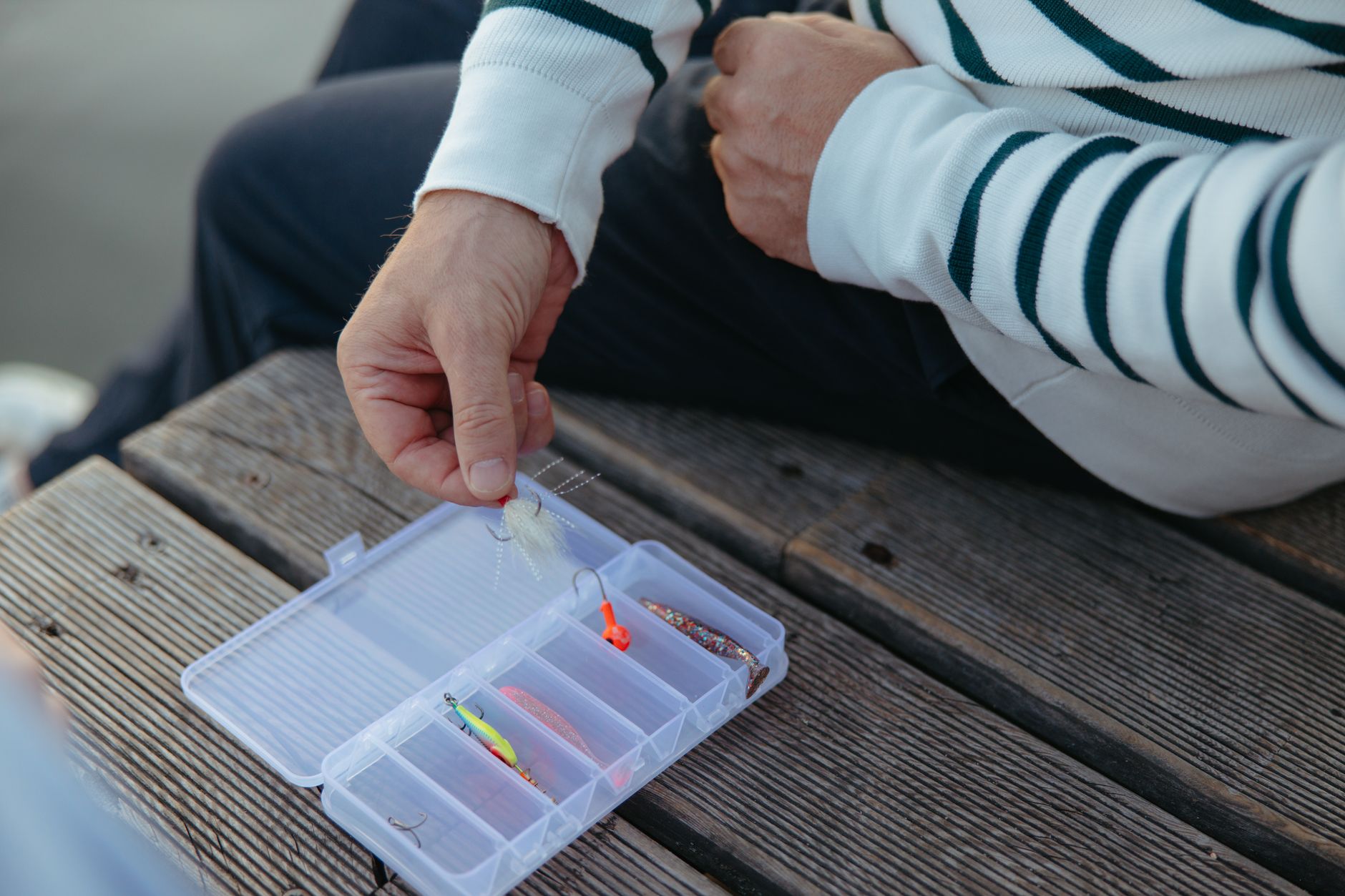
The top tray held what you would expect: hooks sorted by size in small plastic compartments, a few spools of line, lures in colors that made no sense to me because I have never been a fisherman. Weights. A pocket knife, the old kind with a wood handle. A bottle of hook remover solution that had probably been in there since the nineties.
I lifted the tray out to see what was underneath.
There was a plastic bag. A zip-close bag, the freezer kind, thick and clear. And inside the bag, I could see photographs.
Not digital prints. Not phone pictures. Old photographs, the kind with the white borders and the slightly waxy finish that photographs had before everything went digital. The kind you had developed at a drugstore.
I opened the bag carefully. I did not know what I was going to find. I thought maybe there would be a few pictures of my father when he was younger, or pictures of my mother, who died when I was nineteen. I thought maybe there were pictures of me as a boy.
There were pictures of my boys.
Cody at maybe seven, holding up a fish with both hands and a grin that took up most of his face. Bram at five, asleep in the grass at the edge of the water, his fishing rod propped against a rock, his mouth slightly open. Cody and Bram together, sitting side by side on the dock, their feet in the water, not catching anything, just sitting. My father in the background of one shot, baiting a hook, not looking at the camera, just present.
There were dozens of them.
I went through every single one, slowly, at my cold kitchen table on a Sunday morning in April, twelve years of summers in that bag. My boys growing from small to less small to almost themselves. My father growing from vigorous to slower to the man I had driven out to collect three weeks ago. The lake always the same behind them: flat, wide, cottonwoods at the edge, light on the water doing that thing I cannot describe.
There were some I could date by the boys’ sizes and faces. Early ones, Cody and Bram so small I could have carried both of them at once. Middle ones, the boys starting to look like people rather than children, Cody’s face sharpening into something serious, Bram grinning the way he still grins. Late ones, the boys teenagers, longer than I remembered being, and my father’s hair fully white by then, his face wearing the kind of settled patience that comes when a man has decided not to fight what cannot be fought.
I turned one photograph over. On the back, in my father’s handwriting, which I recognized because it looked like mine: Cody, first fish, age 7. June 1999.
I turned over another: Bram asleep. Hot day. Lake was good to us today.
He had written on the backs of some of them. Not all. Just some. Little notes, a date, a name, a sentence. The way you write on the back of a photograph when you want someone to know what they are looking at without having to be there.
He had written them for me.
I sat with those photographs for a long time.
—
The thing I had told myself, for years, was that they had each other. My boys had Arlo. They had Irene. They had their grandfather’s house and their grandfather’s truck and their grandfather’s terrible jokes and the lake where his father had taken him. I had provided the income that made the other things possible. That was a story that worked, as long as I did not look at it too directly.
What I was looking at now, directly, was twelve years of my father doing a thing he had wanted to do with me, with my sons instead. And my sons accepting that substitute without complaint, because children accept what is offered, and what was offered was good. What was offered was a man who showed up. A man with a tackle box and a truck and a lake and the patience to sit on a dock for four hours and catch nothing and call that a fine day.
I thought about the first time Arlo had taken me to that lake. I was eight. My grandfather was still alive then, a man I barely knew but who had hands like two pieces of driftwood and a quietness that I understand better now that I am older. We drove out early, before sunrise, and my father and my grandfather talked some, and we fished some, and mostly we just sat with the water and the light and the cottonwoods. On the way home, my grandfather said something in Lakota that I did not understand. I asked my father later what it meant and he said it was something like: the water remembers what we bring to it.
I thought about that for a long time. I am not a ceremonial man in the way some people are. I do not want to overstate what the lake means to us or turn it into something for a stranger to consume. It is a place. It has been a place for our family for a long time. That is enough to say. But when I sat at that kitchen table looking at those photographs, I understood that my father had not just been taking my sons fishing. He had been bringing them to the water. He had been doing for them what my grandfather had done for him and what he had tried to do for me and what I had not let him do, because I was working.
He never stopped trying. He just changed the destination.
—
I called Cody first.
I told him I had opened the tackle box. I told him what I found. There was a silence on the line and then Cody said, “Yeah. We knew they were in there. He showed us when we were kids. He said he was saving them.”
“Saving them for what?” I asked.
“For you, Dad,” Cody said. “He said he was saving them for you.”
I had to put the phone down for a minute.
When I came back, Cody said, “He talked about you on those trips. He always talked about you. He said you were doing what you thought you had to do.”
I said I did not know if that was a defense or an indictment.
Cody said, “It’s neither. It’s just what Grandpa said.”
I called Bram after. Bram was quieter about it. He said, “I figured you’d find them eventually.” He said, “Grandpa said you’d know what to do with them when you did.”
I said I was not sure I knew what to do with them.
Bram said, “Take us to the lake.”
—
We went in May, about six weeks after I found the photographs.
I drove. Cody flew into Bismarck from Rapid City and rode with me, and we picked up Bram in Mandan, and we drove out to the lake the way my father had driven out there every summer for twelve years with two boys in the cab of his truck. The drive takes about two hours. The road goes through country that is flat in the way that makes some people feel exposed and makes me feel settled, because I was raised in it. The sky is very large out there. The grass is the color of dried wheat this early in the season. You can see the weather coming from a long way off.
I had the tackle box in the bed of my truck. I had bought rods, because I did not own any, and Bram brought some gear of his own. We stopped at a gas station outside of the small town nearest the lake and bought coffee and some packaged food that nobody really wanted but that felt right to buy.
Nobody talked much on the drive. Cody sat up front with me and looked at his phone some and looked out the window some. Bram sat in the back and slept a little. The radio played country music and then nothing and then country music again as we moved in and out of signal range.
Somewhere around the halfway point, Cody said, “He used to stop at the same gas station every year. The one with the broken ice machine.” And Bram, half asleep, said, “It was fixed by the time we were in high school.” And Cody said, “No, it wasn’t. You just stopped caring about it.”
They argued about the ice machine for a few minutes, the way brothers argue about small things that stand in for larger things, and I listened and did not say anything because I did not know which gas station they were talking about and did not want to admit it. But I was grateful for the argument. It was the first normal sound I had heard in months.
I thought about what it meant that my sons knew the route. Every turn, every landmark, the broken ice machine. I had not known the route. I am their father and I had not known the route to the lake where my own father had taken them every summer for twelve years.
That is not a comfortable thing to sit with in a truck cab for two hours. But I sat with it.
We got to the lake in the late morning.
The cottonwoods were just coming into leaf, that early green that is almost yellow, and the water was the color I remembered from my one childhood trip, flat and wide and moving in those long slow shudders. There was nobody else out there. There is rarely anybody else out there. It is not a park. It is not stocked. It is just water that has been there a long time, and land that has been there longer.
We set up along the dock that my father had built, or rather the dock that had been there and that he had repaired so many times it was essentially his. The boards were weathered gray. A few of the planks were newer than the others, the wood still visible in its grain before the weather got to it.
I stood there for a moment before I did anything else.
I am not going to tell you that I felt my father there, because I do not know if that is true and I do not want to say it if it is not. What I will tell you is that the lake looked exactly like the photographs. The light was doing that thing. The cottonwoods were there. And for a moment I could see, or thought I could see, two small boys sitting at the end of the dock with their feet in the water.
I said, “I’m sorry I wasn’t here.”
I did not say it to my sons. Or rather, I said it to the lake, which is its own kind of address.
Cody came and stood next to me. He did not say anything. He put his hand on my shoulder for a moment and then he went to set up his rod.
Bram was already fishing.
—
We stayed until late afternoon.
We caught some fish. Cody caught the most, which surprised me and did not surprise Bram, who said Cody had always been the patient one. We ate the gas station food and drank the coffee cold and talked about things: about Arlo, about the house and what would happen to it, about Cody’s job and Bram’s job and things that were not grief, because you cannot grieve continuously, you have to rest from it and talk about ordinary things.
Cody told a story about Arlo that I had not heard. Apparently, one summer when Cody was about thirteen, my father had let him drive the truck back from the lake on the dirt road, the long flat stretch where there was no traffic. Cody said he had driven in a perfectly straight line for almost a mile and then oversteered into a ditch, and my father had gotten out and assessed the situation and said, “Well. I’ve seen worse,” which turned out not to be true in any verifiable sense but was what you said.
I laughed at that. I laughed hard, for the first time since March.
Bram told a story about the time Arlo had fallen asleep in the boat and drifted to the far end of the lake and woken up deeply confused. And I told the one story I had, from when I was eight, the morning my grandfather spoke in Lakota about the water remembering. I told them what my father said the words meant.
Bram was quiet for a moment and then he said, “He used to say that to us. On the way out here. Every year.”
I had not known that.
I know it now.
—
There is a thing that happens when you are a working man and you tell yourself the work is for your family. The thing is: it is true. The work was for them. The mortgage and the braces and the car insurance and all of it, that was real. I did not work those years out of selfishness. I worked them because I was afraid. Afraid of the alternative, which was to be the kind of man who could not provide, which was a specific and particular fear that comes from growing up with not enough and swearing you will not raise your children with not enough.
The fear was real. The provision was real. The cost was also real.
I have been trying to figure out, in the months since the lake, whether I would have done it differently if I had known what I was trading. I do not think I can answer that honestly. I know what the right answer is. I do not know if it is the true answer. What I know is that my father did not judge me for it. He took what I could not give and gave it himself, for twelve years, and then he put the photographs in a bag and put the bag in the tackle box and left the box to me to find.
He was not keeping a record of my failure. I have had to learn that, slowly, over these months. He was keeping a record of something he loved. He was keeping a record of my boys at the lake. He wanted me to see it eventually.
My grandfather said: the water remembers what we bring to it.
My father brought my sons. He brought them every summer for twelve years. He brought patience and bad jokes and the understanding that sometimes you sit on a dock for four hours and catch nothing and call that a fine day.
What he brought, really, was himself.
—
I have the photographs in a frame now, or rather I have some of them in a frame. There were too many for one frame so I have a box of prints on the shelf and a few of them in a frame: Cody at seven with his fish, Bram asleep in the grass, the two of them at the end of the dock with their feet in the water. My father in the background, baiting a hook.
The tackle box is on the shelf next to the frame. I use it. I have been out to the lake three more times since May. Once alone, and twice with Cody and Bram. Bram is the one who knows most about fishing, from those twelve summers, and he has been patient about teaching me, which is its own kind of gift.
The last time we went, in late September, we sat at the end of the dock in the evening, the three of us, and the light did that thing to the water and the cottonwoods were going yellow at the edges. Cody said, “Grandpa would have liked this.” And I said, “He’s been here before.” And Bram said, “Yeah. But not with you.”
I did not know what to say to that. I sat with it the way you sit with something true.
The water was flat and wide and moving in long slow shudders. The sky was very large. I could see the weather coming from a long way off, which out here in the Northern Plains is always true: you can see what’s coming, you just have to look.
I am fifty-seven years old. My father is gone. My sons are grown. The years I missed are gone with them, and I am not going to get them back, and I have stopped trying to do the accounting on it, stopped trying to figure out if the ledger balances, because it does not balance, and it is not supposed to, and the point was never the balance.
The point, I think, is what you do with the tackle box when someone leaves it to you.
You take it to the lake.
You bring your sons.
You stay until the light does that thing.
This story is a dramatization. Names, characters, and details are invented, and any resemblance to real people or events is coincidental.