The Shawl Ministry They Tried To End
At seven o’clock on a Tuesday morning I was sitting in the third pew from the back of Grinnell Community Church with a canvas bag of yarn at my feet, waiting for a meeting that was not supposed to be about me, when Otto Prewitt stood up at the front table, cleared his throat the way he does when he has already decided something, and said my ministry was going to be discontinued for lack of oversight.
He did not say my name at first. He called it “the shawl program,” like it was a line item and not sixteen years of my life, like it was not four hundred and eleven shawls carried into a hospital room by my own two hands and set down on a stranger’s lap without a signature or a receipt or a single dollar ever asked for in return. He said the words “lack of oversight” twice, and both times he looked somewhere just past my shoulder, not at me, the way a man looks at a wall when he has practiced a sentence and is worried the person in front of him might answer it.
My name is Enid. I am sixty nine years old, and for sixteen years, since three months after I buried my husband, I have knit a prayer shawl for anyone in Poweshiek County who was sitting alone in a hospital bed with nobody bringing them anything warm. I never asked the church to pay for the yarn, though they always did, out of the smallest, most forgotten line in the benevolence budget, forty dollars a month that would not buy a decent secondhand casserole dish. I never asked for a title. I never once, not one single time in sixteen years, put my name on anything I carried through those hospital doors. I have never signed a shawl in my life, and Tuesday morning at seven o’clock, in a fellowship hall that smelled like the coffee urn and yesterday’s very old carpet, a man on the church board tried to take my yarn money away because he had convinced four other people that a ministry with no receipts and no oversight and no name attached to it was a liability the church could no longer carry.
I did not say anything that morning. I sat with my hands folded on top of my bag of yarn and I let him finish, because that is what I have always done when someone with more standing than me decided to talk over the top of something they did not understand. What I did not know, sitting there with my throat gone tight and my eyes on the water stain in the ceiling tile above Otto’s head, was that word had already gotten out. Not from me. I would never have called anyone. It got out the way real news gets out in a small town, quietly, through a hospital chaplain who had watched me carry shawls up and down that fourth floor corridor for sixteen years and who picked up the phone on his own the moment he heard what the board was planning to do.
By the following Sunday, the sanctuary at Grinnell Community Church, a sanctuary that on an ordinary week holds maybe ninety people rattling around in pews built for three hundred, was full. Not full the way it gets full for Easter, with folding chairs down both side aisles and people I had never once seen inside those doors standing three deep at the back, holding shawls I had knit for them years ago, some of them faded soft from years of washing, folded over their arms like they were bringing something back to show me they had kept it.
I need to back up, because you cannot understand what happened in that sanctuary, and you cannot understand what those shawls actually meant, without understanding how a woman who had never knit a stitch past a Christmas scarf ended up carrying four hundred and eleven of them into hospital rooms over sixteen years, one at a time, for strangers who never gave her their last name.
My husband’s name was Walter, and we were married for forty one years, most of them on eighty acres four miles outside of Grinnell where he ran a small dairy operation until his knees gave out and we sold the herd and kept the house. Walter was not a churchgoing man in the way some men are. He believed in the same God I did, but he believed in Him mostly out in the barn at five in the morning, alone with the cows and his own thoughts, and he came to church with me on Christmas and Easter and the Sundays his mother was still alive to notice if he didn’t. I never minded. I have always believed a man’s faith is between him and the Lord, and mine was between me and a whole sanctuary full of people, and we let each other have our own way of it for forty one years.
He got sick in the spring I turned fifty two, and it was fast, faster than anyone expected, a cancer that started in his stomach and moved through him in eight months like a fire moves through dry grass. I spent the last six weeks of his life sitting in a vinyl recliner in a room on the fourth floor of the county hospital, and I want to tell you about that room, because everything that came after started there.
The room was cold in the way hospital rooms are always cold, a cold that has nothing to do with the weather outside and everything to do with the particular loneliness of fluorescent light at three in the morning. Walter slept more than he was awake those last weeks, and I sat beside him with nothing to do with my hands, which for a farm wife of forty one years is its own kind of torment. A woman does not sit still for forty one years. My hands wanted work the same way they wanted breath.
There was a widow two doors down named Halcyon, a small sharp featured woman I had never met before that hospital corridor, who was dying alone of the same kind of cancer that was taking my husband, except nobody came to sit with her. I found that out from a nurse’s aide who mentioned it in passing, the way you mention the weather, that the woman in 412 didn’t have anybody, that her people were scattered or gone or simply not coming, and something in me that had been sitting still for six weeks with nothing to do with my hands got up out of that vinyl recliner and walked down the hall.
I did not know Halcyon. I had nothing to offer her except that I was already awake at three in the morning in that same corridor, carrying the same particular grief a person carries watching somebody die by inches. I sat with her for two hours that first night, mostly in silence, and when I left I told her I would come back the next night, and I did, and I kept doing it for the six weeks Walter had left, splitting my nights between two rooms on the same floor, because it turned out there was more of me to give than I had ever needed for one man alone, even a man I loved as much as I loved Walter.
Walter died on a Thursday in October. Halcyon died eleven days later. I was in the room both times, and I want to tell you something I have never said out loud to anyone at that church, not even in sixteen years of carrying shawls through those halls: I do not know which of those two losses taught me more about what a person needs when they are frightened and alone in a hospital bed. Walter had me, forty one years of me, and every doctor and nurse on that floor knew who Enid Halloway was when they saw me in the hallway. Halcyon had nobody, and by the third week the nurses had started leaving her door open a crack when I was in the building, in case I had a spare hour, because they had run out of other ideas for a woman who was dying without a single visitor of her own.
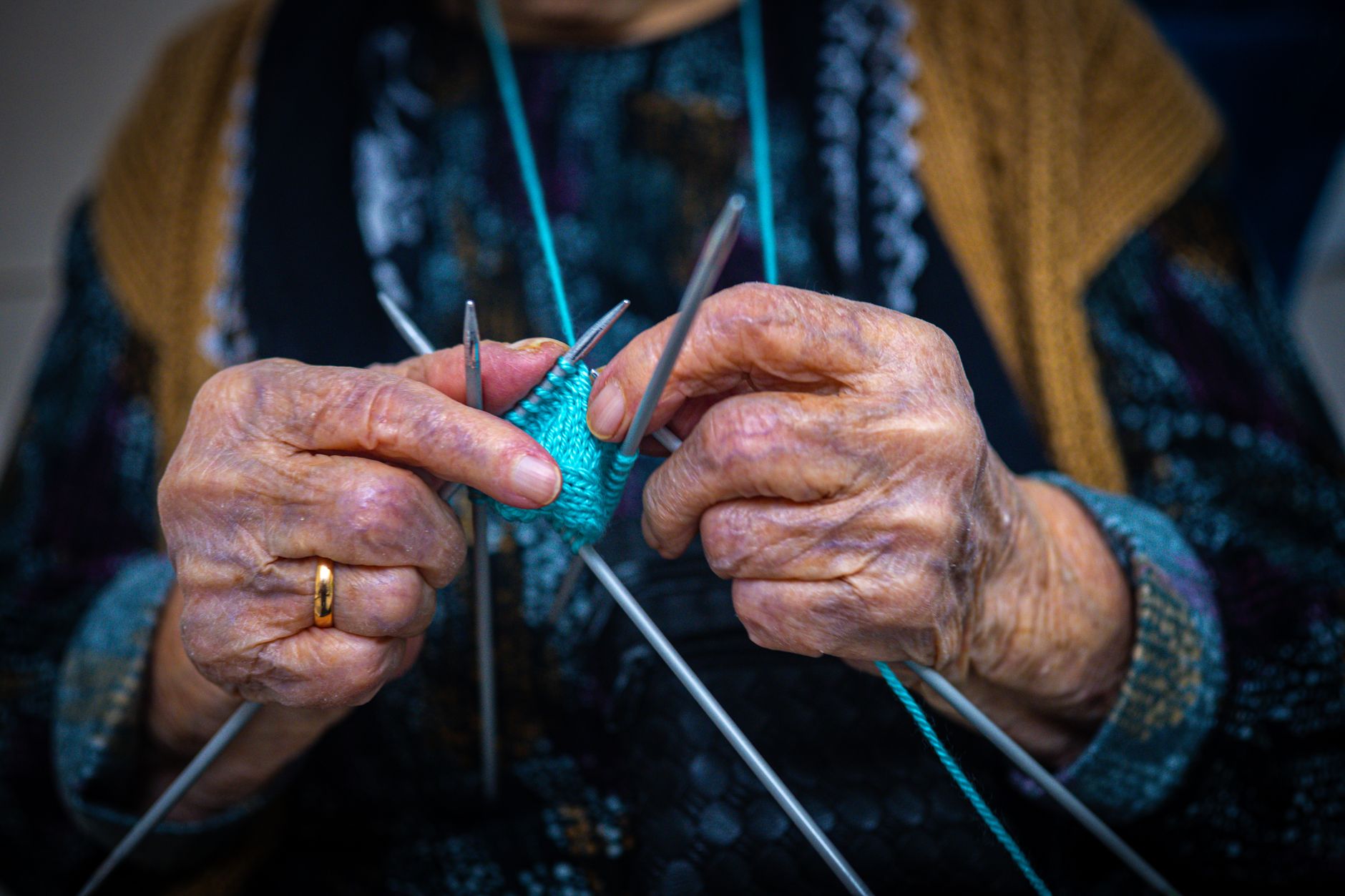
Three months after I buried Walter, I was sitting in my kitchen on a Tuesday evening with nothing in my hands and half my house gone quiet in a way it had never been quiet in forty one years, and I remembered something my own mother used to say, that idle hands in a house of grief are the loneliest thing in the world. I had a bag of yarn in the hall closet that I had bought years earlier for a scarf I never finished, and I sat down that night and taught myself, off a library book and a good deal of unraveling and starting over, how to knit a simple garter stitch shawl, wide enough to cover a person’s shoulders and lap both, warm enough to matter in a room that was always too cold.
I finished the first one in eleven days. I did not know what to do with it once it was done, so I drove it to the county hospital on a Wednesday afternoon, walked up to the nurses’ station on the fourth floor, the same floor where Walter and Halcyon had both died, and asked if there was anyone up there who did not have family close by. There was. There is always someone, in every hospital, on every floor, in every town in this country, and that afternoon it was an eighty three year old man named Merris who had outlived two wives and every one of his own children and was recovering alone from a fall that had broken his hip in a house he was not sure he’d ever get back to.
I carried that first shawl into Merris’s room and I set it on the foot of his bed and I told him it was his to keep, no strings, no visit required, no thank you note expected, and I watched an old man who had not had a single visitor in nine days pull a hand knit shawl up over his shoulders and start to cry in a way that made the nurse in the doorway have to step back out into the hall for a minute herself.
I went home that night and started a second one.
I want to be honest about something, because this is not a story about a saint, and I have never once believed I was one. The shawls were as much for me as they were for anyone lying in that hospital. I had forty one years of a marriage and a farm and a full house behind me, and I had a kitchen table with one chair pulled out from it now, and my hands needed work the way a person needs air, and it turned out that giving something warm to a stranger who had nobody else coming was the only thing in those first hard months that made the nights shorter instead of longer. I have heard people call what I did a ministry, and I suppose by the end it was, but it started as a widow trying to survive her own grief one stitch at a time, and I think the Lord uses exactly that kind of survival more often than we give Him credit for.
I told the church about it eventually, mostly because Pastor Vickers noticed the yarn receipts I was quietly reimbursing myself out of my own household budget every month and asked me, gently, if the benevolence fund could help instead. I said yes, because forty dollars a month is forty dollars a month on a widow’s fixed income, and I have never been too proud to accept help I actually needed. That was the whole of it. Forty dollars a month, no committee, no meetings, no paperwork beyond a receipt I dropped in the church office mailbox once a month. I never asked for recognition. I never once let anyone put my name on a bulletin insert or a prayer chain email. When people asked who made the shawls that kept turning up in hospital rooms all over the county, the hospital staff had taken, on their own, to calling it “the shawl lady,” and I let it stay that way, because the whole point, the entire point of every stitch, was that a person receiving one of those shawls should feel like it came from God’s own hand reaching into a cold room, not from a woman named Enid Halloway who needed something to do with her grief.
Sixteen years. Four hundred and eleven shawls, by my own careful count, kept in a composition notebook I have never shown to a single soul until the week I am about to tell you about. Every color of yarn a craft store in three counties has ever stocked. Newborns in the NICU whose mothers could not afford a going home blanket. Teenagers after car accidents who were embarrassed to be seen crying and could hide behind a shawl pulled up over their face for a minute in private. Veterans recovering from surgeries nobody in their family had time to sit through. Women my own age, sitting alone through a diagnosis their grown children were too far away or too busy to come hear in person. Old men like Merris, who I visited eleven more times after that first shawl before he passed two years later, at which point his daughter, who had finally come from Arizona for the funeral, told me her father had asked to be buried with that shawl folded under his hands, and he was.
I never once asked what happened to a shawl after I left the room. Most people, I assume, kept them a while and then, as life moved on the way life does, let them go, gave them to a thrift store or a grandchild or simply wore them thin over the years the way you wear thin anything you use every day without noticing. I did not need to know. I was not doing it to be remembered. I was doing it because I remembered, every single time I walked onto that fourth floor, exactly what it felt like to sit in a cold room at three in the morning next to a woman named Halcyon who had nobody else coming, and I could not walk past that feeling in another human being for the rest of my life without doing something about it.
Which brings me back to Otto Prewitt and the Tuesday morning board meeting.
Otto joined the church board four years ago, not long after he and his wife moved to Grinnell from Des Moines when he took the assistant manager job at the co-op. He is not a cruel man, I want to say that plainly, because I do not believe cruelty was ever really what drove him. Otto is a man who believes very deeply in order, in ledgers that balance and committees that meet and programs that report their numbers to somebody, and I think, in his own mind, my little shawl ministry looked exactly like the kind of unaccountable, ungoverned, sentimental drift that a church board exists to clean up. He had raised it twice before, quietly, in board meetings I did not attend because I have never in sixteen years been asked to attend one, and each time Pastor Vickers had talked him down, mostly on the strength of a program that cost forty dollars a month and had never once generated a complaint.
What changed, I found out much later, was a new state nonprofit compliance seminar Otto had attended in Des Moines that spring, all about liability and insurance exposure for church-run charitable programs, hospital visitation waivers, background check requirements for anyone entering patient rooms on behalf of an organization. Otto came back from that seminar with a folder full of legitimate, reasonable sounding concerns, and I do not fault him for having them. A hospital visitation ministry that has operated for sixteen years with no formal oversight, no waiver on file, and no background check paperwork is, on paper, exactly the kind of thing a cautious board member is supposed to flag.
What Otto did not have, and what I have come to believe he simply did not think to ask for, was any sense of what those four hundred and eleven shawls had actually meant to the people who received them. He had a line item. He had a risk assessment. He did not have Merris’s daughter, or Halcyon’s story, or the eighty three names in my composition notebook that I had never shown anyone. He stood up that Tuesday morning and moved to discontinue the shawl program pending a full compliance review, a motion that in Otto’s mind was responsible governance and in my ears, sitting three rows back with my yarn bag at my feet, sounded exactly like being told that sixteen years of my grief turned into other people’s comfort had never actually mattered to anyone with the authority to keep it going.
The board voted four to one to table the ministry pending review. Only Pastor Vickers voted no, and even he, God love him, did not fight it the way I think he wanted to, because he is a careful man himself and Otto’s compliance concerns were not, strictly speaking, wrong. I drove home that Tuesday afternoon with my bag of yarn still sitting on the passenger seat where I had set it that morning, and I did not touch a single needle for four days, which had not happened to me in sixteen years, not once, not even the week I had my gallbladder out.
I do not know exactly how word reached the hospital chaplain, a soft spoken man named Reverend Ellsworth Cray who had watched me come and go from that fourth floor for longer than Otto Prewitt had lived in Grinnell. I did not call him. I would not have known what to say if I had. What I learned later was that one of the nurses on the floor, a woman who had been there the whole sixteen years and had personally handed out more of my shawls than I could count, mentioned to Reverend Cray in the break room that the church was shutting the shawl ministry down, and Reverend Cray, without asking my permission and without telling me a single word about it beforehand, began making phone calls.
He did not call to organize a protest. That is not the kind of man he is, and it is not the kind of church Grinnell Community is, either. He called people whose names he had in his own hospital chaplaincy records, people he had prayed with in that building over the years, and he told them, simply, that the woman who had knit their shawl, or their mother’s shawl, or their father’s shawl, was about to lose the small monthly support that let her keep doing it, and that if they wanted to say something about what that shawl had meant to them, Sunday morning at Grinnell Community Church would be the time.
I want to tell you I walked into that sanctuary Sunday morning already knowing what was coming, but I did not. I walked in the way I walk in every Sunday, in my good brown coat, with nothing in my hands for once because I still had not picked my needles back up, and I stopped in the vestibule doorway because the sanctuary was fuller than I had ever seen it, fuller than any Easter, fuller than Walter’s own funeral had been, and there were people standing at the back three deep, and a great many of them, more than I could take in all at once, were holding shawls.
Halcyon’s niece was there, a woman named Persimmon I had never once met, who stood up during the open testimony time Pastor Vickers, visibly moved and a little unsteady himself, decided on the spot to allow, and said that her aunt had died with almost nobody left in this world who remembered her name, and that the last coherent thing Halcyon had said to her on the phone, eleven days before she passed, was that a stranger from her own church had been sitting with her every night so she wouldn’t be alone, and that Halcyon had made her niece promise, if she ever heard that the shawl ministry needed anything, to show up and say so.
Merris’s daughter drove up from a business trip in Kansas City that morning, four hours each way, still in the shawl she’d kept folded in her overnight bag since her father’s funeral two years earlier, and she stood in front of that whole congregation and told them her father died holding a shawl a stranger had made him, and that in the last two years of his life, after that shawl, he had stopped being the loneliest man she had ever known and started, in his own quiet way, being at peace.
A young mother stood up, a woman I remembered vaguely from the NICU three years back, and held up a small worn square that had been a preemie sized shawl for a daughter who was now, she said, laughing and pointing, the loud three year old currently trying to climb over the pew in front of her.
A veteran named Dell, who I had visited after a knee surgery gone wrong left him hospitalized for eleven days with nobody local to check on him, stood up in his VFW cap and said, plainly, that he had served two tours and buried more friends than he had fingers to count them on, and that a widow he had never met before or since had walked into his hospital room one afternoon with a piece of yarn work and had done more for what he called “the thing in his chest that never healed right” than the entire VA had managed in six years.
They kept standing. I lost count somewhere past a dozen, and I want to be honest that I stopped being able to see very clearly after the eighth or ninth one, because I was crying in a way I had not cried since the week I buried Walter, standing at the back of my own church in my good brown coat with my hands empty for the first time I could remember in a very long time.
Otto Prewitt was sitting in his usual pew, third row on the right, and I watched him during all of it, because some part of me, I will admit, wanted to watch. He did not look angry. I want to be fair to him, because he has earned that much from me even now. He looked like a man watching a spreadsheet come apart in his hands and discovering, in real time, in front of the entire congregation, that some of the numbers he had been counting had never actually been numbers at all.
When the testimonies finally slowed, Pastor Vickers, who I do not think had planned any of this and was working entirely off the cuff, asked if anyone on the board wanted to respond. There was a long quiet in that sanctuary, the particular quiet of ninety, maybe two hundred people, all waiting to see what a man does with being wrong in public.
Otto stood up. His voice was not steady, and I want to say that in his favor, because a man who can stand up in front of a packed sanctuary and let his voice shake is a man who is at least being honest about what the moment costs him. He said he had gone into that Tuesday meeting thinking about waivers and insurance exposure and the responsible governance of church resources, and that every single one of those concerns had been, on paper, legitimate. He said what he had not done, not once in four years on that board, was ask a single person who had actually received one of Enid’s shawls what it had meant to them, and that he was ashamed, standing there, of how easily a room full of careful, well meaning people had come within one vote of ending something because none of them had bothered to ask.
He did not stop there. Otto Prewitt, the man who had used the words “lack of oversight” twice without once looking at me directly, turned around in that sanctuary and looked at me standing at the back of it, and said he was sorry, out loud, in front of everyone, and asked if the board could revisit the vote that same week, not to strip away my privacy or force paperwork on me that would make the ministry feel like a compliance exercise instead of a calling, but to find a way to support what I was doing properly, with real board backing instead of a forgotten line item, while still handling the legitimate liability questions in a way that protected both the church and me.
I did not answer him right away. I want to be honest about that too, because forgiveness is not always instant, even in a church, even from a woman who has spent sixteen years believing in exactly the kind of grace Otto was asking me for. I stood at the back of that sanctuary for a long moment with two hundred people waiting to see what I would say, and I thought about Halcyon, and about Merris holding a shawl under his folded hands in a casket, and about how none of what those shawls had done in this world had ever, not once, depended on whether a church board understood it.
What I said, when I finally found my voice, was that I had never done this work to be seen, and that some part of me was going to have to make peace with the fact that on that particular Sunday, I had been seen anyway, by more people than I had ever imagined were carrying my work around in their own homes. I said that I forgave the board, because I understood that caution is not the same thing as cruelty, and that a church which asks hard questions about liability is not a church that has lost its heart, even when it briefly loses its way. And I said, because it needed saying out loud in that room, that I would keep knitting shawls whether the board voted to fund the yarn or not, because I had started this work with nothing but a library book and a broken heart, and I would keep doing it the same way if I had to, but that I would be grateful, deeply grateful, for the church’s support if they meant to give it honestly this time.
The board met again that Thursday, and this time they asked me to come, the first time in sixteen years anyone had thought to invite me into the room where decisions about my own ministry got made. We worked out, together, a simple, light touch arrangement: the church would formally back the ministry and increase the yarn budget, Reverend Cray at the hospital would handle the waiver and visitation paperwork on his end since he already had the relationship with hospital administration, and I would keep doing exactly what I had always done, walking those halls with a bag of yarn work and no name attached to any of it, except now with a church quietly and properly standing behind me instead of barely tolerating me out of habit.
Otto Prewitt drove out to my house himself, three weeks later, unannounced, on a Saturday afternoon. I was in my kitchen with a shawl half finished in my lap, a soft green one for a young man recovering from a farm accident two rooms down from where Walter used to lay, and I saw Otto’s car in the drive and felt my stomach tighten the old familiar way before I remembered there was nothing left between us to be tense about. He stood on my porch and asked if he could come in, and when I said yes, he sat at my kitchen table, the same table where I had knit that first shawl for Merris sixteen years before, and he told me that his own mother had died alone in a hospital in Des Moines eleven years ago while he was traveling for work, and that he had never once forgiven himself for not being there, and that some part of what had made him so quick to shut my ministry down, if he was honest with himself, was that he could not stand to look at proof, every single week, of exactly the kind of presence he had failed to give his own mother when it mattered.
I did not have anything wise to say to that. I am not, whatever that Sunday morning might have suggested, a particularly wise woman. I am a widow who taught herself to knit out of grief and kept doing it because it helped, and I told Otto the only true thing I knew, which is that the Lord does not keep a ledger of who showed up and who didn’t, only of who is willing to show up now, and that his mother, wherever she is, does not need his guilt nearly as much as some stranger in that hospital right this week needs a warm shawl and five minutes of somebody’s undivided attention.
Otto has come with me to the hospital eleven times since that Saturday. He does not knit, and I have told him plainly I have no intention of teaching a grown man with a co-op job and no patience for garter stitch, but he carries the bag, and he sits with me in rooms where I visit people, and twice now he has sat alone, at my suggestion, with a patient who needed company more than they needed a shawl, and come back to the car afterward with his eyes red in a way a man like Otto Prewitt does not let show easily.
I am sixty nine years old now, and I have made four hundred and thirty six shawls as of this writing, the newest twenty five stitched since that Sunday, each one still carried into a room with no name attached, no signature, no receipt. I still do not know what most people do with them after I leave. I have stopped needing to know. What I know now, what that Sunday taught me in a way sixteen quiet years never quite had the occasion to, is that the not knowing was never the point, and that a whole sanctuary full of strangers had been quietly keeping count of what I gave away long after I had stopped counting it myself.
My composition notebook sits on the same kitchen table where Otto Prewitt confessed his mother’s death to me, four hundred and thirty six names long now, and some Sunday evenings, after church, I sit with a cup of tea and read back through it, and I think about Walter in his vinyl recliner and Halcyon two doors down and Merris buried with a stranger’s shawl folded under his hands, and I think about how none of it, not one single stitch of it, was ever really about the yarn. It was about a woman with nothing to do with her hands walking into a cold room in the middle of the night because she remembered, better than almost anyone, exactly what it felt like to need somebody to walk in.
This story is a dramatization. Names, characters, and details are invented, and any resemblance to real people or events is coincidental.