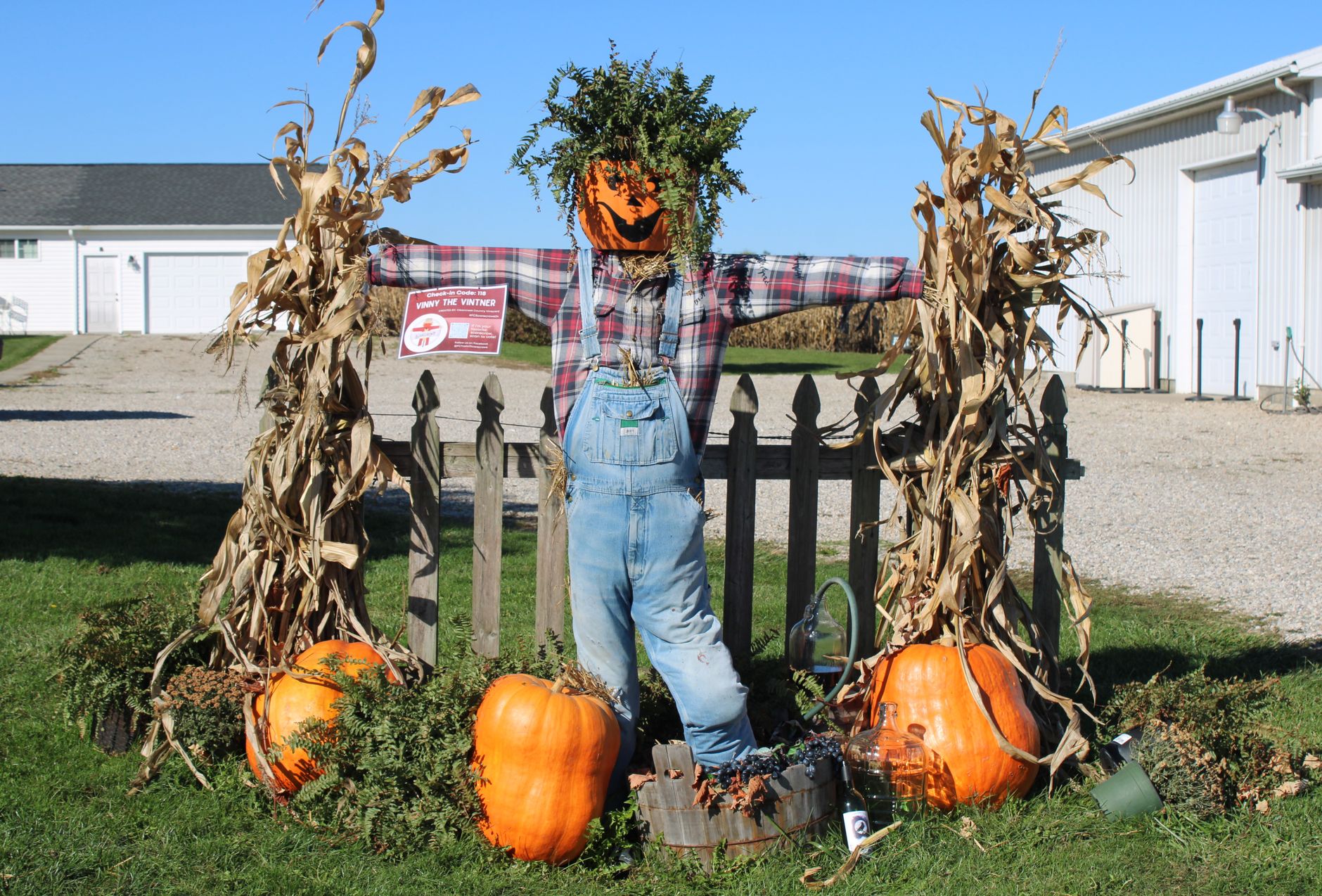
The Scarecrow Contest That Ended Our Feud
For ten years I lost the Harlow County autumn scarecrow contest to the same man, and for ten years I told anybody who would hold still that Amos Pruett was the most insufferable human being ever to stuff a flannel shirt with straw.
I want you to understand I did not arrive at that opinion lightly. I am sixty-nine years old. I have buried a husband, raised a son who lives in Denver and calls on Sundays, and served on the Harlow County Harvest Festival committee for so long that the folding chairs in the church basement have my shape worn into them. I am not a woman who holds grudges for sport. But Amos Pruett had earned mine fair and square, first place ribbon by first place ribbon, every October for a decade, and I had the drawer full of second place ribbons to prove it. Red, every one. A whole drawer of the color you get for being not quite good enough.
The contest is the heart of our festival. You have to understand that too. Harlow is not a big place. We are a square of brick storefronts around a courthouse with a clock that runs four minutes slow, a feed store, two churches that compete over the same forty families, and a diner called the Hen House where the coffee is bottomless and so is the gossip. Once a year, the whole town square fills up with scarecrows. Everybody builds one. The Ladies Auxiliary, the 4-H kids, the volunteer fire department, families, widows, the man who runs the hardware store. They go up along the sidewalks and around the gazebo, and for one weekend our little town looks like something off the front of a calendar. People drive in from three counties. The bakery sells out of everything. And on Saturday at noon, the judges walk the square with their clipboards and pick a winner, and for ten years the winner had been Amos.
My name is Glenna. I have been building scarecrows since before I could vote. My mother taught me, on the farm where I grew up, and she taught me that a scarecrow is not a pile of clothes on a stick. A scarecrow is a person you invent. She used to say you had to know his whole life before you gave him a face. What did he do before he stood in a field? Who did he love? Why is he sad in the shoulders, or proud in the chin? You build the story first, she said, and the straw comes after.
So that is how I build them. Every September I sit at my kitchen table with a cup of tea going cold and I dream up a person. One year it was a train conductor who had missed the last train home and stood forever at his post. One year it was a fisherman’s wife watching the harbor, though we are four hundred miles from any harbor. One year it was my own mother, though I never told a soul that one was her, in her Sunday dress with the little pearl buttons, one hand raised like she was about to correct my posture. I put my heart into them. I put my whole self into them. And every single year, Amos Pruett beat me with a scarecrow that looked, to my eye, like he had thrown it together in a Saturday afternoon.
His were funny. That was his trick. Where I was building sorrow and memory and the ache of a whole invented life, Amos was building jokes. One year he made a scarecrow of a fisherman with an enormous rubber fish that was clearly winning the fight, the man bent backward, straw arms flung wide, hat flying off. Children screamed with laughter. One year he built a scarecrow stuck halfway up a ladder to nowhere, looking down in comic terror, and everybody who walked by pointed and grinned. He built a bride and groom scarecrow where the bride was chasing the groom with a rolling pin. He built a scarecrow of the mayor, which should have gotten him disqualified and instead got him the front page of the county paper.
And every year the judges gave him the blue ribbon, and every year I stood there with my beautiful mournful figure and my red ribbon and I wanted to throw straw at his smug, sun spotted, grinning face.
I should tell you about the face, because the face was the worst part. Amos was a tall man, gone stooped now, with a head of white hair he never combed and a way of putting his hands in his overall pockets and rocking back on his heels when he’d won something. He rocked back on his heels a lot in my presence. He would find me at the awards table, where they served the cider, and he would say, “Well, Glenna, another year, another ribbon for you,” and he would say ribbon the way you’d say consolation, and rock back on his heels, and I would smile at him with all my teeth and say, “Enjoy it while it lasts, Amos,” and go home and not enjoy anything for a week.
Suzette, my best friend since the Nixon administration, used to tell me I was letting him live in my head rent free. Suzette runs the Hen House and hears everything and forgives most of it. “You know what your problem is,” she said one September, sliding me a slice of pie I hadn’t ordered. “Your problem is you take it serious and he takes it fun, and fun wins with judges every time. You want to beat him, put a joke in it.”
“I don’t build jokes,” I told her. “I build people.”
“Then keep losing,” she said, “and keep complaining, and I’ll keep bringing you pie.” Which was fair, and which is friendship, and which did not solve one thing.
I want to be honest about how deep it went, because otherwise you will not understand the size of what came later. It was not just the contest. Amos had gotten in under my skin in a way I could not scrub out. I would be pulling weeds in October and catch myself arguing with him in my head. I would be at the feed store and hear his laugh two aisles over and turn my cart around to avoid him. Once, at a funeral for a woman we had both known since grade school, I saw him across the fellowship hall and I actually walked out to the parking lot rather than stand near him over the ham and the deviled eggs. My son called me on it, the one who lives in Denver. He said, “Mom, you spend more time talking about this Amos fellow than you spend talking about anything else. You sure you two aren’t sweet on each other?” I told him that was the most disgusting thing he had ever said to me and I hung up on him, and then I sat in my kitchen and felt my face burn, because there is nothing worse than a grown child who is a little bit right.
That was where the ten years had left me. A drawer of red ribbons. A rival I had decided was my enemy. And a festival I loved with my whole heart, right up until noon on Saturday.
And then, the year I turned sixty-nine, the whole thing nearly came apart.
It started at the September committee meeting, in the church basement, under the flickering fluorescent light that the deacon has been promising to fix since the second Bush. Bernadette Colley, who chairs the committee and wears her reading glasses on a beaded chain, called us to order and then just sat there for a moment with her hands flat on the table, and I knew before she said a word that something was wrong.
The festival was going to be canceled. That was the size of it. The insurance the county carried on public events had come due, and the premium had tripled, some new rule about liability at gatherings over a certain size, and the town simply did not have it. The little budget that ran the festival, the money from the pancake breakfast and the raffle and the dues, it did not come close. Bernadette had spent two weeks on the phone. There was no money. There was, she said, and her voice cracked on it, likely not going to be a festival this year.
You would have thought she’d announced a death. In a way she had. That festival is the one weekend a year our town gets to be proud of itself out loud. It is where the young people who moved away come home. It is where the widows have somewhere to be. It is where my son, the one time he brought his girlfriend to meet me, finally understood where I came from, walking that square full of scarecrows with his mouth a little open. You cancel that and you don’t just cancel a weekend. You tell a town it isn’t worth the trouble.
The basement went quiet and then loud, everybody talking at once, and over all of it I heard one voice cut through, low and certain, and it belonged to Amos Pruett.
“How much,” he said. “Just the number, Bernadette. How much are we short.”
She told him. It was a big number for Harlow. Not a big number for the world, but for us, a mountain.
Amos nodded slow, the way he does, and put his hands in his pockets, and did not rock back on his heels for once. He looked, for the first time in the ten years I had known him to nod at across a cider table, like a tired old man.
“Then we raise it,” he said. “We got six weeks. We raise it or we don’t have a town worth living in.”
And Bernadette, God help her, looked around that room full of people who were mostly north of seventy, and said, “It would take the two of you.” And she looked at me, and she looked at Amos. “It would take the both of you working it. You two are the only ones who can pull a crowd around this contest, and the contest is the only thing that pulls a crowd worth charging admission to. If there’s a fundraiser to be built around it, you build it together, or there’s no festival to have a contest at.”
I want to tell you I rose to the occasion with grace. I did not. I said, “Absolutely not.” I said it fast and I said it loud, and I heard how it sounded even as it came out of me, small and selfish, a woman more attached to her feud than her town.
Amos didn’t say absolutely not. Amos looked at me across that folding table, under that dying fluorescent light, and he said, quiet, “Glenna. It’s the festival.”
And that was all. It’s the festival. Not a word about ribbons. Not a rock back on the heels. Just those three words, and something in his old face I had never let myself look at before, because for ten years I had been too busy resenting the top of his head at the awards table to ever look him in the eye.
I said yes. Of course I said yes. Suzette was there and she’d have never let me hear the end of it if I hadn’t. But I said it like a woman agreeing to eat glass.
We met the next morning at the Hen House because that is where anything real in Harlow gets decided. Suzette put us in the corner booth and brought coffee and did not linger, which for Suzette is a small miracle. Amos had a legal pad. That surprised me. He’d come with a legal pad and a pencil behind his ear, and he sat across from me and clicked the pencil against the pad and said, “All right. What if the contest is the fundraiser.”
“It already is the contest,” I said. “People come for free.”
“So we make it not free,” he said. “We make it a build. A community build. We charge a fee to enter, we charge a fee to walk the extra part of the square where the big ones go, and we make the whole town want to be in it, not just watch it. And you and me, we headline. We build the two biggest scarecrows this county has ever seen, and we let people pay to vote.”
I looked at him. I hated that it was a good idea. I hated it so much I had to look out the window at the courthouse clock, four minutes slow, to keep my face from telling him.
“People pay to vote,” I said slowly.
“A dollar a vote,” he said. “Vote as many times as you like. Yours against mine. The Glenna and Amos showdown, ten years in the making, winner takes the blue ribbon and the town takes the money. Every dollar goes to the festival. We turn our whole stupid feud into the thing that saves it.”
And there it was. He had taken the one thing I was most ashamed of, the ten year grudge I nursed like a houseplant, and he had turned it into a gift for the town. I felt about two inches tall. I also, and I will be honest with you because it is too late to be anything else, felt the first flicker of something I had not felt toward Amos Pruett in a decade. It was respect. It was awful.
“Fine,” I said. “But I’m going to beat you.”
For the first time in ten years, Amos Pruett grinned at me and it did not make me want to throw straw. “Glenna,” he said, “I have been waiting ten years for you to try.”
So we built the fundraiser. And here is the part I did not see coming, the part that snuck up on me over six weeks of autumn: we built it together.
We had to. You cannot organize a countywide event out of two separate kitchens with a feud between them. So we met, most mornings, in that corner booth. We split the town in two and worked our halves and reported back. Amos took the businesses, the feed store and the hardware store and the bank, because Amos had done favors for every man who ran a business in Harlow and it turned out he had been doing them quietly for years. I took the churches and the auxiliary and the school, because those were mine. We made lists. We made calls. We argued about the price of admission and the layout of the square and whether to let the 4-H kids build a joint scarecrow, which I was against and Amos was for and Amos won because he was right, the kids would bring their parents and their parents would bring their wallets.
And somewhere in those six weeks, over bad diner coffee and a shared legal pad, I stopped hating him.
I learned things. You learn things about a man when you work beside him that you never learn across a cider table. I learned that Amos had lost his wife, Perry, eleven years back. I did the arithmetic on that before he finished the sentence. Eleven years. He started building scarecrows ten years ago. The year after.
“They were her thing,” he told me, not looking up from the legal pad, drawing little boxes in the corner the way men do when they’re saying something hard. “Perry loved that festival. She built the funny ones. She was the funny one, not me. I never had a joke in my life until I married her, and then I had thirty-one years of them.” He clicked the pencil. “First October after she passed, I couldn’t stand the quiet of the house, so I went out to the shed and I built one of her scarecrows. A funny one. Best joke I could think of, because that’s what she’d have done. And it won.”
I sat very still.
“And I thought,” Amos said, “well. She’d have laughed at that. So I did it again the next year. And the next.” He finally looked up at me, an old man in a diner booth, and there was water standing in his eyes that he was too proud to let fall. “I wasn’t beating you, Glenna. I never once thought about beating you. I was keeping a promise to a funny woman I miss every single day. Those weren’t my jokes up on that square. Those were hers. I was just the fellow holding the straw.”
I have thought about that morning more than I have thought about almost any morning in my life. Ten years. Ten years I had built a wall out of a man’s grief and called him insufferable. Ten years I had stood at that cider table wanting to throw straw at a widower who was, every October, standing in a public square telling his dead wife he still remembered how she laughed.
“Amos,” I said, and my voice was not steady. “I’m so sorry. I didn’t know.”
“Course you didn’t,” he said, gruff, wiping his eyes with the back of his hand and pretending it was allergies. “I never told you. I never told anybody. You want to know the truth, I liked that you fought me. Everybody else in this town treats me like a sad old man who lost his wife. You treated me like a rival worth beating. You have no idea, Glenna, how good it feels to be somebody’s enemy instead of everybody’s charity case.”
I laughed, because he wanted me to, and because it was true, and because if I hadn’t laughed I’d have cried right there in the Hen House and Suzette would have wanted to know why for the rest of our natural lives.
“Then let’s give this town a fight worth paying for,” I said.
And we did. Lord, we did.
The fundraiser caught fire. That is the only way I can describe it. When word got around that Glenna and Amos had buried the hatchet and gone into business together to save the festival, the whole county wanted a piece of it. Bernadette put a jar on the counter at the Hen House and it filled up twice a day. The feed store donated the straw. The hardware store donated the lumber. The bank matched the first thousand dollars, which Amos got out of the manager over a handshake I was not privileged to witness but which I suspect involved thirty years of quiet favors coming due. The school kids made posters. The county paper ran a story with a picture of the two of us in the booth, and the headline said RIVALS UNITE TO SAVE HARVEST FESTIVAL, and Amos cut it out and taped it to the wall of the Hen House where it still hangs.
But the centerpiece, the thing that pulled the crowd, was the showdown. Glenna versus Amos. Ten years in the making. A dollar a vote, winner takes the blue ribbon, the town takes the money. We built it up for six weeks. We did it on purpose, the two of us, playing the feud for the crowd even though the feud was gone, because a town will pay to watch two old friends pretend to be enemies far more than it will pay to watch two old enemies admit they’ve become friends. That was Amos’s idea. That was pure Perry, he said, and he grinned when he said it.
I built the best scarecrow of my life. I will not be modest about it. I built my mother.
Not in secret this time. This time I told Suzette, and I told Amos, and I built her the way I had wanted to build her for years but had never dared, because she was too precious to risk losing to a rubber fish. My mother in her Sunday dress with the little pearl buttons, one hand raised, but this time I got the face right, I got the exact expression she wore when she was proud of you and trying not to show it, the pressed lips and the shine in the eyes. I built the woman who taught me that a scarecrow is a person you invent. And I made her real enough that when I stood her up in the square the morning of the contest, Suzette came around from behind the counter and stood in front of her and put her hand over her mouth and said, “Glenna. Oh, Glenna. That’s Mae. That’s your mama.”
And Amos built his.
I didn’t see it until the morning of. We’d agreed to keep them hidden until the square opened, part of the show. So I did not know what he’d made until I walked out onto that square at eight in the morning with the mist still burning off the courthouse lawn and the whole town gathering and the smell of the bakery going and the cider warming, and I saw, across the square from my mother, the scarecrow Amos Pruett had built for the biggest showdown of both our lives.
And this is the part I have to slow down for, because this is the whole story, really. Everything before it was just the ten years it took to get here.
Amos had not built a joke.
For ten years, every single October, that man had built a funny scarecrow to keep a promise to his wife. And this year, the year that mattered most, the year the whole town was watching, the year he could have gone out on a laugh and taken his eleventh blue ribbon in a walk, Amos Pruett had built something else entirely.
He had built two scarecrows.
He had built a man and a woman, sitting side by side on a wooden bench he’d made himself, the kind of bench you’d find outside a feed store. The man was clearly Amos. White hair that wouldn’t comb, overalls, hands in his pockets. And the woman beside him, in a yellow dress, with her head tipped back and her straw mouth open in the biggest, most joyful laugh you ever saw stitched onto burlap, one hand on the man’s knee, the whole body of her caught mid laugh, alive with it, was Perry. He had built his wife laughing. He had spent his eleventh year, and the biggest stage he would ever have, not on a joke, but on the woman who taught him all his jokes, finally letting the whole town see her the way he saw her every single day.
And he had built himself beside her, not laughing. Looking at her. Just looking at her laugh, with an expression I had spent ten years never once bothering to notice on the living man, an expression of pure, quiet, breaking love.
I stood in the middle of that square, between my mother and his wife, and I forgot entirely about the contest.
The crowd found it about the same time I did. I watched it move through them. People would walk up laughing, expecting Amos’s usual gag, and they would read the little card he’d propped at the base, and they would go quiet, and they would take off their hats. The card said, in Amos’s blocky hand: PERRY PRUETT, WHO BUILT THE FUNNY ONES. I MISS HER LAUGH. Somebody’s grandmother started to cry. Then somebody else. By nine o’clock there was a line to see it, a real line, quiet and reverent, folks waiting their turn to stand in front of a straw woman laughing on a bench and remember somebody of their own.
They paid their dollars. Lord, did they pay. But not the way we’d planned. Nobody wanted to vote against Perry. And nobody wanted to vote against my mother either, once Suzette got done telling everyone in the pie line who she was. People started putting their dollars in both jars. Then they started putting in fives and tens and not voting at all, just giving, just wanting to be part of a morning that had turned into something none of us had planned, two old rivals who had each, it turned out, been building the same thing all along. Grief. Love. The people we’d lost. We had just been calling it a contest.
At noon the judges came with their clipboards, and Bernadette walked out to the gazebo to announce the winner, and she stood there with the paper in her hand and she looked at Amos’s bench, and she looked at my mother, and she looked at the crowd, and she put the paper down.
“There’s no winner this year,” Bernadette said, and her voice was thick. “Or there’s two. The committee has decided the blue ribbon goes to both of them. Because I have lived in this town my whole life and I have never once, not one time, seen it come together the way it came together this fall. And I’ll tell you the number.” She held up the festival ledger. “We didn’t just make the insurance. We tripled it. Harlow is going to have its festival for the next three years running, paid in full, because two stubborn old people finally sat down in a booth together.”
The square erupted. And Amos Pruett walked across it, past ten years of ribbons, past his laughing wife and my proud mother, and he stood in front of me and he did not rock back on his heels. He put out his hand.
“Glenna,” he said. “Best rival I ever had.”
I did not shake his hand. I hugged the old fool, right there in the middle of the square, with the whole town watching, and I said into his shoulder where nobody could hear, “She’d have loved this, Amos. Perry would have laughed her head off.”
“I know it,” he said, and his voice broke clean in two. “I know she would.”
That was three autumns ago. We still build together, Amos and I, in the shed behind his place, because he has the better shed and I have the better eye and neither of us is willing to say so out loud. We are the best of friends now, the kind you only get late in life, the kind that come out of the thing you spent years fighting. Suzette says we should have skipped the ten years of feuding and gone straight to the friendship, and maybe she’s right, but I don’t think so. I think we needed the fight. I think Amos needed somebody to treat him like a rival worth beating so he could feel like a man again instead of a widower. And I think I needed to lose ten times to a joke before I could understand that the joke was a love letter all along.
The festival is thriving. The jar on the counter at the Hen House pays for it now, year round, and folks in three counties know Harlow as the town with the scarecrows. And every October, in the square, side by side, we put them up. My mother, one hand raised, proud and trying not to show it. And Perry Pruett, on her bench, head thrown back, laughing forever.
Amos sits with her sometimes, on the real bench beside the straw one, in the early morning before the crowds come. I bring two coffees and I sit with them, the three of us, an old man and an old woman and the wife who taught us both what we were really building.
For ten years I thought I was losing a contest.
I was only waiting to meet my best friend.
This story is a dramatization. Names, characters, and details are invented, and any resemblance to real people or events is coincidental.