The Quilts She Sewed for the Grieving
I had threaded a needle ten thousand times in that church, and not once did I imagine the day a man would stand at the front of it and tell everyone that what I made did not matter anymore.
His name was Reverend Grady. He was thirty-one years old, and he had been our pastor for exactly five weeks when he canceled my ministry from the pulpit, in front of the whole congregation, the way you might announce that the parking lot would be repaved.
I was sitting in the fourth pew on the left, the same pew I had sat in for the better part of forty years, with my reading glasses pushed up into my hair and a half-finished quilt block folded in my lap because my hands do not know how to be still even on a Sunday. And I listened to a boy young enough to be my grandson explain to a room full of grieving and grateful people that the quilt ministry was, in his words, “an outdated use of our space and our budget,” and that going forward, the room where I had worked for four decades would be converted into a media production studio.
I want to tell you the whole of it. Not the angry part first, because there was an angry part and I am not too proud to say so. But the whole of it, the way it really happened, because what came after taught me something about my own life that I had managed to miss for forty years while I was busy living it.
My name is Frances. I am seventy-eight years old. And for most of those years, I have been sewing.
Let me take you back to the beginning, before Reverend Grady, before any of it.
I came to Bethel Chapel in the autumn of 1985, a year after I buried my husband, Walter. He was fifty-one when his heart gave out in the driveway on a Tuesday morning while he was scraping frost off the windshield. I found him there. I will not dwell on that morning, except to say that grief is a thing that arrives all at once and then refuses to leave for a very long time, and in those first months I did not know what to do with my hands or my evenings or my life.
A woman from Bethel, a widow herself named Ada, came to my door about three weeks after the funeral. She did not bring a casserole. Half the county had brought casseroles, and they sat in my refrigerator turning gray because I could not bring myself to eat. Ada brought a quilt. It was not new. It was worn soft at the edges and it smelled faintly of cedar, and she set it in my arms and said, “You don’t have to talk. Just keep this on your bed. It’s been on a lot of beds. It knows what it’s doing.”
I did not understand her then. I understood her later.
I slept under that quilt every night for two years. And I will tell you, there is a particular loneliness to a widow’s bed, the cold half of it where a body used to be, and that quilt did not fill the space, nothing fills the space, but it weighed on me like a hand on the shoulder. It told me I was not the first woman to lie awake in a half-empty bed, and I would not be the last, and somewhere out there were women who had survived this exact ache and gone on to fold quilts for the next one.
When I asked Ada who had made it, she said she didn’t know. “Nobody signs them,” she told me. “That’s the whole point. You don’t make it to be thanked. You make it so somebody has something to hold when there’s nothing left to hold.”
Ada died in the spring of 1987. And at her funeral, sitting in that same fourth pew, I made up my mind. I was a seamstress by trade. I had hands that knew fabric the way some people know music. And I decided that for as long as my eyes and my fingers held out, no family at Bethel Chapel would walk through a death or a long hospital stay without a quilt arriving at their door. No note. No name. Just a quilt, folded on the porch or slipped into a hospital bag, that knew what it was doing.
I made the first one for the Brennan family, who lost a son in a car accident on the highway. I left it on their porch at dawn. I never told a soul. And I have not stopped since.
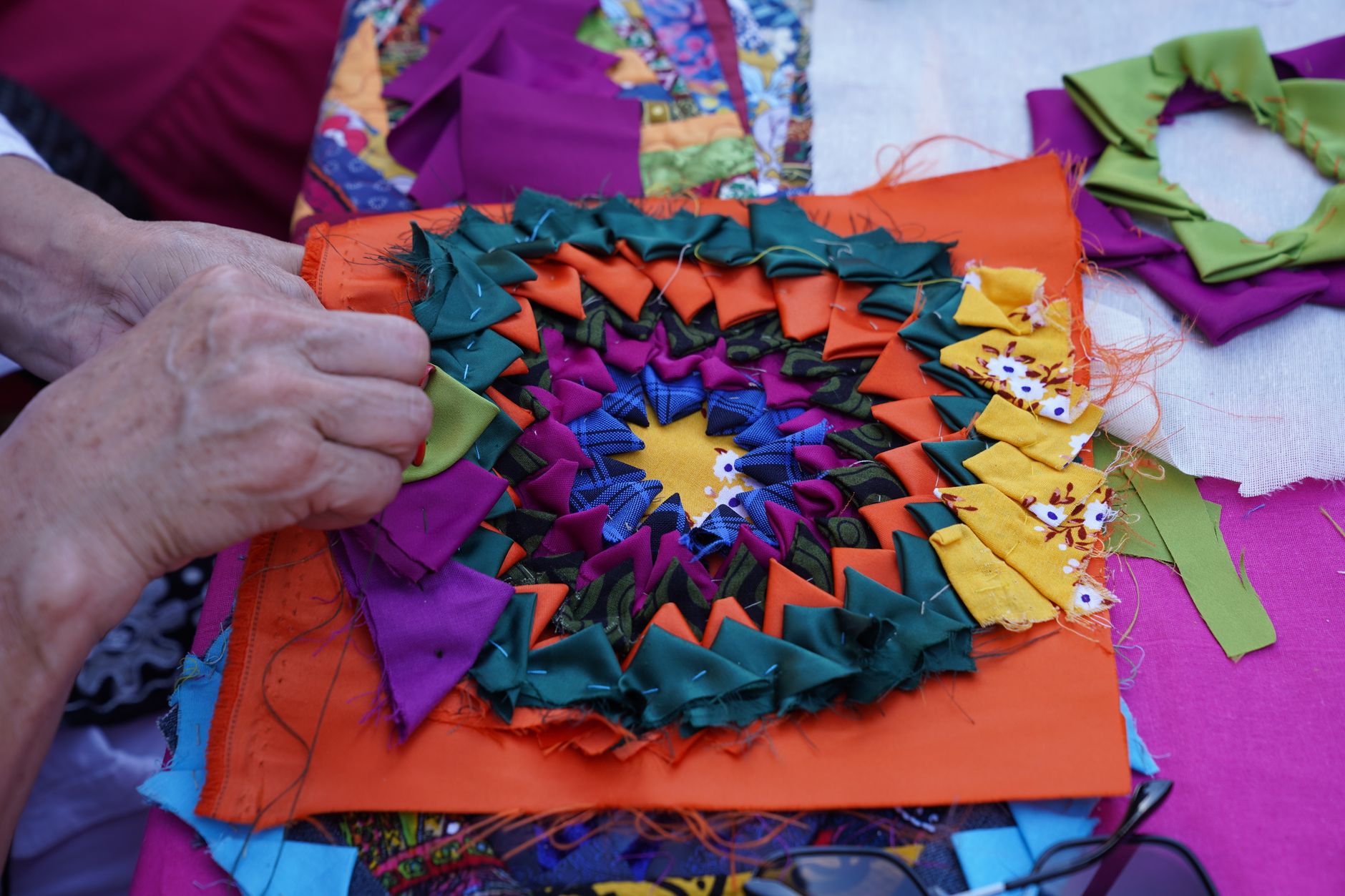
I want you to know what one of those nights was actually like, because it is easy to say “I made a quilt” the way you might say “I baked a pie,” and it was never that. The night before the Brennan boy’s funeral I sat up until almost three in the morning with the radio off and the lamp pulled close, hand-stitching the binding by the light of a single bulb because my eyes were better then but the thread is dark and the fabric is dark and grief does not improve your vision. I had cut every square from shirts and dresses I had been saving for years, the way a seamstress saves the good scraps the way other people save string. I pricked my finger twice and bled on the muslin and had to pick the stitches out and start again, because you cannot send a family a quilt with your own blood in it, that is not the gift. And the whole time I was thinking about that mother, whom I barely knew, lying awake the way I had lain awake the year before, in a house where a bed has gone half-empty and the silence has a shape to it. I was not making a blanket. I was trying to reach across town in the dark and put my hand on a stranger’s shoulder, and the only way I knew how to do that was one stitch at a time. By the time I tied off the last knot the birds had started, and I drove over with the headlights off so as not to wake anyone, and I set it on the porch swing and I drove home and I slept like the dead. That was the first one. There were two hundred more nights like it, give or take, and they did not get easier, and I would not have traded a single one.
Forty years.
I do not know the exact number. I stopped counting somewhere around the two hundred mark, and that was a long time ago. I sewed through eight pastors. I sewed through three church roofs and two furnaces and a fire in the fellowship hall in 1998. I sewed through the loss of my own eyesight in one eye and the slow stiffening of these knuckles into the knotted things they are now. I sewed at my kitchen table at first, and then, when a kind old pastor named Reverend Hollis offered me the small storage room behind the sanctuary, I sewed there.
That room. I should tell you about that room, because that room is where the trouble started.
It was nothing to look at. Cinderblock walls painted the color of weak tea. A single high window. A space heater that rattled. But over forty years I had made it mine. There was my machine, an old Singer that Walter bought me for our tenth anniversary, still running, still true. There were the shelves of fabric, organized by color the way other people organize books. There were the donated scraps, the bins of batting, the coffee can of buttons that had outlived the shirts they came from. And there was the corner where I kept the quilts that were finished but waiting, the ones I made ahead of time because grief does not schedule itself and you cannot start a quilt the day you need it.
I went to that room every Tuesday and Thursday and most Saturdays for forty years. Sometimes other women came and sat with me and we sewed together and talked about nothing, the blessed nothing of women who trust each other. But mostly it was just me and the rattle of the heater and the hum of the Singer.
And then Reverend Hollis retired, and the search committee, in their wisdom, brought us Reverend Grady.
I do not want to be unfair to him. So let me be fair first.
He was not a bad young man. He was earnest. He had ideas, a great many of them, and he had a way of talking about “growth” and “reaching the next generation” and “meeting people where they are” that made the younger families lean forward and made the rest of us fold our hands a little tighter in our laps. He had a laptop he carried everywhere and a way of saying “let’s circle back” that I never did learn the meaning of. He wanted to put the words of the hymns up on a screen so nobody would have to hold a hymnal. He wanted a coffee bar in the narthex. He wanted, above all, to film the services and put them on the internet, so that, as he said, “our reach can extend beyond these four walls.”
And to film the services the way he wanted, with the lights and the cameras and the man at the computer, he needed a room. A room near the sanctuary. A room with a single high window that could be blacked out.
My room.
He came to see me on a Thursday. I remember because I was finishing a quilt for the Okafor family, whose grandmother was in her last days at Mercy General, and I had the binding pinned and I was hand-stitching it down, which is slow work and the work I love most. He knocked on the open door and came in and looked around the room the way a man looks at a house he intends to buy, and I knew before he opened his mouth that he did not see what I saw.
He saw clutter. He saw an old woman and an old machine and a lot of fabric. He saw square footage.
“Miss Frances,” he said, “I’ve heard so much about your sewing. It’s wonderful. It really is. Such a heart for service.” And then he asked me how often the ministry “produced,” and how many “active participants” it had, and whether we had ever “measured our impact.”
I told him I made a quilt for every family that lost someone or had someone in the hospital. I told him I had been doing it since 1985.
He nodded and said that was beautiful, just beautiful, and he made a note on his laptop, and he asked whether the families had ever expressed, in any “documented way,” that the quilts were meaningful to them.
I told him I did not sign the quilts, so the families did not know who to thank, and that was on purpose.
He smiled at me. It was a kind smile and it was the worst thing he could have done, because it was the smile you give a child who has told you something that is sweet and irrelevant. “Well,” he said, “that’s the thing, isn’t it. In ministry today we really have to be able to show the fruit. We have to steward the resources. And I’ll be honest with you, Miss Frances, a room this size, this close to the sanctuary, with the AV potential it has, we have to think about the highest and best use.”
Highest and best use. He used that phrase. I have built a quilt out of less.
He told me he would be bringing it to the congregation. He told me there were other places I could sew. He mentioned my own kitchen. He mentioned, and I will never forget this, that perhaps the quilting could become “more of a seasonal thing, around the holidays, when people are looking for that kind of activity.”
That kind of activity. As if I had spent forty years on a hobby.
I did not argue with him. I am ashamed of that now and I was ashamed of it then, but I have never been a woman who argues, and something in me had gone very quiet and very far away while he talked. I just nodded, and I picked my needle back up, and when he left I sat there for a long time with the Okafor quilt in my lap and I did not cry, exactly, but I came close.
That Sunday, he announced it from the pulpit.
He did it gently, I will grant him that, gently the way you put down an old dog. He thanked me by name. He said the church was so grateful for “Miss Frances and her years of faithful crafting.” He said it was time, as a body, to look forward, to use our gifts and our spaces in ways that would “reach the lost and grow the kingdom.” He said the quilt ministry, while “a lovely tradition,” had “run its season,” and that the room would be repurposed for the new media outreach, which he was very excited about, and which he believed God was calling us toward.
Crafting. Tradition. Season.
I sat in the fourth pew and I felt every one of my seventy-eight years. I felt foolish, which is the cruelest feeling there is, the feeling that you have spent your whole life on something that the world has just informed you was small. I thought of Walter buying me that machine. I thought of Ada at my door with the cedar-smelling quilt. I thought of all those porches at dawn, all those hospital bags, all those nights I sat up finishing a binding because somebody’s mother was dying and I wanted the quilt to be there before she was gone. And I thought, with a flush of pure shame, that perhaps he was right. Perhaps it had been nothing. Perhaps I had imagined it mattered.
There was a young deacon named Lorna sitting two pews ahead of me. She turned around and looked at me, and her face was a thundercloud, and she started to stand up, and I caught her eye and I shook my head, just a little. I did not want a scene made over me. I wanted to go home.
Lorna found me in the parking lot afterward. She was maybe forty, sharp and kind, the kind of woman who runs the food pantry and the blood drive and remembers everyone’s name. She took both my hands in hers and she said, “Frances. He has no idea what he just did. He has no earthly idea.”
“It’s all right,” I told her. “Maybe it’s time.”
“It is not time,” she said, and there was steel in her voice. “And it is not all right. Do you know how many people in that sanctuary this morning have one of your quilts in their house right now?”
I said I didn’t. I had never thought to count it that way.
“Neither does he,” she said. “But he’s about to find out.”
I told her to leave it alone. I told her I did not want a fuss. She did not promise me anything. She just hugged me, and I felt how fierce it was, and she said, “Come next Sunday. Just come and sit in your pew. Will you do that for me?”
I almost didn’t. I will be honest with you. That whole week I sat in my kitchen and I did not touch the Singer, and the Okafor quilt sat finished and folded by the door because I could not bring myself to drive it over, and I felt the particular grief of a person who has had her purpose taken from her and has half-decided the world was right to take it. Twice I picked up the phone to tell Lorna I would not be coming. Twice I put it down.
In the end, the thing that got me out of the chair was the Okafor quilt. Their grandmother had passed on Wednesday. The funeral was Saturday. And whatever I had decided about myself, I was not going to let that family go without. So I drove it over and I left it on the porch at dawn, the way I had left the first one for the Brennans in 1985, and I did not sign it, and standing on that porch in the gray morning I felt, just for a moment, like myself again.
So I went to church that Sunday. I sat in the fourth pew. I told myself I was only going to sit and worship and go home, and that whatever Lorna had planned, I wanted no part of it.
Reverend Grady opened the service the way he always did, bright and quick, full of announcements about the media studio, which he said was “coming along,” and then he moved to call the congregation to worship.
And Lorna stood up.
She was sitting near the front, and she just stood, and she said, in a voice that carried all the way to the back, “Reverend, before we begin, I wonder if I might say something. It won’t take long. And I think the church needs to hear it.”
You could see him hesitate. A young pastor learns fast that you do not stop a deacon in front of the congregation. He said, of course, please.
Lorna turned, not to him, but to all of us. And she said, “Last Sunday we were told that the quilt ministry has run its season. I’ve been praying about that all week. And I think before we close that room, this church deserves to know what was actually made in it.” She paused. “So I’m going to ask a question. And I’d like you to answer it honestly, with your bodies, not your words.” She took a breath. “If you have ever, in your life, been given a quilt in a time of death or sickness in this church, a quilt that just appeared, with no name on it, I’d like you to stand up.”
For a moment, nothing happened. I remember the silence of it, the hum of the heater somewhere, a baby fussing in the back.
And then Harold Pyne stood up.
Harold is eighty-four. He buried his wife of sixty years two winters ago. He stood up slowly, leaning on the pew in front of him, and his voice shook but it was clear. “When my Eleanor passed,” he said, “there was a quilt on the porch the next morning. Blue and white. I sleep under it every night. I always wondered who.” And he looked around, and his old eyes found me in the fourth pew, and he said, “I think I always knew.”
Then the Brennans stood. Both of them, the parents of that boy from 1985, gray-haired now. The mother could not speak. The father said, “Forty years ago we lost our son. Somebody left a quilt. We have buried both our own parents under it since. We never knew who to thank.”
Then a woman I did not know well, from the back, stood and said her daughter had been in the children’s hospital for a cancer that she lived through, thank God, and there had been a quilt in the bag the church packed, a quilt covered in little sailboats, and her daughter still had it, and her daughter was twenty-six now and well.
Then another stood. And another.
I want you to understand what this looked like, because I have tried many times since to describe it and the words are not big enough. It was not a few people. It was not a dozen. They stood the way wheat stands when the wind moves across a field, in a wave, here and there and then everywhere, until I could not count them, until it seemed that half the sanctuary was on its feet. Old men and young mothers. The man who ran the hardware store. The widow who sang alto. A father holding his small son. They stood, and they stood, and they kept standing, and not one of them was looking at Reverend Grady.
They were all looking at me.
I had not understood, you see. In forty years of leaving quilts on porches at dawn, I had never once been in a room where I could see all of it at the same time. I had only ever seen the porches, one at a time, in the gray light, and then I had driven home. I had never seen the harvest. I had only ever planted in the dark.
And there it was. Standing up all around me. Forty years of it, on its feet, breathing.
I started to cry. I am not ashamed of that part anymore.
Reverend Grady stood at the front of his church with his prepared service in his hand, and he looked out at a congregation that was almost entirely on its feet, and I watched the understanding move across his young face like weather. He had asked me, in my little cinderblock room, whether anyone had ever expressed, in a documented way, that the quilts were meaningful. And here was his documentation. Here it was, standing in the pews, unable to speak, holding onto each other.
He set his papers down on the pulpit.
He did not say anything clever. To his great credit, in that moment, he did not reach for a phrase. He came down off the platform, which I had never seen him do, and he walked up the center aisle to my pew, through all those standing people, and he stopped in front of me. And this grown man, this earnest young pastor who five weeks ago did not know my name, got down and knelt in the aisle so that his eyes were level with mine, and he said, quietly, so that only the few of us nearest could hear, “Miss Frances. I am so sorry. I didn’t know. I looked at that room and I saw square footage, and I had no idea I was looking at the most important thing this church does.”
I did not know what to say to him. So I did the only thing I knew how to do. I reached into the bag at my feet, where I always keep a small quilted square I am working on, a little nine-patch, and I pressed it into his hands. “Then learn to sew,” I told him. “I’ll teach you. Thursday mornings.”
He laughed, and it broke into something that was not quite a laugh, and he put his arms around me right there in the aisle, this stranger, this boy, and the whole church was standing and many of them were weeping and someone in the back, I never learned who, began to sing the doxology, very softly, and then everyone was singing it, “Praise God from whom all blessings flow,” and I sat in the fourth pew where I have sat for forty years and I let myself be held.
The room was not converted into a media studio.
I will tell you what happened to it, because I know you are wondering, and because the end of a thing matters as much as the middle.
Reverend Grady put a sign on the door. He made it himself, and it is not a fancy sign, just a piece of wood with letters burned into it, and it says THE QUILT MINISTRY, and underneath, in smaller letters, EST. 1985. He found out, somehow, the year I started. I never told him. I think Lorna did.
And then he did something I did not expect. He did not just save the room. He filled it. He stood up the next Sunday and told the congregation that the quilt ministry was not going to run its season, it was going to outlive every one of us, and that he was looking for hands to learn the craft, because, as he put it, “Miss Frances cannot be the only one who knows how to do the most important thing we do.” Eleven women signed up that morning. And three men. And, every Thursday morning now, there is a young pastor sitting at a second-hand sewing machine with his tongue between his teeth, sewing a crooked seam, getting better, slowly, the way we all did.
He is not very good yet. His corners do not match. But he comes every Thursday, and last month he finished his first quilt, all by himself, a plain one, nothing fancy, and we left it together on the porch of a family that had lost their father, at dawn, with no name on it. He wanted to sign it. I told him no. I told him why. He understood now.
As for the media outreach, he found another room, a perfectly good one in the basement, and he films the services down there, and our reach does extend beyond the four walls now, and I am glad of it, because I have come to believe that the boy was not wrong to want the church to grow. He was only wrong about what was small and what was large. Most of us are. I was, for forty years. I thought I was doing a small thing in a small room, alone in the dark.
I was not alone. I never was. There were two hundred families standing behind me the whole time, and I just could not see them, because I always left before the sun came up.
I am seventy-eight years old. My eyes are not what they were and these knuckles ache when the weather turns, and I do not know how many more quilts are left in these hands. But I know this. When I am gone, the room will still be there, with the sign on the door, and the women I taught, and the young pastor who learned. And someday, when one of them lies in a half-empty bed in the worst season of their life, a quilt will arrive on the porch at dawn, with no name on it, and it will weigh on them like a hand on the shoulder, and it will tell them they are not the first and will not be the last.
That is the only thing I ever wanted to make. Not the quilts. The knowing. The quilts were just how I said it.
Ada was right, all those years ago, standing at my door with a quilt that smelled of cedar. You don’t make it to be thanked. You make it so somebody has something to hold when there’s nothing left to hold.
But I will tell you a secret she did not tell me, because she died before she could, or because some things you only learn by living long enough to be told you no longer matter, and then finding out, in front of God and everyone, that you were wrong.
Sometimes, if you are very lucky, and very old, and very stubborn, the whole congregation stands up, and you get to see the harvest after all.
This story is a dramatization. Names, characters, and details are invented, and any resemblance to real people or events is coincidental.