The Group Chat That Brought Us Back
I am sixty-seven years old, and until last spring the most complicated piece of technology I owned was a slow cooker with a timer I never learned to set.
I want to be fair to that slow cooker. It was a good slow cooker, avocado green, a wedding-ish gift from my husband’s mother in 1979, and it made a pot roast that could bring grown men to tears. The timer had a little dial on the front with numbers worn off by forty years of thumbs. I never set it once. I did not trust it. I trusted my own nose and the kitchen clock with the rooster on it, and between the two of them I never burned a supper in my life. That was the kind of technology I understood. A machine that did one thing, slowly, and let you watch it do it. I should have known I was in trouble the day a machine came into my house that did a thousand things, fast, and hid every single one of them from me.
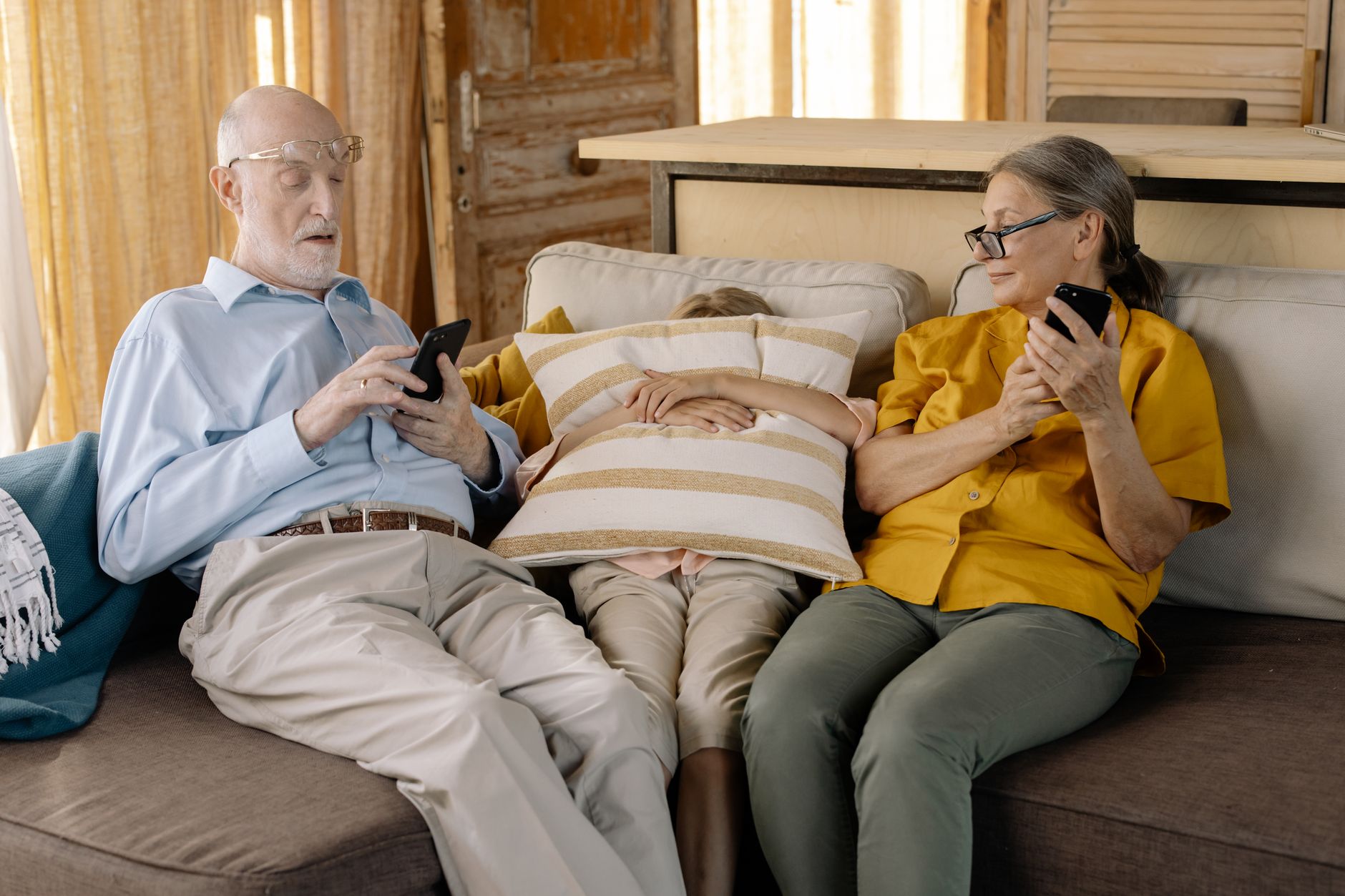
So you can imagine my face when my granddaughter Brielle, who is nineteen and types faster than I can think, sat down next to me at Easter dinner, took my phone out of my hands without asking, and said, “Grandma, we’re putting you in the group chat.” She said it the way you would tell someone you were taking them to the doctor. Firm. A little sorry about it. As if there was no point arguing.
I did not know what a group chat was. I want that on the record. I thought, when she said it, that it was something at the church. A small group. A chat. Coffee and folding chairs. I said, “That sounds lovely, dear, what night does it meet?” and Brielle laughed so hard she had to put her fork down. She laughed until her mother told her to stop, and then she laughed quieter, into her napkin, and I sat there holding half a deviled egg, having said something funny without the faintest idea what it was. That, I would learn, was going to be the shape of my whole spring. Saying funny things. Not knowing why.
I should explain about Brielle, because she is at the center of all of this. She is my oldest son Marcus’s girl, and she has been the boss of me since she was four years old. She is the kind of granddaughter who corrects your grammar and steals the last roll off your plate in the same breath, and who would, I am certain, walk into traffic for me without a second thought. When her grandfather was dying she was only fifteen, and she sat with him for hours she did not have to, reading him the sports page in a voice that did not shake until she got to the car. So when she decided that her widowed grandmother was not going to sit alone in a quiet house with a slow cooker and a landline, that was that. There was no point arguing. There never is, with Brielle.
She set the whole thing up at the dinner table while the ham went cold. She held my phone at an angle so I could not see it, the way you hold a Christmas present you are wrapping, and her thumbs went so fast they blurred. “Okay,” she said, “I’m putting in your picture. Smile.” I did not know she was taking a picture. So the little photograph that represents me to my entire family, to this day, is a picture of a confused old woman looking at a deviled egg with her mouth half open. Tyler says it is the most accurate photograph ever taken of any human being. I have asked Brielle to change it eleven times. She will not. She says it is “canon,” which is a word the young people use for things they have decided you are not allowed to fix.
What it actually was, I learned, was a single long conversation that contained my entire family at once. My two sons. Their wives. My four grandchildren. My sister Pat in Florida, who got added by accident and has refused to leave on principle. Everyone, all of them, in one little green and gray window on a screen the size of a playing card. And every word I typed in there would be seen by all of them, instantly, forever.
I am telling you, if they had explained it to me that way at the start, I never would have agreed.
Let me set the family out for you the way I had to learn it, name by name, because at first that little window was just a stack of words with no faces, and it took me weeks to sort out who was who. Marcus is my oldest, fifty now, which I refuse to fully believe. He builds things and worries about things and shows neither. Dale is my youngest son, forty-six, soft-hearted, the kind of man who cries at long-distance commercials and apologizes for it. Karen is Marcus’s wife, and she is wonderful, and she is the one who keeps the calendar that holds the whole family together. Marcus’s children are Brielle, nineteen and in charge, and Tyler, who is twenty-two and exists, as far as I can tell, to make the rest of us laugh and to hide how much he feels behind it. Dale’s children are Sophie, twenty-three and just made a nurse, the gentlest soul I ever raised a hand over, and little Jacob, who is eleven and types entirely in pictures of dinosaurs. And then Pat. My sister Pat. Sixty-four, in Florida, added by the slip of a teenage thumb, and dug in now like a tick. That is the room. Hold them in your mind. You will need them.
The trouble began on day one. Brielle showed me how to type a message and how to press the little arrow to send it. She did not show me, because she did not think she needed to, that my phone would change my words after I typed them. I learned this the way you learn most hard things in life, which is publicly and all at once.
My son Marcus posted a photograph of his new truck. I was proud of him. I typed, “Looks great, son, your father would be so proud.” That is what I typed. What my phone sent, because it decided it knew better than I did, was, “Looks great, son, your father would be so prawn.”
Now. My late husband, God rest him, was many things. He was not a prawn.
For three full minutes nobody said anything, and I sat there in my kitchen with the phone in both hands trying to understand what I had done wrong. Then they all started at once. Little laughing faces. My grandson Tyler wrote, “RIP grandpa the shrimp.” Brielle wrote, “GRANDMA NO.” My sister Pat in Florida, who I remind you was added by accident, wrote, “What is a prawn.” And I, panicking, trying to fix it, typed, “I meant proud, the phone changed it,” except by then I was so flustered I hit the wrong letters and it came out, “I meant proud, the phone chased it,” and Tyler nearly had to be hospitalized.
That was the first day.
I sat at my kitchen table that night, after the phone had finally gone quiet, and I thought about turning it off and never opening it again. I had been married forty-one years to a man who never once made me feel foolish, and now here I was, made a fool of by a machine the size of a deck of cards, in front of every person I loved. I did not sleep well. I dreamed, I think, about prawns. But in the morning there was a message waiting for me from my youngest grandchild, Sophie, that said only, “Good morning Grandma, I hope you slept good, the prawn thing was the funniest part of my whole week and I needed it.” And I read that three times and I decided, all right. All right. I would stay in a little longer.
That early stretch, I have to tell you, was its own kind of comedy, the slow blind fumbling of it. Nobody warned me the phone made a sound. So the first week I jumped a foot every time it buzzed on the table, like a wasp had got into the kitchen. I learned, eventually, that a long buzz was a call and a short buzz was the chat, except I learned it wrong, so I let three of Karen’s calls go to the little voice box thinking they were the chat, and answered the chat out loud thinking it was a call, saying “Hello? Hello?” to a screen full of typed words while my tea steeped. I could not find the chat again after I closed it. The first four days, every time I shut the phone I lost the whole family inside it, and had to call Brielle on the landline to walk me back in, and she would say “tap the green one, Grandma, the green one, no the OTHER green one,” and I would tap and tap and somehow end up looking at the weather in a city I had never been to. I knew the weather in Tucson for a week. I have never been to Tucson.
It did not get better quickly. The phone, I came to understand, was not on my side. It had ideas. It would take a perfectly ordinary word and swap it for something I had never said in my life and would never say in front of my grandchildren. My daughter-in-law Karen mentioned she was making a casserole, and I tried to type, “I can bring the dessert,” and the phone, in its infinite wisdom, decided I had meant to type something so far from “dessert” that I will not repeat it here, except to say that Karen called me on the actual telephone, voice trembling, to make sure I was all right.
Then there came the period of the misplaced messages, which the family has not let me live down and which I will own up to honestly. I did not understand, at first, that I was in only the one conversation, that there were not separate little rooms for separate people. So I would mean to send something to one soul and broadcast it to all of them like a town crier. I once typed out, intending it for my friend Doreen alone, “Don’t tell anyone but I think Karen put too much salt in that casserole, I had to pour myself two glasses of milk,” and sent it to the family. To the whole family. Including Karen. There was a silence after that one you could have heard a pin drop into in Florida. Pat, the only person who would speak, wrote, “I thought it was salty too,” which did not help anyone and started a second argument. Karen did not make a casserole for two months. When she finally did, she texted me first, privately, once I had learned there was a private way, and the message said only, “I went light on the salt. For Doreen.” She is a good woman. She has a long memory, but she is a good woman.
Then there was the matter of the pictures. The little faces.
Brielle had shown me there was a whole drawer of tiny pictures I could send, and I thought that was just delightful. A little heart. A little flower. A way to say something warm without typing it and risking the phone’s interference. The problem was that the little pictures all looked the same to me, no bigger than a grain of rice, and I could not tell one from another without my reading glasses, which I am never wearing when the phone goes off.
So when my granddaughter Sophie posted that she had passed her nursing exam, the most important day of her young life, I meant to send her a clapping pair of hands. I sent, instead, a tiny picture I could not properly see, and it was only when Tyler wrote “GRANDMA WHY IS THERE A SKULL” that I understood I had congratulated my granddaughter on becoming a nurse with a small grinning skeleton.
Sophie, bless her, wrote back that as a nurse she would be seeing plenty of skeletons and she would take it as a professional welcome. That is the kind of girl she is. She makes room for you even when you have just sent her a skull. But the others were not so merciful. Tyler made the skull my official symbol for a month. Any time I said anything in the chat, anything at all, “good morning” or “is it supposed to rain” or “Dale, are you eating,” Tyler would answer with a little skull, and the rest of them would pile on with skulls, and I would sit in my kitchen squinting at a screen full of grinning skeletons wondering what I had unleashed. Little Jacob, who is eleven, started sending dinosaur skeletons specifically, which he found somewhere, and which he considered an improvement, and which, I have to say, he was not entirely wrong about.
When Marcus and Karen announced they were expanding the back deck, I meant to send a thumbs up. I sent a thumbs down. When my other son Dale wrote that the dog had to have surgery, I meant to send a sad face. I sent, somehow, a face that was laughing so hard it was crying, and Dale did not speak to me for a day and a half until Brielle explained to him that I had not been celebrating the dog’s misfortune. The dog, a foolish old beagle named Biscuit, came through fine, and when Dale posted the photo of him in his little cone, I took twenty full minutes, glasses on, tongue between my teeth, to find the correct sad face, and I sent exactly the right one, and I was so proud of myself that I sent it nine more times by accident because I could not stop my thumb. Dale wrote, “ok grandma we get it youre sad about biscuit.” But he was speaking to me again, and that was what mattered.
And the wreath. I have to tell you about the wreath, because the family will tell you about the wreath whether I want them to or not, and I would rather you heard it from me.
There is a little picture in the drawer that, to my eyes, was clearly a pretty bouquet of flowers. A nice thing to send. So when a cousin posted that her neighbor had recovered from a long illness and was home from the hospital at last, I went to send my flowers, my warm congratulations, and what I sent, what every single person in my family received, was a funeral wreath. The kind you put on a casket. Underneath a message that said the neighbor was finally home.
It took us forty minutes to sort out whether the neighbor was alive or dead. My sister Pat in Florida, who again I remind you joined this family chat entirely by accident and has never met this neighbor, sent her sincere condolences before anyone could stop her. The cousin had to write back, in capital letters, that her neighbor was not only alive but was at that very moment eating a sandwich. Pat then sent a thumbs up, which under the circumstances raised more questions than it answered.
What nobody knew, and what I will admit now, is that I sent the wreath again the next morning. On purpose. Not the funeral one. I went hunting through the whole drawer, glasses on, for a solid hour, looking for the bouquet I had meant to send the first time, because I am stubborn and I wanted to do it right. And I found a bunch of flowers and I sent it, proudly, to the cousin, and it turned out to be a different funeral wreath. A second funeral wreath. The cousin called Brielle. Brielle called me. She said, “Grandma, every flower in that drawer that is in a circle is for a funeral. If the flowers make a circle, somebody is dead. Flowers in a bunch, alive. Flowers in a circle, dead. Say it back to me.” And I said it back to her, “bunch alive, circle dead,” like a schoolgirl, and I have never gotten it wrong since. To this day, before I send any flower at all, I hold the phone up to the window in the good light and I check: is it a bunch, or is it a circle. That is a thing my granddaughter taught me, and it is more useful than half of what I learned in school.
I want to be honest about how all of this felt, because it would be easy to tell it as nothing but a comedy. It was funny. I know it was funny. But it also chipped away at me. I had been a competent woman my whole life. I ran a household, I raised two sons, I balanced a checkbook to the penny, I could put up forty jars of tomatoes in an afternoon and have supper on the table by six. And now my grandchildren were gently, lovingly explaining to me, again, which little picture meant happy and which one meant dead. There is a particular ache in being loved and laughed at at the same time when you are old, an ache that has nothing to do with the laughing and everything to do with the fear underneath it, the fear that you are becoming the thing the young people are kind to instead of the thing the young people come to.
I felt it most, I think, late at night, after the chat had gone quiet and the house had gone quiet and it was just me and the rooster clock and the empty side of the bed. I would think about my husband, who never made me feel slow, who would have sat at that kitchen table and worked the phone out alongside me, the two of us squinting at it together, both of us wrong, both of us laughing, and it would not have felt like failing because there would have been two of us failing. That is the thing about being widowed that nobody tells you. It is not only that you miss the person. It is that you lose the witness. You lose the one who saw you be capable for forty-one years and would have remembered it on the nights you felt anything but. There was no one left who remembered the forty jars of tomatoes. Only grandchildren who knew me as the woman who could not work a telephone.
By this point I was ready to give the whole thing up. I told Brielle as much. I said, “Sweetheart, I am too old for this. I am embarrassing you. Just take me out of it and let me go back to my telephone.” And Brielle, who teases me without mercy and loves me without limit, both at the same time, the way only the young can, said, “Grandma, you are the funniest person in this entire chat and we are NOT letting you leave.” And then she taught me how to make a video call, which is its own chapter of my disgrace.
The video call, you see, is when the phone becomes a little window and the person on the other end can see your face, and you can see theirs. Wonderful in theory. The trouble is I could never find where to look. I would hold the phone up and talk to it and Brielle would be saying, “Grandma, I’m down here, you’re talking to the ceiling,” and I would be staring at the top of the phone giving a lovely speech to a light fixture while my granddaughter looked up my nose.
And I narrate. I know I narrate. My family has told me I narrate. When I am on the video call I describe everything that is happening, out loud, the entire time. “Now I’m picking up the phone. There’s your face. Hello. The mailman is here, I can see him through the window, he’s got a package, I wonder whose. Oh, my tea’s gone cold. Can you see me? I can see you. You look thin, are you eating.” Tyler started keeping a list of my narration and reading it back to me, and I will admit, even I laughed.
That list grew into a thing of its own. Tyler called it “Grandma’s Greatest Hits,” and he would read entries from it aloud at family occasions like a man reading scripture. “Now I’m sitting down. The chair’s still there. Good. Is that you, Marcus, or the lamp.” That was a real one. I had confused my own son with a floor lamp because the picture froze, and I sat there for a full thirty seconds saying “Marcus? Marcus? You’ve gone very still, son,” to a lamp. Tyler nearly fell out of his chair. And here is the thing I did not expect: I started to like being on the list. I started saying things partly to land on it. An old woman wants to be looked forward to, and I had stumbled into a way to be looked forward to, even if the way was being a fool. I told myself I did not mind. Some nights I almost believed it.
So that was the spring. I was the family joke. A gentle joke, a loving one, but a joke. The prawn, the skull, the wreath, the ceiling. My pride took a beating I will not pretend it did not. There were nights I put the phone in a kitchen drawer and shut it and told myself I was done with all of it.
I am glad now that I never quite managed to stay done.
Because here is what I did not understand about the group chat at first, what took me half a year to see. I thought it was a place where my family laughed at me. It was not. It was a place where my family was, all of them, all the time, in one room, for the first time since their grandfather died and the dinners stopped and everyone scattered into their own busy lives. And I was in that room with them. Clumsy. Loud. Wrong about the little pictures. But there.
I should tell you what the dinners had been, so you understand what we had lost. Every Sunday, for years, my husband carved a roast at the head of a table that sat eleven when you put the extra leaf in, and we always put the extra leaf in. The grandchildren fought over the same chairs. Pat called from Florida and we passed the phone around so everyone could shout into it. There was noise. There was a particular kind of noise a family makes when it is all in one room, a noise you do not notice until it is gone. And when he died, the carving stopped, and without the carving the Sundays stopped, and without the Sundays the family did the thing families do, which is not a falling-out, nothing so dramatic as that, just a drifting. A slow quiet drifting into separate busy lives, each of them loving the others in the abstract and seeing none of them. For three years I thought that drifting was the natural order now. I thought my big noisy family had simply ended when the man at the head of the table did. I did not know it had only been waiting for a new table. I did not know the new table would be the size of a playing card and that I would be the one sitting at the head of it, by accident, in a picture of myself holding a deviled egg.
I started to notice things. Because I was the one always in there, fumbling around, I was the one who saw everything. I saw when Sophie posted at one in the morning that her shift had been hard and nobody else was awake to answer her, so I answered her, the only one up, the way old women always are. I saw when Tyler went quiet for two weeks and I was the one who noticed the quiet, because I was always watching that little window, and I called him on the actual telephone and found out he had lost his job and was too proud to say so. I saw the small things. The grandmother things. Because the group chat, the thing I was so embarrassed by, turned out to be the only place I could keep an eye on all of them at once.
There was a night with Sophie I keep close. She had lost her first patient, an old man no family came for, and she sat with him so he would not be alone, and afterward she could not sleep, and she typed it into the chat at one in the morning the way you whisper a thing into a dark room hoping someone is awake. Nobody was. Except me, with my bad sleep and my tea, glasses already on. I did not know the right words. I am not a nurse, I have only buried people, not eased them out. So I told her the truth, that the old man was lucky, in the only way a person can be lucky on the last day of his life, because a gentle girl held his hand, and that I hoped when my turn came there was a Sophie on the shift. I sent it with no skull, no wreath, no wrong picture, just the words, and I checked them twice. She wrote back, “I’m okay now Grandma. Thank you for being up.” And I sat there in the dark and understood, maybe for the first time, that my being up, my foolish insomniac always-in-the-chat self, was not nothing. It was a thing. It was the thing.
I started doing it on purpose after a while. Every morning with my coffee I would put on my glasses, the good ones, and I would scroll back through everything that had been said in the night, slowly, reading every word, the way I used to read the paper. I learned the rhythms of them. I learned that Marcus only posts when he is happy and goes silent when he is worried, so the silence is the thing to watch. I learned that Karen says “I’m fine” when she is not. I learned that Tyler hides everything behind a joke, which means the meanest jokes are usually the days he is hurting most. I had spent years thinking my grandchildren had drifted out of reach of an old woman in a quiet house. They had not drifted anywhere. They were all right there, every day, in the little green window, telling me exactly how they were if only I was patient enough to read it. The fumbling had bought me a seat in the middle of all their lives. I would not have traded that seat for anything, skull picture and all.
I even made my peace with Pat, which I did not think a phone could do, since the two of us had not made our peace in person in thirty years. She is my younger sister and we are too alike to be near each other, all sharp edges and old scores. But in the chat, sideways, not looking right at each other, we found we could talk. She would answer my fumbles before anyone else, defend my skulls, ask “what is a prawn” in a way that I came to understand was her standing next to me. One morning she wrote, just to me, “I would have sent the wreath too. We were never any good at the little pictures, you and me. Mama wasn’t either.” And I cried over my coffee, because she was right, our mother would have sent a hundred funeral wreaths to living people and never apologized for one, and I had not thought of our mother kindly in years, and Pat had given her back to me in one line. Accident or not, I am glad that thumb slipped. I am glad Pat is in the room.
And then came the Tuesday I will never forget.
It was late, near eleven, and I was in the recliner with my tea, half asleep, when the phone buzzed. It was Dale. Just three words, in the family chat, where everyone could see them. “Dad’s in the hospital.” And then, before any of us could even understand, he meant his father-in-law, Karen’s dad, not realizing in his panic how it would land on me, a widow, in a chat that called my late husband “Dad.”
For a moment the whole family froze. You could feel it through the screen. Nobody knew what to type. The grandchildren did not know if they should be frightened. The grown sons did not know what to say to each other. It was the kind of silence that, in my experience, can crack a family right down the middle, the silence where everyone waits for someone else to be brave first.
And I, the family fool, the prawn woman, the one who could not work the little pictures, did the only thing I knew how to do. I started a video call. All of them at once. I did not even know you could do that. I think I hit the wrong button, honestly. But it rang every phone in the family and one by one their faces came up in little boxes on my screen, Dale red-eyed in a hospital hallway, Sophie in her scrubs, Tyler in the dark of his apartment, Brielle with her hair in a towel, Marcus and Karen on the road already, all of them, the whole scattered family suddenly in one window the size of a playing card.
I was looking at the ceiling, of course. I always am. Somebody said, “Grandma, we can see your light fixture.” And somebody laughed, just a little, through the fear. And I said, the way I always do, narrating, because that is who I am, “Now I’m looking at all of you. There’s Dale. There’s the baby, Sophie, you look tired, are you eating. We’re all here. Everybody’s here. Whatever it is, we’re going to be here for it together, all of us, in this little phone.”
And we were. We stayed on that call for two hours. Karen’s father came through his surgery just fine, as it turned out. But we did not know that for the first hour, and in that hour, my whole family sat together in the glowing boxes on my screen and they prayed and they cried and Tyler told a terrible joke and Brielle told him to shut up and Sophie explained the medical words none of us understood. Little Jacob, eleven and frightened and not knowing what else to do, sent a single dinosaur into the chat in the middle of it all, and somehow that dinosaur broke the worst of the fear, and we all laughed, the wet kind of laugh that is mostly relief looking for somewhere to go. We were a family again, in a room again, the way we had not been since the funeral. And the only reason was that the silly old woman who could not work her phone had mashed the wrong button at exactly the right moment.
When it was over, when the good news came and the boxes started saying goodnight one by one, Brielle stayed on the line after the others had gone. Just the two of us. My towel-haired girl who had put me in the chat in the first place. She was quiet for a while. Then she said, “Grandma. You know how we’re always laughing at you?”
I said I had noticed, dear, yes.
And she said, “We’re not, really. I mean we are. But it’s because you’re the only one who’s always there. You’re the one who keeps us together. Nobody talked to anybody before we put you in here. We didn’t know it would be you.” And then, because she is nineteen and cannot bear a tender moment, she added, “Even though you sent a funeral wreath to a guy who didn’t die.”
After that Tuesday, something shifted, and it shifted in all of us, not just me. The family started using the chat differently. On purpose. Karen suggested we bring back Sunday dinner, and so we did, the real kind, with the leaf in the table, and the ones who could not drive in joined on the video call propped against the gravy boat so Pat in Florida and Sophie on a shift could be at the table too. There is a permanent grease spot on my phone screen now from being leaned against the butter dish every Sunday. I would not clean it off for the world. My husband carved the roast for forty-one years and I never thought anyone would carve it again. Marcus carves it now. And I hold the phone.
We planned a reunion, the first in years. It came together in the chat over a month, everyone arguing about dates and who would bring what, Pat insisting she would fly up if somebody would tell her, finally, what a prawn was. And we had it, in Karen’s backyard, in June, all of us in one place for the first time since the funeral, thirty-some people who had drifted apart pulled back into one loud noisy yard by a string of foolish messages on a phone. Pat came. She and I sat in lawn chairs and did not fight once, which is its own miracle, and she said, “We did all right, didn’t we, getting them all here,” and I said we had, though it was an accident, and she said, “Most of the good things are,” and we let it sit. At one point Tyler stood up on a picnic bench and read “Grandma’s Greatest Hits” aloud to the entire reunion, and I sat in my lawn chair and let him, my whole family laughing in the sun, every one of them there, and I thought, if being a fool is what bought this, then I will be a fool. I will be the family fool until the day I die and count it the proudest job I ever held.
I am still in the group chat. I am still terrible at it. Last week I told my entire family, by accident, that I had a doctor’s appointment for a “colonoscopy” and added “looking forward to it,” because I had meant to send that to a friend about a lunch and the phone, my old enemy, put the two together. Tyler has not recovered. He says it is his favorite thing I have ever done. He added it to the Greatest Hits at the very top, above the prawn, which he says is the highest honor he can give. I have stopped fighting it.
I have learned the little pictures now, mostly. I wear my glasses for the wreath one, just to be safe. Bunch alive, circle dead. I have learned where to look on the video call, although I still drift up to the ceiling when I get excited. I narrate less. Not none. Less. I have my own private chat with Karen now where the salt is never mentioned, and a private one with Pat where it mostly is. I know which green one to tap. I have not been to Tucson, but I no longer know its weather, and I count that as growth.
But I have learned something bigger than any of that, something I would not have learned if Brielle had not taken my phone out of my hands at Easter dinner and refused to give it back. I learned that there is a kind of love that does not look like much from the outside. It looks like a confused old woman pressing the wrong buttons. It looks like a prawn and a skull and a funeral wreath. But underneath it, it is a grandmother who showed up, every single day, in the only room where her whole family still gathered, and stayed there, fumbling and present and watching over all of them, so that on the one night it mattered most, when the family went silent and afraid, there would be somebody already in the room, light fixture and all, to say the thing that needed saying.
We’re all here. Everybody’s here. And we’re going to be here for it together.
That was always the only thing I was trying to type.
This story is a dramatization. Names, characters, and details are invented, and any resemblance to real people or events is coincidental.