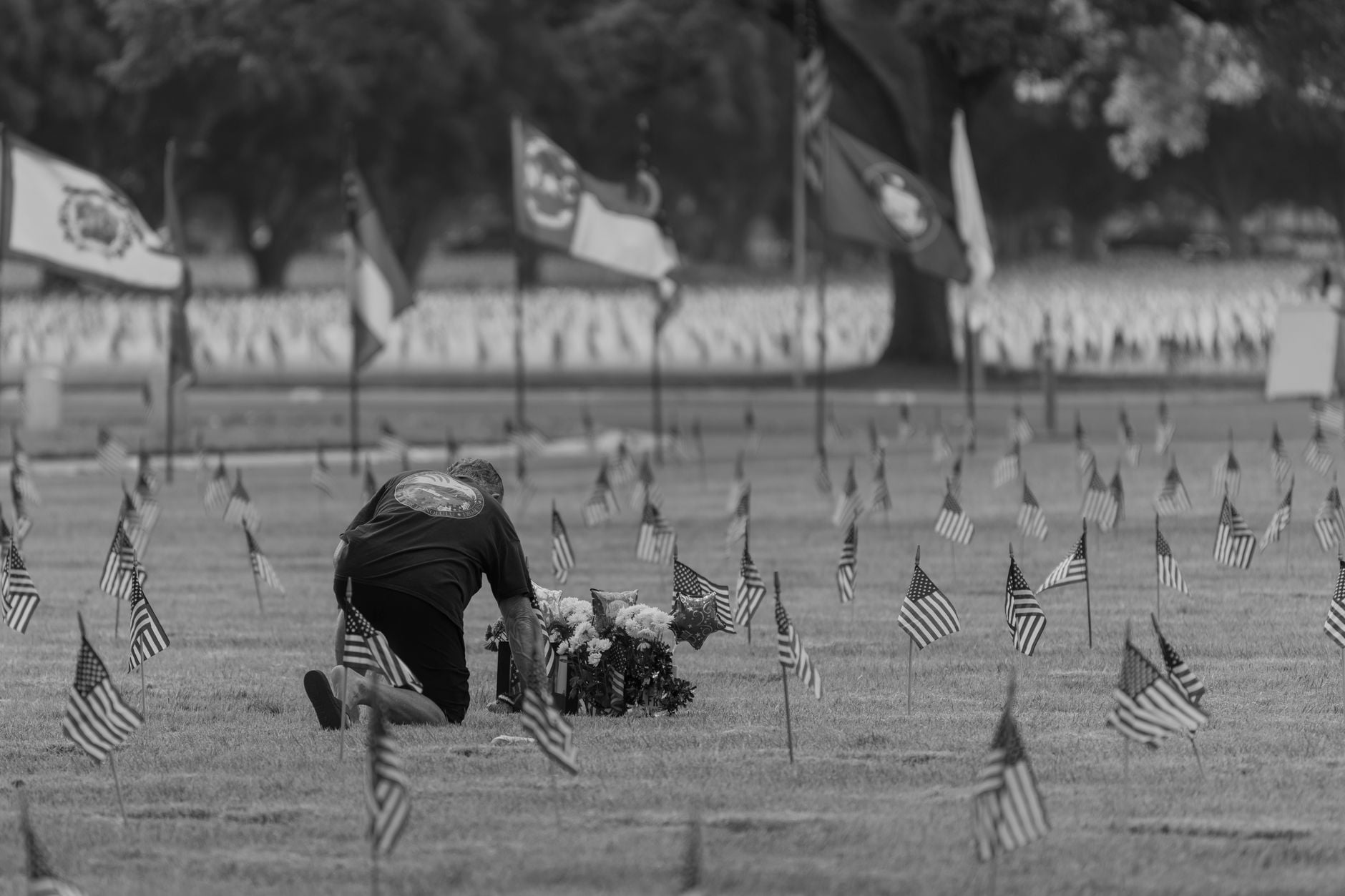
The Man Who Kept Corey’s Grave
The jar
The next Thursday, I brought a pint mason jar from my pantry, the kind I put up beans in. I set it at the base of Corey’s stone, tucked in the grass beside the geraniums, with the lid screwed on tight against the weather.
Inside I put an index card and a pencil stub. On the card I wrote:
Whoever you are, thank you. He was my son. I would like to know who is keeping him company. You do not have to say. But thank you. Nadine Lassiter.
I drove home and did not sleep well.
The following Thursday, I found the jar where I left it. The lid was snapped on again. And inside was a different card, in careful square print, the kind a man writes when he is not used to writing to ladies.
Ma’am, I mean no harm and I will not trouble you. It is an honor to look after him. Please do not think about it more than you need to. A friend.
I sat on the folding stool with that card in my lap for most of an hour.
I wrote back that same day.
I am not troubled. I am grateful. May I ask how you knew my son?
A week passed, and then another reply.
I did not know him, ma’am. I wish I had. I owe him a great deal. I am not ready to say more. I hope you will forgive me. It is not my place to take up your time with it.
I read that one a long time.
I wrote one more card, that first summer.
Would you tell me your name?
The answer took a month to come. It was only two lines.
Not yet. I am afraid you might not want to know me once I do. R.
R.
I carried that card in my purse until the corners turned soft.
The first sergeant
I thought, naturally, it had to be one of his soldiers.
So I called Corey’s old first sergeant, Dennis Rourke, who had stood beside me at the funeral and given me his cell phone number in case I ever needed anything. I never had, until that July.
“Ma’am, I’d know if one of mine was driving to Tennessee every week to look after him,” he said. “They’d have told me. And every man in that platoon signed your card. Whoever this is, he’s not one of ours. But I like him already.”
I hung up with the thread cut. If it was not a soldier from his unit, then who?
Meanwhile every Thursday the flag stood straight, the grass lay square, and the stone shone. I kept right on thanking a ghost in a mason jar.
The week I left out
I need to tell you something about the week my son died, and I need to tell you plainly, because I did not for a very long time.
It was a Thursday night. I was in my nightgown, watching a game show I did not care about, when I heard car tires on the gravel. Two cars. Not one.
I knew before I opened the door.
There is a thing that happens when a mother sees an Army officer and a chaplain in dress uniform standing on her porch at nine at night. Your body knows. You begin to say no before they have said a word. I was still saying no when the major took off his cap and said my name.
Corey had been on a night training exercise at Fort Campbell. A truck had left a wet range road in the dark and rolled over. Four soldiers were hurt. Corey was hurt worst.
They had flown him to the hospital in Nashville.
He was alive for two more days in the only way a machine allows.
I will not walk you through those two days. I will say only that on the second morning a woman in a gray cardigan sat down beside me, and that she was kind, and that she asked me a question I was not prepared to answer.
After the funeral, there were envelopes that came to my house. Plain white ones, from an office in Nashville, with a return address I recognized and could not bear to read twice. I took them out of the mailbox, put them in the kitchen drawer under the dish towels, and closed it.
I will come back to that drawer.
Ohhhhhh my goodness 😇 This one blew up every single feeling inside me. It is Amazing😇 I Love it so very much ❤ ❤❤❤❤❤❤❤❤❤❤❤❤❤