The Girl Who Carried the Farm Sign
She had braided it herself that morning and asked me twice if it was straight. I had on my blue gingham shirt, the one Ben says I look like a farm calendar in.
Dad climbed up onto the wagon and settled himself on the straw bale in front, right behind Hilda’s sign. He looked around for Lily and frowned.
“Where’s our sign girl?” he said.
Mom was already up on the wagon with Owen on her lap. “Lily wanted to walk with Kristin,” she said. “Didn’t you, Lily?”
Lily looked at me. I did not want to lie to my father, and I did not want to start a scene on the school lot ten minutes before the fire trucks rolled out. So I said the true part.
“She’s walking with me, Dad.”
Then I reached up and lifted Hilda’s sign out of Ben’s brackets, painted side toward the wagon.
It was heavier than it looked, two old pine planks and a hundred years. I handed one end down to Lily, and I kept the other.
Dad watched us do it. I saw something cross his face, a question, and then the band started up and the first fire truck hit its siren, and Ben put the tractor in gear.
Main Street
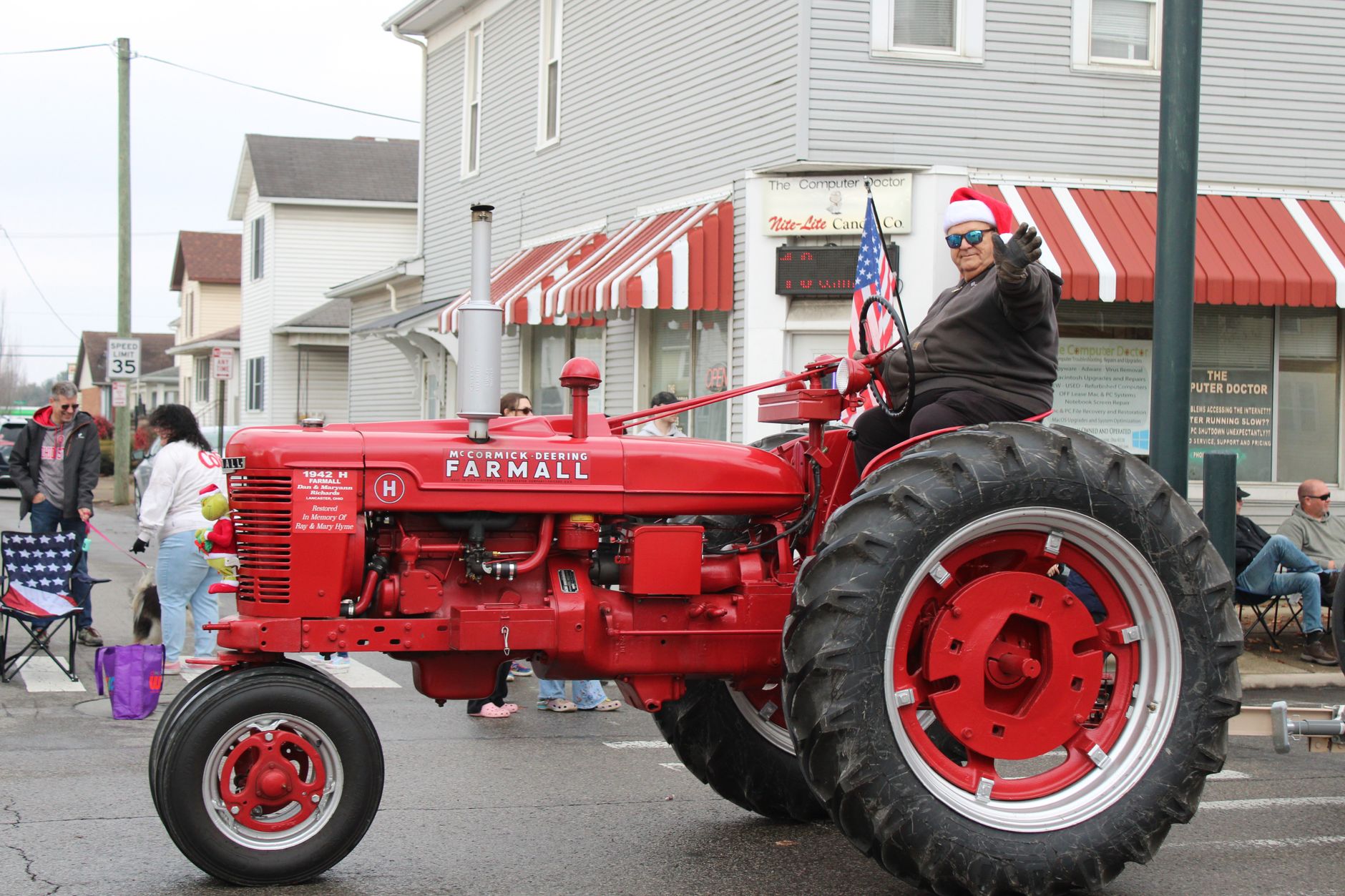
We stepped out onto Main Street at ten o’clock, between the antique tractor club and the Cub Scouts. Lily on the left with her end of the sign.
Me on the right with mine. Ben behind us on the green tractor at a walk, and the hay wagon rolling behind him with Mom, Owen and Dad.
Main Street in our town is four blocks of brick storefronts between the grain elevator and the Lutheran church.
People had set their lawn chairs out along the curb at six in the morning to save a spot, the way they do every year, and the sidewalks were full from the hardware store to the bank.
The first block, nobody knew what we were. I could see them reading the float behind us, the Century Farm certificate Ben had mounted on the backdrop, and looking back at us, puzzled. A woman and a girl carrying an old board.
We carried the painted side turned back toward the wagon, so Dad could see Hilda’s letters from his bale. From the curb it was only a weathered gray board.
Then, somewhere in front of the drugstore, an old man in a lawn chair leaned forward to see the board better, and I heard him say to his wife, “That’s the Gustafson barn sign. I’d know those planks anywhere.”
He started clapping. Just him, at first. His wife joined in. Then the family next to them, and the people next to them.
By the middle of the second block, the clapping was rolling ahead of us down the street like a wave.
It was not the polite clap people give a float. It was for the girl with the sign. People were leaning out of their lawn chairs to see her.
Lily held her end so straight and so steady her arms started shaking. She did not look at the ground once.
“Mom,” she whispered, without turning her head. “They’re clapping for us.”
“They’re clapping for you,” I said. “Keep your end up.”
Somebody’s little boy ran out to the curb and waved at her. A teenage girl from the volleyball team yelled, “Go, Lily!”
A woman I know from the co-op, Jean, stood up out of her chair and put her hand over her heart, and I almost lost it right there.
I heard someone near the bank say, “Whose girl is that?” and someone else say, “That’s the Gustafson girl. That’s Arne’s granddaughter.”
Lily heard it too. I saw her shoulders come up an inch.
I did not look back at my mother. I could feel her, though. You can always feel your mother behind you.
I could feel her watching the people on the curb clap for the child she had left off a list, while they waved politely at the float she was riding on.