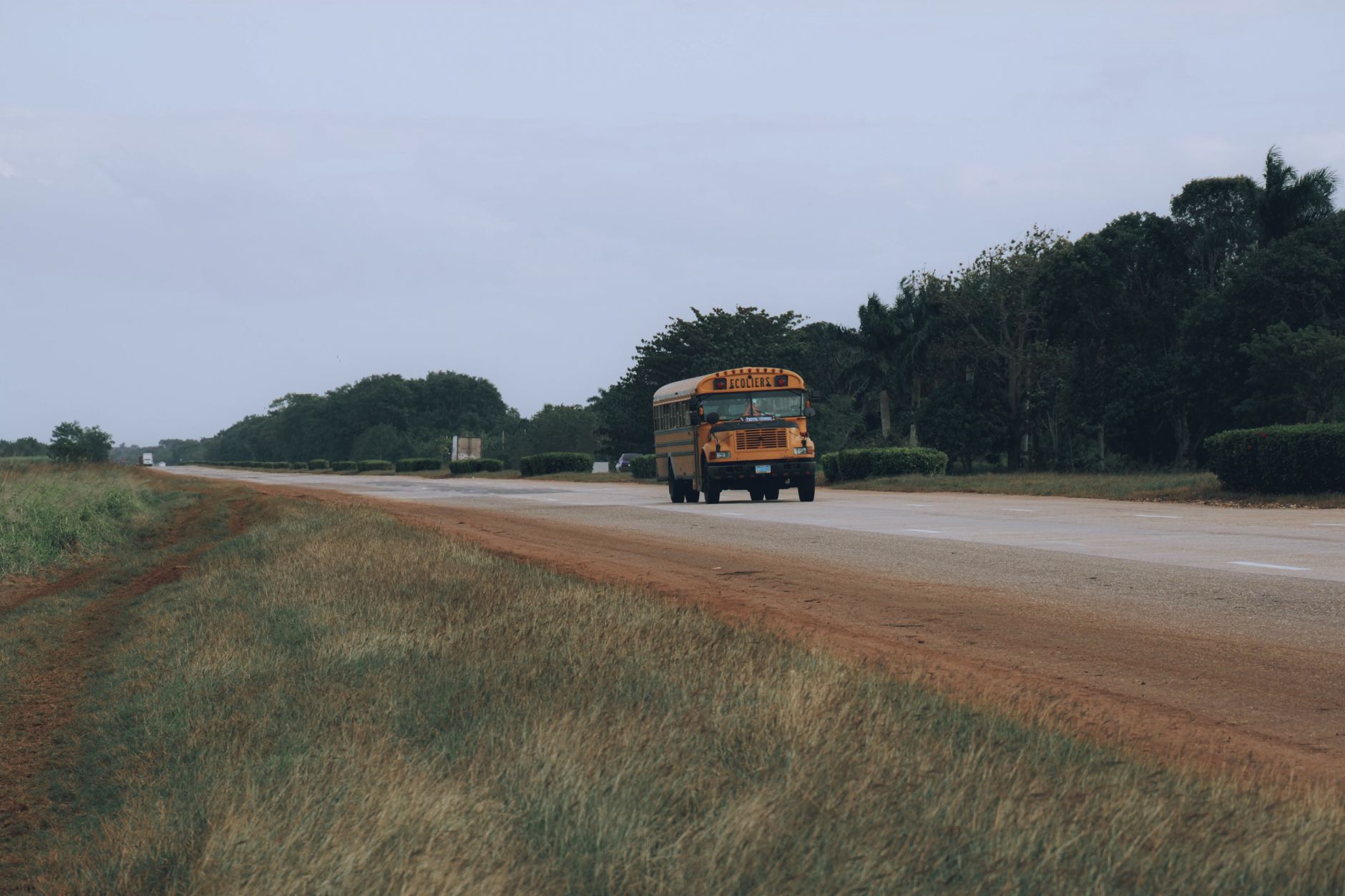
The Minute I Held the Bus
“I just want to say,” Joyce said, and then she could not say what she wanted to say. She let it go at that.
I said, “He’s a good boy.”
“He is,” she said. “He’s a good boy.”
That was all we said. She shook my hand, hard, the way a farmer’s wife does when she’s finished a conversation, and drove away.
Later in the fall she sent a plate of kolaches home with Danny on the bus. Apricot and poppy seed, in wax paper, with no note.
The next summer was the first surgery, at the children’s hospital in Omaha, four hours away. He came back in the fall on two crutches, and the crutches made the minute longer. Seven minutes some mornings, in the rain. I still did not close the door.
After that the minute stopped being a thing I did for Danny. It became a thing the bus did.
I gave it to everybody. Not on the sheet, which had only the one minute, and a good deal of the time not even that, but in the way I drove and the way I looked at a mailbox.
A little girl named Teresa Kuncl missed a stop on a January morning with ten below on the dashboard. Her mother was still buttoning her coat on the step.
I watched the mother get her kid zipped up. I never touched the horn.
A boy named Brandon Sigmund stood at the end of his lane in kindergarten and would not let go of the mailbox post. His fingers were white on it. His mother stood behind him.
I opened the door and I waited. It took eleven minutes. That is still the record. Every kid on that bus watched him through the windows, and not one of them hollered.
When he finally let go, he walked up the steps, sat in the very front seat, and looked straight ahead for the whole ride. I never mentioned it.
Brandon would be about thirty now. I expect he doesn’t remember a thing about it.
There was a rule on my bus that I never wrote down and never said out loud. Nobody runs for this bus. If you are running, I have done something wrong.
Danny rode my bus for twelve years. First grade through his senior spring.
He had three more surgeries over those years, two in Omaha and one in Lincoln. By the end of high school he had a titanium hip and a way of walking that had mostly straightened out.
He was not a talker. He took the seat behind me every morning of those twelve years, and I never assigned it.
In the tenth grade he began reading on the way to school, thick paperbacks about engines. By senior year he was bringing the manual for a motor grader.