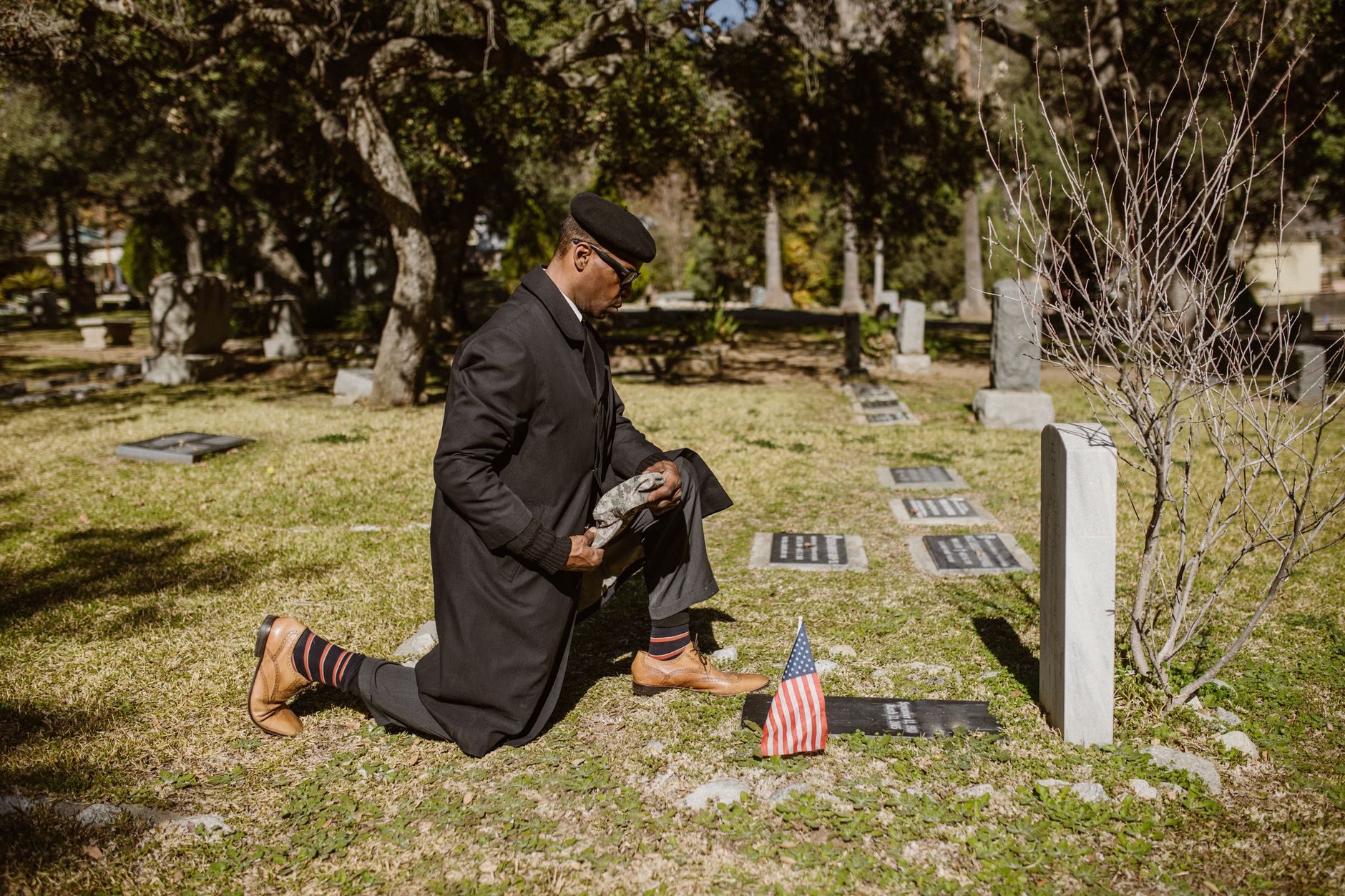
The Flag Man of Platte County
Then the side door opened. Cody came through it in his white gloves and his dress coat, carrying something folded against his chest in both arms. Dwayne Pospisil walked in behind him, in the same gloves, the man who had held the other end of every flag I had folded for thirty-one years.
Cody stopped in front of my chair.
Merle took a long breath through his nose, the way he does before he reads the roll.
“I’m going to say a few things,” Merle said, “and you’re not going to like it, Ray, and you’re going to sit there anyway.”
He opened the ledger. Terri must have handed it to him; I hadn’t seen her do it.
“Starting in March, Terri and Cody and a few of the ladies wrote to every family in this book. Eleven hundred and sixty-four letters. We couldn’t find the rest. Some have moved, and some have passed. The mail is still coming back. We have a box of it.”
He looked out at the room.
“Every family that ever took a flag out of Ray Soukup’s hands,” Merle said, “stand up.”
I heard the chairs.
It is not like applause. There was no noise in it but the scrape of folding chairs and the quiet of a few hundred people finding their feet at once.
“I told you not to look back,” Merle said, “but you’re going to anyway.”
I turned around in the chair.
Marcella Hoefs was in the aisle in her wheelchair with Gary behind her, and she had her chin up. A man in a feed cap I’d delivered to for twenty years. Three sisters I’d never seen together who all had the same nose. A girl of about nine in a green 4-H jacket, standing on her chair. Wilbur Dostal’s grandson, who looked exactly like Wilbur Dostal. Harlan Wehrbein’s daughter, holding a wooden case with a folded flag inside.
They went all the way to the back wall and out the open doors onto the lawn, where another hundred or so stood in the sun, listening through a speaker somebody had clamped to the doorframe. Terri counted them after. Three hundred and seventy-one people, and another two hundred and some had sent a letter or a picture of a mantel with a flag on it, from Arizona and Texas and a base in Germany.
I had known those faces one at a time, each in the worst week of their lives. I had never seen them all in one place.
Merle nodded to Cody and Dwayne.
They unfolded the flag.
It was a new one, a big cotton flag, five feet by nine and a half, with a paper certificate pinned to it. It had flown over the Capitol in Washington on a day in March. Merle had written to the Congressman’s office, and nobody in the county would have thought of it but him.
Cody took the striped end. Dwayne took the stars. They stood with the flag stretched between them, waist high, across the front of my chair, and in that hall full of three hundred and seventy-one people the only sound was the flagpole rope ticking outside.
They folded it.
Lengthwise, then lengthwise again. Then the first triangle, and the second. Neither of them looked at me. They looked at the cloth, the way you look at a thing you’ve been trained not to ruin. I counted without wanting to. Three, four, five. Cody’s thumbs were doing it right. Seven. Eight.
Nine.
The point did not wander. I watched it the whole way. It came to the edge, and the stars lay down exactly square.