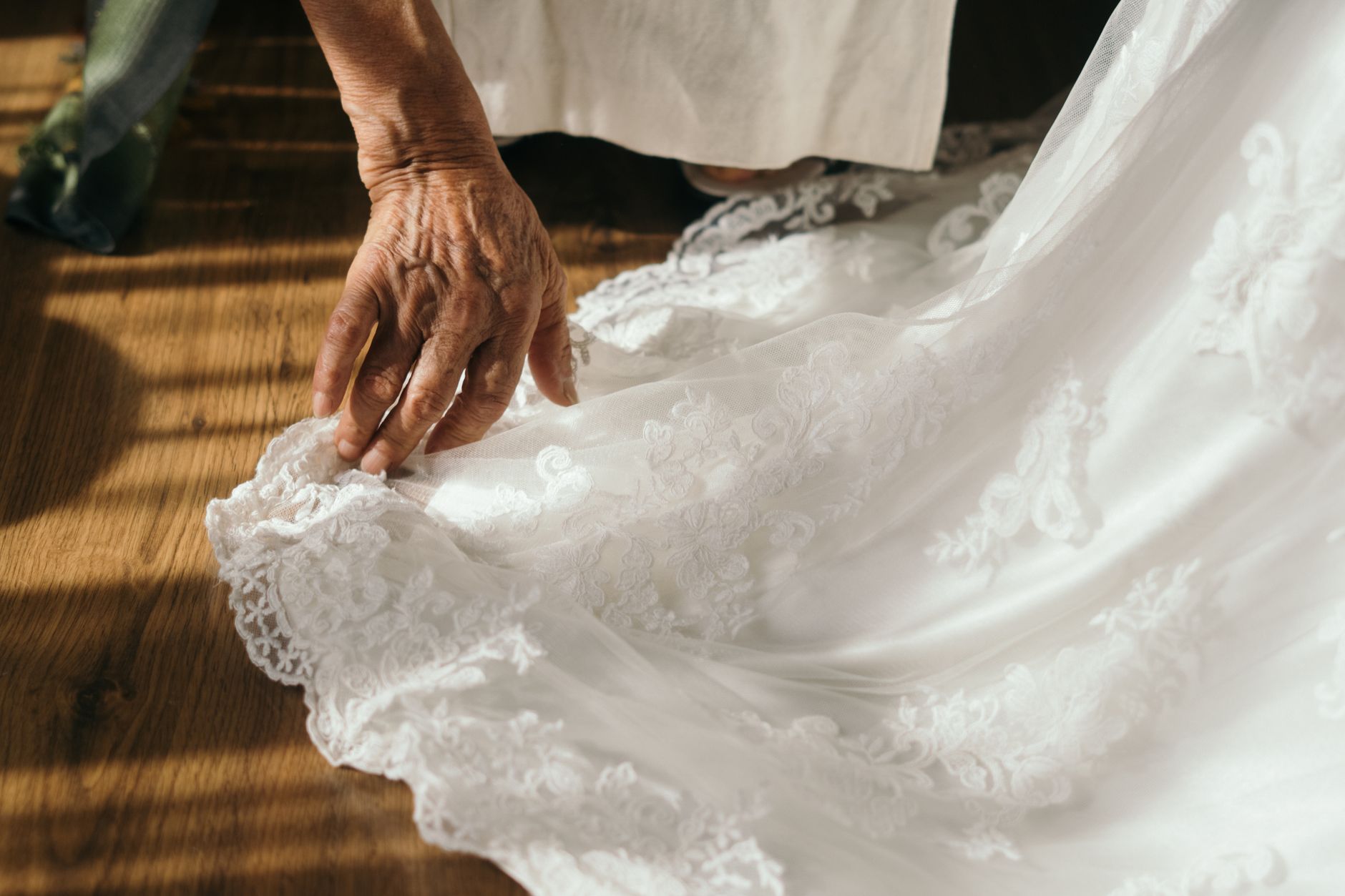
The Wedding Dress My Neighbor Remade
I did not know. I still do not entirely.
I tried, you understand. Over the next three weeks I filled Darlene’s chest freezer with chicken and noodles in forty-eight-ounce tubs. I sent Alan over on a Saturday to put new boards on her back steps and to pull the dead lilac. I brought my good rolling pin, the one that was my mother’s, and tried to give it to her, and she looked at me for a long time and said, “I have a rolling pin.”
I asked her once, in the second week of May, at her back door. “Darlene. Why?”
She had a spool of thread in her hand and she turned it over.
“Tammy got married at the courthouse in Reno when she was nineteen,” she said. “She phoned me from the parking lot. I’ve taken in a hundred and fifty gowns, and I’ve never made one from the first cut to the last button for a girl who was going to stand in the church in it.”
Tammy is her daughter. She lives in Oregon. I had always known that and never known more.
“So don’t thank me,” Darlene said, and put the spool in her pocket.
Paulette came on the second Sunday of May. I had told her on the phone, the whole of it, and she was quiet so long I said her name. Then she said, “I’ll be there at noon.”
She stood in Darlene’s kitchen in her church dress with her hands on the strap of her purse and looked at the gown for a good while.
“I was twenty,” she said to me.
“You’d have looked like you were churning butter,” I said, and she laughed, the real one, the one she had at nine. Then she asked Darlene if she could help carry the dress form to the window, and she did.
The last thing was the waist stay.
Darlene showed it to me on the final Friday, the week before the wedding, when everything else was done: a length of grosgrain ribbon that sits inside the dress, snug at the natural waist, with a hook and eye at the end, to take the strain off the seams so the weight of the skirt hangs from the ribbon and not from the fabric. Every good gown has one. Mine had one.
“I kept yours,” she said.
She turned back a fold of the lining to show me.
The old ribbon had gone gray at the edges, and it was stitched, with tiny invisible stitches, into the new one, so that the two lay one on top of the other. And on the old ribbon, in ballpoint that had faded to the color of a bruise, in a hand I would have known with my eyes shut, someone had written:
A. 24. 5-76. She’ll lose it from nerves.
That was my mother. She had taken the waist in the night before, and she had written the number on the tape for the next time, in case there was a next time. She wrote on everything. She wrote in the margins of cookbooks.