The Wedding Dress My Neighbor Remade
The twenty-first day was a Tuesday. I know because the garbage truck had come and gone and I was dragging the can up the drive when Darlene’s back door opened.
She did not call out. She was standing in the doorway in her stocking feet with the thimble on its ribbon and a tape measure around her neck, and her hair, which she keeps short and gray and parted on the side, was standing up in the back as if she had been running her hands through it. She looked like she had not slept. She looked like a woman who had finished a hard thing.
“Get Hailey,” she said. “Tell her to bring shoes. Flats. Something she’d stand in for a while.”
“Darlene.”
“I’m not talking about it yet,” Darlene said. “Come to the door in an hour. Both of you. Don’t bring your daughter. Not yet.”
So I called my granddaughter off her sleep and told her what I knew, which was nothing, and an hour later the two of us came up Darlene’s back steps. The index card was gone from the storm door.
Darlene held the door open, and for the first time in three weeks the curtains were pulled wide.
It was all light in that kitchen. Late April, the redbud out, the sun coming flat through the glass across the linoleum. The table had been cleared and wiped, and in the corner by the window stood the dress form, the adjustable kind with the dial at the neck, and on it, pinned and basted in places so it still had a half-finished look, stood a wedding gown.
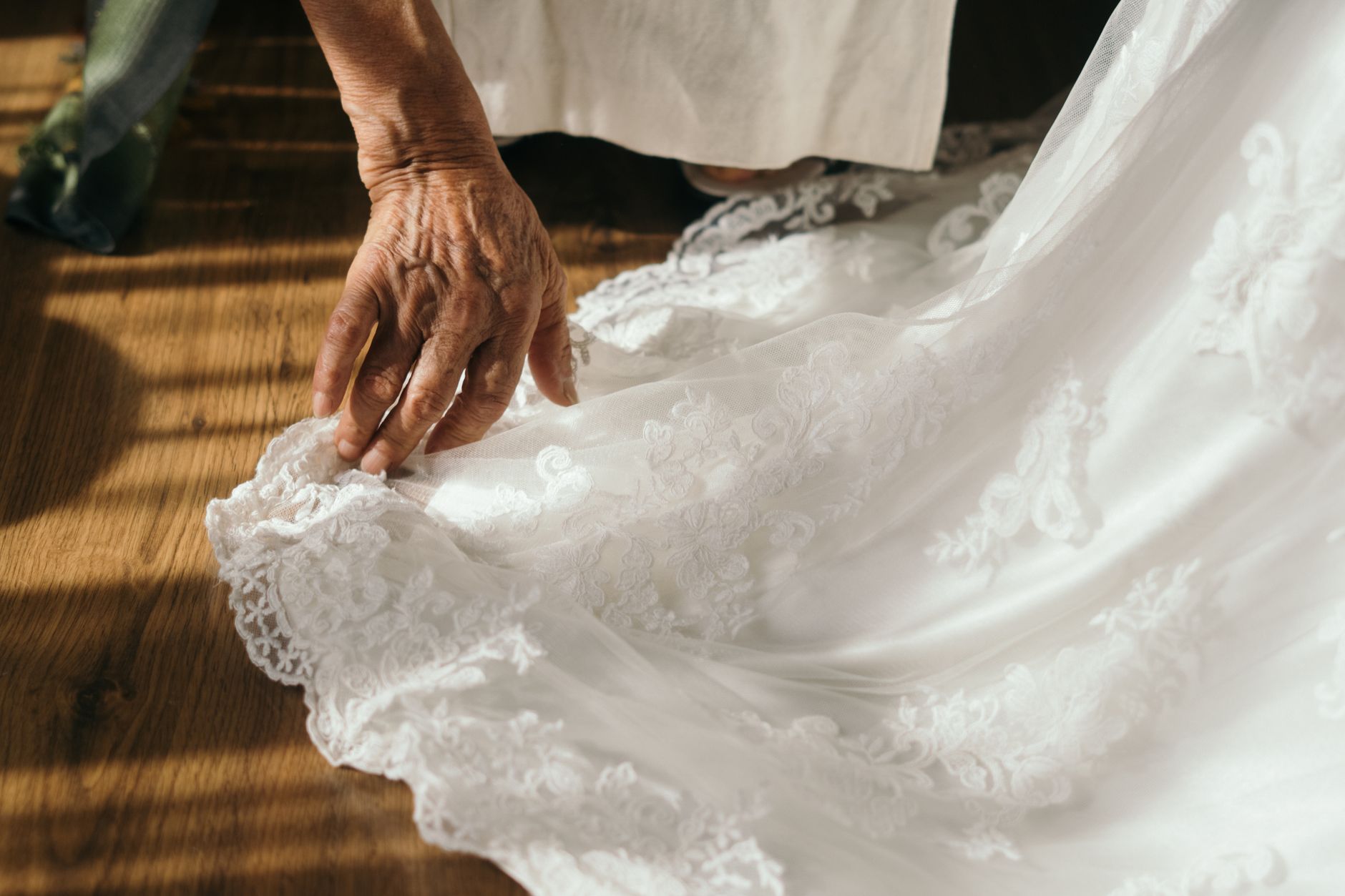
It was my gown, and it was not. I knew the fabric the way you know your own handwriting. I knew the weight of that satin, how it fell in a long clean line with no ruffle to it and held the light on its folds. I knew the lace, the corded flowers. But the standing collar was gone and so were the sleeves. Where the high neck had been there was a wide scoop that dipped to a soft point, with a sheer panel of tulle rising from it across the collarbone, and over the tulle, hand-set, one flower at a time, the lace flowers from my sleeves, so that the lace appeared to float on the bare skin like a scattering of frost.
The skirt was longer. The seam where the length had been added was invisible. I looked for it and could not find it.
I did not say anything. Hailey did not either. She let go of my hand.
“Go ahead,” Darlene said, to her, not me. “Put it on. There’s a screen. The changing room is the pantry, I’m sorry, I only have the pantry.”
Hailey walked up to the dress form first. She put her hand flat on the bodice and held it there, and she said, in her small flat nursing-home voice, “Mrs. Oster. Whose is this?”
“Your grandmother’s,” Darlene said. “She said yes to every cut.”