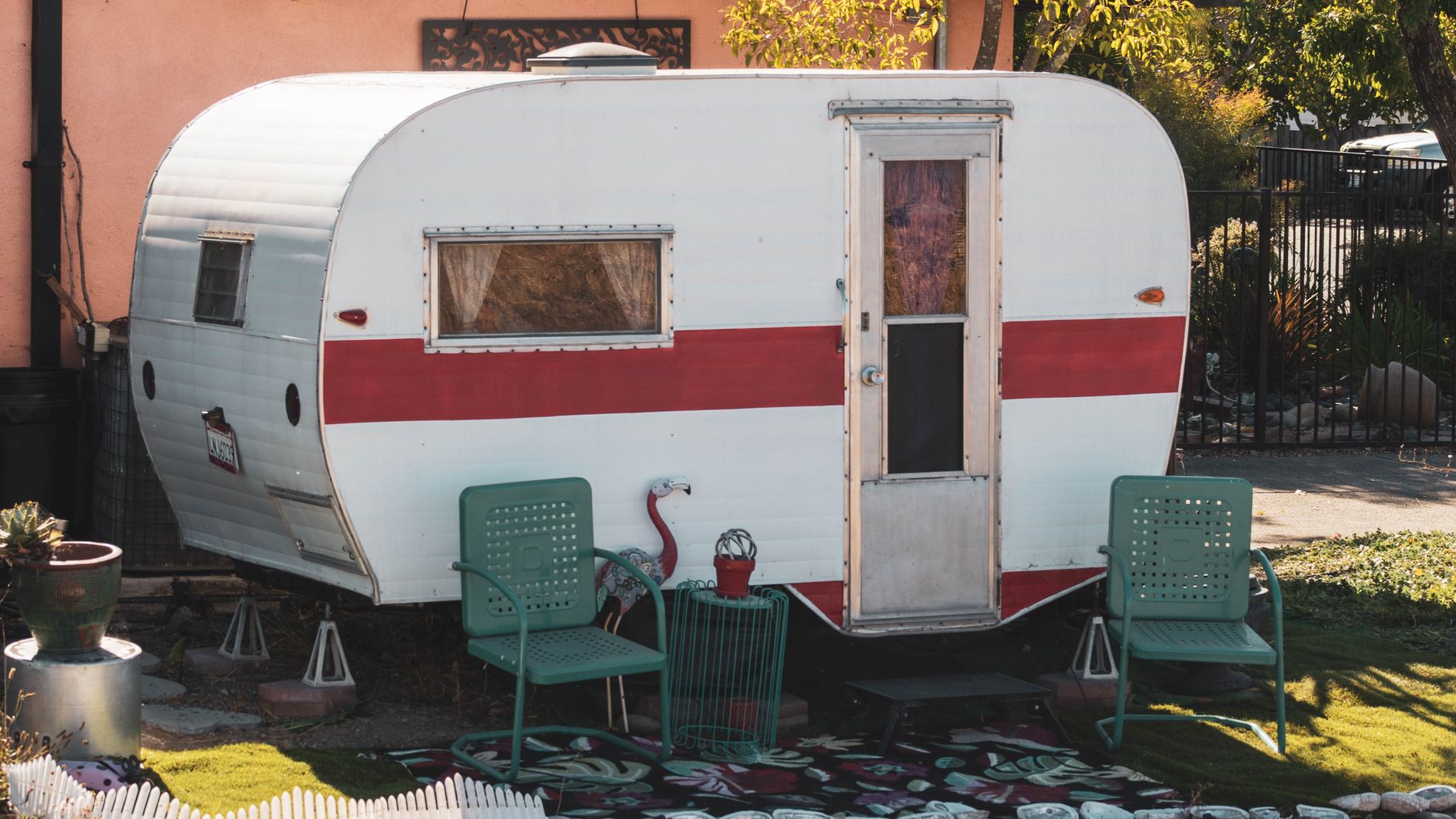
The Camper in the Side Yard
The Couch
Brian slept upstairs on the couch in the little den under the roof. It is a lumpy plaid couch, five and a half feet long, and Brian is six foot one.
He could have come out to the camper. It never came up. I think we both knew that if he walked out there with his pillow before something changed, it would only make the problem quiet.
By the fourth night, he was walking bent over in the mornings. By the sixth, he was taking ibuprofen with his coffee and rubbing his back on the door frame.
But the couch was not the hard part for him. I know that now. The hard part was the house.
He came down every morning to a kitchen where his wife had already been up an hour taking care of his mother. He sat across from his mother, who knew exactly why. He looked at his kids, who had stopped laughing.
At the dealership, the guys had heard. One of the older salesmen asked Brian, right at the counter, which one of them was in the doghouse.
Brian laughed it off. But he told me later that he went out to his truck at lunch that day and sat there twenty minutes without turning on the radio.
That was eight nights in a house full of people with nobody to say goodnight to. I am not proud that it cost him that. I am also not sorry it cost him something. Both of those are true.
The Pie Crust
There was one good thing in those weeks I want to tell.
On the second Sunday, Phyllis was sitting at the kitchen table. Maddie came through looking for a snack.
“Maddie,” Phyllis said. “Do you know how to make a pie crust?”
Maddie looked at her like she had asked if she knew how to shoe a horse. “Like, from scratch?”
“Is there another way?” Phyllis said. I was at the sink. I did not turn around. I kept washing the same pan for about ten minutes.
Phyllis could not stand at the counter long, and she could not bend to the oven at all. So she sat in the good chair with her walker beside her and had Maddie bring everything to the table.
The big yellow bowl. And the pastry cutter that had been her own mother’s, which Brian had fetched from the farmhouse with her clothes.
“Cold,” Phyllis kept saying. “Everything stays cold. Your hands are warm, so you don’t touch it more than you have to.”
“Cut the shortening in until it looks like little peas,” she said. “Not sand. Peas.” Maddie worked the cutter with her tongue between her teeth.
Phyllis reached over and pinched the dough between two fingers. “Little more water,” she said. “One tablespoon. No more than that.”
When it was rolled out, she showed Maddie how to fold it in quarters to move it to the pan without tearing. Then how to crimp the edge with her thumb and two fingers.
Phyllis’s hands were spotted and knotted at the knuckles. Maddie’s were smooth and quick. They were doing the same thing, on the same pie, at the same table.
“My mother taught me this at your exact age,” Phyllis said quietly. “Fifteen. On a farm table in Marathon County. She said a girl who can make a crust can always feed people.”
“Grandma,” Maddie said. “Will you teach me the apple filling too?”
“Every Sunday I’m here,” Phyllis said, “I’ll teach you something.” She kept that promise. They made four pies that fall, and Maddie still makes that crust better than I do.