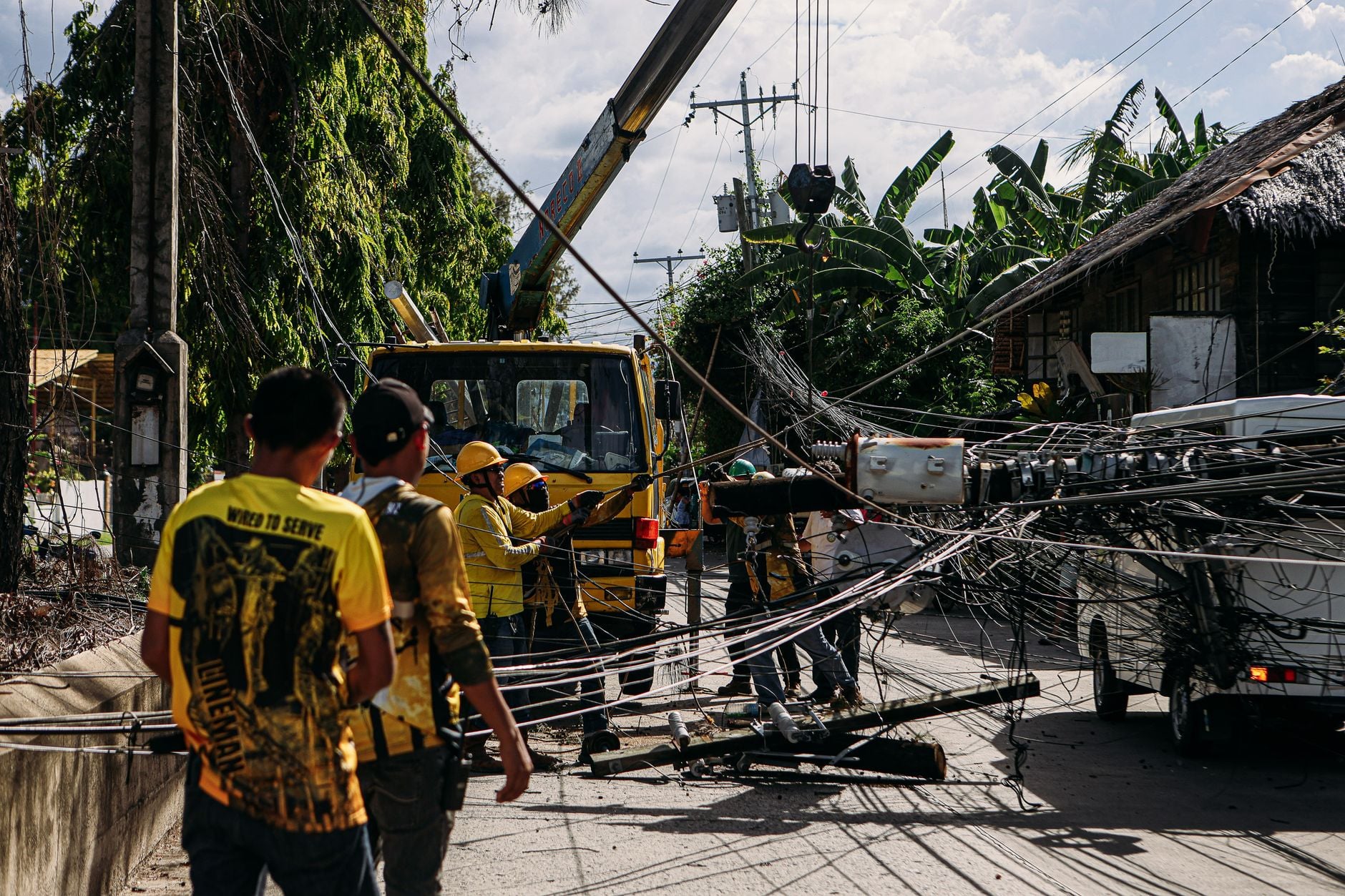
The Night the Lineman Came Home
Nicole shook her head. “Another time,” she said. “Not tonight. I’m too full and too tired, and you’ve got the early shift.”
The forecast had said a wintry mix. Out on the prairie, a wintry mix can mean almost anything.
Sometimes it means a little sleet that bounces off the windshield. Sometimes it means the thing nobody who works on power lines wants to hear.
It started raining on a Tuesday afternoon, two weeks after Thanksgiving, and the thermometer on the shop wall read thirty-one degrees.
Rain at thirty-one degrees does not stay rain. It lands on whatever it touches and turns to glass.
Our line superintendent, Rick, stood at the window of the shop with his coffee and watched it come down. Rick has been with the co-op for thirty-four years. He did not say anything for a while, and then he said, “Boys, call your wives.”
By supper the trees along the shelterbelts were bowed over like old men. By ten that night every wire in three counties wore a sleeve of ice as thick as a broom handle.
You could stand in the yard and hear the cottonwoods cracking out in the dark.
Then the wind came up out of the northwest, the way it does behind a front, and the lines started to gallop.
That is what we call it when iced wires catch the wind and start jumping, swinging up and down in long slow waves, sometimes six or eight feet.
I was in the truck with Luis when the first ones went. We were patrolling a three phase line west of the substation, trying to see what we were in for, and we heard it before we saw it. It sounded like rifle shots, one after another, out in the dark.
Luis is thirty, and he has been on my crew for four years. He came up through the lineman school in Mitchell, and he is the kind of apprentice turned journeyman you thank God for. He does not talk much on a job. He looked at me and said, “That’s a lot of poles.”
By morning we knew how many. Over three hundred poles down across our territory. Some of them snapped clean at the ground line.
Some of them broken halfway up, hanging in the wire like a puppet with its strings cut. About four thousand members were dark.
And behind the ice came the cold. The sky cleared Wednesday and the temperature fell like a rock, down into single digits by Wednesday night, seven degrees on the bank sign in town, with a wind that made it feel like fifteen below.
People think storm work is a scramble, everybody running every which way. It is not, or it is not supposed to be.
A storm like that one is a plan, and the plan is old, and the plan is good, because it was written by men who learned it the hard way.
The power comes back from the top down. First the transmission lines that feed the substations, which our wholesale supplier handles.
Then the substations themselves. Then the main three phase feeders that run out of each substation, the backbone lines that carry the most members.
After the feeders come the taps, the smaller lines that branch off the feeders down the section roads. You do the taps with the most members first.
After the taps come the single services, one farm or one house at a time. That is the order, and nobody jumps it.
I want to be plain about that, because people get it wrong. A lineman does not get to choose whose lights come on.