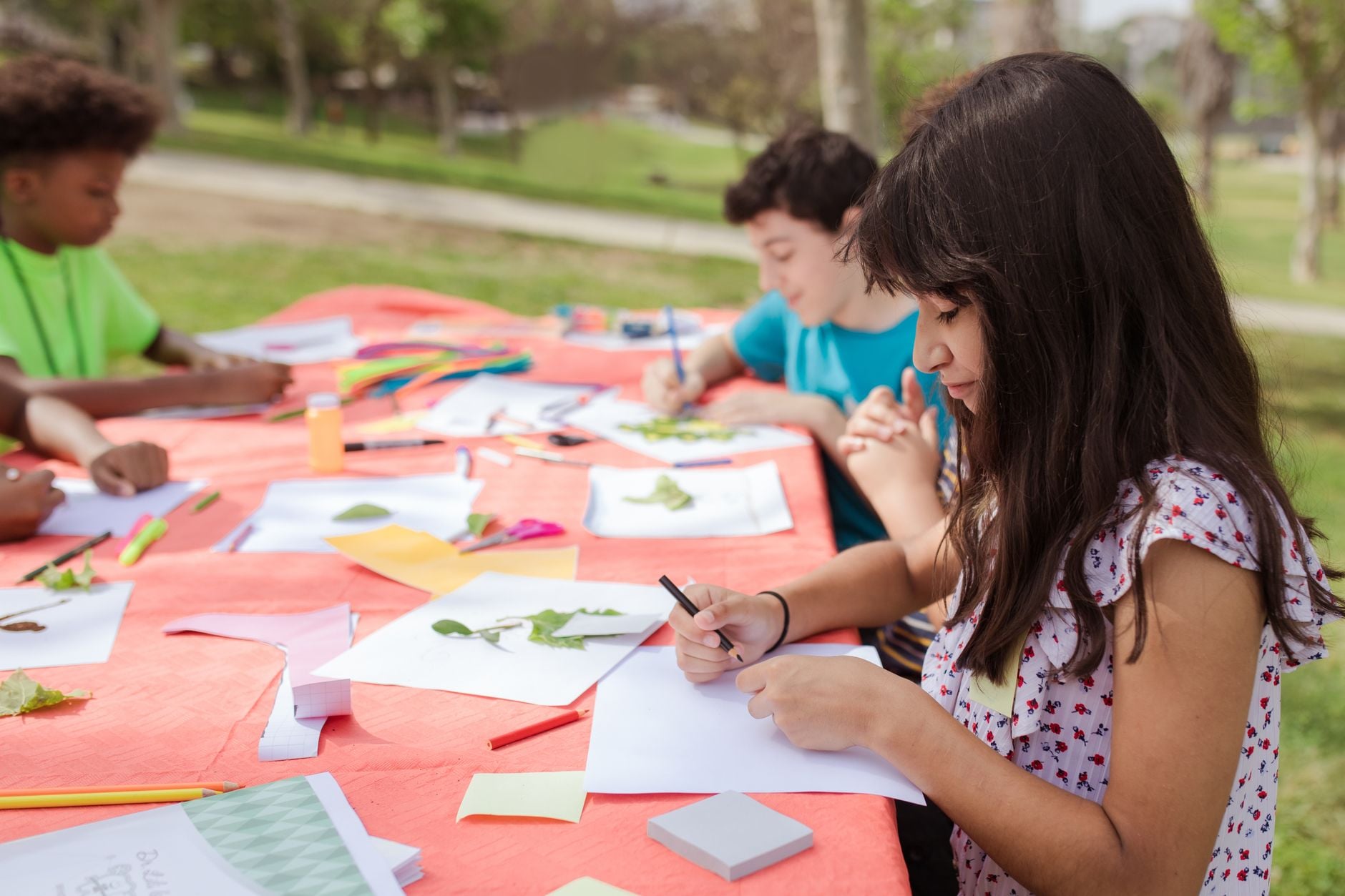
The Bible School Under the Cottonwood
Friday Morning
Friday was a beautiful June morning, the kind you get maybe ten of a year in North Dakota.
No wind, which is a miracle. The cottonwood fluff was coming down like snow, and the sky was so blue it looked fake.
I was on my hay bale with my sun hat and my whistle at nine, and every kid in that yard knew the morning song by heart now.
We were on the second verse, doing the motions, when I heard a car door shut out by the road.
The kids kept singing. I didn’t.
Tammy was standing at our gate. She had on her good blouse, the light blue one she wears to council meetings.
She had a child by each hand: her grandkids, Ella and Doug, six and eight, up from Fargo for the month while their mom worked.
I knew they were signed up at church. I had seen their names on the sheet, first and second on the list.
Tammy looked at the clothesline full of paper arks. Then at the cross on the garage. Then at me.
The song ended, and thirty-eight kids turned around on their hay bales to see who had come.
Doug broke loose from her hand and ran straight across the yard to the Larson boys, who he had been swimming with all week at the town pool. Ella hung on to Tammy’s skirt and stared at the clothesline.
Tammy walked across the grass. I stood up off the bale. I did not know what she was going to say, and I did not know what I was going to say back.
“They begged,” she said. Her voice was small. “Every night this week. ‘Grandma, the Larsons get to go to the farm. Grandma, Noah has a calf there.’ Doug cried at breakfast.”
“We do have a calf,” I said.
“I know.” She almost laughed, and then she did not. “Robin, can they stay? I’ll pay. I’ll pay whatever.”
“There’s nothing to pay here,” I said. “That’s the whole point of it.”
She stood there a long moment. The cottonwood fluff was landing in her hair. Then she said, “Do you need any help?”
The Snack Table
I put her on the snack table, because it was the only job left, and because I did not trust either one of us with more than that.
Tammy Wolff, chair of the church council, in her good blue blouse, poured red Kool-Aid into paper cups for forty children and two teenagers and one eighty-one-year-old woman in a lawn chair. She did not spill a drop. She never does.
She did not say much the first hour. She cut cheese slices into squares with my old paring knife and lined up graham crackers in rows like soldiers, and every so often I saw her watch the kids doing the motions, and her face did something I could not read.
At snack time Marlene, who has never been shy one day in her life, looked up from her lawn chair and said, “Tammy, I ran this Bible school for thirty years with a shoebox. Robin’s run it for twelve with the same shoebox. You want to see the shoebox?”
Tammy said she would. Marlene showed her the felt figures, and the faded sun, and the cow with one ear missing because somebody’s little brother chewed it in 1991.
Tammy held the cow for a long time.
Then she came and found me by the clothesline, where I was pinning up the last of the Jonah crafts, and she stood next to me and handed me clothespins one at a time without being asked, the way she used to when we hung bedsheets together for the church rummage sale.
“I said outdated,” she said.
“You did.”
“I’ve been saying it in my head all week.” She handed me another clothespin. “Robin, we’re down to sixty people. Mike and I were at Cindy’s church in Fargo at Easter, and they had a Bible school like a rock concert, with five hundred kids and a light show, and I came home and looked at our church and I was scared.”
“I know,” I said.
“I wanted something that looked like a growing church. I wanted the paper to come out and take a picture and have it look like we were alive.” She was folding and unfolding a clothespin bag in her hands. “I never once thought about who couldn’t pay. Not once. I didn’t even think about the Larsons.”
“You didn’t ask me,” I said. “That’s what hurt. Not the vote. That you didn’t call.”
“I know. I was afraid you’d talk me out of it.” She wiped her eyes with the back of her hand. “You would have, too.”
I did not say anything for a minute. Then I handed her the end of a paper rainbow and she held it while I pinned it, and that was about as much as either of us could say right then.