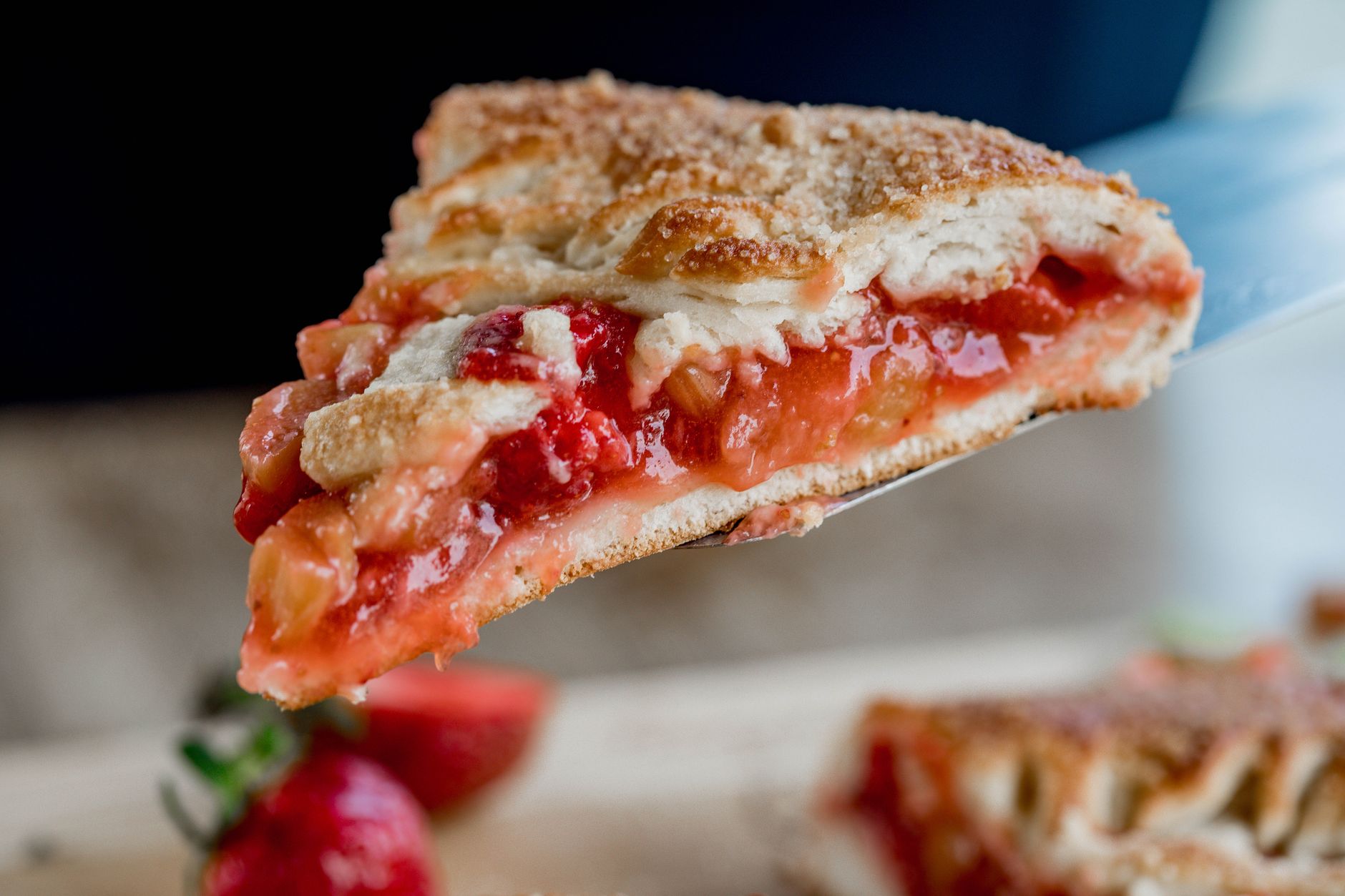
Grandma Elsie’s Rhubarb Custard Pie
I saw her come down the basement stairs alone, in a nice blue blouse, holding her purse in front of her like a shield.
She looked thin. She’d lost weight since August. Her color needed doing. I noticed that, God help me.
Thirty years of a hairdresser’s eye. Her roots were an inch grown out, and she had always been so careful about her roots.
She went through the line with her plate. Turkey and dressing, potatoes, green beans.
She smiled at the ladies serving and said thank you to every one of them, the way her mother raised her. She did not look over at me once.
Then she got to the dessert table.
I was in my apron, setting out the last pie, the thirtieth one, at the end of the row.
I had flour on my hands and a knife in one of them. I set the knife down. Pam stopped across the table from me.
She looked down at the rows of pies. She knew it. Of course she knew it.
She had made that pie for her mother, and then she had made it for Mrs. Arndt, and she knew exactly what she was looking at.
She picked up a slip.
She read the front. I watched her lips move a little, the way Doris taught us all to do in second grade. Elsie Jorgensen. Rhubarb custard pie. 1951.
She turned it over and read the back. All of it. The rolling pin, the sugar and flour, fifteen minutes, the nutmeg. And the orange. I watched her get to the orange.
The line behind her stopped. Two farmers, the Kessler brothers, in their good shirts. Three of the kitchen ladies with the coffee pots. A young mother with a baby. Nobody said one word.
Pam looked up at me, across thirty pies.
Her eyes were wet. Her mouth was pressed together hard, the way it gets when she is trying not to cry in public, and I knew that face better than my own.
I’d seen it at her wedding and at her baby’s funeral and at the hospital the night my daddy almost died.
For a second I thought she was going to put the slip down and walk out. I think she thought so too. I saw her look at the stairs.
She set her plate down on the end of the dessert table instead. Very carefully, the way you set something down when your hands are shaking.
Then she turned and walked to the front of the basement, past all the long tables and the folding chairs, to where Janet, the pastor’s wife, stood by the coffee urns with a stack of napkins.
“Janet,” Pam said. Her voice was thin, but the basement was quiet enough now that it carried. “Can I say something? To everybody? Just for a minute?”
Janet looked over at me. I don’t know what she saw on my face.
I put the pie server down on the table, and wiped my hands on my apron, and nodded to her. Janet handed Pam the little microphone they use for the prayer.
Pam held that microphone in both hands. The whole basement got quiet, the way a church gets quiet when somebody walks up who isn’t supposed to be up there. Three hundred people, and you could hear the coffee urns ticking.
“Most of you know me,” Pam said. “I’m Pam Schultz. I’m Doris Hoffman’s daughter. Some of you saw me in the paper in August, with a ribbon. For best pie at the fair.”