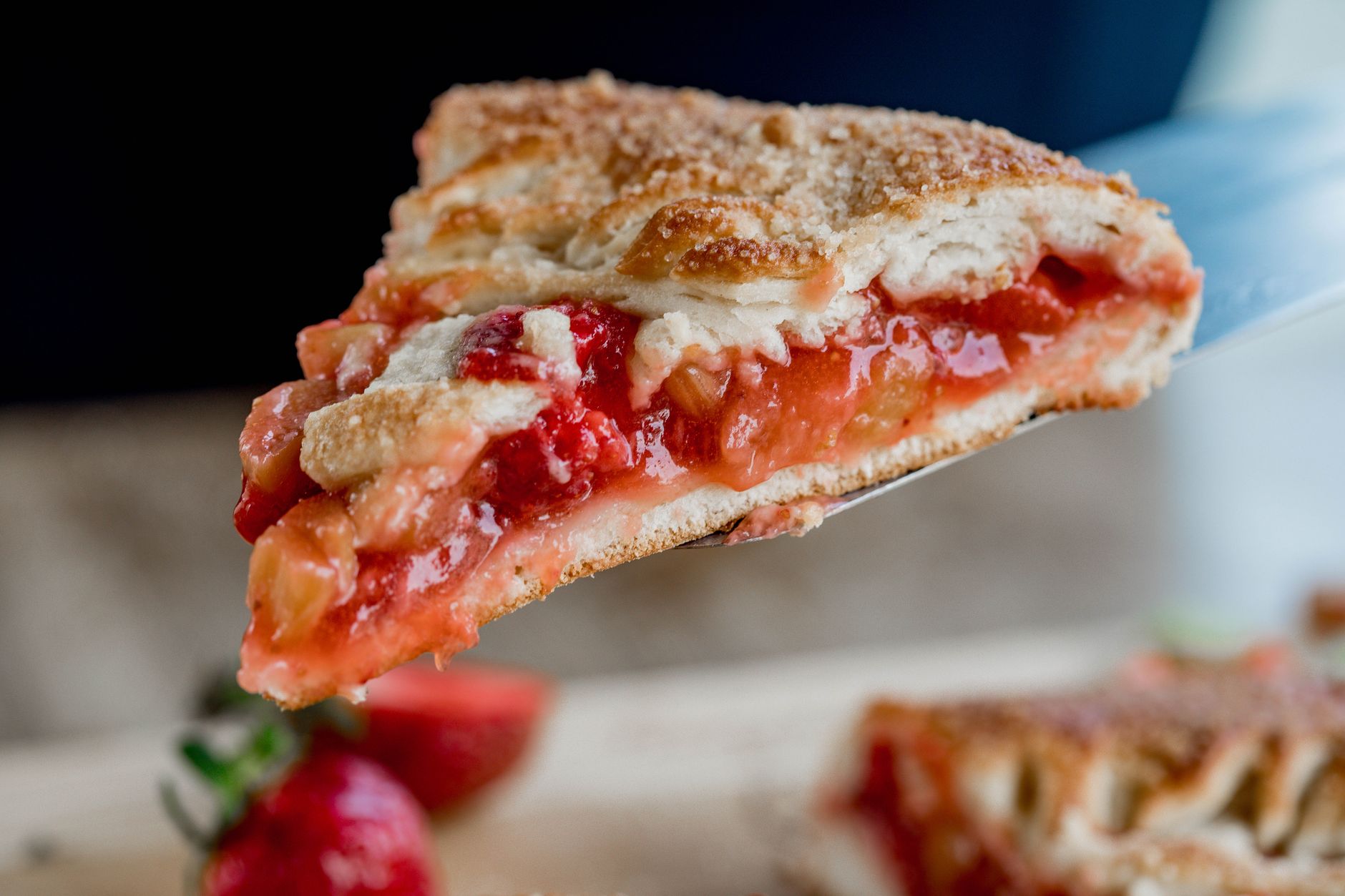
Grandma Elsie’s Rhubarb Custard Pie
“I have been trying to say it to her face since August,” I said. “She won’t open the door, Dean. This is the only door I have left.”
Dean nodded. He took the slip back, set it on the pile, and went on cutting. He never asked me about it again. That was his blessing, and I knew it.
The Saturday before the supper, Dean and I took over the church kitchen at six in the morning.
The church has two big ovens down there, old Garlands that run hot on the left side, so you turn your pies halfway through.
I rolled crust at the long steel table where Grandma used to roll hers. Dean ran the ovens.
“Light,” I kept saying to myself on the rolling pin. “You are not mad at it.” And I wasn’t, mostly, by then. Mostly I was just tired, and a little scared, and missing my grandmother something terrible.
By four in the afternoon we had thirty pies cooling on every flat surface in that basement. The whole church smelled like nutmeg and orange and browned sugar.
The custodian, a big quiet fellow named Jim, came down to check the furnace and just stood in the doorway breathing.
“Lord have mercy,” Jim said. “That’s Elsie’s pie. I’d know that smell anywhere. She brought one to the house when my dad died.” He went back upstairs wiping his eyes with the back of his wrist.
That was the first time I cried that weekend. Not the last.
That night Dean and I slid all thirty pies into the big church refrigerator, the way custard has to be kept, and went home and slept like the dead.
Sunday the supper started at eleven, right after the late service. The line was out the basement door and up the stairs by ten forty-five.
I set out the pies in rows on the dessert table, cut eight ways, every slice on its own little paper plate.
And beside every plate, I laid one of my slips, name side up. Two hundred and forty of them.
The ladies of the church kitchen saw me doing it. Nobody asked a single question. Marilyn picked up one slip, read it, and put it right back where it had been. Then she went and got more forks.
They picked up their pie, and they picked up the slips. Some of them read them right there at the table.
Some of them put them in their pockets. An old man named Walt read his, then turned it over, and then he stood there a long time.
“Elsie made this for my Ruthie’s funeral,” Walt said to nobody in particular. “Brought it in a towel, still warm. Nineteen eighty-eight.” He tucked the slip in his shirt pocket behind his reading glasses.
That happened over and over. People held up their slips and said, “Oh, Elsie’s,” and “I remember this,” and “My mom used to make this, she got it from your grandma.” I hadn’t expected any of that.
I think about half the town read those slips that afternoon. And I know some of them had seen the paper in August.
I saw the looks. I heard a woman at the second table say, “Wait. Isn’t this the one that won the fair?”
Pam came at about twelve thirty.
I didn’t know if she would. I’d half hoped she wouldn’t, and half prayed she would, and I couldn’t have told you which half was winning.