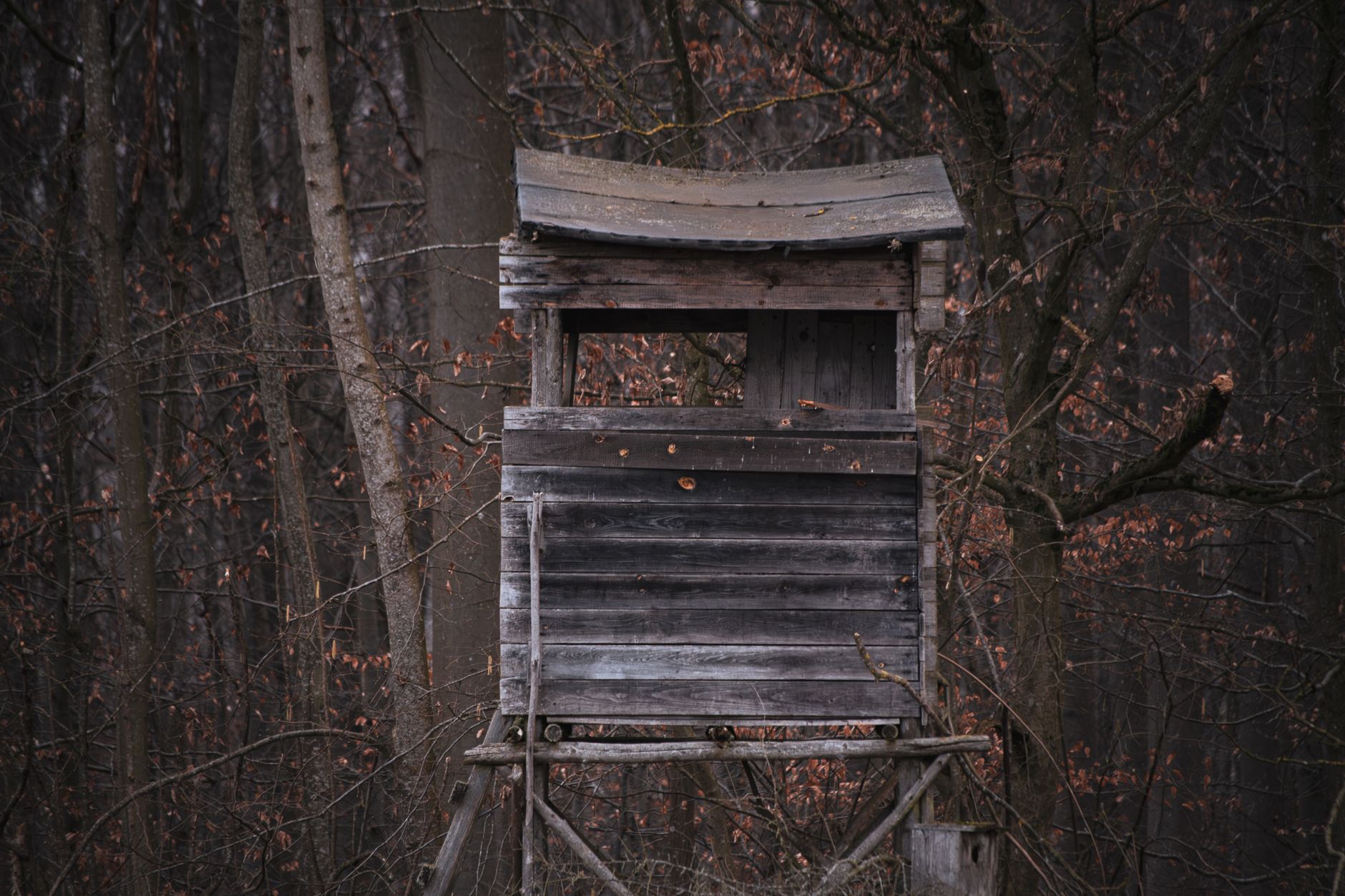
The Widow in the Deer Stand
Then I went to Wes’s stand.
It sits eight feet up in a bur oak above the crossing, where the deer come down off the hill to water. He built it out of treated lumber in 1998 and he replaced the boards every few years whether they needed it or not. The ladder is two-by-fours. The bench is a plank. The rail across the front is a two-by-six he ran his hand along so many seasons that the top of it has gone smooth and dark.
I climbed up. Under the bench somebody had left a hand warmer packet and a candy wrapper.
And I sat where he used to sit, and I looked at the rail.
Wes kept his tally there, cut in with a pocketknife. A notch for every deer that stand ever gave him, twenty-some of them, small and neat. Then a bigger cut, deeper, in a boy’s uneven letters: CODY. AGE 12. And next to it, in Wes’s hand, small: PROUD OF YOU.
I had never seen that. In all those years I had never once climbed that ladder.
I did my crying up there, where nobody was looking, and then I went home and did not sleep.
Friday I went back in the daylight with Wes’s cordless drill and a box of deck screws. I am fifty-eight years old and I was not going to sit eight feet up in the dark on a ladder I had not checked. I put my weight on every rung. The fourth one gave a little, so I cut a new one from a board in the shop and screwed it on. I shook the rail. I stood on the bench. It was as sound as the day he built it.
I left the sign where it was. I left the metal stand. I did not want anything to look different.
Saturday I was up at four.
I filled Wes’s steel thermos, the dented green one that rode in the cab of a county road grader for thirty-one winters. I put on long underwear and two pairs of socks and his brown chore coat, which still hangs on the hook by the back door and which I have not washed. I put on an orange stocking cap. I was not hunting and the law does not ask a person to wear orange just to sit in a tree, but opening morning there are rifles in every draw in Boone County, and nobody was going to mistake me for anything but a person.
I did not take a rifle. I had no use for one.
I took three cups.
I thought of Wes, who never in his life let a man stand in his yard without offering him something.
I left the pickup in Don’s yard, behind his machine shed, so there would be no truck sitting at my gate. His kitchen light was on. He came out on the step in his sock feet.
“Schmitt’s at the corner,” I told him. “If you hear anything you don’t like, you call him. Don’t wait for nine.”
He nodded. “It’s twenty-two degrees, Marlene.”
“I’ve got his coat on.”
I crossed the road with a flashlight. The chain on my gate was hanging loose and the padlock was open, hooked through one link. Somebody had been by already that morning, or the night before, to leave it that way.
Brings me back to my early age. Enjoyed 😉