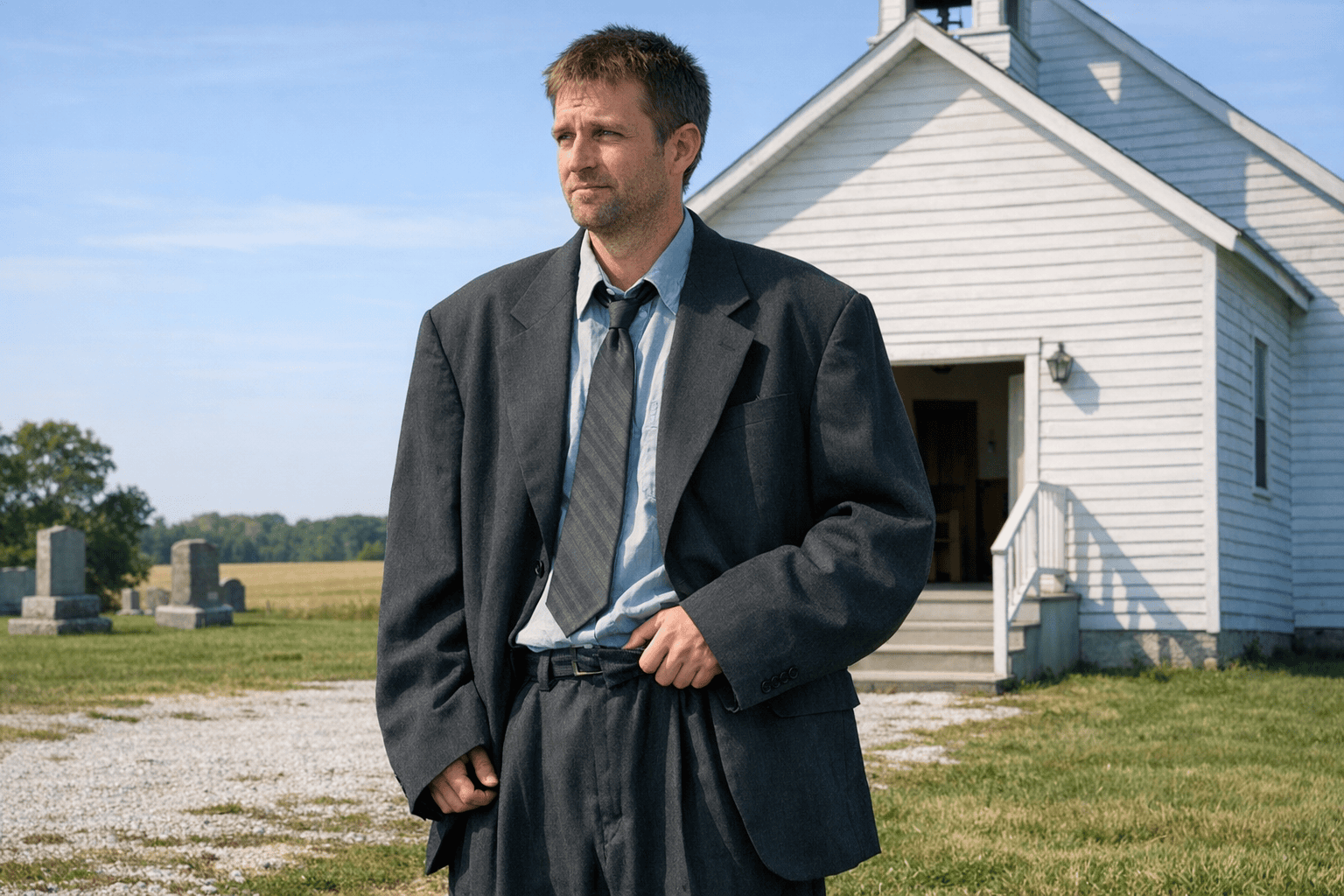
The Suit My Brother Left Behind
What came apart
Here is the part where I could tell you I forgave everybody in a warm circle in that kitchen and we all cried and healed. That is not what happened, because that is not how it goes in a house where the ranking has been set in concrete for twenty-six years.
What happened is slower and truer than that.
Trent’s management job at the farm-supply chain two counties over lasted another five weeks. He got let go again, the third time in two years, and this time there was no soft landing waiting, because the family friend on the Cornerstone board had heard from Diane herself exactly how Trent had conducted himself in that building, and word in a river valley travels faster than any interstate. The doors that used to open on my brother’s name because of who my father drank coffee with started closing one by one. It turns out a reputation is a thing you actually have to earn too, and my brother had spent his whole life spending one he never built.
The new truck got repossessed in the spring. I did not celebrate it. I found, to my own surprise, that I did not have any celebration in me for it. I had spent so many years wanting my parents to see the difference between us that when the difference finally showed itself in the plainest possible terms, all I felt was tired, and a little sad, and mostly just far away from all of it.
Mandy left him about a month after the truck.
Kyle, the friend with the poisoned folder, I never spoke to again. I did not need to. I had thrown his numbers in a trash can on a county bus and walked into that boardroom with my own, and that was all the answer he was ever going to get from me.
My mother, later
My mother called me about two months into the new job.
I almost did not pick up. But I did, because she is my mother, and because a person can set a boundary without setting fire to the whole field.
She did not apologize. Not really. Not in the clean way you want it in the movies, where somebody says the exact right words and the years lift off you like fog. What she said was, “I didn’t know that suit was so bad on you. I didn’t really look.”
And you know what, I believe that is the truest thing she has ever said to me. She did not look. For twenty-six years, she did not look. It was easier to hand me my brother’s leftovers than to see me clearly, because seeing me clearly would have meant seeing what they had done, holding two sons up next to each other and choosing, over and over, every single day, in a thousand small ways, which one got the new keys and which one got the safety pins.
“I got a jacket that day from a stranger,” I told her. “A woman who met me for one morning looked at me for about four seconds and saw the whole thing. You had twenty-six years, Mom.”
She was quiet on the line.
“I’m doing well,” I said, and I meant it. “I wanted you to know that. Not so you’d feel bad. Just so you’d know. I’m doing well, and I did it myself, and I’m not coming back to that table to eat the dry end of the roast anymore.”
I did not say it mean. I said it the way you close a gate you are not going to open again for a while. Firm, and even, and final.