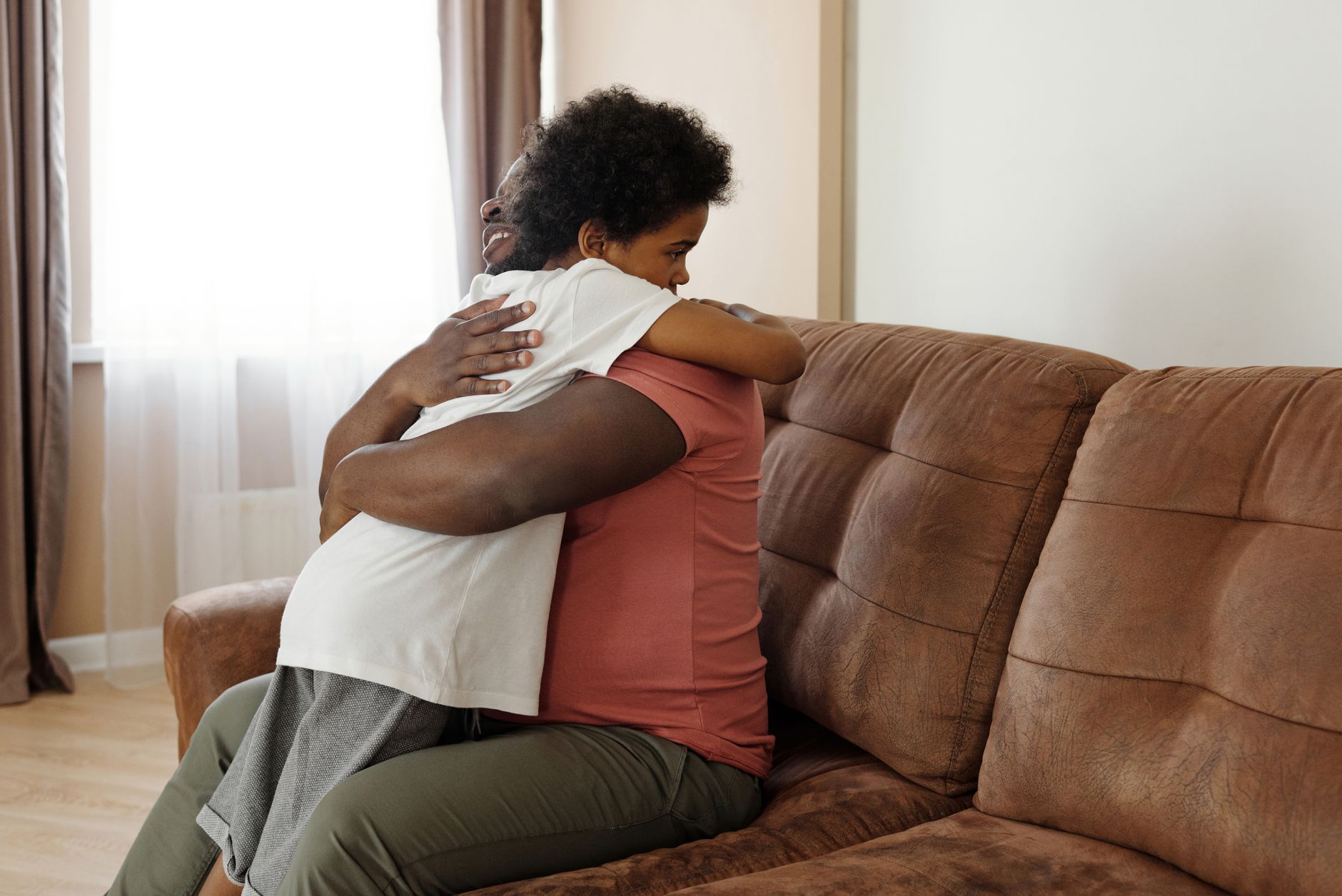
The Phone Call That Changed Everything
The sound of his open hand against the side of my face was louder than any argument we had ever had in forty-one years of being father and son.
One second I was standing at the counter saying, “Megan, honey, could you please not smoke in the kitchen. My lungs cannot take it anymore.” The next second my head snapped sideways, my ear was ringing like a struck bell, and the whole bright room tilted a few degrees off level, the way a boat does when a wave hits it wrong.
I am sixty-seven years old. I spent thirty-one of those years on the floor of a grain and feed mill outside of Marion, Ohio, breathing dust that the doctors now tell me is the reason I wheeze going up a flight of stairs. I raised that boy by myself in a two-bedroom rental with a furnace that only worked when it felt like it. And there I stood, in the spotless kitchen of a house I never once dreamed he would be able to afford, with my only child’s handprint burning on my cheek.
Megan blew a long thin ribbon of smoke toward the ceiling like nothing at all had happened. She was wearing the kind of exercise clothes that cost more than my first car, her makeup done at nine in the morning for no reason I could see, and she looked at me the way you look at a coupon that has expired. Like I was an inconvenience. Like I was clutter in a house that had been decorated to look like nobody actually lived in it.
“Maybe now you’ll stop talking,” my son said.
That is the part I keep coming back to. His voice did not crack. He was not red in the face. He was not shaking with rage the way I would have been. He sounded bored. He sounded put out, like I had made him get up off the couch to deal with something small and annoying. Like I was the disruption in his morning and not the man who had just been hit by his own child.
Then he leaned over, kissed Megan on the top of her head, and asked her if she wanted to go out for dinner that night. She smiled at him, tapped her cigarette out into a clean saucer I had washed and dried an hour earlier, and said that sounded perfect.
Fifteen minutes later I heard the front door close. I heard the beep of their car unlocking in the driveway. I heard the two of them laughing at something, easy and light, as the engine turned over and they backed out and drove away, leaving me standing alone in a silence that was somehow heavier than any noise.
The clock ticking on the wall. The hum of a refrigerator the size of a phone booth. And my own breathing, tight and shallow and painful, pulling against the damage in my chest.
That was the morning everything changed. I just did not know it yet.
The House That Was Never Mine
Let me back up, because a slap like that does not come out of nowhere. It is the last brick in a wall that gets built one small insult at a time, and if I am honest with you, I had been helping lay that wall myself for the better part of a year.
My name is Walter. My wife, Ellen, passed six years ago from a stroke that took her in the time it takes to make a pot of coffee. We had been married thirty-nine years. After she was gone the mill let me stay on part time for a while, mostly out of kindness, and then a bad winter and a worse lung scan made the doctor sit me down and tell me plainly that the dust years were catching up and I had to stop.
So I stopped. I sold the little house Ellen and I had paid off, because I could not manage the stairs or the yard or the property taxes on a pension and a Social Security check. I moved into a rented room for a while. And when my son, Kevin, found out, he called me up and made what sounded, at the time, like the kindest offer a father could ask for.
“Dad, this is ridiculous,” he said. “You are not going to live in some rented room like a college kid. We have got all this space. Move in with us. Megan and I would love to have you.”
I want you to understand something about how that felt. When Kevin was seven years old and had the flu, I sat on the bathroom floor with him at three in the morning so he would not be scared. When he was in high school and wanted to try out for baseball, I picked up a second shift on weekends so we could afford the equipment and the fees. I went without a lot of things so that boy would never feel like his father had given up. And here he was, grown and successful and offering me a home. I cried a little after we hung up. I thought I had done something right.
I sold most of what I had left. The recliner Ellen used to fall asleep in. My tools. The good winter coat, because Kevin said his neighborhood was nicer than that and I would not need it. I brought two suitcases and a cardboard box of photographs to a big house in a subdivision two counties over, a house with a three-car garage and a lawn service and a kitchen island bigger than the bedroom I grew up in.
They gave me what they called the guest room.
It took me a few weeks to understand what that word really meant in that house. It was not a room for me. It was a room staged for the idea of company that never came. There was a bed with a hard decorative pillow that said LIVE LAUGH LOVE that you were apparently not supposed to actually sleep on. There was a window with a latch that did not catch, so on cold nights the draft came right through, and when I mentioned it to Kevin twice he said he would get to it and never did. There was a small bathroom down the hall that Megan referred to as “Walter’s bathroom” in a tone that made it clear it was the one she did not want to touch.
On the nightstand I kept one framed photo. Kevin at his high school graduation, cap on crooked, my arm around his shoulders, both of us grinning like a couple of fools who thought the whole world was laid out ahead of us like a road. I used to look at that picture every night and try to find the line, the exact place, where that boy turned into the man who could not be bothered to look up from his phone when I came into a room.
I never did find it. Walls do not go up all at once. They go up one brick at a time, and you keep telling yourself it is not really a wall, it is just this one thing, and you can live with this one thing.
The Bricks I Pretended Not to See
I told myself to be grateful. I told myself over and over. Do not be difficult, Walter. Do not be a burden. Do not be one of those old men who complains. They have given you a roof. Keep the peace.
So I kept the peace while they charged me rent. That surprised me, but I told myself it was fair, that a grown man should pay his way, and I signed over a piece of my pension check every month into an account Kevin set up. He said it was easier that way, that he would handle the household finances and I would not have to worry about a thing. I trusted him. He was my son. Of course I trusted him.
I kept the peace when Megan reorganized the kitchen so the coffee I drank was on the highest shelf, the one I could not reach without the step stool that made my chest hurt. I kept the peace when they went out to dinner three and four nights a week and never once asked if I wanted to come along, and I ate a sandwich standing at the counter so I would not leave crumbs on the good table. I kept the peace when Kevin introduced me to a business friend as “my dad, he stays with us,” like I was a boarder, like I was a piece of furniture that came with the house.
And I kept the peace about the smoking, right up until I could not anymore.
Megan smoked in the kitchen every morning. I had asked her, gently, more than once, to please take it outside or to a room with a window that opened, because my doctor had been clear that another bad chest infection could put me in the hospital and my lungs had no reserves left to fight with. She would roll her eyes and crack a window that did nothing and keep right on smoking. Kevin’s answer, every time, was the same. “Dad, it is her house too. Do not make a thing out of it.”
Her house. Not once, in all those months, did he say our house in a way that included me. I paid to live in a room I was not allowed to sleep comfortably in, in a house where I was told the air itself was not mine to ask about.
The morning of the slap, I was not angry when I asked her. I want that on the record. I was tired, and I was scared, because I had woken up wheezing and my chest had that tight wet feeling that I knew from experience was the start of trouble. I asked her the way you ask someone for a small mercy. Please. My lungs cannot take it.
And my son hit me for it.
I have turned that morning over in my mind a thousand times since. Not the pain of it, the pain faded. What I keep touching, like a tongue going back to a broken tooth, is how ordinary it was to him. He hit his own father across the face and then asked his wife where she wanted to eat dinner. That was the moment something in me that had been bending for a year finally broke clean through. Not my heart. My patience. My habit of making myself small.
I stood in that kitchen alone and I made a decision. I was done being grateful for scraps. I was done pretending. I was going to do the one thing I had spent a year telling myself not to do.
I was going to stop keeping the peace.
The Names I Had Not Dialed in Years
I walked down the hall to the guest room. My cheek was throbbing and hot, and when I looked in the little bathroom mirror I could already see the color coming up under the skin, that deep bruise blue. I sat down on the edge of the bed that was made for a stranger, and I picked up my phone, and my hand was shaking.
I scrolled past the numbers that only lit up around Christmas. Past old neighbors who had moved to Florida and stopped writing back. And I found three names I had not called in a long time, because when you are trying not to be a burden you stop reaching out to anybody, even the people who would run to help you.
Let me tell you about those three.
There was Danny. When Danny was nineteen his father threw him out over something that was not his fault, and he had nowhere to go, and Ellen and I gave him our couch and then our spare room for the better part of two years. We fed him. I taught him to change his own oil and to shake a man’s hand like he meant it. Danny is fifty-one now, and he is one of the best elder-law and civil attorneys in central Ohio. He put himself through school with a grit that still makes me proud, and every year on my birthday he calls me, and every year I tell him he does not need to.
There was Karen. Her mother, Ruth, lived two doors down from us and got sick when Karen was in high school, and Ellen and I looked after Ruth, drove her to treatments, sat with her, so that Karen could stay in school and not drop out to be a nurse to her own mama. Karen is a reporter now for one of the bigger papers in the state. She has broken stories that put crooked men in courtrooms.
And there was Sam. Sam was a college kid who worked summers at the mill with me, a skinny quiet boy whose own family had scattered, and he ate supper at our table more nights than not for three summers running. Sam went into accounting, then into forensic work, and now he is a financial investigator who can follow a trail of money through a dozen accounts the way a hound follows a scent. He is that good.
Three people. I had held all three of them up when they were sinking, and here is the thing about doing that: some folks take the hand you offer and then forget your name the minute they are back on dry land. But some of them never forget the hands that held them up. Some of them spend the rest of their lives waiting for a chance to hold you up in return, and they are almost grateful when you finally let them.
I pressed the first number. Danny.
He picked up on the first ring. “Walter? Is everything okay?”
And I almost lied. Old habit, strong as gravity. I almost said, “Oh, I am fine, son, just calling to say hello.” I had the words halfway up my throat.
Instead, for the first time in longer than I can remember, I told the flat truth to another human being.
“No,” I said. “I am not okay. My son hit me this morning. I need help.”
There was a silence on the line, and then Danny’s voice came back low and steady, and I heard the boy I had raised on that couch turn into the man he had become. “Walter, listen to me. Do not touch anything. Do not clean up. Do not throw anything away. I am going to make some calls and I am going to be there. Tell me exactly what happened, from the beginning.”
I talked for twenty minutes. Then I called Karen, and then I called Sam. By the time I hung up the third call, my cheek was still swollen and my chest was still tight, but something down in the center of me had gone quiet and firm, like a fence post set in concrete. I was not a burden in someone else’s house. I was a man with forty years of receipts, in my heart and, as it turned out, on my phone.
The Photographs I Had Been Taking All Along
Here is something I have not told you yet, because I was a little ashamed of it, and it took me a while to understand it was not shame I should feel. It was foresight.
For about six months, without ever quite admitting to myself why I was doing it, I had been taking pictures. Not of anything obvious. Not of people. I took pictures of things. I told myself I did not know why. But the phone knew, even when I did not.
That night, after I had made my three calls, Kevin and Megan came home. I heard the garage door rumble up and their voices float upstairs, light and cheerful, exactly the way they had left, like the morning had never happened, like a father with a bruised face was not lying in the dark down the hall. I did not go out to them. I lay on the bed that was not really mine and I opened the photo album on my phone and I scrolled.
The window latch that did not catch, with the gap you could see daylight through in winter. The bathroom with the water stain in the corner that they never fixed. The little space heater I had bought with my own money because the draft got so bad. Screenshots of the bank transfers, month after month, from my account to the household account Kevin controlled. A photo of the note Kevin had left on the counter one morning that said, in his own handwriting, “Dad, if you cannot follow the house rules maybe we need to talk about other arrangements,” which he wrote after I had left a coffee cup in the sink.
And now, that day, one more photo. A picture I had taken of my own face in the bathroom mirror, an hour after he hit me, the bruise coming up dark and unmistakable, the time and date stamped right there in the corner of the image by the phone itself.
For six months those pictures had looked to me like evidence of my own failure. Proof that I could not keep the peace well enough, that I was too much trouble, that I asked for too much. That night, for the first time, they looked like something else entirely.
They looked like a record. They looked like the truth, stamped and dated and impossible to argue with.
The next morning I woke before dawn. My cheek had gone from red to that deep, ugly, purple-black that only comes up a full day later. I took one more photograph in the gray light. Then I put on the soft gray cardigan Kevin had given me for Christmas two years back, before whatever it was in him had gone cold, and I walked into that kitchen like it was any other morning.
Kevin was at the island scrolling his phone. Megan was eating yogurt out of a little glass jar. Neither one of them looked up.
“Morning,” I said.
Kevin grunted something. Megan said nothing at all.
I poured myself a cup of coffee, and I carried it over, and I sat down in the exact spot where I had been standing the morning before when my son’s hand came across my face. My hands were not shaking anymore. My heartbeat was slow and even. I drank my coffee and I waited, and I have never in my life felt so calm about anything.
At nine o’clock in the morning, the doorbell rang.
Nine O’Clock
Kevin finally lifted his head. He looked at the front door, then at me, and something in his face flickered, because I do not think in all those months he had ever once seen me sit still and unbothered like that.
“Are you expecting somebody?” he asked.
I set my cup down. I pushed my chair back. I stood up, and I felt every one of my sixty-seven years and none of them at the same time.
“Yes,” I said. “I am.”
I walked to the door and I opened it, and there they were on the wide clean porch, the three of them, standing together in the flat morning light. Danny in a charcoal suit with a leather folder under his arm. Karen behind him with a notebook, and I want to be clear, she had told me on the phone she was not there as a reporter and she never wrote a word of this for her paper, she was there as Ruth’s daughter and my friend. And Sam, quiet Sam, with a laptop bag over his shoulder and a look on his face I had never seen on him before, the look of a man who has already found what he was sent to find.
Kevin came around the island. “Dad, who are these people?”
Danny stepped inside, calm as still water, and put out his hand, not to shake, but to hand Kevin a card. “Kevin, my name is Danny. I am an attorney. I have known your father since I was nineteen years old and had nowhere to sleep. He is a client of mine now, and a friend for a lot longer than that.” He looked around the kitchen, at Megan frozen with her yogurt spoon halfway to her mouth, at the saucer she still used for an ashtray. “We are here to talk about a few things. It would be better for everyone if we all sat down.”
I have to hand it to my son. He tried, at first, to do what men like him do. He got loud. He said this was his house and we could all get out. He said I was confused, that I was an old man who did not know what he was saying, that nothing had happened, that I had fallen.
That was the wrong word to say in front of Danny.
“Fallen,” Danny said, and he opened the leather folder and laid a single sheet on the counter. It was a printout of the photograph I had taken of my own bruised face, time-stamped, from the morning before. “Walter, is this the injury you told me about?”
“It is,” I said.
“And how did you get it?”
“Kevin hit me across the face,” I said, and I looked my son dead in the eye when I said it, “because I asked his wife to please not smoke in the kitchen.”
The room went very quiet. Megan set her spoon down.
What the Paper Trail Showed
I thought that would be the end of it. The bruise, the photo, Danny explaining, in that flat courtroom voice, exactly what the state of Ohio thinks about a grown man striking his elderly father, and what the words elder abuse mean when they are written on a police report. I thought that was the whole of the reckoning.
But then Sam set his laptop bag on the counter, and he cleared his throat, and it turned out my son had a great deal more than a slap to answer for.
“Mr. Walter asked me to look at the household finances,” Sam said, careful and precise the way he has always been. “Specifically the account that Kevin set up to collect his father’s monthly contribution. Walter, you told me you were paying rent. You told me Kevin was handling everything so you would not have to worry.”
“That is right,” I said.
“You were paying,” Sam said, “a great deal more than rent.” He turned the laptop so we could all see the screen. “Over the last eleven months, the transfers out of your father’s pension and savings into the account you controlled add up to a number that is not rent, Kevin. It is most of what he had. And this account here.” He pointed. “This is where a good portion of it went. Not to the mortgage. Not to household expenses. To a personal line of credit in your name, and to charges I can itemize for anyone who wants to see them.”
I felt the floor go a little soft under me. Not from surprise, exactly. From grief. Because that was the last brick, and it was the heaviest, and I finally understood the whole shape of the wall. He had not just been unkind. He had been quietly draining the man who raised him, a little every month, betting that I loved him too much to ever look, betting that I would keep telling myself to be grateful right up until the money was gone and I had nowhere left to go and no way to leave.
Kevin’s face changed then. All the bluster went out of it. He looked, for a second, like the seven-year-old on the bathroom floor, and part of me, God help me, still wanted to comfort him. That is the thing nobody tells you about being a parent. It does not switch off. Even then.
But I did not comfort him. For once in my life, I let the silence do the work.
Danny closed his folder. “Here is where we are,” he said. “Kevin, your father has a documented injury, a witness, and a clear financial record. He would be well within his rights to file a police report this morning for assault, and to pursue the misappropriated funds through the courts, and I will tell you plainly that with what Sam has assembled, he would win. Both times.”
“Dad,” Kevin said, and his voice finally cracked, a whole day too late. “Dad, please.”
I looked at him for a long moment. Then I looked at Megan, who had gone white and would not meet my eyes. And then I looked out the window at the flat gray morning, and I thought about Ellen, and about a two-bedroom rental with a bad furnace, and about a little boy who used to think I hung the moon.
The Door I Walked Out Of
I want to tell you I forgave him on the spot, that I chose mercy and we all wept and made up. That is how the story would go if it were a movie. It is not how it went.
What I chose was dignity. There is a difference.
I told Kevin, with Danny writing it all down, exactly what was going to happen. Sam would produce a full accounting of every dollar that had left my accounts, and Kevin would return every cent of it, in full, on a schedule Danny would put in writing and that Kevin would sign. Not because I needed to punish him, though Lord knows a part of me wanted to. Because that money was Ellen’s and my whole life of work, thirty-one years of grain dust and double shifts, and it was going to fund the rest of my life, not his line of credit.
As for the assault, I told him I would hold the police report. Hold it, not tear it up. Danny kept the original, time-stamped photo and the signed statement in his files, where it sits to this day, and I told my son that the day he ever raised his hand to another human being who could not defend themselves, that report would find its way to the right desk. He understood me. I made sure he understood me.
And then I told him I was leaving, and that I would not be back.
I packed my two suitcases and my box of photographs while Danny waited in the front hall. I took the framed picture off the nightstand, the graduation one, and I stood there holding it for a minute. Then I put it in the box too, because that boy was real once, and I was not going to pretend he never existed, even if I could not live in the same house as the man he became.
Sam carried my bags. Karen drove. And Danny, who had a couch of his own now and a family of his own now, told me on the porch that his mother-in-law had a mother-in-law suite over the garage, a real one, with a door that locked and a window latch that worked and a bathroom that was mine and nobody else’s, and that it was empty, and that I would be doing them a favor by not letting it sit unused. I knew a kindness dressed up as a favor when I heard one. I had spent my whole life dressing up kindnesses that way myself. I let him do it.
That was four months ago.
I live in that little apartment over Danny’s garage now, and I pay him a fair rent that he grumbles about accepting. My chest is better than it has been in years, because nobody smokes anywhere near me and the air is my own. Kevin has returned a little over half of what he took, on the schedule he signed, and Danny tells me the rest will come. I have not spoken to my son since I walked out that door, though he has left me a few messages. I have not decided yet what to do with them. I may never decide. That is my right, and it took me sixty-seven years to learn that some things are my right.
Karen comes by on Sundays sometimes and we drink coffee and talk about her mother, who was a good woman. Sam fixed the latch on my new window himself, even though it already worked, because that is the kind of thing Sam does. And Danny’s kids call me Grandpa Walter, which was not asked for and not expected and is the best thing that has happened to me in six years.
I think a lot about that morning in the kitchen. Not the slap. The slap was just the sound that woke me up. What I think about is the fifteen minutes after, when I sat alone in that terrible silence and picked up my phone.
I had spent a whole year believing I was a burden, a piece of clutter in a house full of things too nice to use. But a burden is not what I was. I was a man who had spent his whole life holding other people up, and I had simply forgotten that the ones you lift up do not always let you fall.
You spend your years wondering if any of the good you did stuck to anything. If it mattered. If anyone remembers. And then one morning you find out. You find out in the voices of the people who show up on the porch at nine o’clock sharp, folder under one arm, ready to stand in front of you like a wall of their own.
I raised my son alone and I would not trade the raising of him for anything, even now. But I learned something at sixty-seven that I wish I had known at forty. The people you help are not a debt they owe you. They are a family you build. And when the family you made by blood forgets who you are, the family you made by kindness will remember for both of them.
My cheek healed weeks ago. You cannot even see the mark.
The part of me that finally stood up out of that chair and walked to that door: that part never healed back down. It stayed standing. And I have been standing ever since.