
I stood in the doorway of Room 6 at Meadowbrook Hospice House with my keys still in my hand, and for almost a full minute I did not go in.
I want to be honest about that minute, because it is the truest thing I can tell you about this whole story. I did not walk into my father’s room like a man who had already forgiven him. I walked in like a man who was still deciding, keys pressing a groove into my palm because I was gripping them so hard, my truck still ticking in the parking lot behind me, one foot on the tile and one foot still, in every way that mattered, in the hallway. Raymond was lying in the bed with the afternoon sun coming soft through the curtains, thinner than I had ever pictured him, his eyes finding mine the second I appeared in that frame like he had been watching the door the whole time, the way a man watches a door when he has run out of anything else to hope for.
Nobody would have blamed me for turning around. That is not something I am saying to sound noble. It is a fact I have turned over in my mind a hundred times since, because I checked it against every person who loves me before I ever got in the truck, and every one of them, my wife included, told me the same thing. Nobody would have blamed you, Daniel. Not one soul on this earth would have thought less of you for letting that door stay shut.
My father, Raymond, walked out on our family when I was eight years old, and for the better part of the twenty eight years since, he was a man I knew mostly by his absence. I am thirty six now. I have a wife, Karen, and two children, Eli and Grace, and a mother, Linda, who raised me alone in a rented house on Bellwood’s east side and who died three years ago still praying for the man who left her, which is a detail I did not understand until very recently and which I am going to tell you the whole truth of, because I think it is the reason I was standing in that doorway at all.
This is not a story about a villain. I want to say that plainly, up front, because if you are waiting for me to describe a cruel man who deserved to die alone, that is not who my father was, and it is not the story I am telling you. My father was a weak man, and an afraid man, and for a long stretch of his life a drinking man, and those things cost my mother and me more than I can easily put into words. But weakness is not the same thing as villainy, and somewhere in the last thirty six years of my life, mostly because of what I believe and what my mother modeled for me long before I was ready to understand it, I stopped needing him to be a villain in order to make sense of my own pain. This is a story about what it costs, and what it gives back, to walk into a room you have every right to avoid.
—
My parents married young, the way people did in Bellwood in the years before I was born, in a small ceremony at Grace Bible Church with my mother’s side of the family filling one side of the sanctuary and almost nobody filling the other, because Raymond’s own father had died when Raymond was seventeen and his mother had moved to Kentucky not long after and was not close to her son even then. My mother used to tell me, in the years after Raymond left, that she had known within the first year of marriage that something in him drank at his own confidence the way rust drinks at iron, slow and from the inside, and that she had married him anyway because she believed love was supposed to be a kind of medicine for a wound like that. She was twenty two. She did not yet know that a wound like Raymond’s does not heal because someone loves it hard enough. Sometimes it only widens the person doing the loving.
I remember my father in fragments now, the way you remember anything from before you were nine, but the fragments I kept are good ones, which is its own kind of complicated. I remember him teaching me to throw a baseball in the side yard of the house on Cutter Street, patient in a way he was not patient about anything else, moving my elbow an inch at a time until the throw came out right. I remember him singing along, off key and unembarrassed, to the radio in his truck on the drive to my grandmother’s house every other Sunday. I remember one Christmas Eve, the last one we had all four of us in that house, when he carried me up to bed on his shoulders and told me I was going to be a better man than he was, which at the time I understood as nothing more than a father’s tired affection, and which I have understood very differently every year since.
The drinking got worse the year I was seven, though I did not have the words for what was happening at the time. I understood it instead as a change in the air of the house, a kind of held breath that settled into every room after my father came home. My mother tells me now, and I believe her, that she tried everything a woman in a small Indiana town in that decade knew how to try. She poured out bottles. She drove him to a program two counties over and sat in the parking lot for four hours waiting to bring him home. She prayed over him in a way I only fully understood once I became a praying man myself, on her knees at the foot of their bed at an hour when she thought I was asleep, which I was not.
None of it held him. In the spring I was eight years old, my father packed one duffel bag on a Tuesday morning while I was at school, and by the time the bus dropped me at the end of Cutter Street that afternoon, his truck was gone from the driveway and it did not come back.
—
I want to tell you about the day he left honestly, because I think the honest version matters more than a softened one. My mother did not cry in front of me that first week, not once, though I know now from things she told me later that she cried every night after I fell asleep, sitting at the kitchen table with the overhead light off so the neighbors would not see. What I remember instead is her competence. She sat me down on the porch steps the same evening, the concrete still warm from the day’s sun, and she told me that my father loved me, and that he was sick in a way that had nothing to do with germs, and that his leaving was not a single thing I had done or failed to do. I did not believe the last part for a long time. Most children do not, no matter how many times a mother says it.
For the first two years there were birthday cards, no return address, postmarked from towns I had to look up on a map, Terre Haute one year, then Evansville, then a town in Kentucky near where his own mother had settled. The cards got thinner as the years went on, both literally and in what they said, until by the time I turned twelve, they stopped coming altogether. My mother never once badmouthed him to me, which I did not appreciate as a gift until I became a father myself and understood exactly how much restraint that takes when you are furious at a man and your own child still loves him. She worked the register at the Bellwood Farm and Feed six days a week for eleven years, then moved into the office there when her knees gave out from standing, and she raised me inside Grace Bible Church the whole time, teaching my Sunday school class herself some years because we could not afford for her to miss a shift to hire a sitter.
I was angry through most of my teenage years, the kind of anger that does not announce itself as grief because grief is too soft a word for a fourteen year old boy to reach for. I got into two fights in high school over comments other boys made about my father, comments that were not even especially cruel, just true, the kind of small town talk that follows a family for a decade after something breaks in it. I told my mother once, I believe I was sixteen, that I hoped Raymond was dead, and that I would not go to his funeral if he was. She did not scold me for saying it. She only said, quietly, that she hoped I would feel differently someday, and that she would keep praying I did, and I remember being furious that she was praying for him at all instead of only for me.
Get a new story in your inbox every morning.
Facebook doesn’t show you every story we post. Our free newsletter does. Join 2,500+ readers.
—
There was one attempt at contact in my early adulthood, and I think it is important that I tell you about it honestly, because it explains a great deal of the hesitation I carried into that hospice doorway years later.
I was nineteen, home from a semester at Ivy Tech, when I got a collect call from a number I did not recognize, from a county lockup two states away. I accepted the charges before I understood who was on the other end of the line, and when I heard my father’s voice for the first time in seven years, thick and slower than I remembered it, asking if I could wire him three hundred dollars for a bond, I felt something in my chest go cold in a way I had never felt before or since. I did not send the money. I hung up the phone without a single word back to him, and I did not tell my mother about the call for almost a year.
I carried that refusal as a kind of proof for a long time, proof that I had been right about him, proof that whatever the man had once been in the side yard on Cutter Street teaching me to throw a baseball, the man on that phone call was who he actually was underneath it. I built a good portion of my twenties on that proof. It let me stop wondering about him. It let me close a door I had been standing in front of, half open, for eleven years, and I will tell you plainly that closing it was a relief.
—
I met Karen the year after that phone call, at a young adults gathering at Grace Bible Church that I had only gone to because my mother asked me to, and I found I could tell her the whole true version without flinching, the drinking and the duffel bag and the collect call I hung up on, and she did not look at me like I was a project to fix. She looked at me like a person whose story made sense of him, which is a different thing entirely.
We married four years later in the same sanctuary where my parents had married, which felt like an act of quiet defiance, a claim that our marriage would not go the way theirs had. Eli came two years after that, Grace three years after him, and somewhere in the ordinary work of being a husband and a father, coaching Eli’s little league team on the same field where my own father had once corrected my elbow, my faith stopped being the inherited thing my mother had handed me and became something I actually leaned my weight on. A man does not walk into a room he has spent twenty eight years avoiding on willpower alone. He walks in on something sturdier than that, or he does not walk in at all.
My mother, Linda, died three years ago, a stroke that took her fast on a Tuesday morning much like the one, all those years earlier, when Raymond’s truck disappeared from the driveway on a different Tuesday. In the last year of her life, in a conversation I did not understand the full weight of until much later, she told me she had never once stopped praying for Raymond, not out of any illusion about what he had done to us, but because she believed, all the way down, that no man was too far gone for grace to still be reaching for him. I told her, gently, that I did not think I had that in me. She only smiled, the tired smile she gave me any time she thought I would understand something in my own time, and said that she was not asking me to have it yet.
—
The call came on a Thursday afternoon in early July, while I was still at work at Bellwood Hardware, where I have managed the lumber counter for nine years. It was not Raymond who called. It was Pastor Mike Sutter, who has led Grace Bible Church since I was in my twenties, and who told me, in a voice careful the way a pastor’s voice gets careful when he is about to hand you something heavy, that a hospice chaplain two counties over had reached out to every Grace Bible Church in the state directory, working backward from a scrap of memory Raymond had given the hospice intake nurse, the name of a church and a town he had not set foot in for almost thirty years but had apparently never fully let go of either.
Raymond was dying. Lung cancer, diagnosed too late to do anything but slow it, and by the time anyone found him he was already in a hospice bed in a town called Danvers, forty minutes from Bellwood, with no listed next of kin the hospital could locate and reach, no wife, no other children, nobody at all except a chaplain named Carol Whitfield who had sat with him three separate evenings and finally asked him, straight out, if there was anyone in the world he wished could know.
He had given her my name. Daniel. My mother’s name, Linda, though he did not yet know she had passed. And the name of a church he had walked out of the sanctuary of on his wedding day nearly forty years before and never once returned to.
Pastor Mike did not tell me what to do. I want to be clear about that, because I have heard from other men since that their own pastors pushed them one direction or another in a moment like this, and mine did not. He only said that Raymond was asking, and that Carol Whitfield had given him a number to pass along if I wanted it, and that whatever I decided, he would be praying for me either way. I thanked him. I hung up the phone standing in the lumber aisle at Bellwood Hardware with a tape measure still in my other hand, and I did not move for a long time.
—
I did not tell Karen right away. I drove home that evening the long way, past the Farm and Feed where my mother had worked six days a week for eleven years, past the ballfield, past Cutter Street itself, which I still drive down sometimes without entirely meaning to, and by the time I pulled into our own driveway I had built and dismantled the same argument with myself probably a dozen times.
The argument for going was not complicated, on the surface. He was dying. Whatever he had been, he was a human being at the end of his life with nobody beside him, and I believed, and still believe, that there is a particular cruelty in a man dying entirely alone that has nothing to do with what he deserves and everything to do with what mercy is for in the first place. If mercy only went to people who had earned it, it would not be mercy. It would be a transaction, and I do not think that is what my faith has ever asked of me.
The argument against going lived closer to the surface than I wanted to admit. He left us. He let a collect call be the only word I heard from him in seven years and then let seventeen more pass in total silence. My mother spent eleven years standing behind a register so I would not go without, praying every year of those for a man who never once, as far as I knew, tried to make it right with either of us. Going to that bedside felt, some nights that week, like erasing something true about what my mother had carried.
I told Karen that night at our own kitchen table, the same kind of table my mother used to sit at with the light off, and she listened the whole way through without interrupting, which is one of the things about her I have never stopped being grateful for. When I finished, she asked me one question, the same question I have turned over more times than any other since. She asked, if Raymond died without you ever having gone, is that a version of this story you could live inside for the rest of your life.
I sat with that question for three days. I prayed more in those three days, I think, than I had in the previous three years combined, not eloquent prayer, mostly just the same handful of words repeated in the cab of my truck on my lunch break, Lord, show me what to do with this. I called Pastor Mike back on the second day and asked him, plainly, whether going meant I was saying what Raymond did was acceptable. He told me something I have carried since, that forgiveness has never once required a person to say a wrong was small. It only requires a person to release the weight of carrying it as a debt still owed. Nobody, he said, would think less of me either way. But he thought I already knew what I was going to do, and that I had known it since the moment Pastor Mike said Raymond’s name on the phone.
He was right. I think some part of me had decided the second I heard my father was asking for me by name, and the three days after that were not really about deciding. They were about finding the courage to do the thing I had already decided.
—
I drove to Meadowbrook Hospice House on a Sunday afternoon, after church, still in the shirt I had worn to the service, a plain button shirt Karen had ironed that morning without either of us saying out loud why it mattered that I look presentable for a man who had not seen my face in seventeen years. I parked in the gravel lot outside a building that did not look the way I had pictured a hospice looking, low and quiet with sheer curtains in every window and a small garden along the front walk that somebody clearly still tended even though half the people inside would never see another spring.
I sat in my truck for eleven minutes before I went in. I know it was eleven minutes because I watched the clock on the dash the whole time, unable to make myself open the door, my keys still in my hand though the truck was off and there was no reason left to be holding them except that letting go of them felt like letting go of the last excuse I had to stay in that seat. A nurse at the front desk pointed me down the hall to Room 6 without asking who I was, which told me Carol Whitfield had already prepared them for the possibility that I might come, and that possibility, more than anything else, was what finally got me out of the truck.
I stood in that doorway with my keys still in my hand, and Raymond turned his head toward me the second I appeared in the frame, his eyes finding mine like a man who had been watching that door for longer than he would ever admit out loud. He was smaller than I remembered him, the illness having taken weight off him the way illness does, his hospital gown loose at the shoulders, his hair gone mostly white, but his eyes were the same eyes from the side yard on Cutter Street, sunken now but alert, tracking me the whole way from the hall into the room the way a man tracks the one thing he has been afraid he would never see again.
“Daniel,” he said, and his voice cracked on the single syllable of my name in a way that told me he had rehearsed saying it and had not expected it to cost him this much to actually say it out loud.
I did not answer right away. I want to be honest that there was a version of me standing in that doorway who was still, even then, deciding whether to turn around, and I think that version of me deserves to be named in this story rather than edited out of it, because I believe most people standing where I was standing would recognize him.
“Hey, Dad,” I said instead, and it was the first time I had called him that in twenty eight years, and I felt the word land somewhere in my chest I did not know was still tender.
—
The first visit was not the reconciliation you might be hoping for. We talked for maybe twenty minutes, mostly small and careful things, the drive over, the weather, a question about Eli and Grace that he asked with a kind of tentative hope, as though he was not sure he had the right to ask about grandchildren he had never met. I did not bring up the drinking. I did not bring up the collect call. I sat in a chair pulled a careful distance from the bed, not yet close, and when a nurse came in to check his vitals I used the interruption as a reason to leave, telling him I would try to come back, not promising it the way you promise a man you trust.
I came back the next day anyway. And the day after that.
It was on the third visit that Raymond told me, without my asking, what he had never once tried to explain in any of the birthday cards or the single phone call from all those years ago. He told me about his own father dying when he was seventeen with nothing settled between them, about the fear that had followed him his whole life that he was built out of the same broken material, about the drinking that started as a way to quiet that fear and became, instead, the very thing that made the fear true. He did not use his own history as an excuse. I want to be clear about that, because I have heard other men soften their own failures behind a hard childhood, and Raymond did not do that. He said, plainly, sitting up as far as his strength allowed him that afternoon, that he had been afraid, and that fear does not excuse what a man does to the people who trusted him, it only explains where the poison started. He said he was not asking me to understand it. He was only telling me because he did not want to die with me believing he had simply not cared, when the truth, worse in some ways, was that he had cared and been too much of a coward to act like it.
I told him about the collect call. I had not planned to. It came out of me on the fourth visit, sitting a little closer to the bed than I had the day before, and I watched something in his face fold in on itself when I described hanging up the phone without a word, watched him understand, maybe for the first time in seventeen years, exactly what that silence had cost him even though he had never once heard my voice on the other end of it to know I was there at all.
“I don’t blame you,” he said. “I want you to know that. I don’t blame you for hanging up that phone, and I never once blamed your mother for anything, not one single day. She kept you. She raised a good man out of nothing but her own two hands and whatever she believed in harder than I ever managed to believe in anything. I know she’s gone now. Pastor Mike told me. I am sorrier about that than I know how to say to you.”
I did not tell him, that day, that I forgave him. I want to be honest that forgiveness did not arrive as a single sentence spoken across a hospital bed. It arrived the way most true things arrive, slowly, across five visits in eight days, built out of small honest exchanges rather than one dramatic scene, and I think that slowness is part of why I trust it now as something real rather than something performed for an audience neither of us actually had.
—
The morning everything in this story turns was the sixth day, a Friday, and I knew before I even walked into the room that something had changed in Raymond overnight, the particular stillness of the hallway outside his door, the careful way Carol Whitfield met me at the nurses’ station instead of letting me walk straight past her, the gentleness in her voice when she told me his numbers had dropped in the night and that if there was anything left I wanted to say to him, she did not think there was a great deal of time left to say it in.
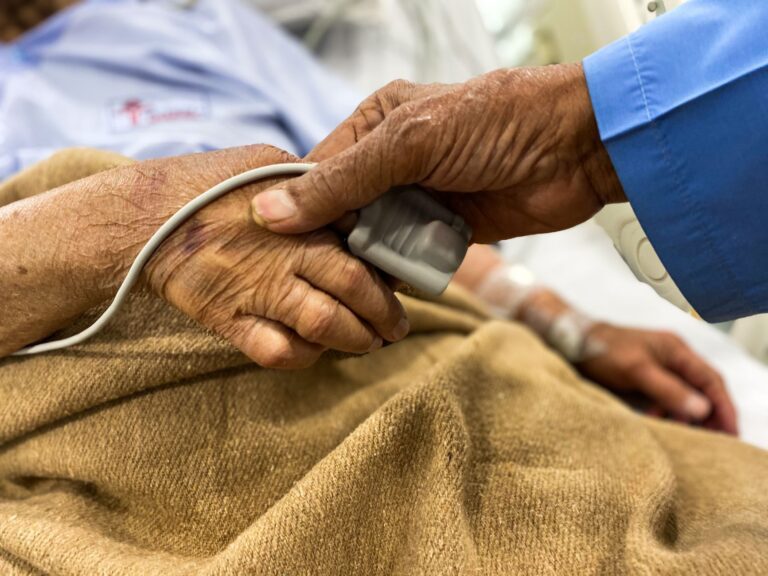
I stood in that doorway again, keys in my hand out of habit rather than any real intention of leaving, and Raymond turned his head toward me the way he had every single time, slower now, his eyes taking a moment longer to focus, but finding mine all the same. I did not hesitate that day. I crossed the room and pulled the chair right up against the bed, closer than I had let myself sit on any of the five visits before it, and I took his hand off the blanket into both of mine.
His hand was thin, the skin loose over the bones the way it gets at the very end, but his grip found strength I did not expect, holding onto my hand the way a man holds onto a rope he has been thrown after believing, for a very long time, that no rope was coming.
“I’m sorry, Daniel,” he said, and his voice had almost nothing left in it, barely more than breath shaped into words. “For all of it. For every year I wasn’t there. For every card I should have written and didn’t. For the phone call. I’m not asking you to say it’s alright. It was never alright. I’m only asking you to know that I know it, and that I am sorry, all the way down, for every piece of it.”
I leaned in close, my face near his the way you lean in when a voice has gotten too quiet to hear any other way, our hands still together on top of the blanket between us, and I told him the truest thing I have ever told another human being.
“I forgive you, Dad,” I said. “I forgive you. And I’m here. I’m not leaving.”
He closed his eyes, and I watched something move across his face that I can only describe as relief so complete it looked almost like pain, and he held onto my hand for a long time after that without either of us saying another word, because there was nothing left that needed saying out loud. We sat like that, his hand in mine on the blanket, our faces close, the afternoon light soft through the curtains the same way it had been soft on the day I first walked in, for the better part of an hour, and I understood, sitting there, that whatever this was, it was not a scene either of us had planned or performed. It was simply two men, a father and a son, finally in the same room with nothing left between them but the truth.
—
Raymond died four days later, early on a Tuesday morning, the same day of the week his own truck had once pulled out of our driveway and the same day of the week my mother’s own heart had finally given out three years before him. I was there. I had been there every day since that Friday, sometimes with Karen beside me, once with Eli, who was old enough at eleven to understand a little of what was happening and who held his grandfather’s hand for the first and only time in his life two days before Raymond passed.
Carol Whitfield told me afterward that the last hours are rarely dramatic, that death mostly comes quiet if a person is not fighting it, and Raymond was not fighting it. He had said what he needed to say. I had said what I needed to say back. In his last conscious hour he asked me, in a voice barely above a whisper, to tell him about my mother, about the woman she had become in the thirty years he had missed, and I told him about the Farm and Feed and the eleven years behind that register, about the Sunday school class she taught herself so we would not have to pay a sitter, about the quiet prayer at the foot of her own bed that I had once resented and had come to understand as the truest inheritance she ever gave me. He wept, quietly, hearing it, tears of a man finally allowed to grieve, out loud, everything his own fear had cost him.
He asked for one hymn before he grew too tired to ask for anything else, Amazing Grace, which I sang to him low and off key in a hospital room in Danvers, Indiana, the same way I remembered him once singing off key and unembarrassed to the radio on Sunday drives to my grandmother’s house. He held my hand through the whole of it, eyes closed, breathing slow, and somewhere in the second verse I understood I was not singing it to comfort a stranger. I was singing it to my father, and some knot in my chest that I had been carrying since I was eight years old finally, quietly, came undone.
—
We buried Raymond in the small cemetery behind Grace Bible Church, not far from where my mother is buried, a plot Pastor Mike helped me arrange that same week, because I decided that a man who spent his last days finally trying to make something right deserved to rest in the same ground as the woman who never stopped praying for him. The funeral was small. There was no long line of mourners, no grand eulogy about a life well lived, because that would not have been honest. I stood at the front of that small gathering, Karen and the children beside me, Pastor Mike beside them, and I told the truth as plainly as I have told it to you.
I said that my father left us when I was eight years old, and that it cost my mother and me more than most people in that church fully knew. I said that he was not a good father for most of his life, and that I was not going to stand at his graveside and pretend otherwise, because a grace that requires a lie to make it presentable is not the kind of grace I believe in. And I said that in the last eight days of his life, my father did something very few people ever manage to do. He told the truth about himself, without excusing it, and he asked, honestly, for the one thing he had no right left to ask for, and I gave it to him, not because he had earned it, but because I finally understood, standing in that hospice doorway with my keys still in my hand, that mercy was never supposed to be something a person earns. It is something a person is given, freely, by someone who has decided that carrying the debt any longer costs more than releasing it.
—
I think about that doorway often now, more than a year later. I think about how close I came, more than once in those three days of praying in the cab of my truck, to deciding that nobody would blame me for staying away, and how true that would have been, and how little it would have mattered in the end. The question was never really whether anyone else would blame me. The question was whether I could live inside a version of this story where I let a dying man ask for me by name and did not go.
My mother spent thirty years praying for a man she had every right to stop praying for, and I used to think that prayer was wasted on someone who would never change. I do not think that anymore. I believe now that her prayers were not really a bet on Raymond changing at all. They were an act of faith that grace goes looking for people long after everyone else has given up looking, and that it is not our job to decide who has earned the search. It is only our job, when we are given the chance, to be the hands grace happens to be using that particular day.
I do not think I would have found my way into that room without my faith carrying me there. It would have been easier, by every reasonable measure, to let that door stay shut, and nobody, including the people who loved me most, would have thought less of me for it. I went because I believe, in a way I did not fully believe before that week, that mercy chosen freely, when it costs you something real to choose it, is the closest thing to the presence of God I have ever felt with my own hands.
I held my father’s hand on that hospital blanket in his last conscious hour, our faces close, nothing left unsaid between us, and I would not trade that hour for anything either of us lost in the twenty eight years before it. Some debts are not meant to be collected. They are meant to be released, freely, by the one person who still has the right to hold onto them, and I am the son who finally understood that in time to say it out loud to the one man who needed to hear it most.
This story is a dramatization. Names, characters, and details are invented, and any resemblance to real people or events is coincidental.