The Mother They Sat In The Parking Lot
I want to start with the forty acres, because nothing that happened at that wedding makes sense without them.
My husband Wayne and I farmed just outside Miller’s Ford, Missouri, for thirty four years. Corn and soybeans mostly, a few head of cattle when the fences were good, and a little garden behind the house that I still cannot bring myself to let go to weeds even though there is nobody left to eat what grows in it but me. Wayne died three years ago this past March. His heart just stopped one Tuesday morning while he was loading feed into the truck, and I found him in the gravel of our own driveway with his cap still on. Sixty three years old. We had been married thirty nine of them.
After the funeral, the county extension office lady kept using the word “adjustment,” like grief was a mattress you had to get used to sleeping on wrong. What nobody tells you is that a working farm does not care that you are grieving. It still needs someone at five in the morning. I hired help where I could and I sold off the back forty, the acreage along the county road that Wayne and I had always talked about someday splitting into house lots if either of our kids wanted to build out there. Neither of them did. Wyatt was renting a place in town by then, working as a lineman for the rural electric cooperative, and my daughter Renee had already moved to Springfield with her own family. So the back forty sat there being nothing but taxes and mowing, and in the spring of last year I sold it to a young couple who wanted to raise goats, and I put the money in an account and did not touch it, because I did not yet know what it was for.
I found out what it was for in April, when Wyatt sat across from me at my own kitchen table, turning a coffee mug in slow circles the way his father used to when he was working up to something.
“Mom,” he said, “I asked Kayla to marry me.”
I already knew Kayla a little. She was a dental hygienist over in Springdale, twenty six years old, quick laugh, the kind of girl who remembered your name the second time she met you. I liked her. I still like her, and that matters to how the rest of this goes, so I want to say it plainly now before anything else: this is not a story about a wicked daughter in law. Kayla did nothing wrong that day except be too overwhelmed to see what her mother was doing until it was almost too late.
“That’s wonderful, Wyatt,” I said. “What’s got you looking like you swallowed a hornet, then?”
He told me. Kayla’s parents, Gary and Debbie Renner, ran a real estate office over in Springdale, the bigger town twenty minutes east of us, and from everything Wyatt described, they liked people to believe they did better than they did. Debbie in particular had strong opinions about what a wedding ought to look like, opinions that ran well past what the Renners could actually afford. Wyatt said Kayla had cried on the phone with him the week before, not because she did not want to marry him, but because her mother kept talking about a venue in Springdale that cost more than either family could reasonably spend, and Kayla did not know how to tell her mother no.
“I don’t want Kayla feeling less than,” Wyatt said. “But Mom, I can’t cover something like that. Not on a lineman’s paycheck, not with what we’re trying to save for a house.”
I did not decide anything at that table. I want to be honest about that. I told him I would think on it, and I did, for about four days, mostly sitting on the back porch in the evening looking out at the field where the back forty used to be. And here is what I came to.
Wayne was not going to walk his son down an aisle. Wayne was not going to stand up and dance with me at our boy’s wedding, was not going to shake Gary Renner’s hand and tell some story about Wyatt as a kid that would make the whole room laugh. Everything Wayne would have given to that day, I could not give in his place. But I could give the one thing that was still mine to give, which was the money sitting in that account from land that had his sweat and thirty four years of his life worked into the dirt of it.
So I called Pearl Higgins.
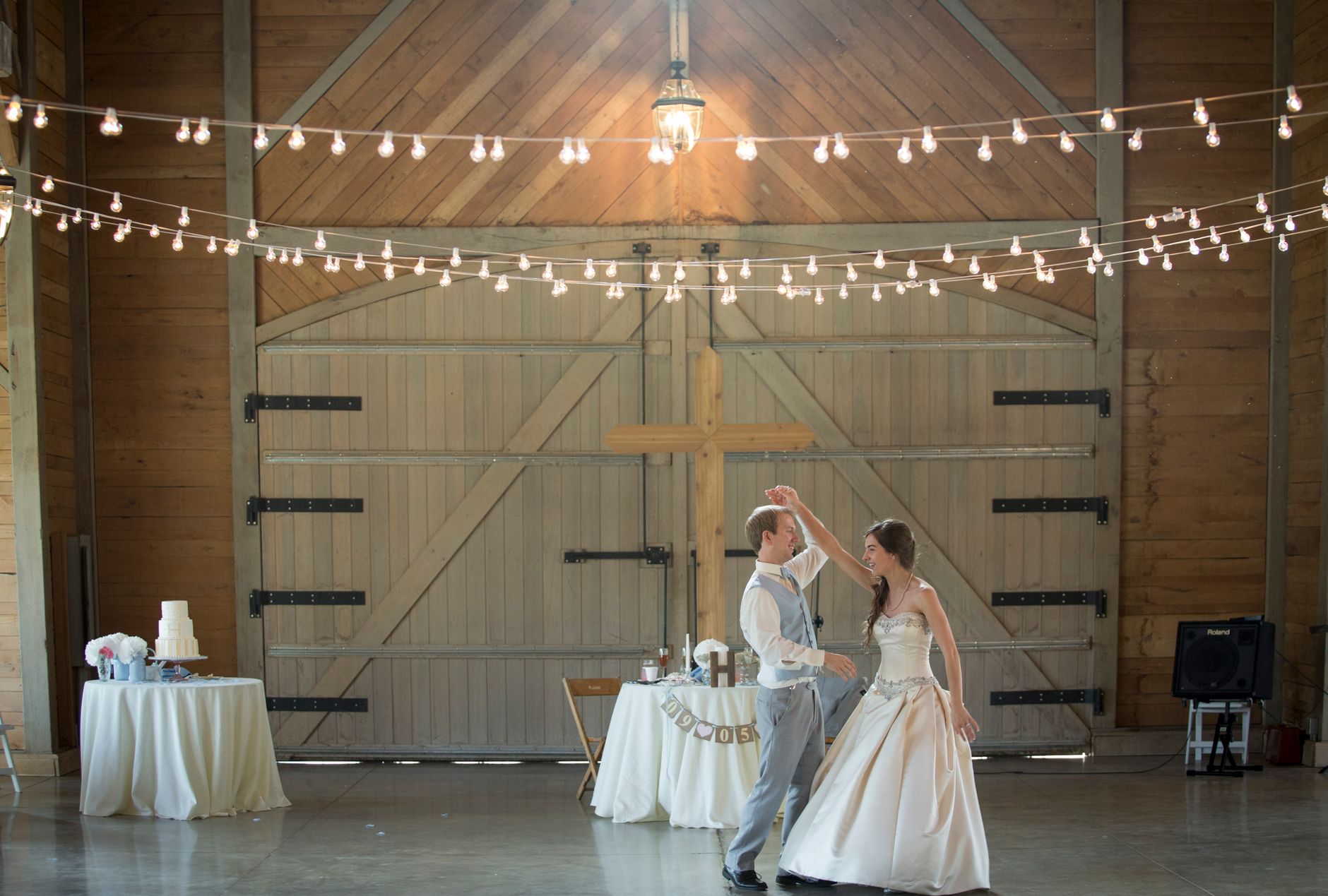
Pearl and I go back to junior high at Miller’s Ford, when she was Pearl Danvers and we used to trade lunches because her mother packed better sandwiches than mine did. Pearl owns the Oak Hollow Barn now, a renovated dairy barn out past the county road with white string lights strung across the rafters and big glass doors on the south side that catch the evening sun just right. It is, by a wide margin, the nicest wedding venue within an hour of Miller’s Ford, and I knew before I ever called her that it would be more than the Renners were budgeting for.
“Pearl,” I said, “I need you to let this look like it came together the ordinary way. I don’t want Kayla’s family feeling like charity, and I don’t especially want it announced. I just want my son’s wedding paid for, quietly, by me.”
Pearl did not ask many questions. She has buried a husband too, and I think some things you only fully understand from inside that particular grief. She booked the date, took my deposit of seventeen thousand four hundred dollars, and let the paperwork sit under a generic “Byrd/Renner wedding” file the way it would for anybody.
I paid for Prairie Rose Catering myself as well, thirteen thousand eight hundred dollars for a plated dinner, an open bar for four hours, and a wedding cake from the bakery on Main Street that Kayla had pinned on her phone eleven separate times, according to Wyatt. And in June, after the invitations had gone out, I quietly booked and paid for six nights at a beachfront condo in Gulf Shores, Alabama, seven thousand three hundred dollars including the flights, because I wanted my son and his new wife to start their marriage looking at an ocean instead of staring at a credit card bill.
Altogether, between the venue, the catering, and the honeymoon, I put thirty eight thousand five hundred dollars of my husband’s land into that wedding. I never told Debbie or Gary Renner where the money came from. I let them believe whatever arrangement made sense to them. Looking back, I think that was my mistake, not the giving, but the quiet of it. I have never in my life been a person who needed credit for doing a kind thing. I am not sure I still believe that is always a virtue.
Over the months of planning, I saw the Renners a handful of times, at a engagement dinner in May and twice more when the two families met to go over details neither Wyatt nor Kayla much cared about, seating charts and flower colors and whether the DJ should play line dance songs, which Debbie was firmly against because, she said, “we’re not doing a barn dance, Loretta, we’re doing a wedding,” even though the wedding was, in fact, being held in a barn.
Debbie Renner is a striking woman, I will give her that. Sharp blazers, a laugh that carries across a restaurant, the kind of confidence that makes people assume competence and money behind it whether or not either is actually there. She has a way of talking about her own life that always circled back to how much better it was than whoever she happened to be talking to. At the engagement dinner she asked me, in front of both families, whether I still kept the farm going “all by yourself out there,” in a tone that managed to make thirty four years of Wayne’s and my life sound like something to be pitied. I let it go. I have gotten very good, since Wayne died, at letting things go.
What I did not let go of, what I turned over more times than I probably should have, was a comment Debbie made at the final planning meeting, three weeks before the wedding, when she was going through the seating chart on her laptop and mentioned, almost as an aside, that she and Gary had decided to seat “the smaller family groups” toward the back and outside the main tent flow, “just to keep the flow of the room feeling full and lively for photos.” I did not think much of it at the time. I did not know yet that “smaller family groups” meant me.
The morning of the wedding, I got up at five out of old habit, the way you do after thirty four years of farm mornings whether or not there is still stock to feed. I drove out to Wayne’s grave before I got ready, the way I do before anything important, and I told him his boy was getting married that afternoon and that I hoped I had done it the way he would have wanted.
I wore a dress I had saved for eight months to buy, a cornflower blue that the saleswoman in Springdale swore matched my eyes, the same color Wayne used to tease me about wearing whenever he wanted to get himself out of trouble for something. I got my hair done in town. I drove out to the Oak Hollow Barn a full hour before the ceremony, because I wanted time to see Wyatt before things got hectic, time to maybe help Kayla with something if she needed it, time to just stand in that barn for a minute and feel proud of what I had built for my son without anyone ever needing to know it was mine to build.
I did not get that hour.
A young woman I did not recognize, maybe twenty two, with a clipboard and an earpiece and a laminated seating chart, met me on the gravel walk before I had even reached the barn’s main doors. She was polite, even a little apologetic in her manner, which I have come to believe was not her fault at all but rather instructions passed down to her from somebody else.
“Mrs. Byrd? I’ve got you in our overflow section today, just this way.”
I asked her what that meant, because I truly did not understand. There were, by my count, a hundred and forty guests invited to that wedding and the Oak Hollow Barn, which I had personally paid seventeen thousand four hundred dollars to rent, seats two hundred comfortably. I knew that because I had asked Pearl the exact same question myself back in April.
The young woman led me past the parking area, past the row of pickup trucks and the caterer’s van idling with its back doors open, to a spot on the asphalt about forty feet from the barn’s south entrance. There was a single card table set up there, the folding kind you would use for a garage sale, with one metal folding chair and a small paper card reading “Byrd Family” taped to the front edge.
That was my seating chart. A card table in a parking lot.
“There’s been some kind of mistake,” I said. “I’m the groom’s mother.”
The young woman checked her clipboard and her face did something complicated, somewhere between confusion and apology. “I have you listed here, ma’am. I’m so sorry, I just go by what’s on the sheet.”
I did not make a scene. I want to be honest that some part of me, in that first minute, assumed it truly was a clerical error, the kind of mix up that happens at every wedding when somebody’s cousin gets seated at the wrong table. I sat down at the card table in my cornflower blue dress to wait it out, thinking someone would come find me, apologize, walk me in.
Nobody came.
I sat there through the ceremony itself, which I could hear faintly through the propped side door, my son’s voice saying his vows to a woman I liked, in a building I had paid for, while I sat forty feet away on a folding chair meant for nobody. I did not cry. I want you to understand that about me. I have cried plenty in my life, plenty since Wayne died, but I did not cry sitting at that card table. What I felt was quieter and colder than crying, a kind of understanding settling into my chest the way frost settles into a field overnight, so gradual you do not notice until the whole thing is white.
After the ceremony, guests began filtering toward the barn’s south entrance, the tall glass doors Pearl had put in specifically so the evening light would pour across the dance floor. String lights came on inside. I watched, from my card table, as a hundred and forty people I had, in every practical sense, paid to feed and shelter and entertain, filed past me into a golden room full of laughter, without a single one of them looking twice at the widow sitting alone on the asphalt.
It was around then that Debbie Renner came out to the parking area to wave in a few late arriving guests, friends of Gary’s from the golf club in Springdale, from what I overheard. She spotted me at my little table on her way back in and paused just long enough to say what she said.
“This is the overflow section,” she told me, gesturing at the empty asphalt around us like she was showing off a feature. “Family finds a way to make do, don’t you think, Loretta?”
I did not answer her. I have found, since Wayne died, that silence very often does more work than anything I could say out loud in a moment like that. She smiled at me, a tight, satisfied sort of smile, and went back inside to the golden light and the string music, and I sat there in the growing dark with the sound of a DJ starting up a slow song somewhere behind those glass doors.
I want to tell you what I thought about, sitting out there. I thought about Wayne loading feed in the driveway on the last ordinary morning of his life. I thought about the back forty, about the goats that young couple was probably raising on it right now, not knowing that the money from their check had bought a barn full of string lights for people who did not think I belonged inside it. I thought that if Wayne could see me sitting on a folding chair in a parking lot at our son’s wedding, he would have come across that gravel like a man half his age, and I was almost glad, in a strange way, that he could not.
A caterer’s assistant, a college aged boy in a Prairie Rose Catering polo, came out around then to grab something from the van and noticed me sitting alone. He was maybe nineteen, sunburned across the back of his neck, clearly not part of whatever arrangement had put me there.
“Ma’am, are you supposed to be out here? We’ve got plenty of room inside.”
“I’ve been told this is the overflow section,” I said.
He looked at the empty asphalt, at the single card table, at the glass doors forty feet away glowing with light and music, and something in his face suggested he understood exactly how strange that sentence was. He did not say anything else, but a few minutes later he came back out with a full plate from the buffet and a glass of the sparkling cider they were serving to guests who did not drink, and he set it in front of me without a word, like he did not know what else to do about an unfairness that was not his to fix.
I want that boy to know, if he ever reads this, that his was the only kindness offered to me in the first hour of my son’s wedding, and I have not forgotten it.
I do not know exactly how long I sat out there. Long enough for the light to go from gold to blue. Long enough that I had started, quietly, to plan how I would leave without anyone seeing me go, because by then some part of me had decided I would rather drive myself home in a cornflower blue dress and grieve this new loss privately than sit through one more minute of being on display as the family nobody wanted inside.
I did not get the chance to leave, because Pearl Higgins found me first.
Pearl had stepped outside to check on the parking arrangement for a delivery truck, something unrelated entirely, and she nearly walked right past me before she registered who was sitting at the little card table in the dark.
“Loretta.” Her voice did something I had not heard from anyone yet that whole evening. It went sharp with anger on my behalf. “What in the world are you doing out here?”
I told her, as plainly as I could manage. Pearl’s face went through several things in quick succession, confusion, then understanding, then something that looked a great deal like the particular fury of a woman who has just realized somebody used her venue to humiliate her oldest friend.
“You paid for every square foot of that barn,” Pearl said. “I have your check. I have the contract in your name. Loretta, get up, you’re coming inside with me right now.”
I hesitated. I am not, by nature, a woman who likes a scene, and I told Pearl as much.
“I’m not asking you to make a scene,” Pearl said. “I’m asking you to walk into the room you paid for and sit down like the mother of the groom, which is exactly what you are.”
She walked me in through the side door, not the main glass entrance where everyone would see, and got me settled at a small empty table near the edge of the dance floor before anyone much noticed. I want to say that was the end of it, that I quietly rejoined the reception and the evening smoothed itself out from there. It was not, and it did not.
Because about twenty minutes after Pearl brought me in, the DJ handed a microphone to Gary Renner for the toasts, and Gary, after a few rambling and sincerely sweet words about his daughter, passed the microphone to his wife.
Debbie stood up in a room lit gold by string lights she had never paid a dollar toward, in a barn she had never signed a contract for, holding a microphone in front of a hundred and forty guests, and she said the words I have turned over in my mind every day since.
“Gary and I wanted nothing but the absolute best for our little girl,” Debbie said, her voice carrying easily across the room, practiced, warm, the voice of a woman used to being believed. “And we made sure of it ourselves. Every detail of this beautiful day, we made happen.”
I watched my son’s face when she said it. Wyatt was standing near the head table with Kayla’s hand in his, and I saw something shift across his features, a flicker of confusion quickly smoothed over, the look of a man doing quick math that was not adding up. He knew, better than almost anyone in that room, exactly what his mother had spent and exactly what the Renners had contributed, which, if you want the honest number, was the rehearsal dinner at Rosie’s Diner in town and nothing else.
Pearl Higgins was standing near the barn’s side entrance with a folder in her hand, the same folder she kept the vendor paperwork in for every wedding she hosted, and I watched her jaw tighten as Debbie kept talking, describing a venue selection process, a catering negotiation, a honeymoon surprise, none of which the Renners had had a single hand in.
It was Pearl who moved first. She walked to the small sound table where the DJ was working and said something to him I could not hear. The DJ glanced at his laptop, then at Pearl, then handed her a second microphone, the backup one they use for announcements about parking or the bar closing.
“I don’t mean to interrupt,” Pearl said, and her voice, amplified across that barn, was steady in a way that made every conversation in the room stop at once, “but I’ve run this venue for eleven years and I like to give credit where it’s owed, especially on a night this beautiful. Debbie, Gary, I know you’re proud of your daughter, and you should be. But I signed this contract back in April with a woman who sat down at my desk and paid every dollar of the deposit herself, in full, no questions asked, because she wanted her son to have a wedding his father would have been proud of. That woman is Loretta Byrd, and unless somebody moved her table again, she is sitting right over there.”
I have never in my life wanted so badly to disappear and to stand up at exactly the same time.
The room turned. A hundred and forty faces, most of whom I had never met, found me at my small table near the dance floor, and for one long, terrible, beautiful second, nobody said a word.
Then Wyatt crossed the room.
He did not run, exactly, but he moved with the kind of purpose I remembered from when he was a boy chasing down a calf that had gotten loose from the pen, focused and fast and unwilling to let something get away from him twice. He reached my table and knelt down in front of my chair so we were eye level, the way his father used to when he wanted to make sure I was really hearing him.
“Mom,” he said, quiet enough that it was just for me, though I do not think anyone in that silent room missed it, “were you outside this whole time?”
I told him the truth. I told him about the card table, about the overflow section, about Debbie’s remark on her way back in from greeting the golf club friends. I watched my son’s face go through the same frost settling I had felt at that folding table, except on him it arrived not as quiet but as something closer to his father’s temper, which Wayne had passed down whole and which Wyatt rarely let out.
He stood up and turned to face the room, still holding my hand.
“My mother paid for every part of this wedding,” Wyatt said, and he did not raise his voice, which somehow made it land harder than shouting would have. “The barn. The dinner all of you just ate. The band. She’s paying for the flights Kayla and I take out to Gulf Shores tomorrow morning. She did it quietly because she didn’t want anyone feeling less than, and this afternoon, my mother was told there wasn’t room for her inside the wedding she paid thirty eight thousand five hundred dollars for, and she was put at a card table in the parking lot instead.”
Kayla, I should tell you, was already crying by this point, and not the kind of crying you do at a wedding out of joy. She crossed the room to her own mother, and I could not hear everything that passed between them in that low, urgent voice young women use when they are furious and trying not to make it worse in public, but I caught enough. “Mom, how could you. How could you do that to her and then stand up there and lie about it in front of everyone.”
Debbie Renner is many things, but she is not, I will say in fairness, a stupid woman, and she understood immediately that the room had turned against her in a way no amount of sharp blazers and confident laughter could talk its way back out of. She set the microphone down. She did not apologize to me, not that night, not in front of everyone, though she managed something that might generously be called an apology later, quieter, in the parking lot as guests were leaving, a stiff “I hope there’s no hard feelings, Loretta, I just wanted the day to feel a certain way,” which I did not fully accept and have not fully accepted since, because I do not believe an apology built entirely around what you wanted the day to feel like, with no mention of what you did to another person to get it, is really an apology at all.
What happened next, though, is the part I want you to have, because it is the part that actually healed something.
Pearl had the DJ clear a spot at the head table, right beside Wyatt, the seat that etiquette says belongs to the mother of the groom and that had never once, in all of Debbie’s planning, actually been assigned to me. Wyatt walked me over himself, my hand in his, past a hundred and forty guests who now knew exactly whose money had built the evening around them, and he sat me down in that chair like it was the most natural thing in the world, which, I suppose, it should have been from the start.
The band started up again. People danced. Somebody, I never did find out who, sent a plate of the wedding cake over to my seat with a little note that just said “thank you for tonight” in handwriting I did not recognize.
Kayla came and sat with me for a while during the reception, her makeup gone from crying, and she took my hand across the table.
“I didn’t know,” she said. “I swear to you, Loretta, I did not know what my mother had planned. I would never. I love you like you’re my own mother, and I am so sorry.”
I believed her then and I believe her now. Kayla is not her mother, and I have made a point, in the year since, to make sure she never once feels caught between the two of us.
I did leave that reception with something changed in me, though, and I want to be honest about what it was, because I do not think dignity restored means anger erased. I set a boundary with the Renners that night that I have kept since. I do not attend family gatherings hosted at their house. I speak to Debbie when I must, at Wyatt and Kayla’s, briefly and politely, and no further. I have not, and will not, explain myself to her again. Some bridges you rebuild. Others you simply stop crossing, and let the person on the other side manage the distance however they like.
The town found out, of course, the way small towns always do. Somebody at that wedding told somebody at the feed store, and by the following Tuesday, half of Miller’s Ford had heard some version of the story, most of them accurate, a few embellished in ways that made Debbie sound worse than even I would have described her. I did not correct the embellished versions. I am not proud of that, but I am honest about it.
Pearl and I still meet for coffee most Thursdays. She never did charge me for what she called “the interruption fee,” meaning the moment she took that second microphone, and I have told her more than once that if she ever needs anything from me, all she has to do is ask.
Wyatt and Kayla came back from Gulf Shores tanned and settled into their marriage the way young couples do, quietly, day by day, and Kayla has made a habit since of calling me every Sunday evening, not because anyone told her to, but because she says it is her favorite part of the week. I believe her about that too.
I still go out to the back forty sometimes, or what used to be the back forty, and watch that young couple’s goats through the fence line, and I think about Wayne, and about the frost settling in over a field overnight, and about how a person can sit at a card table in a parking lot feeling smaller than she has ever felt in her life and still, somehow, be the one who was right all along.
I paid for that wedding because I loved my son and because I did not want his bride to start her marriage feeling less than anyone else in that barn. I would do it again tomorrow, every dollar of it, even knowing how the day started. But I will tell you this much, and then I will let this story rest.
Nobody sits me at a card table anymore. Not at that family’s gatherings, not anywhere. I found out, at sixty one years old, in a cornflower blue dress on a folding chair in a gravel parking lot, exactly what I am worth, and I have not forgotten it since.