
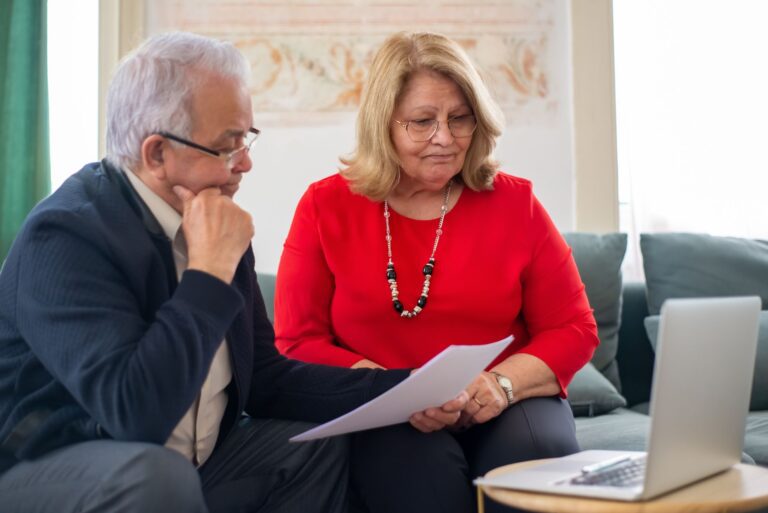
The loan officer’s name was Jonathan, and he had no idea he was about to blow up my marriage. He was just doing his job, scrolling through a routine file at First Harvest Credit Union on a Tuesday morning in March, trying to shave half a point off our mortgage rate. I remember the particular quiet of that office. A space heater humming under the desk. A dish of peppermints nobody had touched. My husband Paul sitting beside me in his good jacket, the one he wears to parent-teacher conferences and funerals, looking calm in a way I would later understand was not calm at all.
My name is Victoria. I am forty three years old. I grew up twenty minutes from where I live now, in the kind of flat, quiet stretch of Indiana where the tallest thing on the horizon is a grain elevator and everybody’s mailbox has a last name painted on the side instead of a number that means anything. I married Paul sixteen years ago in a church that both our grandmothers had been baptized in, and for all sixteen of those years I believed, without ever really examining the belief, that we were the kind of couple who did not keep big things from each other. We had a rule, one we said out loud often enough that it had started to feel like a vow we’d added after the fact: no big money decisions alone. Not because either of us distrusted the other. Because we had both watched other marriages in this town come apart over exactly that, a secret account, a bad investment, a truck bought behind a spouse’s back, and we had promised each other early on that we would not be that story.
I want to be honest about how ordinary that Tuesday morning felt right up until it wasn’t. We had brought our folder of statements the way Jonathan’s office had asked, ready for a normal thirty-minute conversation about points and closing costs. Jonathan pulled our full credit file to run the numbers, the way he told us later he does a dozen times a week without anyone in the room expecting anything but boredom. He scrolled. He stopped scrolling. He went quiet for a beat longer than felt natural, the kind of pause you learn to notice after enough years of reading a room, and then he looked up, not at me, at Paul, and asked whether we wanted to talk about the personal guarantee on the business loan before he ran our debt to income ratio, because as it stood, it was going to sink our approval.
I asked what business loan. I remember my own voice sounding strange to me, too even, because some part of me already understood before my brain had caught up that I was about to hear something I had not been told. Jonathan looked at me the particular way a person looks at you when they realize, mid-sentence, that they have just said something out loud that you were supposed to already know. Paul did not look at me at all. He looked at the desk.
The number on the screen
The number Jonathan read off that screen was one hundred sixty five thousand dollars. A commercial loan, opened eleven months earlier, to a diesel repair shop out on County Road 9. Personally guaranteed by my husband. The shop belongs to Paul’s younger brother David.
I sat there doing math in front of a stranger, the worst kind of math, the kind where each new number makes the last one make a horrible new kind of sense. A hundred sixty five thousand dollars is not a number a bank hands out on a handshake. Banks like First Harvest require an equity injection, cash the borrower or the guarantor puts in up front, before they will release a dime of their own money into a small business that has already shown the kind of cash flow trouble that sends a man looking for a loan in the first place. I did not know that fact yet, not really, not the way I would come to know it over the following weeks. But sitting in that office, watching Jonathan’s screen, some old instinct in me was already reaching backward through the calendar toward a withdrawal I remembered seeing on our retirement statement the spring before and letting go without asking enough questions, because Paul had told me it was a temporary shift between funds, a rebalancing, nothing to worry about.
It was not a rebalancing. It was sixty thousand dollars, pulled from our joint retirement accounts, wired to David’s shop as the equity injection the bank required, and logged on the withdrawal paperwork itself, in Paul’s own handwriting, as a loan to David.
Who Paul is, before this
I do not want to write Paul as a cartoon, because he is not one, and sixteen years of marriage do not erase themselves over eleven months of silence, even eleven months this bad. Paul is a good father to our two kids. He coaches our son’s baseball team in the spring without being asked twice, he has never once forgotten an anniversary, and until that Tuesday morning I would have told anyone who asked that he was the steadiest, most transparent man I had ever known. He works as a project manager for a farm equipment dealer two towns over, solid pay, not flashy, the kind of income that builds slowly instead of all at once. We built our retirement accounts the same way, slowly, automatically, a set percentage out of every paycheck since the year we married, never touched, never borrowed against, a number we checked twice a year together at our kitchen table with actual pride in what two ordinary incomes could become if you just left them alone long enough.
David is younger than Paul by four years, and their relationship has always been the kind where Paul is the responsible one and David is the one who needs rescuing, gently, quietly, in ways that never quite get discussed as rescuing. Their father helped David open the diesel shop on County Road 9 a dozen years ago, using the last of his own retirement money to do it, a decision Paul has told me more than once he watched cost their parents comfort in their final years. I understand now, looking back, that Paul carried something like guilt about that, a sense that he had gone off and built a stable, forgettable career while David and their father bet everything on a shop that never quite got easy, and that guilt is not nothing. It does not excuse what he did. But it explains, at least, why he was the kind of vulnerable that let this happen instead of some other kind of family emergency.
Get a new story in your inbox every morning.
Facebook doesn’t show you every story we post. Our free newsletter does. Join 2,500+ readers.
The night we made our rule
I keep coming back to a specific night early in our marriage, because I think it is the reason this hurt the way it did instead of landing as an ordinary financial mistake. We had been married maybe two years, still renting a small house on the edge of town, when Paul came home and told me, almost sheepishly, that a coworker had tried to talk him into a truck loan that would have stretched us thin for the better part of three years, a good deal on paper, a bad decision for two people just starting to build something. He had said no on the spot, he told me, specifically because he had pictured having to explain it to me afterward instead of with me beforehand, and he did not like how that pictured conversation felt.
We sat on the porch steps of that rental house that night and made the rule out loud, half joking and half completely serious the way you are about promises when you are young and still deciding what kind of marriage you intend to have. No big money decisions alone. Not because we needed permission from each other like children, but because a decision made together carries both people’s judgment instead of just one person’s guilt or one person’s hope. We said it again at our first anniversary, half as a joke, and again the year we bought this house, and it became one of those private phrases married couples build for themselves, shorthand for an entire philosophy neither of us ever expected to need spelled out again after the first few years. Hearing Jonathan read that guarantee off his screen, eleven months after Paul broke that exact rule in the exact way we had promised each other we never would, was its own kind of wound, separate from the money itself.
The season that broke the shop
The trouble at David’s shop started the way trouble usually starts out here, slow and then all at once. A rough harvest season two years back cost three of the region’s biggest hauling outfits their contracts with the grain co-op, and when those outfits stopped running as many rigs, they stopped bringing them in for the kind of routine diesel work that had kept David’s bays full for a decade. Add a blown transmission on David’s own tow truck, the one thing that let him pick up broken-down rigs on the highway and bring in emergency work, and by the winter before that Tuesday morning, David was three months behind on his shop’s own lease and had laid off his one full-time mechanic.
David called Paul the night the tow truck finally died for good, stranded on the shoulder of Route 24 with a rig he had gone out to rescue at eleven at night, and had to call a competitor’s flatbed to come haul his own truck in, the kind of humiliation that costs a small-town mechanic more than the repair bill ever could. Paul did not tell me about that call either, not until months later, but he has described it to me since as the night he decided, quietly and on his own, that he was not going to let his little brother’s name become a cautionary tale repeated at the feed store the way their father’s near-collapse once was. I understand the impulse behind that decision even now. I have simply had to make him understand that protecting David that way, alone, cost something too, and the something it cost was me.
Paul told me, months later, that David came to him on a Sunday afternoon, sitting on the tailgate of his truck in our driveway, and said he had exactly one path left that did not end in locking the shop’s doors for good: a bank loan big enough to replace the tow truck, cover three months of back lease, and restock parts credit that every supplier in three counties had already frozen. First Harvest would extend it, David told Paul, if someone with strong, clean credit would personally guarantee it, and if David could show an equity injection of his own instead of asking the bank to carry the entire risk alone.
David did not have sixty thousand dollars. Paul did, or at least Paul had access to it, sitting in an account with both our names on it, thirty years from the day either of us planned to touch it.
What Paul did instead of asking me
Here is the part I have had to sit with the longest, longer than the money itself. Paul did not ask me. He has told me since, more than once, in more than one register, from defensive to truly broken, that he meant to. That he kept meaning to. That he told himself he would bring it up once he had a clean, uncomplicated way to explain it, once David’s shop had stabilized enough that the story would end well before I ever had to hear the messy middle of it. He has told me he was afraid I would say no, and afraid, underneath that, that saying no to David would be a kind of final verdict on his brother that Paul was not ready to hand down.
So he withdrew the sixty thousand dollars from our joint retirement account in a single transaction, on a Thursday in April, and he wrote, on the withdrawal form itself, in the little blank space that asks for a reason: loan to family business. He wired it to David’s shop’s account two days later. He personally guaranteed the full one hundred sixty five thousand dollar loan First Harvest extended on top of that equity injection, which meant that if David’s shop ever failed to make a payment, the bank could come after Paul’s income, our house, our remaining savings, to collect. He did all of this without a single conversation at our kitchen table, the table where we had promised each other, more than once, out loud, that we did not do this.
He told me later he truly believed it would all resolve itself before I ever had reason to look closely at that account. Eleven months is a long time to bet a marriage on a belief like that.
Back in the loan office
I want to go back to that room at First Harvest, because I have relived it enough times now that I can walk through it almost frame by frame. Jonathan, to his credit, did not make it worse than it already was. He is a decent, careful man doing an uncomfortable job, and once he understood he had stumbled into the middle of something between a husband and wife rather than a simple paperwork gap, he offered to step out and give us a few minutes alone. I told him to stay. I wanted a witness. I wanted someone in that room besides the two of us, because some small, cold part of me already understood that whatever Paul said next, I needed to hear it with a professional third party present, the same way you want a witness in the room for anything that might later need to be proven rather than remembered.
Paul did not deny any of it. I will give him that much credit, even now. He confirmed the guarantee. He confirmed the sixty thousand dollars. He confirmed that the withdrawal happened eleven months earlier and that he had told me, at the time, that it was a routine rebalancing between our retirement funds, a lie so small and so specific that I had not thought to question it, because why would I question a routine word from the man I trusted with everything.
Jonathan finished running our numbers, more out of professional obligation than any real hope, and confirmed what he clearly already suspected. With an undisclosed personal guarantee of that size sitting on Paul’s file, our debt to income ratio did not clear what the refinance required. We did not get the lower rate we came in for. We got, instead, the actual current shape of our finances, laid out on a stranger’s screen, truer than anything either of us had said to each other in eleven months.
The drive home
We drove home in a silence I do not have adequate words for. I remember looking out at roads I have driven my whole life, the same grain elevators, the same mailboxes with the same painted names, and feeling like a tourist in my own life, because the man in the driver’s seat was someone I had apparently never fully known. I was not screaming. I want to be clear about that, because I think people expect a scene like this to be loud, and mine was not. I sat very still and asked Paul, once, to just tell me everything, all of it, start to finish, before we walked back into a house with our children’s shoes lined up by the door.
He did. It took the whole rest of that drive and another hour at our kitchen table after the kids were in bed. The guilt about their father’s retirement money going into that same shop years earlier. The Sunday on the tailgate. The withdrawal form. The wire transfer. The personal guarantee he signed alone, at a branch across town from ours, specifically, I came to understand later, so that no teller who knew me by name would mention it in passing at the grocery store the way people do in a town this size.
I told him what I was feeling was not only anger, though there was plenty of that sitting in my chest like a stone. It was the specific, sick vertigo of understanding that a decision this size, joint retirement money and his own name on six figures of someone else’s debt, had been made and carried and hidden from me for nearly a year, in a marriage where I had truly believed, every single day of it, that we did not keep that kind of secret from each other. I told him that a loan I never agreed to was not protection, no matter what word he used to describe it to himself at two in the morning when the guilt caught up with him. It was a decision made for me, about me, without me, and dressed up afterward in the language of love so it would go down easier if I ever found it.
Why I did not simply leave
I know some people reading this will wonder why I did not pack a bag that same night. I thought about it. I will not pretend the thought did not cross my mind, more than once, in the weeks that followed. But sixteen years is not nothing, and Paul’s failure here was not infidelity in the way people usually mean that word. It was a failure of partnership, a specific, serious, financial betrayal built on guilt about his brother and fear of my reaction, and I decided, after a great deal of sitting with it, that the question that mattered most was not whether Paul had done something unforgivable. It was whether he was capable of doing the actual, uncomfortable work of making it right, in full, with consequences that cost him something real rather than just an apology that cost him nothing but words.
So instead of leaving, I made three decisions, and I told Paul all three of them the same night, calmly, without raising my voice, because I wanted him to hear them as decisions and not as the opening round of a fight.
First, we were getting a lawyer, not a marriage counselor, not yet, a lawyer, because a hundred sixty five thousand dollars of guaranteed debt and sixty thousand dollars of undisclosed retirement withdrawal is a legal and financial problem before it is anything else, and I was done letting it live in the soft, forgivable language of family favors.
Second, David’s shop was getting a full financial accounting, every ledger, every invoice, every bank statement since the loan closed, whether David liked it or not, because I was not going to let sixty thousand dollars of my own retirement sit inside a business I had never once been shown the books of.
Third, whatever came out of that accounting, the informal, handshake version of this loan was over. If David owed Paul, and by extension owed me, sixty thousand dollars, it was going to become a real, enforceable, notarized promissory note with real terms, or the family relationship attached to it was going to have to survive without my trust in it, possibly for a long time.
The accounting
The lawyer we hired, a calm, precise woman who has handled small business disputes in our county for over twenty years, walked us through exactly what an equity injection and a personal guarantee mean in practical terms, and none of it made me feel better in the moment, though it did make me feel like I finally understood the shape of what I was dealing with. She helped us request, formally, a full accounting of David’s shop’s finances since the loan closed, framed not as an accusation but as a condition of Paul’s continued willingness to carry a guarantee of that size on his own credit going forward.
What came back over the following three weeks was not the clean story David and Paul had both told themselves. The sixty thousand dollar equity injection had done exactly what it was supposed to do, replaced the tow truck, cleared the back lease, restocked the parts credit, and by the time of that Tuesday morning at First Harvest, the shop was, by every real measure, stable again. Contracts were coming back. The shop had turned a small profit for four straight months. David had not stolen the money or squandered it on himself, which was, I will admit, a relief I had not let myself hope for until I saw the ledgers with my own eyes.
But not one dollar of it had been repaid to Paul, or to us, in eleven months, and there was no actual repayment schedule anywhere in writing, only a verbal understanding between two brothers that David would start paying it back once things were solid, an understanding with no date attached to it, no interest, no consequence for delay, nothing that would have held up for one second if anyone but family had been on the other end of it.
The real note
I sat in on the meeting where David signed the new agreement, because I told Paul plainly that I was done being the person who found things out after the fact, and this was one piece of paper I intended to watch get signed with my own eyes. It was not comfortable. David is not a bad man, and watching him understand, in real time, that his brother’s wife was the reason the informal favor he had leaned on for a year was becoming an enforceable legal document was not a satisfying scene, whatever a person might expect. It was quiet, and a little grim, and necessary.
The note our lawyer drafted set a real interest rate, modest but real, and a fixed monthly repayment amount tied directly to the shop’s own bank account, structured so payments came out automatically rather than waiting on David to remember or afford them on his own schedule. It set a repayment term of six years. And it attached a lien against a piece of equipment in the shop, the replacement tow truck the original sixty thousand dollars had helped buy, as real collateral, so that the debt was not simply David’s word against a piece of paper anymore. If David’s shop failed and the debt went unpaid, that truck belonged to Paul, and by extension to our own retirement, not to David’s goodwill.
David signed it without an argument, which told me something too. I think some part of him had been waiting, this whole time, for someone to make the arrangement real instead of leaving it as a soft, unspoken thing hanging over every family dinner. He told Paul afterward, in front of me, that he was sorry it had taken a stranger at a bank to force an honest conversation none of them had been willing to have on their own, and I believed him.
What Paul had to do
The note handled David’s side of it. It did not touch what Paul owed me, and I told him so plainly. An apology, even a sincere one, was not going to be the thing that let me trust him with our joint money again, because he had already proven, once, that guilt could make him quiet in exactly the moments quiet cost the most.
What we settled on instead, over several long conversations and one very direct session with an actual financial counselor, was concrete. Every retirement account we hold now requires both our signatures for any withdrawal above a set, modest threshold, a rule our credit union will flag automatically if either of us tries to move around it alone. Paul took on extra hours consulting on weekends for a farm equipment client he already knew, and every dollar of that extra income goes directly back into rebuilding the sixty thousand dollars our retirement lost, on a schedule I track myself, separate from whatever David repays on his own note. And once a quarter, we sit down together, at that same kitchen table, and go through every account line by line, out loud, the exact habit we always claimed to have and had, in fact, quietly let slide long before David’s shop ever needed rescuing.
Where things stand now
We did eventually refinance the house, on the second try, four months later, once David’s repayment schedule was showing up as an asset on paper instead of a hidden guarantee, and once the accounting had shown the lender exactly what it needed to see to feel confident in us again. Jonathan ran the numbers a second time, and this time there were no long pauses.
David’s shop is doing well. He has paid four months of the new schedule on time, automatically, without being asked, and last month he called Paul, not to ask for anything, but to tell him the number of contracts he had signed for the spring season, the kind of call that means something different now than it would have a year ago. I do not know yet whether I fully trust him with our name attached to his business again. I am learning that trust, once it is spent this way, does not come back all at once. It comes back one automatic payment, one quarterly review, one honest conversation at a time, and I have decided that is not a punishment. It is simply what rebuilding actually looks like, when you refuse to let an apology stand in for the years of proof that come after it.
I think about that laminate desk at First Harvest more often than I would like to. Not with anger anymore, most days. With a kind of grim gratitude that it was Jonathan’s ordinary Tuesday morning pause, and not some worse discovery years down the road, that finally forced the truth of our own finances into a room where I was sitting, and listening, and finally allowed to ask the questions that had been mine to ask all along.
I have thought a lot, since, about what I would say to a woman sitting where I sat that morning, watching a stranger’s screen tell her something her own husband never did. I would tell her that the anger is allowed to be as large as it wants to be, and that it does not have to answer to anyone’s timeline but her own. I would also tell her that forgiveness, if it comes at all, should never be asked to arrive faster than the proof does. Paul did not earn his way back into full trust by apologizing well, though he did apologize, more than once, more sincerely than I expected. He earned it one automatic payment at a time, one quarterly review at that same kitchen table, one honest phone call from David that Paul no longer felt he had to hide from me. That is the only kind of repair I believe in anymore. Not the kind that happens in a single conversation, however tearful, but the kind that has to be proven over and over, on a schedule, until it stops feeling like proof and starts, slowly, to feel like simply how we live now.
Some nights I still open that retirement account on my phone before bed, out of habit more than suspicion, and watch the number climb back toward what it was before that Thursday in April. It is not there yet. It will not be there for a while longer. But it is climbing, on a schedule two of us set together, at a table where nothing gets decided alone anymore, and for now, that is the whole of what I asked for, and the whole of what I got.
This story is a dramatization. Names, characters, and details are invented, and any resemblance to real people or events is coincidental.