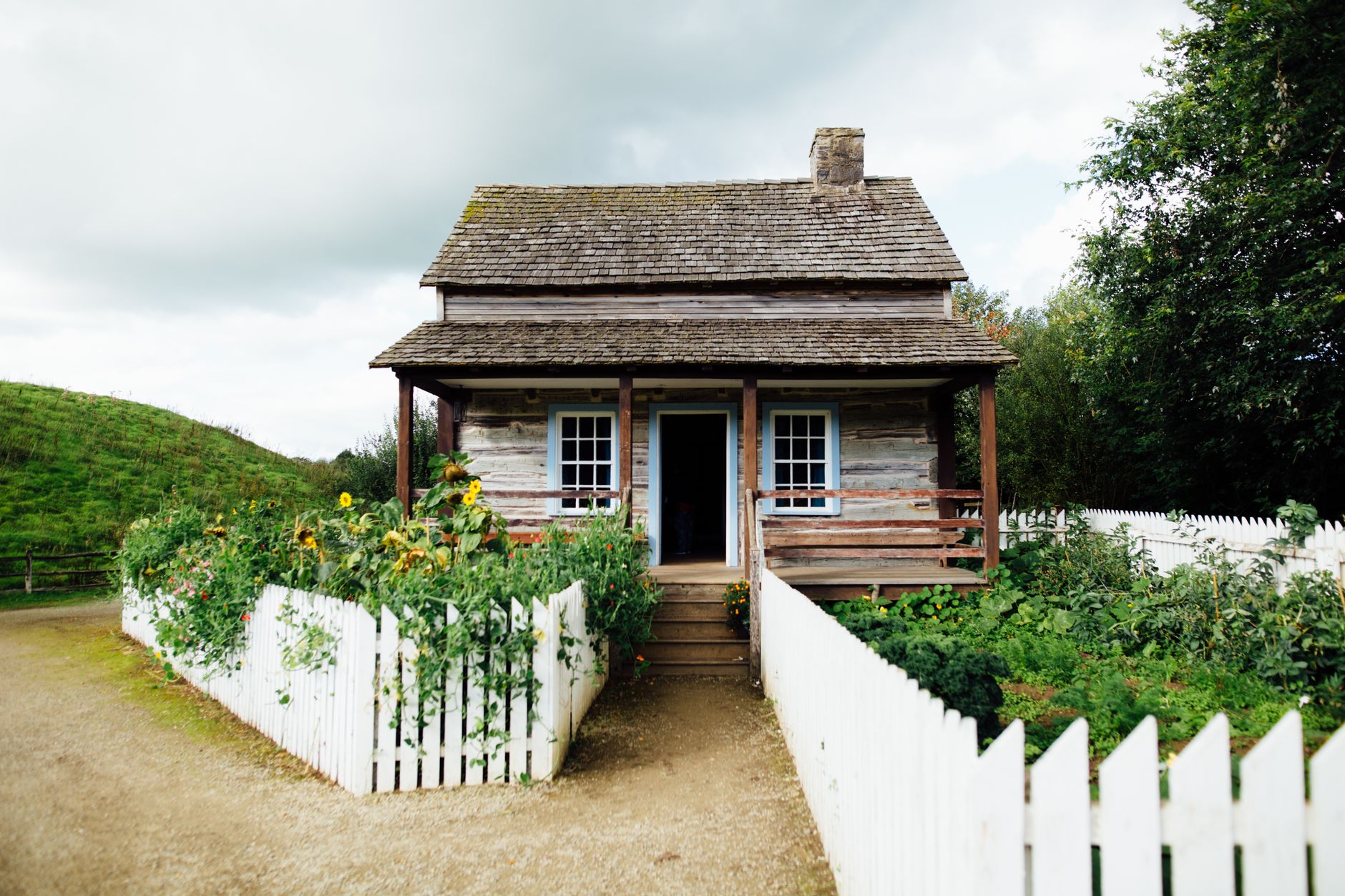
The House My Father Never Owned
The chair caught me on the left side of my jaw, and the sound it made was not the sound I expected. I always thought violence would be loud, a crash, a roar. Instead it was almost quiet, a dull crack of wood against bone, and then the ringing started in my ear like someone had struck a tuning fork inside my skull.
I went down against the coffee table. My hand found the carpet, the same beige carpet I had crawled across as a toddler, worn thin in a path from the couch to the kitchen. Blood dripped from my lip onto a throw pillow my grandmother had cross-stitched thirty years earlier, a little house with smoke curling from the chimney and the words Bless This Home stitched underneath in faded blue thread.
My mother stood in the doorway to the kitchen with a dish towel still in her hand. She did not move to help me up. She did not gasp. She looked at me the way you look at a stain you already knew was going to be there.
“You deserved it, pig,” she said.
Not screamed. Said. Flat, almost bored, like she was reading off a grocery list.
I want to tell you I said something back. Some line that would make this story satisfying right out of the gate, some flash of fire that put my father in his place on the spot. I did not. I lay there on the floor of the house I grew up in, tasting copper, and I said nothing at all.
But something in me was already moving, even if my mouth wasn’t. Somewhere underneath the pain and the ringing and my mother’s voice telling me I deserved to be hit by a grown man for saying no, a single thought surfaced, clear as a bell in a flooded basement.
My name is on the deed to this house. And they don’t know it.
To understand how I ended up bleeding on my grandmother’s needlepoint pillow at twenty-four years old, you have to go back further than that night. You have to go back to who I was in this family long before my father ever picked up that chair, and to who my grandmother was before any of us understood what she’d actually done for me.
My name is Dana Whitfield. I grew up in Bellwood, a town of about four thousand people where the water tower still says Home of the Bellwood Bison, where the diner on Main Street has been slinging the same meatloaf special since before I was born, and where everybody’s business eventually becomes everybody’s business whether you want it to or not. I have one sister, Harper, two years older than me, and for as long as I can remember, we occupied two very different rooms in our parents’ hearts.
Harper was the golden child. When she wanted a car at sixteen, my father sold his bass boat to make it happen. When she wanted a wedding that never ended up happening because the fiance backed out three weeks before the date, my parents ate the deposit on the venue without a word of complaint, like it was simply the cost of loving Harper. When Harper cried, the whole house rearranged itself around her tears.
I was the cautionary tale. I got pregnant with my son Liam the summer I turned seventeen, and from that day forward I became the thing my mother measured other people’s daughters against at church potlucks and family reunions. Not out loud, not exactly, but in the tightening of her mouth every time somebody asked how I was doing. In the way my father introduced me at his hunting buddy’s retirement party as “our other girl” without using my name. In the way I was expected to be grateful for the apartment above their garage instead of ashamed that a twenty-four-year-old working mother was still paying four hundred dollars a month to live over a lawnmower and a chest freezer full of venison.
Liam’s father left before Liam was born. I don’t talk about him much because there isn’t much worth saying. He is not part of this story because he chose not to be part of any story that involved diapers or daycare bills or 2 a.m. fevers. I raised my son alone, worked the overnight shift at Dot’s Diner on Main, and told myself every single day that this was temporary, that someday I would have my own front door that nobody else held a key to.
What almost nobody in my family knew, what I barely let myself think about most days, was that my grandmother had already given me that front door. I just hadn’t opened it yet.
My grandmother, Ruth Sawyer, was my mother’s mother, and she was the only person in that family who ever looked at me like I hadn’t ruined something by being born the way I was, or by getting pregnant the way I did. Grandma Ruth lived in the old farmhouse on Miller Road, the same house my mother grew up in, the same house that eventually became the house where my parents lived and where I got hit with a chair. It had been in her husband’s family since before the Depression, a white two-story with a wraparound porch and a rose bush by the mailbox that Grandma Ruth babied like a third child.
When Grandma Ruth’s health started failing, ovarian cancer that moved faster than any of the doctors expected, my mother said she was too busy with her job at the school district to take on caretaking. Harper said she “couldn’t handle watching Grandma like that,” which was Harper’s way of saying she didn’t want to. My father mostly stayed out of it entirely, because sickness and dying weren’t things he knew how to be around.
I was twenty-two, pregnant history behind me, Liam already two years old and starting to talk, and I was the one who showed up. I brought Liam with me most nights because I had no one to watch him, and Grandma Ruth loved having him there, said his laugh was the only thing that made the chemo smell in that house bearable. I learned how to change her bandages. I learned how to get her in and out of the bath without hurting her. I read to her from her worn King James Bible when her eyes got too tired to read for herself, the Psalms mostly, the ones about deliverance and refuge, and some nights I fell asleep in the recliner beside her bed with Liam curled against my chest.
Nobody paid me for those months. I did it because she was the only person in my life who had never once made me feel like an embarrassment.
About four months before she passed, Grandma Ruth asked me to drive her into town on one of her better days, to the office of a lawyer named Walt Hargrove who had handled her husband’s estate decades earlier and had known our family longer than I’d been alive. She didn’t tell me why. I sat in the waiting room with Liam coloring on the back of an old newsletter while she went in alone.
When she came out, she took my hand in the parking lot, her grip surprisingly strong for someone so thin by then, and she said, “This house is going to remember who sat with me, Dana. Don’t you go telling your mother or your sister a thing about it. Not yet. Maybe not for a long while. You’ll know when the time comes.”
I didn’t understand what she meant until after the funeral, when Mr. Hargrove called me in for what he described as “a follow-up regarding the property.” He told me, gently, like he was handing me something fragile, that six months before she died, Grandma Ruth had executed a deed transferring the farmhouse into joint ownership between herself and me, with right of survivorship. Not through the will, where Harper and my mother might contest it or fight over it in front of a judge. A quiet deed, recorded at the county courthouse, sitting there in the public record the whole time, plain as day for anyone who thought to look.
When Grandma Ruth passed, her half of that ownership didn’t go into probate to be divided up among her children. It came straight to me, automatically, the way right of survivorship works. Which meant that as of the day my grandmother died, I was not a poor relation living above a garage out of charity. I was a legal co-owner, and then eventually the outright owner, of the house my parents had been living in and calling theirs for two years.
I never told them. God help me, I want you to understand why, because it wasn’t cowardice, or at least it wasn’t only cowardice. I was twenty-two years old with a toddler, no husband, working diner shifts to keep gas in my car. I did not have the money to fight my own family in court, and more than that, I did not want to be the reason my mother lost the only house she’d ever lived in as an adult. I told myself I was being kind. I told myself Grandma Ruth would want peace in the family more than she’d want me waving a piece of paper in anybody’s face.
So I sat on it. I kept paying my four hundred dollars a month to live above the garage of a house that was legally, at minimum, half mine, and eventually, after some further paperwork Mr. Hargrove walked me through regarding my mother’s remaining share, entirely mine. I let my father sit in his recliner like a king. I let my mother redecorate the kitchen with money that, in a very real sense, wasn’t hers to spend on a house that wasn’t hers to renovate. I let Harper treat the place like a second home she was entitled to, throwing Mia’s birthday parties in the backyard, storing boxes of her old clothes in the spare bedroom.
I told myself I was choosing peace. Looking back, I think I was choosing the same thing I’d always chosen in that family: to make myself smaller so nobody else had to feel uncomfortable.
That peace lasted almost two years. It ended on a Tuesday in January, with a phone call, a chair, and my mother’s voice telling me I deserved to bleed on my grandmother’s pillow.
That afternoon started ordinary enough. I was folding my son’s laundry on my bed in the little apartment above the garage, the late light coming in gold through the thin curtains, dust hanging in the air like something out of a hymn. Liam was in the next room narrating a cartoon to himself, telling his superhero he wasn’t scared of anything. My phone buzzed against the comforter. Harper.
“You’re watching Mia tonight,” she said. No hello. No how are you.
I told her no. I explained, calmly, that I had a night shift at Dot’s, that I was already covering for my coworker Tasha, that I couldn’t just drop everything because Harper had “plans,” which in Harper’s vocabulary usually meant a man she’d met two weeks earlier and a bar forty minutes away.
There was a pause, and then a laugh that had nothing funny in it. “You think you get to say no to me?” she said. “Watch what happens when I tell Dad.”
She hung up before I could answer. I stood there a second with the dial tone humming in my ear, one of Liam’s little Batman shirts sliding off the pile and landing face-down on the carpet. I told myself Harper was being dramatic, the way she’d been dramatic our whole lives, and that nothing would come of it. I’d stopped being afraid of my father’s temper years ago, or at least I thought I had.
I worked my shift at Dot’s that night same as always. Tasha slid past me with a full tray and told me the old man at the counter was asking after my pie again. I poured coffee, I smiled at strangers, I pretended the ache behind my ribs was just tiredness and not the slow creeping dread that had been building since Harper’s call. By ten o’clock my feet hurt and my back throbbed and I drove home on autopilot, gravel popping under my tires as I pulled into the driveway a little before midnight.
The house was dark except for the living room window, the one light my parents always left burning, the one that used to feel like a lighthouse to me as a kid and now just felt like a spotlight aimed at whoever walked through that door.
Liam was already asleep at my mother’s, same as most nights, since the pipes in my little apartment screamed whenever anyone showered and my mother insisted it was easier for him to sleep in the guest room downstairs. I climbed the porch steps thinking about nothing more than a hot shower and my own pillow.
The second I opened the front door, I knew something was wrong.
My father was sitting in his recliner in the dark, not watching television, not reading, just sitting there with his arms crossed like a man waiting up for a curfew violation. My mother stood near the kitchen doorway with a dish towel in her hands, twisting it the way she twisted it when she was working herself up to something.
“Harper says you told her no,” my father said. Not a question.
“I did,” I said. “I have work. I have Liam. I can’t just drop everything every time Harper decides she has plans.”
“That girl needed help and you couldn’t be bothered,” my mother said. “After everything this family has done for you.”
I felt the old, familiar heat rise in my chest, the same heat I usually swallowed. This time I didn’t swallow it all the way. “Everything this family has done for me,” I repeated. “I pay rent to live over a garage. I’ve watched Mia more times than I can count without anybody thanking me for it. I’m allowed to say no once.”
My father stood up out of that recliner faster than a man his size should have been able to move. “You don’t get to talk to your mother like that in her own house.”
That was the last thing I remember him saying before the kitchen chair came off the floor and swung toward my head. I threw my arm up, which is the only reason it caught my jaw instead of my temple. Then I was on the ground, tasting blood, staring at my grandmother’s needlepoint pillow six inches from my face, and my mother was telling me I deserved it.
I did not call the police that night. I want to be honest with you about that, because I’ve turned it over in my head a hundred times since, wondering if I should have. But I was thinking about Liam asleep down the hall, about how a squad car in the driveway at midnight would be the thing the whole town talked about for a year, about how somewhere in the back of my mind I still believed, even bleeding on that floor, that making a scene would be my fault, not theirs. That old family arithmetic doesn’t disappear just because somebody finally hits you with a chair.
What I did instead was get up. I didn’t say another word to either of them. I walked past my father, who wouldn’t meet my eyes anymore now that the anger had drained out of him and left something closer to shame, and I went down the hall to the guest room where Liam was sleeping, curled up under a quilt Grandma Ruth had made him the year he was born, little tractors stitched in green and yellow thread. I picked him up without waking him, carried him out to my car, and drove the short distance to Dot’s Diner, because it was the only place I could think of that would be open and quiet and safe at that hour.
Tasha was closing out the register when I walked in with a sleeping four-year-old on my hip and blood dried along my jaw. She didn’t ask a single question. She locked the door behind me, put a bag of ice from the soda machine in a dish towel, and sat with me in a booth until the sun came up, Liam sleeping the whole time in the booth beside us like nothing in the world was wrong.
The next morning I went to the emergency room in the next county over, not Bellwood’s little urgent care where the nurse on duty would have known my mother from the church choir. The doctor there documented a hairline fracture along my jaw and photographed the bruising, standard protocol, she told me, for any injury consistent with an assault. I didn’t tell her much about how it happened. I didn’t need to. The X-ray told its own story.
I spent that day in a motel off the highway with Liam, both of us eating vending machine crackers and watching cartoons on a television bolted to the wall, and somewhere around hour six of sitting on that scratchy bedspread, I stopped crying and started thinking clearly for what felt like the first time in years.
The motel room smelled like carpet cleaner and old cigarette smoke nobody could quite scrub out of the walls, and the ice machine down the hall clattered every twenty minutes or so like a small mechanical heartbeat. Liam thought it was an adventure. He built a fort out of the extra pillows and narrated a whole storyline for it, some brave knight defending a castle from a dragon that lived in the parking lot, and I lay on the other bed with a bag of gas station ice against my jaw and let him talk, grateful beyond words that whatever had happened to me the night before had happened in a hallway he never saw and a room he never woke up in.
I thought about calling Tasha’s cousin, who did hair out of her garage and knew a woman renting rooms by the week, just so we’d have somewhere steadier than a motel while I figured things out. I thought about calling my mother, some old reflex in me still expecting her to soften once she’d had a night to think it over. I didn’t call her. I sat with that particular kind of quiet you only get once in a while in life, the kind where you finally hear your own thoughts without anybody else’s voice layered over them, and in that quiet I understood something I’d been avoiding for two years: the paperwork sitting in Mr. Hargrove’s file cabinet wasn’t just proof of ownership. It was proof that somebody, once, had looked at me and decided I was worth protecting, even after I was gone. I owed it to her, and to Liam, to stop treating that proof like a secret I had to apologize for.
I called Mr. Hargrove’s office the following Monday.
He remembered me immediately, remembered my grandmother fondly, and when I explained what had happened, there was a long pause on the line before he spoke again, his voice gentler than I expected from a man who mostly handled property disputes and farm estates.
“Dana,” he said, “you have owned that house outright for going on a year and a half now. Nobody has ever had the right to lay a hand on you inside it. Not your father, not anybody.”
I told him I wasn’t ready to do anything drastic. I told him I just wanted to understand my options. He walked me through it patiently: as sole titleholder, my parents and my sister were, in the strict language of the law, occupants without a lease, effectively tenants at will, there at my discretion and nothing more. If I chose to formalize that relationship, I could set terms. If I chose to end it, I could give proper notice and, if they didn’t leave, pursue a lawful eviction through the county court.
I told him I needed time. What I didn’t tell him, because I could barely admit it to myself yet, was that I needed those six months not to decide what I was going to do, but to build the life that would let me survive doing it.
Those six months were the hardest and steadiest stretch of my life. I picked up every double shift Dot’s would give me. I opened a separate bank account my mother didn’t know existed, the first secret I’d ever kept from her on purpose since I was old enough to understand what secrets were. I found a two-bedroom rental on the other side of Bellwood, small, a little worn around the edges, but with a landlord who didn’t share a single relative with me, and I signed a lease the week Liam turned five. I enrolled him in the kindergarten across town. I went to church on Sundays not out of habit anymore but because sitting in that sanctuary, in a pew a few rows behind where my grandmother used to sit, was the only place I still felt her looking out for me.
And quietly, methodically, with Mr. Hargrove’s help, I confirmed every piece of the paperwork Grandma Ruth had set in motion four years earlier. The deed was clean. The title was mine. There was nothing left standing between the woman bleeding on that carpet in January and the woman who, come summer, would walk back into that house not as a daughter asking permission, but as the owner setting terms.
I never confronted my father directly about the chair. I didn’t need a scene to know what I knew. I needed paper.
The notice went out on a Sunday, because Sundays were when my family gathered on that porch for what they called brunch and what was really just an excuse for Harper to drink mimosas out of jelly jars while my mother pretended our family was the kind of family that had brunch traditions. I wasn’t there when it happened. I was two towns over at Liam’s soccer game, cheering for a boy in shin guards two sizes too big, when my phone started buzzing with calls I didn’t answer.
I heard about it in pieces afterward, first from a cousin who couldn’t keep her mouth shut, later confirmed by my mother herself. A process server had walked up the porch steps around eleven that morning and handed my father a thirty-day notice to vacate, my name printed clean and official at the top as the property owner of record. Harper, mid-sentence and mid-mimosa, had dropped her glass on the porch boards when she heard my father read my name out loud. My father, according to my cousin, went the color of old paper and sat down hard in the same recliner he’d been sitting in the night he swung that chair.
My mother called me that evening, and for the first time in my entire life, she was the one whose voice broke.
“Dana, what is this,” she said, and I could hear her hands shaking through the phone, could hear the dish towel probably twisted to nothing in her fist. “What have you done.”
I let the silence sit there a moment before I answered, the same silence she’d let sit over me while I bled on her floor.
“I signed papers,” I said. “Same as you taught me. When somebody in this family doesn’t do what you want, you make them feel it.”
She didn’t have anything to say to that. For once in her life, my mother had no comeback ready.
I want to tell you I felt triumphant in that moment, and there was a piece of me that did, a small hard kernel of satisfaction I’m not ashamed of. But mostly what I felt was tired, the particular exhaustion of finally setting down something heavy you’ve been carrying so long you forgot it had weight.
I didn’t leave them on the street. Whatever they’d done to me, I wasn’t willing to become the kind of person Grandma Ruth would have been ashamed of. Mr. Hargrove helped me draw up terms more generous than the law required: ninety days instead of thirty, help locating a rental within their budget, even an offer to let my mother take the china cabinet that had been her mother’s, no strings attached. My father never once thanked me for any of it. My mother sent one stiff, unsigned card in the mail that said only “we’ll be out by the date.” Harper didn’t speak to me for four months, furious less about the eviction, I think, than about the fact that Mia would no longer have a free backyard for birthday parties.
The day they moved the last of their boxes out, I drove to the farmhouse alone, without Liam, just to stand in the empty living room for a while. Somebody, my mother probably, had taken down Grandma Ruth’s needlepoint pillow, the one with Bless This Home stitched across a little chimney house, and left it discarded on the closet floor upstairs like trash. I found it while I was walking through the empty rooms, and I sat down right there on the dusty carpet and held it against my chest and cried in a way I hadn’t let myself cry since the night of the chair.
I cleaned that house top to bottom over the following weeks. I repainted the kitchen my mother had redecorated with money that was never really hers to spend. I planted a new rose bush by the mailbox, a cutting I’d taken from Grandma Ruth’s original years before without really knowing why I’d saved it. I hung her quilt, the one with the tractors, on the wall of Liam’s new bedroom, the room with the window that looks out over the same fields Grandma Ruth used to watch the sun come up over while she drank her coffee.
Liam is seven now. He plays in the same yard where his great-grandmother taught me to shell peas on the back steps, in the shade of a maple tree older than any of us. He doesn’t remember much about the apartment above the garage, and he certainly doesn’t remember the night his mother came home bleeding, because I made sure he never had to know that part of it. What he knows is that this house is ours, that nobody can take it from us, that his mother’s name is on a piece of paper filed in the county courthouse that says so in plain black ink.
My father and I speak maybe twice a year now, brief and careful conversations that never touch what happened in that living room. My mother has never apologized, not really, though she sends a birthday card for Liam every October with a twenty-dollar bill tucked inside, which I let him keep because whatever she is, she’s still his grandmother, and I won’t make him pay for the debts that are mine to settle, not his.
Harper and I are slowly, carefully rebuilding something. It helped, I think, when she finally asked me last spring, sitting on my new front porch with actual coffee instead of a mimosa, how I’d found the strength to do what I did. I told her the truth. I told her I didn’t find strength that night on the carpet. I found it four years earlier, in a hospice bedroom, reading Psalms to a dying woman who saw something in me nobody else in our family had bothered to look for.
Mia comes over most Saturdays now, and she and Liam chase each other around the same maple tree that shaded my grandmother’s garden, and some evenings when the light goes gold over the fields the way it used to when I was a girl on that same porch, I look at the two of them and I think Harper and I might actually get to raise our kids as something more than the two sisters our parents used against each other. It is slow. It is not owed to me, and I don’t pretend it is. But it is something, and after everything, something is not nothing.
Word got around Bellwood, of course, because nothing stays quiet in a town of four thousand people for long. I heard it at the diner, whispered between the register and the coffee station, half the versions wildly wrong, some woman telling Tasha she’d heard I’d swindled my own mother out of house and home. I let the wrong versions go. I stopped needing the whole town to understand what happened on that carpet or in that lawyer’s parking lot four years earlier. I only needed my son to grow up in a house nobody could take from him, and a version of me that never again mistook silence for peace.
Some nights, after Liam’s asleep, I sit out on that wraparound porch by myself and I think about the deed sitting quiet in the county records for two whole years while I served coffee for tips and paid rent I never should have owed. I think about how long I let people who hurt me believe they had power over me they never actually held. And I think about my grandmother’s voice in that parking lot, telling me the house would remember who sat with her.
It did remember. It just took a broken jaw and a piece of paper to make the rest of the family remember too.