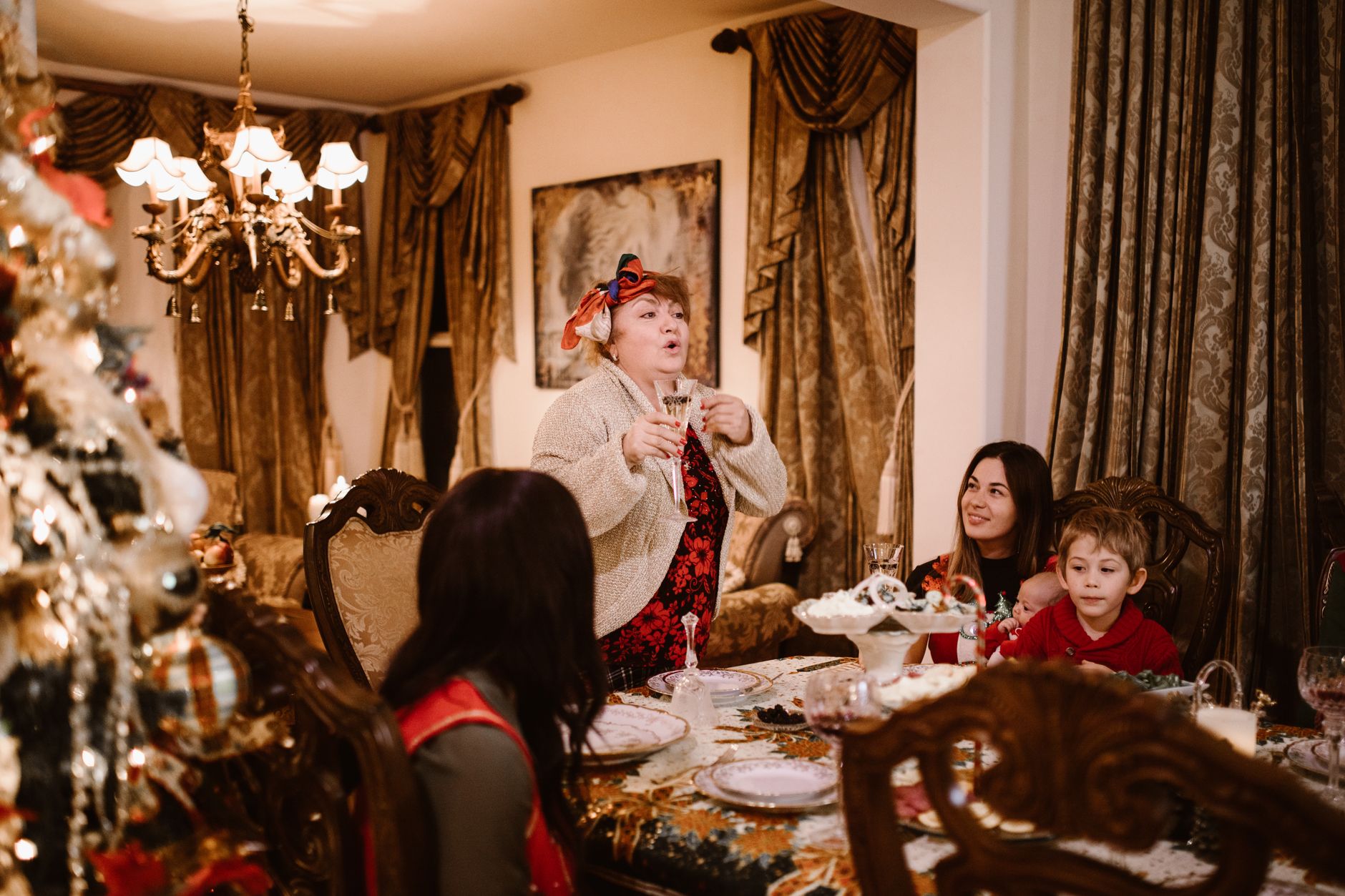
The Casserole That Became Evidence
I want you to understand something before I tell you what happened in that kitchen. I was not the kind of woman who plotted. I was the kind of woman who ironed her husband’s shirts on Sunday nights, who remembered every allergy at every family dinner, who showed up with a homemade casserole even when nobody thanked her for it. For eleven years I believed that being good, being quiet, being easy to live with, was its own kind of protection. I found out the hard way that it isn’t. But I also found out, on one long Saturday evening in a house that smelled like lilies and money, that quiet and helpless are not the same word.
My name is Caroline Voss. I kept my maiden name when I married Marcus Hartwell, more out of stubbornness than anything else, and that small decision turned out to matter more than I ever could have guessed. I was thirty nine years old, standing in my mother in law’s kitchen in Scottsdale, Arizona, holding a sweet potato casserole I had made from scratch that morning, when Diane Hartwell told me not to embarrass the family.
She said it the way she said everything, softly, pleasantly, like she was commenting on the weather instead of handing me a warning.
“Marcus’s new girlfriend is arriving soon,” she said, one hand resting on her marble counter, watching the light fade over the backyard pool. “She’s wealthy. Important. Don’t say anything awkward.”
I did not drop the casserole dish. I did not raise my voice. I set it down on the counter with both hands, the way my own mother taught me to set down anything precious, carefully, like it still mattered even if nobody around me thought it did.
“Of course,” I said. “I understand.”
Diane’s mouth softened into something like satisfaction. That was the thing about a woman like Diane. She loved a quiet daughter in law, as long as the quiet worked in her favor.
Where I actually came from
I need to back up, because you cannot understand what happened at that dinner without understanding where I started. I did not grow up anywhere close to Scottsdale. I grew up in Marion, Ohio, a farm town an hour north of Columbus where the tallest building downtown was the grain elevator and the biggest event of the summer was the county fair. My father drove a propane truck for thirty one years. My mother taught third grade at the elementary school two blocks from the house I grew up in. We went to the same small Methodist church every Sunday, and on Friday nights in the fall the whole town emptied out into the high school stadium to watch boys we all knew by name try to win a game that meant more to us than it probably should have.
I met Marcus Hartwell at that same county fair the summer I turned twenty six. He was working a booth for his father’s company, Hartwell Construction, which back then was a modest outfit that built pole barns and additions and the occasional new home for a family that had saved up for years. His father, Walter Hartwell, was a broad shouldered man who had served in the Army as a young man and never stopped carrying himself like it. Walter ran his crews the way he ran his life, fair, plain spoken, and generous in a way that never called attention to itself. Every year Walter’s company sponsored two scholarships through the local VFW post, small ones, a few thousand dollars each, for the sons and daughters of veterans in Marion County who wanted to go to trade school or college and could not quite afford it on their own. He named it after nobody but himself, quietly, and most people in town did not even know he was the one funding it until years later.
Marcus, back then, was easy to love. He had his father’s build and his mother’s polish, but none of Diane’s edges yet. He drove me to Columbus for our first real date and got lost twice and laughed about it instead of getting frustrated. He met my parents at our kitchen table and ate two helpings of my mother’s pot roast and asked Walter Hartwell’s son questions about propane trucks like he actually wanted to know the answers. I married him three years later in the same Methodist church I was baptized in, wearing my grandmother’s veil, with the VFW honor guard standing at the back of the sanctuary because Walter insisted on it as a tribute to my own father’s years of quiet service on the local rescue squad.
For the first few years, we lived twenty minutes from my parents in a house Marcus built with his father’s crew, and life was ordinary in the way that felt like a gift once you have lost it. Then Walter died of a heart attack on a job site in the spring I turned thirty two, and everything changed at once.
Marcus inherited the company. Diane, who had never worked a single day for Hartwell Construction while Walter was alive, suddenly had opinions about all of it. Within eighteen months she had convinced Marcus that Ohio was small, that Ohio was beneath what the company could become, that Arizona was where real money lived. Marcus expanded into commercial development, renamed the company Hartwell Construction and Development, and moved us to Scottsdale into a gated community with a name that sounded like a resort. Diane followed within the year, buying a house four minutes from ours, and from the moment she arrived she treated my Ohio upbringing like something to be managed rather than something I had brought into the marriage as a gift.
I kept cooking from scratch. I kept driving myself to church on Sundays, even after Marcus stopped coming with me. I kept sending money quietly, every year, to the same VFW scholarship fund Walter had started, now folded into something Diane rebranded as the Walter Hartwell Foundation, because it felt like the last honest thread connecting the man I married to the boy I fell in love with at a county fair booth.
I did not know yet that the thread was already fraying somewhere I could not see.
The second phone
The changes started small enough that I told myself I was imagining them. Marcus began staying late at the office in Tempe two, then three nights a week. He started keeping his phone face down on the nightstand, a habit he had never had in eleven years of marriage. He got a second phone, a cheap prepaid one, and told me it was for a work project he could not discuss because of a nondisclosure agreement. I believed him for longer than I am proud of.
I want to be honest about something. I did not confront him, not because I was weak, but because I had learned, over eleven years married into a family like the Hartwells, that confrontation was a performance Diane always won. She would tilt her head and say something like “Caroline, dear, you’re being emotional” in a tone so gentle it took the air right out of the room, and somehow within minutes I would be the one apologizing. So instead of confronting Marcus, I did something quieter. I called a divorce attorney in Phoenix named Rosalind Cho, a woman a friend from my old Ohio church group had recommended after her own difficult split from a man with tangled business assets.
Rosalind asked me one question in our first meeting that changed the entire shape of what came next.
“Caroline,” she said, “do you have any idea how much of your marital net worth is tied up in that construction company, and whether it’s actually as healthy as your husband’s family wants people to believe?”
I did not. Nobody had ever shown me the books. Diane handled the household accounts for both her house and, increasingly, ours, insisting it was simpler that way, and Marcus had stopped discussing the business with me years earlier, first out of habit, then out of what I now understand was avoidance. Rosalind told me that before I did anything else, I needed a forensic accountant, someone who could look past the surface of Hartwell Construction and Development and the Walter Hartwell Foundation and tell me, honestly, what I actually owned a stake in and what I was actually protecting myself from.
She recommended a firm out of Phoenix that specialized in exactly that kind of quiet, careful digging. I signed the engagement letter on a Tuesday afternoon in March, in Rosalind’s office, my hands steadier than I expected them to be. I told no one. Not my sister, not my mother, not a single soul in Marion, Ohio who still asked me every Christmas how married life in Arizona was treating me.
My silence, the same silence Diane had always mistaken for obedience, had quietly turned into paperwork.
What the numbers said
It took four months for the first real report to land on Rosalind’s desk, and when she called me in to go over it, she asked me to sit down before she started talking, which is never a good sign from a divorce attorney.
The marital finances were messier than I expected, threaded through with a Tempe apartment lease Marcus had signed eight months earlier under a shell name that traced back, with almost no effort, to his own initials. There were withdrawals to a jewelry store in Scottsdale I had never set foot in. There was a credit card I had never seen a statement for. All of that, painful as it was, was almost expected. Women in my position learn to brace for that kind of discovery.
What I did not expect was the second half of the report, the part about the Walter Hartwell Foundation.
The forensic accountant, a careful, soft spoken man named David Okafor, had pulled the Foundation’s tax filings and bank records as part of establishing the full picture of what Marcus and Diane controlled financially, since the Foundation’s board seats were held by Marcus and Diane and its administrative costs ran through the same accounting office as the company. What he found were a series of transfers, small at first and then larger, moving out of the Foundation’s scholarship account and into accounts that eventually funded, among other things, that Tempe apartment lease and a down payment on a piece of jewelry that matched, almost to the dollar, an entry on that mysterious credit card.
Walter Hartwell’s scholarship fund, the one that had put two kids from veteran families through trade school every single year since before I married into this family, the one the VFW post back in Marion still announced proudly every spring at their Memorial Day ceremony, had been quietly drained to pay for my husband’s affair.
I sat in Rosalind’s office and I did not cry. I want to tell you I cried, because that would make a better story, the kind where the wronged woman finally breaks. But what I actually felt was something colder and steadier than tears, something that felt less like grief and more like the moment a fog finally clears off a familiar road. I finally understood the family I had married into, all the way down to the bottom of it.
“What happens now,” I asked Rosalind, “if this isn’t just a divorce issue? If this is theft from a nonprofit?”
Rosalind explained that the Foundation, small as it was, still had a board of directors, three men from Marion who had served with Walter or known him through the VFW, and that under Ohio nonprofit law they had a legal obligation to investigate credible evidence of misappropriated funds. She told me I had two choices. I could fold this discovery quietly into the divorce settlement and let my attorneys use it as leverage behind closed doors. Or I could send what David Okafor had found to the Foundation’s board directly, anonymously if I wanted, and let them decide what to do with it, knowing it might become public, knowing it might blow up far bigger than my marriage ever needed to.
I thought about Walter Hartwell eating pot roast at my parents’ table. I thought about the VFW honor guard standing at the back of my wedding. I thought about two kids every year in Marion, Ohio who would never know that the scholarship that sent them to welding school or nursing school had come out of money that should have kept flowing after Walter died, and had instead been quietly redirected into a life I was never invited into.
I sent the file to the board myself, anonymously, on a Thursday in June, four days before Diane called to invite me to dinner and tell me not to embarrass the family.
The night of the dinner
By the time I stood in that Scottsdale kitchen holding my casserole, I had been carrying the knowledge of everything, the affair, the shell lease, the drained scholarship fund, for three months without saying a single word to anyone in the Hartwell family. I had learned to hold my face still. I had learned to let Diane believe her warning had landed exactly the way she intended.
The house was arranged the way Diane always arranged it for company that mattered, wine glasses lined in a row like soldiers, silver serving spoons polished until they threw back the light, the white sofa nobody was allowed to actually sit on gleaming under the recessed lighting like a museum piece. Marcus stood near the entryway in a navy shirt I had ironed for him that very morning out of a habit I could not seem to break even now, checking his watch, then checking me, over and over.
“Caroline,” he said, quiet, almost gentle, the way a man sounds when he is asking for something he has not earned, “tonight doesn’t have to be uncomfortable.”
I looked at him and thought about how strange it was, to hear a man ask for peace while standing in the middle of the wreckage he had built.
“I agree,” I said.
That answer made him nervous. I could see it move across his face, a flicker of doubt he could not place. Good. Somewhere, four hundred miles away in Phoenix, an envelope had already been opened by three men on a nonprofit board who had known his father. A file had already been read. And one name inside that file, mine, was about to turn this careful, catered evening into something none of them could control with a well timed smile.
The front door opened at six thirty exactly.
Priscilla Adair walked in the way a woman walks in when she has spent her whole life being welcomed before she even speaks. Expensive handbag over one shoulder. A diamond bracelet that caught the recessed lighting the same way Diane’s silver did. Perfect posture, the kind that comes from confidence rather than posture lessons. She had the bright, polished ease of someone who believes every room has already been arranged for her comfort.
Diane rushed forward first, both hands out like she was greeting royalty. Marcus followed half a step behind her, too tense to look truly happy, though I doubt anyone in that room besides me was watching closely enough to notice.
I stayed by the buffet, my hand still resting on the edge of the casserole dish.
Priscilla smiled warmly at Diane. She smiled at Marcus. Then her eyes moved past both of them and found me, and something in her face shifted in a way I will remember for the rest of my life.
It was not shame. It was not surprise, not the ordinary surprise of a mistress meeting a wife for the first time. It was recognition, the specific, private recognition of someone matching a face to a name she has read somewhere important.
Her eyes dropped from my face to the plain gold wedding band on my hand, then to the casserole dish under my palm, as though some small, ordinary detail had just clicked a lock open in her mind that she had not expected to find in that kitchen.
Diane was still smiling, oblivious, already reaching for a wine glass. Marcus had gone very still, the particular stillness of a man realizing too late that he has walked two people who should never meet into the same room.
Priscilla took one slow step toward me. She lowered her voice so only I could hear it, though I would learn later that voice would not stay lowered for long.
“Are you Caroline Voss?” she asked. “Caroline Voss from the file?”
The truth Diane never saw coming
I have thought many times since that night about how differently it could have gone. Priscilla could have said nothing. She could have smiled and let the evening continue exactly as Diane had scripted it, another quiet dinner where the wife absorbs the humiliation and goes home to cry where nobody has to watch. But Priscilla Adair, it turned out, was not simply a wealthy woman Marcus had been quietly seeing behind that second phone. She was a forensic accountant, a partner at the very firm David Okafor worked for, and three weeks earlier her managing partner had assigned her, personally, to lead the independent audit the Walter Hartwell Foundation’s board had authorized the moment they opened my anonymous letter.
She had been dating Marcus for two months by then, introduced at a charity gala neither of us had ever attended together, and she had no idea, none at all, that the man buying her dinner in Tempe and the family whose foundation she had just been assigned to investigate were one and the same, until she read the name Caroline Voss typed at the bottom of a whistleblower letter three days earlier and then walked into a kitchen in Scottsdale and watched that exact name appear on the woman standing quietly by the buffet.
“I need everyone to sit down,” Priscilla said, and her voice had changed entirely, the warmth gone, replaced by something precise and unshakeable. “Diane. Marcus. There’s something you both need to know, and I think you should hear it from me before it comes from anyone else.”
Diane’s smile finally cracked, just at the edges. “Priscilla, sweetheart, whatever this is, we can discuss it after dinner.”
“No,” Priscilla said. “We can’t.”
She explained it plainly, the way I imagine she explained hard numbers to nervous clients every day of her career. She was a certified forensic accountant. Three weeks earlier, her firm had been retained by the board of the Walter Hartwell Foundation to conduct an independent audit after the board received a detailed, documented complaint alleging that scholarship funds meant for the children of local veterans had been diverted for personal use. She had pulled the financial records herself. She had matched the withdrawal dates. She had traced a Tempe apartment lease and a jewelry purchase back to Foundation funds that were supposed to be sending kids from Marion, Ohio to trade school and nursing programs. And three days ago, she had read the name attached to the original tip that started the whole investigation.
“Caroline Voss,” she said, looking directly at me, not unkindly, almost with something like respect. “You’re the one who sent the file.”
The kitchen went completely silent. I could hear the pool filter humming outside the window.
Marcus’s face had gone the color of the white sofa nobody was allowed to sit on. “Caroline,” he said, and it came out cracked, “what did you do?”
“I protected two children in Marion County who don’t even know your name,” I said, “from losing a scholarship your father built with his own two hands, because you needed a nicer apartment for someone you were lying to your wife about.”
Diane found her voice again, sharp now, all pretense of gentleness gone. “This is absurd. This is a family matter, and I will not have it discussed in my kitchen by a woman my son is casually seeing.”
Priscilla turned to her, and I watched a woman who had built a career reading liars for a living look Diane Hartwell directly in the eye. “Diane, I’ve reviewed your signature on eleven of these transfers personally. This stopped being a family matter the moment Foundation funds left a nonprofit account that your name and your son’s name are both fiduciaries on. I have a professional and, frankly now, a personal obligation to disclose everything I know to the board tomorrow morning, and to recuse myself from any further personal relationship with Marcus effective immediately, because I will not be an unknowing accessory to whatever this family has been doing to that scholarship fund, or to that woman.”
She said that last part looking at me.
Marcus tried, weakly, to say something about accounting errors, about how complicated the books had gotten since his father died, about intentions that were never as bad as they looked. Diane tried, more forcefully, to insist that Priscilla was overstepping, that this was a misunderstanding, that surely something could be arranged. I stood by the buffet and watched two people who had spent eleven years making me feel small in that exact kitchen finally run out of the one thing that had always saved them before, an audience willing to stay quiet.
I was not quiet anymore. I had not been quiet for months. They just had not noticed yet.
What justice actually looked like
The weeks after that dinner did not unfold like a movie. There was no single dramatic gavel moment, no perp walk, nothing tidy enough for a headline. Justice, in a case like this, moved the way real justice usually does, slowly, through paperwork, through board resolutions, through phone calls between lawyers that I was mostly not present for and did not need to be.
The Foundation’s board, three men in their sixties and seventies who had all known Walter Hartwell personally, men who still met once a month at the VFW post on Center Street in Marion, voted unanimously within two weeks to remove both Marcus and Diane from their positions as directors. They referred the matter to the Ohio Attorney General’s charitable law section, as they were legally obligated to do once Priscilla’s audit confirmed a pattern of diverted funds rather than an honest accounting mistake. Marcus, facing the very real possibility of a criminal referral for misappropriation of nonprofit funds, agreed through his attorney to a full restitution plan, repaying every dollar traced out of the scholarship account, plus penalties, over eighteen months, in exchange for the Attorney General’s office declining to pursue criminal charges as long as the repayment held. It held. I made sure, through Rosalind, that it held, checking in with the board every quarter for a full year after the divorce was final.
The divorce itself, once Rosalind had the forensic report and the audit findings in hand, was not the drawn out battle I had once feared. Marcus’s attorney understood, quickly, that a public fight would only draw more attention to a story his client badly needed to stay quiet. I walked away with a settlement that reflected eleven years of marriage and a business I had, in fact, helped build in ways nobody ever gave me credit for, keeping the household books in the early Ohio years, cosigning loans when the company was small enough that Marcus’s name alone would not have covered them, standing beside Walter at ribbon cuttings and county fair booths back when Hartwell Construction was still just a name on the side of two pickup trucks.
Diane’s world, the one built entirely on being seen as generous and important, did not survive the story leaking into Marion the way small towns always find a way to let things leak. The VFW post where Walter’s honor guard had once stood at the back of my wedding held a quiet meeting that spring and voted to rename the scholarship the Walter Hartwell Memorial Fund for Veterans’ Families, administered directly by the post itself, with no Hartwell family member allowed anywhere near the finances again. Diane, I heard through my sister, who still lives twenty minutes from Marion, stopped coming back to Ohio for the Memorial Day ceremony she used to fly in for every year to be photographed standing beside a check with her son’s name on it.
Priscilla Adair and I spoke exactly once more after that dinner, a brief, professional phone call a month later when the audit was finalized. She thanked me, in a careful, measured way, for having the courage to send that letter, and told me that in fifteen years of forensic accounting she had rarely seen a family that spent so much energy protecting its image and so little protecting the people who trusted it. She never dated Marcus again after that night. I do not know what became of her personally, and I never asked. She had done her job, and she had done it with more integrity than anyone else at that table, and I respect her for that more than she probably knows.
What I kept, and what I let go
People ask me sometimes, the few who know the whole story now, why I did not just confront Marcus the day I found the second phone. Why I waited months, why I let myself sit through one more dinner in that kitchen, smiling, absorbing Diane’s warning, playing the part they had all assigned me for eleven years.
The truth is, I did not wait because I was afraid. I waited because I understood, better than any of them ever gave me credit for, that a woman who confronts a family like the Hartwells with nothing but hurt feelings loses. A woman who confronts them with a forensic accountant’s report, a board of directors who loved her father in law more than they loved her husband, and a divorce attorney who had already done the math, wins. My silence was never surrender. It was the only weapon I had that they could not see coming, and I sharpened it for four months while Diane mistook it for obedience.
I moved back to Marion, Ohio, eight months after that dinner, into a small house two streets over from the one I grew up in. My mother still teaches third grade two blocks away. I go back to that same Methodist church every Sunday, and last Memorial Day I stood at the back of the VFW post with my sister while the commander, a retired Army First Sergeant named Roy Delgado who had served with Walter decades ago, read the names of the two students receiving the newly renamed scholarship fund this year. One of them was a nineteen year old girl whose father had done two tours and come home with a bad hip and a good heart, heading off to nursing school in the fall on money that finally, actually, reached the family it was always meant for.
I did not cry at that ceremony either, not really, though my eyes did sting a little when Roy Delgado, without naming me, thanked “the person whose honesty made sure this fund would outlive the family that almost let it die.” Nobody in that crowd but my sister knew he meant me. I liked it that way. I had spent eleven years being watched and judged in a kitchen four hundred miles from home. I did not need to be watched or thanked here. I just needed to know that the money my father in law worked so hard to set aside for kids like that girl was finally, quietly, doing exactly what he built it to do.
I set my empty casserole dish down on the folding table at the VFW hall that afternoon, next to a dozen others brought by women I had known my whole life, and nobody moved it to the far end of the buffet to remind me where I stood. There was no far end. There was just a table full of food made by people who actually wanted me there, and for the first time in a very long while, that was enough.
I think about Diane sometimes, standing in that Scottsdale kitchen with her wine glasses lined up like soldiers, warning me not to embarrass the family. I never did embarrass them, not really. I just stopped protecting them from the truth of what they had already done to themselves. There is a difference, and it took me eleven years, one anonymous letter, and one very well dressed forensic accountant walking through the wrong front door on the wrong night to finally understand it.