The Boy Who Never Stopped Being Kind
I was seventeen and I had a full life planned out on a legal pad in my nightstand drawer. College in the fall, a dorm room I’d already picked wallpaper for in my head, a boy named Danny Osric I was pretty sure was going to ask me to prom before Easter. I grew up in Cedar Bend, a town in Kansas small enough that the water tower had my graduating class’s year painted on it a full two years before we graduated, because the football boosters were that confident we’d get there. My daddy worked the elevator at the co-op. My mama sang alto in the choir at First Baptist and dragged me to Wednesday night youth group whether I wanted to go or not.
Six months before prom, she dragged me to Wednesday night youth group one more time.
We’d had a lock-in planned, games and pizza and a devotional about patience that I remember exactly nothing of, and I stayed late helping Miss Arlene fold the folding chairs because I liked being useful and because Danny Osric was helping too and I wanted an extra fifteen minutes in the same room as him. My daddy couldn’t come get me, he was working a late shift checking grain moisture, so I drove myself home in the Cutlass my parents had handed down to me for my birthday that spring. Two miles from our house, at the intersection of County Road 12 and the highway, a man who had been drinking at the Elks Lodge since four in the afternoon ran the red light doing better than seventy.
I don’t remember the impact. I remember the color of the sky right before it, that particular deep blue-black Kansas gets in April when the stars come out early, and then I remember white ceiling tiles and my mother’s face and a pain in my hips and legs that felt like the inside of me had been rearranged by something with no regard for how a body is supposed to fit together. Because it had been. My pelvis was shattered in four places. Both femurs broke. There was a surgeon at the regional hospital in Salina who told my parents, in the hallway, in a voice he probably thought was too quiet for me to hear through the door, that I would likely never walk unassisted again, and that we should be grateful I would walk at all, in any fashion, with enough surgeries and enough years.
I was seventeen. I did not want to hear the word grateful.
The next six months are still, to this day, the hardest stretch I have ever survived, and I have survived a few things since. I went from a girl who ran track in the spring to a girl who needed help getting from a bed to a chair. I watched my mother’s face rearrange itself into a kind of permanent careful cheerfulness that I understood, even then, was costing her something enormous every single day. I watched my father stop singing along to the radio in the truck, which he had done my whole childhood without fail, and I never once heard him do it again after that April. Danny Osric came to see me twice in the hospital and then stopped coming at all, and I understood that too, in the flat, resigned way you understand things at seventeen when the world has already taught you more than it should have.
By the time prom rolled around in the fall of my senior year, the legal pad in my nightstand had a lot of pages crossed out on it. I had a wheelchair I was still learning to be graceful in, though grace was not a word I would have used for it then, and I had a body that did not do what I told it to anymore, and I had exactly zero interest in putting on a dress and watching everyone else’s life continue on schedule while mine sat in the corner in a borrowed chair.
The corner at prom
My mother would not hear of me staying home.
She had a way of saying things that left no real room for argument, not because she was harsh, she was the gentlest woman I have ever known, but because she said them like facts of weather. “You deserve one night,” she told me, sitting on the edge of my bed with the dress we’d picked out together laid across both our laps, a soft blue thing with enough fabric to drape over my legs and the chair without anyone having to see what she and I both knew they’d stare at anyway. I didn’t believe her. I put the dress on because it was easier than fighting her, and because some small stubborn piece of me, the piece that had run the four hundred meter the spring before the crash, still wanted one night that looked like a normal girl’s life, even from a distance.
The Cedar Bend High gymnasium was strung with white lights and butcher paper stars that the junior class had cut out with the wrong kind of scissors, uneven and a little sad if you looked closely, though nobody was supposed to look closely. My father wheeled me in through the side door because the front steps didn’t have a ramp yet, that wouldn’t come for another two years, after my parents spent an entire summer writing letters to the school board about it. He parked me at a table near the punch bowl, kissed the top of my head, and told me he’d be back at eleven.
I spent most of that night in the corner. My dress was arranged carefully over my legs, the way you arrange a blanket over something you don’t want people to have to think about. I watched everyone else laugh and dance and live the version of senior year I had been building on that legal pad since I was fourteen. Some kids avoided looking at me entirely, the way you avoid looking at the sun, like eye contact might burn something. A couple of girls I’d been friendly with since second grade waved from across the gym and did not come over. One boy, a sophomore I barely knew, actually rolled his eyes when his friends dared him to ask me to dance, loud enough that I heard it, and I have spent thirty years being grateful I don’t remember his name, because it means I let it go, eventually, the way you have to let go of the small cruelties or they’ll take up permanent residence in you.
And then Marcus Doyle walked up.
I want you to understand who Marcus Doyle was in Cedar Bend, Kansas, in the fall of that year. He was the starting quarterback, the boy whose name was on the marquee outside the Dairy Freeze after every Friday win, the boy college scouts had already started writing letters to, the boy every girl in that gymnasium would have crossed the room barefoot on broken glass to dance with. He had no reason on this earth to walk over to the corner table where the girl in the wheelchair sat with her dress arranged over her legs like a secret.
“Hey,” he said, and his voice was soft in a way I hadn’t expected from a boy that big, a boy whose shoulders filled out a letterman jacket like it had been sewn onto him. “Want to dance?”
I felt my whole face go hot. “I… I can’t,” I whispered, and I meant it as a fact, the same flat fact my body had been teaching me for six months, and I braced myself for him to nod, awkward, and back away the way everyone backed away.
He smiled instead. It wasn’t a pity smile. I have thought about the difference between a pity smile and a real one more times than I can count in the thirty years since, and his was real, all the way up into his eyes.
“Then we’ll figure something out,” he said.
And somehow, we did.
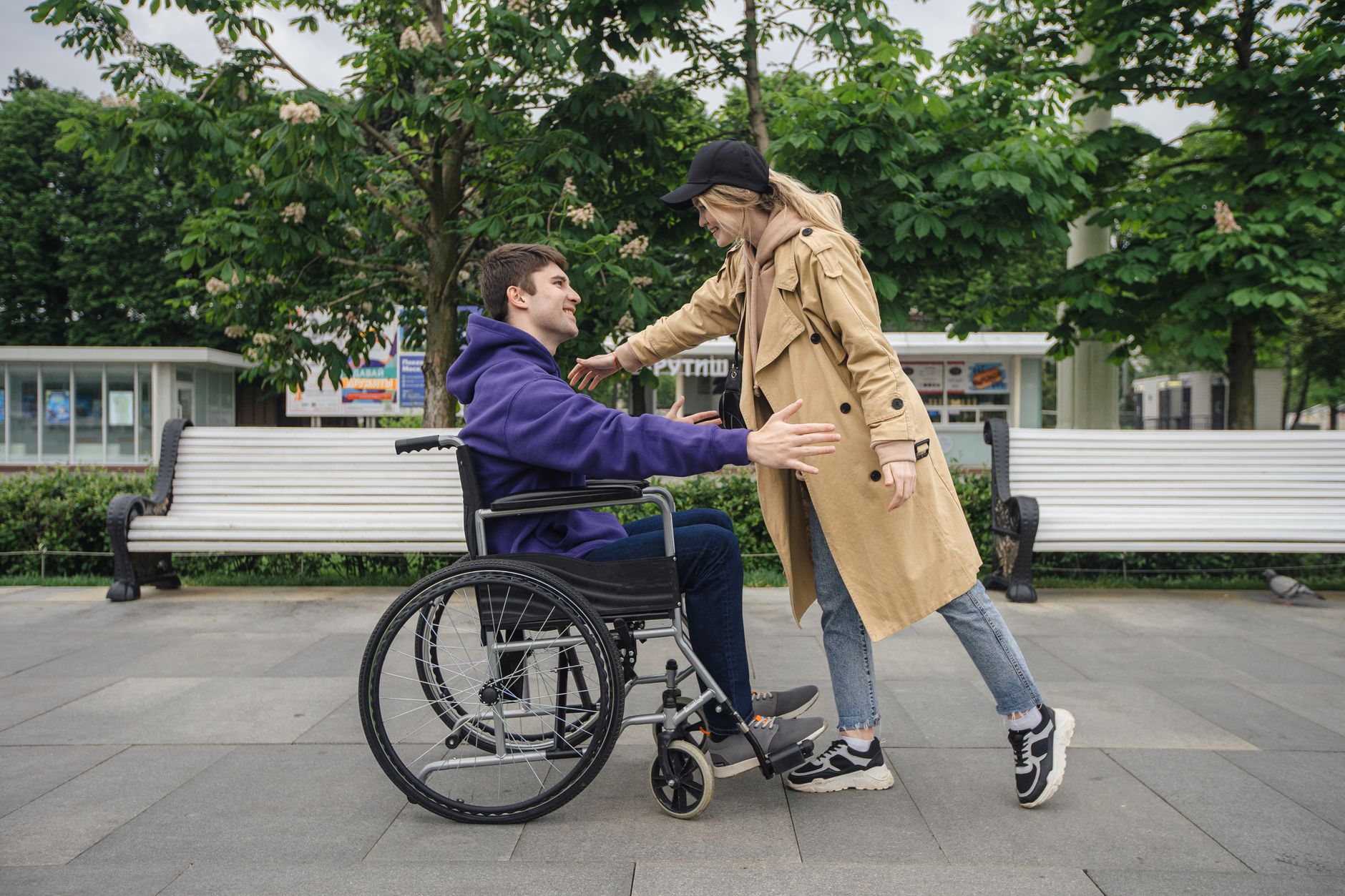
He crouched down first and asked me, actually asked me, what would feel good and what wouldn’t, which nobody, not one single adult in six months of hospitals and physical therapy rooms, had thought to do in quite that way. Then he got behind my chair and spun it, slow circles under those crooked paper stars, and when a slow song came on he crouched down again and took both my hands in his and just held them, moving them gently in time with the music like we were dancing even though only half of us technically were. For ten minutes, under bad gymnasium lighting, with a boy who had every reason to be dancing with someone else, I was not the girl people averted their eyes from. I was just a girl at her prom, dancing, however that had to look.
I never told him what that ten minutes did for me. I don’t think I had the words for it then. I’m not sure I fully have them now, thirty years and a great deal of therapy later, but I’ll try: he gave me back, for ten minutes, the version of myself I thought the drunk driver on County Road 12 had taken for good. He didn’t fix my legs. He fixed something else, something that mattered just as much, maybe more, because legs can be worked on with surgeries and years, but the part of you that believes you’re still worth asking has to be handed back to you by somebody, and Marcus Doyle handed it back to me without being asked to and without ever knowing what he’d done.
After graduation, I never saw him again. He went off to play college ball somewhere out east on a scholarship, and Cedar Bend does what small towns do, it keeps some names alive in conversation for a few years and then lets them fade into the version of the past that only comes up at reunions. I heard, secondhand, through my mother, through the church, through the grapevine that runs under every small town like tree roots, that things hadn’t gone the way anyone expected for him. A knee injury. A dropped scholarship. And then, over the years, less and less, until his name stopped coming up at all, the way names do.
Thirty years of learning to stand
My own life, meanwhile, took the long, slow shape that lives take when you’ve been handed a body that has to be rebuilt one inch at a time.
There were more surgeries than I can list here without this turning into a medical chart instead of a story. There was a rod in my left femur and pins in my right that still set off the metal detector at the courthouse to this day. There was physical therapy three times a week for years, in a windowless room at the regional hospital with a therapist named Deb who had the patience of a saint and the bluntness of a drill sergeant, both qualities I needed in equal measure. There was pain that never, in three decades, has fully gone away, a low ache in cold weather that I have simply learned to live alongside, the way you live alongside a difficult neighbor.
And there was, slowly, standing.
I will never forget the first time I stood on my own, holding parallel bars in that same windowless room, eleven months after the crash, my legs shaking under me like a newborn colt’s. Deb cried. I cried. My mother, watching through the little window in the door because she wasn’t allowed in during sessions, cried hard enough that the janitor asked if she needed him to call somebody.
It took years after that to walk with a cane instead of bars, and years more before I could walk short distances without one at all, though to this day I keep one in my car and in my office, because some mornings the ache wins and I’m not too proud to lean on something. I went to college two years later than my original legal pad had planned, at the state university, and I chose physical therapy as my major before I’d even finished my first semester, because I understood something in my bones, literally, that most twenty year olds don’t get handed: I understood exactly what it felt like to need someone to believe your body could still do more than it currently could, and I wanted to be that person for other people.
I built a career out of that ten minutes on a gymnasium floor, even though it took me a long time to see the throughline that clearly. I got my doctorate in physical therapy. I worked for a decade at a rehabilitation hospital in Wichita, and then, when my father’s health started failing and my mother needed help, I came home to Cedar Bend and did something that terrified me more than any surgery had: I opened my own clinic, on the corner of Third and Maple, in a building that used to be a hardware store, with a loan I wasn’t sure I could pay back and a business plan built on the idea that small towns deserve real rehabilitation care too, not just a once-a-week visit from a traveling therapist out of the city.
I named it the Cedar Bend Wellness and Rehabilitation Center. I put a ramp at the front door before I put in the front desk, because I remembered exactly what it felt like to be wheeled in through a side door like an afterthought. Twenty two years later, it’s the largest employer on that side of town, and I have watched hundreds of people, farmers with blown-out backs and kids with sports injuries and grandmothers recovering from hip replacements, take their first shaky steps in that building the way I once took mine in Deb’s windowless room in Salina.
I never married. That’s its own story, one I don’t need to tell here, except to say that I built a full and good life, a life with purpose in it, a life I am proud of, even without the particular shape I’d once sketched out on a legal pad at fourteen. I have nieces and nephews who call me Aunt Gracie and a staff at the clinic I love like family and a church community that has held me up more times than I can count. I built all of that. I am proud of every inch of it.
But I never forgot the boy in the gymnasium.
The café
Thirty years is a long time, long enough that I stopped actively thinking about Marcus Doyle most days, the way you stop actively thinking about most of the people who shaped you, even the ones who shaped you the most. He lived in the back of my mind the way a favorite old photograph lives in a drawer, not framed on a wall, but not thrown away either, brought out every so often when something jogged the memory. A slow song at a wedding. The smell of a gymnasium. A stranger’s kindness to someone the world had decided not to look at.
It was a Tuesday morning in April, thirty years almost to the season since that prom, when I walked into the Wagon Wheel Café on Main Street the way I did most mornings before opening the clinic, for coffee and the particular kind of quiet you only get in a small town diner at seven in the morning before the breakfast rush.
I was juggling my coffee and a stack of files I shouldn’t have been carrying in one arm, and my cane caught the leg of a chair I hadn’t seen, and the coffee went everywhere, scalding across both my hands, splashing onto the floor, the kind of small public humiliation that at seventeen would have flattened me and at fifty-two mostly just made me irritated at myself. A couple of the regulars at the counter turned to look, the way people do, some of them concerned, one older man just staring in that flat way that still, after everything, makes something in my chest tighten a little.
Then someone rushed over from the direction of the kitchen with a rag already in hand.
“Hey, don’t worry, I’ve got it,” he said, already crouching to mop up the mess on the floor before I could even get my bearings, and something in the register of his voice, low and easy and immediately kind, snagged at a memory I couldn’t place yet.
I looked up.
He was a man in worn blue scrubs, the kind the county hospital issues its custodial and support staff, faded from what must have been a hundred washes, and he moved with a pronounced limp, favoring his left leg in a way that spoke of an old injury that had never been properly fixed. He cleaned the spilled coffee off the floor with quick, practiced efficiency, the kind you only get from doing a job like that every single day for a long time, and then he stood, wincing slightly as he straightened, and went and got me another coffee from behind the counter without being asked, refusing to let the girl behind the register charge me for either one.
I watched him dig into his own pocket to make up the difference at the register, counting out what looked like his last few coins, careful and a little embarrassed about it, the way people are when they’re doing math in their head that doesn’t quite balance and they’re doing it in public.
Something in my chest tightened, and this time it wasn’t the stares.
When he turned back around to hand me my coffee, I looked at him, really looked, past the tired lines around his eyes and the gray threading through hair that used to be sandy brown, and I found the jawline I remembered from a gymnasium three decades ago. The eyes. Older, and tired in a way that went deeper than a bad night’s sleep, but unmistakably his.
Marcus.
He was older, and tired, and he was limping through a minimum wage job in a hospital hallway with the same worn dignity he’d once carried across a dance floor with me, and I understood in that instant that whatever had happened to him in thirty years had not been kind. But underneath all of it, in the way he’d crouched without a second thought to clean up a stranger’s mess and refused to take her money for a second coffee, he was still that same gentle boy.
He didn’t recognize me. There was no reason he should have. I had been a scared seventeen year old in a wheelchair for ten minutes of his senior year, one kindness among probably hundreds he’d handed out that year without a second thought, and I had spent thirty years walking around with legs he never got to see finish healing.
I sat there after he went back to the kitchen, my second coffee going cold in my shaking hands, and I felt something settle into place in my chest that I can only describe as a door opening that I hadn’t known was still there to open.
I knew, right then, that this was my moment. He had no idea what I was about to do for him.
What I found out
I didn’t say anything to him that day. I needed a night to think, and if I’m honest, I needed a night to make some calls first, because I have never been the kind of person who acts on a feeling without first making sure the feeling has ground underneath it.
I called Dottie Ferris, who ran the front desk at Cedar Bend County Hospital and had run it since roughly the beginning of time, and who knew, I was fairly sure, the full employment history of every person who had ever worked in that building. I didn’t have to ask much. Dottie has never needed much invitation to talk.
Marcus Doyle, it turned out, had torn up his knee badly in his sophomore year of college ball, the same knee, Dottie said, that had already been quietly troubling him since a hard hit senior year of high school that he’d never told anyone about because he didn’t want to sit out a single Friday night of his final season in Cedar Bend. The college surgery didn’t take the way it should have. He lost the scholarship the following spring when the coaching staff decided he was more medical liability than asset, and he came home instead of finishing his degree, because his mother had been diagnosed with early-onset dementia that same year and there was nobody else to look after her.
He spent the better part of two decades doing exactly that. Working odd jobs around Cedar Bend that could flex around doctor’s appointments and bad days, taking care of a woman who, by the end, didn’t reliably know his name, burying her four years ago after a decline that Dottie described, quietly, as long and hard on him in ways that had visibly aged him past his years. He’d never married. Never had the money or the stability, Dottie guessed, and never quite the heart for it either, not after so many years spent as somebody’s full-time caretaker.
He’d been working custodial and patient-support at the hospital for six years, the knee never properly repaired because he’d never had insurance worth the paper it was printed on and never the several thousand dollars a real surgery would cost out of pocket. Dottie told me, lowering her voice the way she did when she was about to say something she probably shouldn’t, that his shift supervisor, a man named Roy Kessinger who ran the custodial department like a fiefdom, had taken to calling Marcus “mop boy” in front of the younger staff and had written him up twice in the last year for moving too slow on his rounds, never once asking why a man who used to run a forty yard dash in under four and a half seconds now couldn’t keep pace pushing a cart down a hallway.
I sat in my kitchen that night with all of that laid out in front of me like an X-ray, and I did not sleep much.
What I said to him
I went back to the hospital the next afternoon, not the café, because Dottie had told me his shift, and I found him in a supply hallway near the east wing, restocking a cart, alone, which I was grateful for.
He looked up when he heard my cane on the tile, and there was a flicker of recognition, the polite kind, the kind that says you look like someone I helped yesterday, not the kind that says I know exactly who you are.
I didn’t waste the moment. I had spent all night deciding what I would say, and once I was standing in front of him I found I didn’t need the notes I’d half-written in my head.
I leaned in close, and I said something I had carried for thirty years.
“Thirty years ago, at Cedar Bend High, a girl sat alone at prom in a wheelchair because a drunk driver had just taken her legs six months before, and every boy in that gymnasium looked past her except one. He crouched down, and he asked her what would feel good, and he spun her chair under the paper stars, and for ten minutes he made her feel like a girl instead of a burden. I have thought about those ten minutes nearly every week for thirty years, Marcus. I am that girl. My name is Grace Calloway, and you have no idea what you gave me that night, and I am not leaving this hallway until I’ve given at least some of it back.”
His hands froze mid-air, a stack of paper towel rolls halfway onto a shelf, and for a long moment he just looked at me, and I watched thirty years of a hard life move across his face, disbelief and then something that looked almost like shame, the particular shame of a proud man caught in worn scrubs by someone from a life he used to have, and then, underneath both of those, something that broke my heart clean open: hope, the kind a person doesn’t let themselves feel very often once they’ve been let down enough times.
“Grace,” he said, testing the name like it might not be real. “Grace Calloway. In the… you were in the chair.”
“I was in the chair,” I said. “I’m not anymore, mostly, thanks in no small part to you deciding thirty years ago that a girl in a corner deserved ten minutes of your senior prom.”
He set the paper towels down very carefully, like his hands weren’t entirely steady, and he didn’t say anything for a moment, and I let the silence sit there, because some moments don’t need to be filled.
“I think about that night sometimes,” he finally said, quiet. “Not often. But sometimes. I always wondered what happened to you.”
“I got up,” I told him. “It took a lot of years and a lot of surgeries and a therapist named Deb who I owe my whole life to, but I got up, and I stood, and eventually I walked, and I built a clinic three blocks from here that exists because a boy once taught me, without either of us knowing it, that the worst thing that ever happened to me didn’t get the final say on who I was. I need you to know that before I say anything else, because what I’m about to offer you isn’t charity, Marcus. It’s a debt. And I have been thirty years overdue on it.”
The offer
I told him, standing in that supply hallway with a cart of paper towels between us, that I had an opening at my clinic, had actually had one for three months that I’d been too shorthanded to properly advertise, for a facilities and patient-transport coordinator, a real position, salaried, with full health insurance starting on day one, no waiting period, the kind of job that comes with dignity attached to the title instead of a nickname a supervisor uses to make a grown man feel small.
I told him that the health insurance would cover, immediately, the knee reconstruction he needed and had never been able to afford, that I already had a call in to an orthopedic surgeon in Wichita I’d sent a hundred patients to over the years and trusted completely, and that I would personally walk every step of that recovery beside him in my own clinic, the way Deb had once walked every step of mine, because I understood, better than almost anyone alive, exactly what a body feels like when it’s been left half-fixed for years past when it should have been made whole.
He tried to say no. Of course he tried to say no. Pride is a heavy thing to set down, especially for a man who has spent two decades being the one who takes care of everybody else, his mother, his patients, a stranger with spilled coffee in a diner, and has forgotten, somewhere along the way, that it’s allowed to run in the other direction too.
“I don’t need saving, Grace,” he said, and there was an edge in it, not at me, I understood even then, but at the whole shape of a life that had worn him down to needing to say that out loud.
“I know you don’t,” I told him. “I’m not saving you. I’m paying you back. There’s a difference, and I need you to let me find it, because I have spent thirty years being the woman a boy once refused to look past, and I am not about to become the woman who looks past him now that the roles are turned around.”
He cried then, standing in that hallway in his worn blue scrubs, a big man, a former quarterback, folding down onto an overturned bucket by the shelving with his face in his hands, and I sat down next to him in the only way I could, easing myself onto the same bucket’s edge with my cane across my knees, and I put my hand on his back the way my mother used to put hers on mine in that hospital room thirty years ago, and I didn’t say anything else for a while, because some things don’t need more words. They just need somebody to stay.
What came after
I would love to tell you it was simple after that, and in the ways that mattered most, it was. In the practical, everyday ways, it took some doing. Roy Kessinger did not take kindly to losing an employee he’d spent a year mistreating, and made a few ugly comments on Marcus’s way out the door that I will not repeat here, except to say that I made sure, quietly, that the hospital’s HR director heard about the “mop boy” comments and the write-ups issued for a limp nobody had bothered to ask about, and Kessinger did not last another year in that department. Sometimes the reckoning doesn’t need to be loud. It just needs to land where it’s owed.
Marcus started at my clinic three weeks later. The surgeon in Wichita operated on his knee that same summer, a full reconstruction that should have happened twenty years earlier and finally did, and I sat in that waiting room the whole time, the same kind of chair I’d once been wheeled through in a different building thirty years before, and when the surgeon came out and told me it had gone better than expected, I cried in a hospital waiting room for the second time in my life over the same man’s legs, except this time it was relief instead of grief.
His recovery took the better part of a year, physical therapy three days a week, and I will admit I broke every professional boundary a clinic owner is supposed to keep and worked with him myself more sessions than I probably should have, because I wanted, selfishly, to be the one standing next to the parallel bars when he took his first steady steps the way Deb had once stood next to mine. I got that. I got to watch a boy who spun my wheelchair under paper stars learn to trust his own body again, one careful step at a time, in the same building where I’d learned to trust mine.
He works at the clinic still, three years on now, not doing custodial work but running our whole facilities and transport department, the kind of job where his name is on an office door instead of stitched on a worn uniform, where the newest hires call him Mr. Doyle out of respect instead of anything meaner. He walks without a limp most days now. On the cold ones, like me, he leans on a cane a little, and neither of us has ever needed to explain that to the other.
Last October, the clinic held its twenty-fifth anniversary fundraiser at the VFW hall out on Route 9, string lights strung across the rafters, a local band setting up in the corner, the closest thing Cedar Bend has to a grand event most years. I wore a soft blue dress I’d had made for the occasion, not unlike the one my mother laid across my lap on the edge of my bed all those years ago, and near the end of the night, when the band slowed things down, Marcus crossed the room toward me the way he had once crossed a high school gymnasium.
“Want to dance?” he asked, the same soft register in his voice that had undone something in me at seventeen and had put something entirely different back together at fifty-two.
This time, I didn’t say I couldn’t. I set my cane against the nearest table, took his offered hand, and we danced, actually danced, two people who had once needed a chair and a slow spin and a great deal of patience just to manage ten borrowed minutes, moving under real lights instead of paper stars, on our own two feet, thirty years and a whole debt of kindness later, finally even.
My mother, who is eighty-one now and was there that night in the front row of folding chairs same as she’d once waited by a gymnasium door, told me afterward that watching us dance was the closest she’d ever come to understanding what she meant, all those years ago, when she sat on the edge of my bed and told a devastated seventeen year old girl that she deserved one night.
She was right. I did. It just took thirty years, a spilled cup of coffee, and a boy who never stopped being kind long enough to find out that kindness always, eventually, finds its way back around.
This story is a dramatization inspired by the kinds of quiet acts of grace that happen in small towns every day. Names, characters, and certain details have been created for the purposes of this telling.