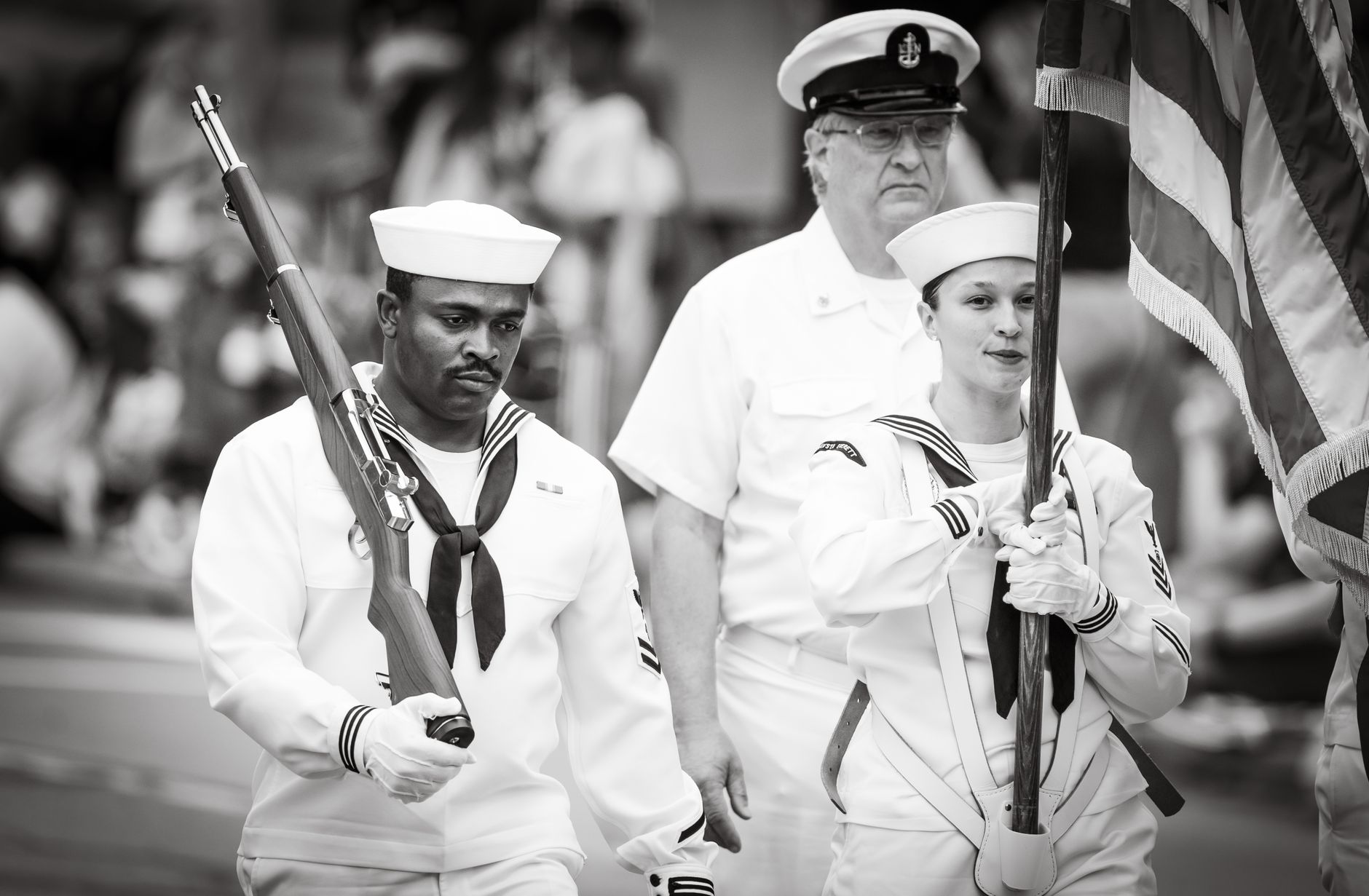
The Sister They Called Disappointing
I want to tell you about the six hours I spent driving through the night before my brother’s Trident ceremony, because that drive is the part nobody at Naval Amphibious Base Coronado ever asked me about. Not my mother. Not my father. Not even Ryan, who I would have driven through worse than a dark interstate to see.
I left Norfolk a little after midnight. I drove through Virginia into North Carolina, then caught a flight out of Raleigh that put me on the ground in San Diego by four in the morning Pacific time, jet lagged, running on gas station coffee and the kind of tired that lives behind your eyes instead of in your legs. I checked into a motel two miles from the base, changed into a black dress I had ironed on a bathroom counter with a travel iron, and made it to the gate by six.
I tell you this not because I need credit for showing up. I tell you this because by the time my mother told a security guard I was “just the disappointing sister,” I had already been awake for over twenty four hours, and I still did not raise my voice.
That was always the part of me my family understood least. Not the silence itself. The discipline behind it.
My name is Emily Carter. I am thirty one years old. And for ten years, my family told themselves a story about who I was that had almost nothing to do with the truth, because the truth was harder to sit with than the lie, and my family has never much cared for hard things.
The Boy Who Got to Be Loved Out Loud
Ryan is two years younger than me. Growing up in Virginia Beach, he was the kind of kid a whole town decided to be proud of before he had done anything to earn it, and then he went and earned it anyway, which made it worse. Football captain. Homecoming king. The boy my father bragged about in hardware stores and church hallways and at every Fourth of July barbecue our extended family ever hosted.
“Ryan is serving his country,” my father would say, chest out, like the sentence tasted good in his mouth.
Then he would look at me, standing a few feet away with a paper plate of potato salad, and add, “Emily is still trying to figure things out.”
I heard some version of that sentence at every family gathering for a decade. Figuring things out. It is what people say when they want to erase you gently, so gently that if you object, you are the one who looks unreasonable.
Here is what I was actually doing while I was “figuring things out.”
I dropped out of James Madison University halfway through my sophomore year, in the fall after my roommate’s older brother came home from Afghanistan and never really came all the way back. I watched what six months in a combat zone did to a person who had been laughing and easy before he left, and something in me that I still cannot fully explain decided I needed to understand that world instead of standing outside it feeling sorry for people in it.
I enlisted in the United States Navy in March, the spring I turned twenty. I did not tell my parents until the paperwork was signed, because I already knew what my father would say, and I did not want to spend my last few weeks as a civilian arguing with him about it.
I was right to expect a fight. What I did not expect was the particular shape of his disappointment. My father did not say he was proud. He did not say he was scared for me, which would have at least been honest. He said, “Ryan already talks about the Navy. Don’t make this a competition, Emily.”
As if wanting to serve my country was something I had stolen from my little brother instead of something I had chosen on my own, for my own reasons, that had nothing to do with him.
I went through boot camp at Great Lakes, and from there I tested into a pipeline most people outside the military have never heard of: Explosive Ordnance Disposal. EOD techs are the ones who walk toward the thing everyone else is trained to run from. We disarm bombs. We clear routes. We work alongside infantry units, Marines, and, more often than most people realize, Naval Special Warfare, because SEAL platoons need someone who can render safe whatever the enemy has buried in the ground in front of them.
EOD training is brutal by design, built to break people who cannot handle sustained fear without losing their hands to steady. I made it through. I was one of four women in my class who did. By twenty five I had made Chief Petty Officer, which in the Navy is not a rank you are handed. It is a rank the enlisted community votes you into, after a board of senior Chiefs decides you have earned the right to wear the anchor.
I never explained any of this to my family, because every time I tried, my father changed the subject to Ryan, and after enough years of that, I stopped trying. I sent birthday cards. I mailed gifts home from wherever I was stationed, sometimes from places I was not permitted to name on a customs form, so the packages arrived with vague country codes and no return address, and my mother turned that mystery into a character flaw. “Emily and her secrets,” she would say to my aunts, laughing a little, like the not knowing was my fault instead of a security requirement written into my contract.
I missed two Christmases, a wedding, my grandmother’s funeral, and every single church cookout my family hosted for the better part of a decade. I was not missing them because I did not care. I was missing them because I was in places where the difference between coming home and not coming home sometimes depended on how steady my hands were at three in the morning with a headlamp and a knife.
The Compound
I am not going to describe the worst day of my career in detail, because some of it is still classified, and because some things do not need every detail to land the way they need to land. But I will tell you enough that you understand what Commander Nathaniel Hayes understood the second he saw my name on a guest list, and what my own family, sitting three feet away from me, never once thought to ask.
Six years ago, I was attached to a Naval Special Warfare platoon on a route clearance and compound assessment mission in a district of Helmand Province I still cannot pronounce out loud without my chest going tight. The platoon breached a mud brick compound that intelligence had flagged as a weapons cache. It was rigged. The first device took out the point man’s leg below the knee. The platoon commander, a young lieutenant junior grade barely two years older than me, pulled him back toward the breach point and stepped on a second device that had been buried under six inches of packed dirt specifically to catch whoever came to help the first casualty.
That is the kind of cruelty war teaches you to expect and never fully stop hating.
The compound’s roof came down in the blast. Two men were trapped under collapsed brick with the secondary device’s dust still hanging in the air, and nobody knew if there was a third device waiting under them.
I went in.
I do not remember deciding to. I remember the weight of my kit, the taste of dust, and the sound of a young officer trying not to scream while I worked a headlamp beam over a wire I could not afford to misread. I got them both out. I took shrapnel across my left forearm and my ribs doing it, which is where the scars my family never had permission to ask about came from, the ones that live under sleeves and cardigans I have worn to every family gathering since, the ones nobody in my family has ever once asked me a real question about, because asking would have required them to imagine me as something other than the disappointing sister.
The young lieutenant junior grade I pulled out that day was Nathaniel Hayes.
He made it home. He kept serving. Six years later, he was a Commander in the United States Navy, standing on a stage at Naval Amphibious Base Coronado, about to place Tridents on the chests of the newest class of Navy SEALs, and somewhere in the guest manifest paperwork that Naval Special Warfare Command runs before any ceremony with that level of security, my name came across a desk, attached to a Silver Star citation with his own name in it.
I did not know any of that would happen when I booked my flight. I did not go to Coronado expecting anyone to recognize me. I went because my little brother was about to become a Navy SEAL, and whatever our family had done to me over the years, I still loved him enough to drive through the night to watch it happen.
The Morning of the Ceremony
The morning smelled like sea salt, warm asphalt, and paper coffee cups going cold under the white event tents. Somewhere behind our row, a little boy waved a small American flag until the plastic handle knocked against a folding chair leg, over and over, a small patient rhythm under everything else.
I found my brother near the staging area before the ceremony started, and for one second, before anyone else got to him, it was just us, the way it used to be when we were kids sharing a bunk bed and he was scared of the dark and I was the one who stayed awake until he fell asleep.
Then he looked at me in my simple black dress, my hair still damp from a motel shower, and he said, “Don’t embarrass me today, Emily.”
I want to be honest about what that line did to me. It did not make me angry. Anger would have been almost a relief, something with heat in it. What it did was hollow me out, quietly, the way cold water does when you stand in it too long without noticing you have gone numb.
So I folded my hands in my lap.
I smiled.
And I stayed quiet.
That was the part of me my family always hated the most. Not when I fought back, because I rarely did. Not when I cried, because I had mostly stopped doing that in front of them years earlier. Not when I left birthdays early or stopped coming to Thanksgiving. They hated it when I went silent, because my silence meant I had already read the room, counted every exit, and decided exactly how much of myself I was going to let them see that day. Silence, to my family, looked like weakness. It has never once been weakness. It is the most controlled thing I do.
At 6:14 that morning, a young security guard at the gate checked my visitor pass against the printed ceremony roster and frowned, because my name was listed under a different column than the rest of the family seating. Before I could explain, my mother stepped in front of me.
“She is just his sister,” she told the guard, touching the pearls at her collar the way she does when she wants to sound gracious while she is doing something small and mean. “Not important. Please don’t let her make this uncomfortable.”
The guard looked at me. Then at his clipboard. Then back at my mother, uncertain.
I could have said something. I had an email from the Naval Special Warfare protocol office folded in my purse with my full name and rank printed in the subject line. I had the number of a Senior Chief I had served two deployments with saved in my phone since 5:42 that morning, a man who had texted me before sunrise to make sure I knew which gate to use, a man who would have walked out to that checkpoint himself if I had called him.
Instead, I said, “This seat is fine,” and I sat down.
Sometimes dignity is not a speech. Sometimes it is keeping your hands folded while people mistake your restraint for surrender.
My cousin Madison turned around in her red sundress, sunglasses pushed up into hair that had clearly seen a blowout that morning, and gave me a smile with an edge sharpened into it.
“Emily, seriously, why are you sitting here? This area’s for immediate family.”
“I am immediate family,” I said.
“I meant supportive immediate family.”
Aunt Patricia laughed softly at that, the kind of laugh that pretends to be an accident. My father did not tell either of them to stop. My mother did not tell them to stop. And Ryan, standing twenty feet away in his dress whites with the gold Trident not yet pinned to his chest, heard every word of it. His jaw stayed tight and his eyes stayed forward, the posture of a man trying to look like discipline instead of complicity. But when Madison said supportive immediate family, the corner of his mouth moved.
Not a smile. Something worse. Agreement.
The stage in front of us held a podium, rows of folding chairs for the graduating class, an American flag standing motionless in the still morning air, and a table draped in velvet holding small wooden cases. Inside each case, a gold Trident pin caught the early California light like a small, private fire. Around us, families shifted in their seats, programs crinkling, coffee lids clicking open, fathers standing a little taller than their posture usually allowed, the whole tent humming with a pride that I understood completely and had simply never once, in ten years, been allowed to receive from my own family.
Then my father leaned across my mother and said, in the low, reasonable voice he uses when he wants an audience to believe he is being kind, “Emily, after this, don’t try to come to the private reception unless Ryan invites you. This is a military crowd. People will ask questions.”
I turned my head slowly. “What questions?”
His smile tightened at the edges. “About what you do. Where you’ve been. Why you never talk about it.”
My mother gave a small, helpless laugh for the benefit of the row behind us. “Honey, today is about Ryan. Don’t make this strange.”
“I drove here for Ryan,” I said.
“No,” Ryan said, from where he stood near the line of candidates, quiet enough to stay under the microphone but loud enough to reach our row. “You drove here so people would notice you.”
I want you to understand what that sentence cost me, coming from him specifically, because it was the same accusation my parents had been making my whole adult life, and hearing it from my little brother, in front of two hundred strangers and everyone who shared my blood, was the closest I came that morning to letting my face show anything at all.
I did not let it show anything.
I looked at my brother in his perfect uniform. At my mother’s hand still resting on her pearls. At my father leaning back in his chair like a man who believed the verdict had already gone his way, because in our family, it always had. For one ugly second I wanted to reach into my purse, take out the folded invitation with the Naval Special Warfare protocol stamp on it, and lay it on my father’s knee so the whole row could read what he had never once cared enough to ask me directly.
I did not.
I smoothed the black fabric over my knees and turned my eyes toward the podium, because some things you do not hand to people who have already decided not to believe you.
The Salute
Commander Hayes had been speaking with a row of Senior Chiefs near the staging area, going over the run of show one last time before the ceremony began. I watched him the way you watch anyone in a position of authority when you have spent your career learning to read a room full of armed men for the smallest change in posture. I saw his gaze move across the family section once, then a second time, no longer scanning. Recognizing.
He said something quiet to the Senior Chief beside him. The Senior Chief looked toward our row, then nodded once.
My mother noticed him first, the way you notice a shift in weather before you can name what changed. Her laugh, the small performing laugh she had been using on the row behind us all morning, disappeared so fast it left her mouth slightly open.
Commander Hayes stepped away from the podium. The line of Senior Chiefs turned with him, a small formation reorganizing around a decision that had already been made. I watched my brother’s face change by the smallest possible amount, a flicker in his jaw, and it was enough. Whatever confidence he had been standing on slipped, the way it does when the ground under a person turns out to be thinner than they assumed.
Every family under that tent watched a United States Navy Commander walk directly toward the woman my mother had just called, out loud, in front of strangers, not important.
He stopped in front of my folding chair. He clicked his heels together, and he raised his right hand to his brow in a full, formal salute, the kind you render to a superior officer or to someone whose service earned it beyond any question of rank.
“Ma’am,” he said, loud enough now for the whole section to hear him, “we’ve been expecting you.”
I stood, because you stand for that, even in a black dress with a motel iron crease still holding along the hem, even with your hands shaking slightly for the first time all morning. I returned the courtesy the way I had been trained to, steady, unhurried, the same discipline I had been using on my own family for the last twenty minutes turned now toward something that finally deserved it.
“Commander,” I said.
He lowered his hand, and for a moment he just looked at me, the way you look at someone you carry with you without ever expecting to see them standing in front of you again in daylight, in California, at a ceremony that had nothing to do with the worst morning of both your lives.
“Chief Carter,” he said, and I heard my mother inhale sharply at the word Chief, a word she had never once used about me, because she had never once asked what I did for a living long enough to learn it. “I did not know Petty Officer Carter’s brother was in this class until I saw your name on the security manifest last night. I have been hoping to shake your hand again for six years.”
He turned, then, toward the rows of families, toward the graduating candidates standing at attention, toward my brother, whose face had gone the color of the white tent canvas above us.
“Some of you may not know this,” Commander Hayes said, his voice carrying easily across the quiet crowd the way a man’s voice carries when two hundred people have suddenly stopped talking to listen, “but the community you are joining today does not exist without people like this woman. Chief Petty Officer Emily Carter is a Navy Explosive Ordnance Disposal technician. Six years ago, in Helmand Province, she went into a collapsed structure under threat of a secondary device to pull two wounded operators out with her own hands. One of them was a young lieutenant junior grade who is standing in front of you today, wearing this uniform, because Chief Carter decided his life was worth more than her own safety. She was awarded the Silver Star for that day. I do not think there is a Trident in that case behind me that would exist without people willing to do what she did.”
I did not look at my parents. I did not need to. I could feel the silence coming off our row like heat off pavement, the particular silence of people realizing, all at once and too late, exactly how much they had gotten wrong.
What the Family Learned That Morning
My mother’s hand had not moved from her pearls. My father’s mouth had opened slightly and stayed that way, the posture of a man rehearsing several different things to say and finding none of them adequate. Aunt Patricia had gone very still. Madison had lowered her sunglasses over her eyes, which I understood, because there are some moments you would rather not be looked at during.
And Ryan. My little brother stood in his dress whites with his Trident still in its case on the table, staring at me like he was seeing me clearly for the first time in a decade, which, in a way, he was.
Commander Hayes did not linger on the moment longer than protocol allowed, because he had a ceremony to run and eighteen other young men and women waiting for the proudest day of their careers, and I would not have wanted him to make it about me even if he had tried. He returned to the podium. The ceremony continued. Names were called. Tridents were lifted from their velvet cases and pinned onto chests by fathers, mothers, spouses, mentors, the traditional honor of placing the pin usually falling to whoever a candidate chooses to represent what got them there.
When they called Ryan’s name, he did not walk toward our father, who had already half risen out of his seat expecting to be the one, the way he had expected to be the center of every proud moment of Ryan’s life since Ryan was six years old scoring his first goal in a rec league game.
Ryan walked toward me.
He stopped in front of my chair, his eyes wet in a way I had never once seen in twenty three years of being his sister, and he said, quiet enough that only our row could hear it, “I didn’t know. Emily, I swear to God, I didn’t know.”
“I know,” I said, because I did know, and because some cruelties come from malice and some come from a family that has spent so long telling itself a comfortable story that nobody thought to ask if the story was true.
“Will you pin it?” he asked. “Would you pin it for me?”
I want to tell you I said yes right away, gracious and easy, the kind of forgiveness that makes a good story tidy. The truth is I hesitated, because ten years of being erased does not undo itself in the space of one salute, and because some part of me wanted him to sit for one more minute in the discomfort of what his family had done. But I looked at my brother, twenty three years old, about to carry a weight most people will never understand, and I thought about the years I had spent learning that dignity means choosing grace even when you are owed an apology first.
I pinned his Trident myself, there on that stage, in front of the commander who owed me his life and the family who had spent a decade acting like I owed them an explanation for mine. My hands were steady. They have always been steady. It is the one thing the Navy trained into me that my family never managed to shake loose.
After
We did not fix ten years in one afternoon. I want to be honest about that too, because the tidy version of this story would have my parents apologizing on the spot, weeping, transformed, and that is not exactly what happened. What happened was quieter and, I think, more real.
My father found me near the coffee table under the tent afterward, holding a cup he had not touched, and he said, “I didn’t know you were Chief. I didn’t know any of it.” Not I am sorry. Not I was wrong. Just the plain, uncomfortable fact of his own ignorance, offered like it might stand in for an apology if I was generous enough to accept it that way.
I told him the truth. “You never asked.”
He did not have an answer for that, and to his credit, he did not try to invent one. He stood there holding his own coffee, an older man in a golf shirt at his son’s Trident ceremony, working through the particular grief of realizing he had spent a decade being proud of the wrong things out loud and dismissing the right things in silence.
My mother apologized three days later, over the phone, in the careful, rehearsed way she apologizes for things, the kind of apology that is really asking to be forgiven more than it is offering anything. I accepted it, because I have found that holding onto every unearned cruelty eventually costs you more than it costs the person who handed it to you. I did not pretend it had not happened. I have simply decided not to let it be the only thing that defines what is left of our family.
Ryan and I talk more now than we have in years. He called me two weeks after the ceremony, late at night, his voice different than I had ever heard it, and asked me to tell him about the compound, about the Silver Star, about all the things he had spent a childhood assuming I was too unimportant to have a story worth hearing. I told him what I could. Some of it will always stay behind a line I am not permitted to cross, and he has learned, finally, not to ask past that line, because he understands now what that silence actually means.
Commander Hayes and I have kept in touch since that morning too, an occasional message on a holiday, the kind of bond that does not need much maintenance because it was built once, permanently, in a collapsed building on the worst day of both our lives. He told me once that he thinks about that morning at Coronado more than he thinks about the day itself, because watching a family finally understand who I was felt, in his words, like watching a debt get paid that had been owed a long time before he ever met me.
I think about the little boy behind our row, the one waving his small flag until the plastic handle kept tapping the chair leg, patient and steady through all of it, through the cruelty and the silence and the salute and everything that came after. I think about how he will grow up not knowing any of our names, not knowing what almost happened under that tent, only knowing that he was there on a beautiful morning in Coronado when something in the air changed.
I know what changed. It was not that a commander saluted me. Commanders do their jobs, and mine happened to intersect with a moment my family could not talk their way around.
What changed was smaller and slower than that, and it happened somewhere between my mother’s hand tightening on her pearls and my brother’s hand shaking as he asked me to pin his Trident. It was the moment my family finally had to sit with the version of me that had been standing in front of them the whole time, steady, quiet, disciplined, and worth more than they had ever once bothered to find out.
I did not need the salute to know my own worth. I had already carried that with me through every deployment, every silence, every holiday I spent alone because showing up cost more than staying away. But I will not pretend it did not feel like something, watching the people who called me disappointing finally understand, all at once, in front of two hundred strangers under a white tent by the sea, exactly who they had been calling that name.
My name is Chief Petty Officer Emily Carter. I kept my family’s secrets long before I ever had to keep the Navy’s. And on the morning my brother earned his Trident, I finally let one of mine see daylight, not because I needed them to know, but because for the first time in ten years, someone finally asked.