The Chest My Stepdaughter Built Me
The delivery driver set the box down on my porch like he was setting down a bag of sand, both arms under it, knees bent, the whole production of a man moving something that did not want to be moved.
“Careful,” he said, straightening up and rubbing his lower back through his brown uniform shirt. “This thing is seriously heavy. Feels like bricks in there.”
I told him I hadn’t ordered anything. He shrugged, said the label had my address plain as day, and asked me to sign the little screen with my finger, which I did, because what else do you do when a stranger hands you a clipboard on a Tuesday morning in April.
He drove off down our gravel road, the truck kicking up a little cloud of dust past the mailbox that still says VINCENT & JEAN HALE in Jean’s handwriting, stenciled onto a wooden board I painted the summer we moved in. I stood there a minute with my hand on the box before I even looked at the label, because something about the weight of it, the way it had settled into the porch boards, made my chest go tight before I understood why.
Then I looked at the return address.
One letter. Just the letter G, no last name, a street address in a town three hours east of here that I did not recognize.
My heart started going like I’d run somewhere. I hadn’t heard that letter attached to anything in five years, three months, and twelve days. I know the number exactly because I have marked every one of those days on the calendar that still hangs in my kitchen, the same kitchen where a girl I raised from the age of four told me I didn’t matter and meant it.
I dragged the box inside, set it on the kitchen table, and stood over it for what felt like a long time. I thought about all the things it could be. I thought Grace was finally sending back every birthday present, every graduation card, every stuffed animal I’d bought her when she was small enough to still want one, mailing my whole fatherhood back to me in a cardboard coffin so she wouldn’t have to look at it in her own house anymore. I braced for that. I told myself I could take it.
There was no packing tape holding anything neat, no foam peanuts, no bubble wrap, nothing you’d expect from something ordered off a website. Just a thick canvas moving blanket, the kind movers use to wrap furniture, cinched tight with rope in a crosshatch pattern like whoever packed it had done it with their whole body, leaning into the knots.
I cut the rope with my pocketknife and folded back the blanket, and the smell hit me before my eyes had even made sense of the shape underneath it. Sharp. Clean. Unmistakable. The smell of freshly cut cedar, so strong it filled the whole kitchen in a single breath, and underneath that smell was something else, something that made my stomach drop before I understood what I was looking at.
My knees actually gave out. I had to grab the back of a kitchen chair to keep from going down onto the linoleum.
And when I finally got the blanket all the way off and saw what my stepdaughter had sent me, the air left my lungs completely, and I stood in my kitchen and cried like I had not cried since the day we buried her mother.
The girl I raised
To understand why a cedar box could bring a grown man to his knees, you have to go back to a spring afternoon almost twenty years before that delivery truck ever found our road.
I met Jean Kowalski at a fish fry the Millhaven Volunteer Fire Department threw every year on the second Saturday of May, the kind of small-town event where half the county shows up because there’s nothing better to do and the fish is always good. She was standing at a folding table selling raffle tickets for the new engine fund, and she had a four-year-old on her hip who kept trying to grab the whole roll of tickets out of the cash box.
That four-year-old was Grace.
Jean’s first husband had left when Grace was barely walking, gone west for work and never really come back, not even for holidays after the first couple of years. Jean was raising her alone on a receptionist’s wage at the county clerk’s office and whatever she could pick up doing books for the feed store on weekends. I was thirty-one, divorced myself with no kids of my own, working as a diesel mechanic at the co-op, and I bought forty dollars worth of raffle tickets I did not need just so I could keep talking to her.
We were married the following spring in the same little Lutheran church where Jean had been baptized, out past the county road where the corn comes right up to the parking lot. I never formally adopted Grace. Her father was still alive somewhere in Wyoming, still cashing the occasional child support check the state garnished from wages nobody could quite verify, and Jean always said we’d handle the paperwork someday, and someday kept getting pushed back the way it does when a marriage feels solid enough that paper seems beside the point.
But paper never had anything to do with what I was to that girl.
I taught her to ride a bike in the church parking lot, running alongside her with my hand under the seat until my back gave out and I finally just let go and watched her wobble away from me down the asphalt, screaming with laughter, not even realizing I’d let go. I taught her to tie her shoes with the two-loop method because the bunny-ears method never stuck for her. I sat through nine years of school plays, and I mean sat through, folding chairs in gymnasiums that smelled like floor wax, watching her play a tree in third grade and a lady-in-waiting in the sixth-grade Shakespeare unit and, in her junior year, a truly wonderful Emily in Our Town that had me wiping my eyes in a way I blamed on gymnasium dust when other parents asked.
I scared off exactly one prom date, a boy named Cody Reyes who showed up forty minutes late smelling like he’d pre-gamed the evening in somebody’s truck, and I stood in our doorway with my arms crossed and did not say a word, just looked at him, and Grace was furious with me for a week and then admitted two weeks later that she was glad I’d looked at him like that because Cody Reyes turned out to be exactly the kind of trouble I’d pegged him for.
I was, in every way that a kitchen table and a driveway basketball hoop and a hospital waiting room can measure, that girl’s father. She called me Dad from the time she was maybe six years old, somewhere around when she stopped remembering to ask where her other dad was. It came out of her mouth so easy and so often that I stopped noticing it as a gift, the way you stop noticing your own heartbeat, until the day it was taken back.
The morning everything ended
Jean died on a Tuesday in October, eleven days before Grace’s eighteenth birthday.
There was no warning. She’d complained of a headache the night before, the kind you take two aspirin for and go to bed, and in the morning I found her on the bathroom floor and nothing I did, nothing the paramedics did, nothing the doctors at the regional hospital did, brought her back. An aneurysm, they told me. Sudden. Nothing anyone could have caught. The kind of death that doesn’t give you the mercy of bracing for it.
Grace was a senior in high school, eighteen years old in eleven days, and she lost her mother on a Tuesday morning with no warning at all, and I watched that girl come apart in a way I had no tools to fix. I had lost a wife. She had lost the only parent who had never once left her, and that is a different kind of falling, one with no floor under it at all.
We limped through that year together, or I thought we were limping through it together. I cooked dinners neither of us ate. I sat outside her door some nights when I heard her crying and didn’t know whether going in would help or make it worse, so mostly I just sat there on the hallway floor with my back against the wall until the crying stopped and I could go to bed knowing at least she’d fallen asleep. I went to her graduation in May and clapped until my hands hurt when they called her name, and she came down off that stage and hugged me hard, and for one whole hour I thought we were going to be all right.
Grief does not move in straight lines, though. It comes back around when you least expect it, and it needs somewhere to land, and eight months after we buried Jean, it landed on me.
It started with the closet.
Jean’s clothes had hung untouched in our bedroom closet since the morning I found her, her cardigans and her church dresses and the flannel shirt she wore around the house on Saturdays, still holding the shape of her shoulders on the hangers, still faintly carrying her perfume if you leaned in close enough, which I had done more than once, alone, at two in the morning, when the house got too quiet.
That spring, the Padgett family, who lived out on County Road 9 with three kids under ten, lost their whole house to an electrical fire that started in the garage. Nobody was hurt, thank God, but they lost everything, every stitch of clothing, every photograph, every winter coat, in the space of one bad hour. The church took up a collection. Neighbors dropped off casseroles and hand-me-downs. And I looked at that closet full of Jean’s things, hanging there unworn and unusable to anyone, and I thought about a woman who spent her whole life giving things away to people who needed them more, who used to drop off bags of outgrown clothes to the church clothing closet every single spring without fail, and I made a decision I believed with my whole heart she would have wanted me to make.
I boxed up Jean’s clothes and drove them to the church, and the pastor’s wife made sure they got where they were needed, and half of them ended up warming the Padgett kids that next winter.
Grace came home from her friend’s house that Saturday and went looking for her mother’s blue cardigan, the one she said still smelled like her, the one she used to wear around the house sometimes when the grief got bad and she needed something with her mother’s scent on it, and she found an empty closet.
I will hear the sound she made for the rest of my life.
“Where are Mom’s clothes?” she asked me, standing in the kitchen doorway, and I could see it happening in her face, the exact moment the floor dropped out from under her again.
I told her. I told her about the Padgetts, about the fire, about believing Jean would have wanted her things used and not stored away to rot on hangers. I thought, God help me, that I was explaining something reasonable.
“You had NO RIGHT!” she screamed at me, and I had never in eighteen years heard that girl scream like that, not once.
“Grace, please,” I said, my hands up, trying to slow the whole thing down. “Your mom would’ve wanted to help. We can’t stay stuck in the past.”
“We?” she snapped, and her voice cracked on the word like something breaking clean in half. “There is no ‘we,’ Vincent. You’re not my father. You were just her husband. She’s gone now, so YOU DON’T MATTER.”
She had never once called me Vincent. Not in fourteen years. It landed harder than anything else in that sentence, harder even than the rest of it, because it told me exactly how far away from me she had already gone in her own head before she ever said the words out loud.
She grabbed her bag off the kitchen chair and walked out the door, and I let her go because I thought she needed a night to cool off at her friend’s house, the way eighteen-year-olds do.
That was the last time I saw her for five years.
The long quiet
I want to tell you I handled the next five years with some kind of grace, no pun intended, but mostly I handled them the way a man handles a wound he can’t stop touching.
I called her the next day. No answer. I called the day after that. No answer. I left messages that got shorter and more careful each time, because I didn’t want to say the wrong thing and push whatever door was still open a little further shut. Within a month her number had been changed or blocked, I never knew which, because the calls started going straight to a voicemail box that was full and not accepting new messages.
I wrote letters. Actual letters, on paper, because I thought maybe something slower and more deliberate than a phone call might get past whatever wall she’d built. I wrote to her at the address I had for her college dorm, and later at an apartment address a mutual friend from church quietly passed along to me without telling Grace she’d done it. I don’t know if any of those letters were opened. I never got one returned to sender, which I chose to take as a small mercy, a sign that at least they were landing somewhere, even if nothing came back.
I sent emails on her birthday every year. I sent one on the anniversary of Jean’s death, not to reopen the wound but because I thought maybe grief shared, even one-directionally, was better than grief carried alone. I never once got a reply.
Millhaven is a small town, the kind where everybody’s business travels whether you want it to or not, and over those five years I picked up fragments of Grace’s life the way you pick up static off a radio station just out of range. She’d gone to college two hours from here on a partial scholarship. She’d graduated. She was working somewhere in social services, somebody said, helping families in crisis, which struck me even then as its own kind of quiet irony, a girl who couldn’t forgive the family she had helping strangers hold theirs together. Pastor Nowak ran into her at a wedding once, two counties over, and said she looked well, said she asked to be remembered to me, which was the single warmest scrap of information I got in half a decade and I turned it over in my mind for weeks like a coin.
I kept the house exactly as it was. I still slept on my side of the bed, out of habit more than anything, leaving Jean’s side made up the way she liked it, pillows fluffed, corner folded down. I kept a photo of the three of us, taken at Grace’s eighth-grade graduation, on the mantel where it had always sat. I went to church every Sunday and sat in the same pew, third from the back on the left, because Jean liked being close enough to the door to slip out if a baby started crying during the sermon, and old habits don’t know their reasons died with the person who had them.
Friends tried to get me to move on from the whole thing in different ways. My buddy Earl, who I’ve known since diesel mechanic school and who now runs the parts counter at the co-op, kept telling me to let it go, that kids find their way back when they’re ready and pushing only pushes them further. My sister in Ohio told me I should sell the house, that living in a museum to two people who weren’t speaking to me anymore, one because she couldn’t and one because she wouldn’t, was its own kind of slow death. I understood what they were saying. I didn’t do any of it. I marked the days on the calendar instead, a small tally mark in pencil in the corner of every Sunday square, and I told myself that as long as I was still counting, I hadn’t given up, and as long as I hadn’t given up, some part of the door was still propped open on my end even if I couldn’t see her side of it.
Some nights the loneliness in that house was a physical thing, a weight sitting on my chest when I woke up at three in the morning in a bed built for two people, in a house built for a family of three, with one framed school play program in a drawer for every year that had ever gone right and one silent phone for every year that had gone wrong since.
I want to be honest about something. There were nights I was angry at Grace, angry in the ugly, unfair way grief lets you be angry at people you love. I would think, she lost her mother, but I lost my wife and then I lost my daughter in the same year, and nobody sent casseroles for that second loss because nobody even knew it had happened. But the anger never lasted. It always burned down to the same coal at the bottom, which was just missing her, plain and simple, missing the sound of her key in the door after school, missing arguing with her about curfew, missing being somebody’s dad.
Five years, three months, and twelve days. That is a long time to keep a light on in a window nobody’s driving toward.
The box on the porch
Which brings me back to that Tuesday morning in April, standing in my kitchen with a canvas moving blanket in my hands and the smell of fresh-cut cedar filling every corner of the room.
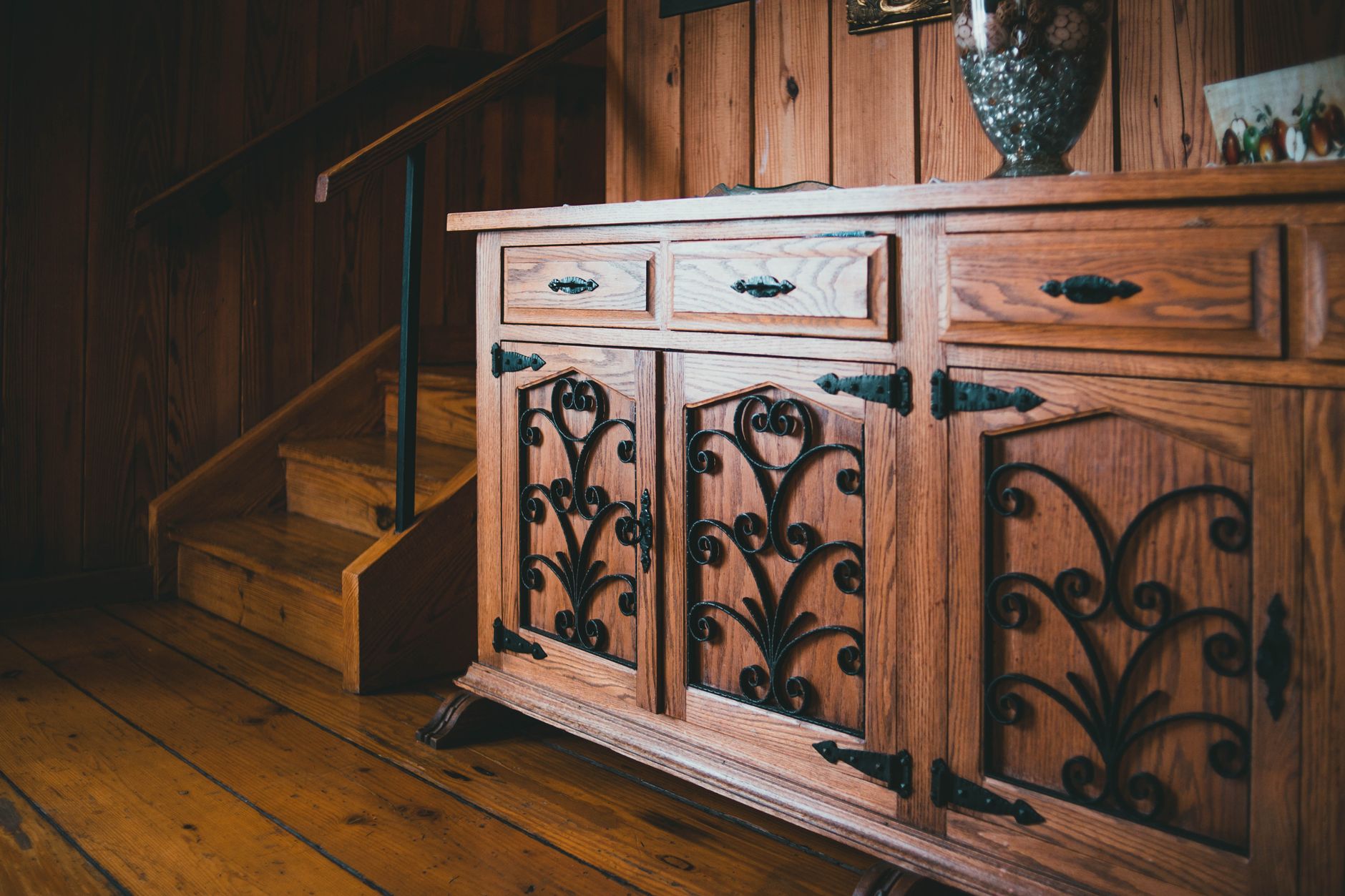
What I was looking at, once my eyes finally made sense of the shape, was a chest. Not a modern one bought off a shelf somewhere, but something built, hand-built, with dovetail joints at the corners cut clean and tight the way you only get from someone who took real time with it, and a lid that had been hinged with proper brass hardware, the kind that costs real money and gets ordered special. The wood was cedar through and through, pale gold with those darker streaks running through it, sanded smooth and finished with something that gave it a soft glow instead of a hard shine, the kind of finish that says somebody rubbed this by hand instead of spraying it out of a can.
Carved into the lid, in letters maybe four inches tall, cut deep enough that I could feel the grooves with my fingers before I could even read them clearly through the tears, was one word.
JEAN.
Underneath it, smaller, a line I recognized instantly because it was the same line printed in the church bulletin the day we buried her, a verse from Proverbs that Jean’s own mother had loved and passed down to her: SHE IS CLOTHED WITH STRENGTH AND DIGNITY, AND SHE LAUGHS WITHOUT FEAR OF THE FUTURE.
I stood there with both hands flat on that lid for a long time before I could make myself open it, because some part of me understood already that whatever was inside was going to finish breaking me open in a way five years of silence had not managed to do.
When I finally lifted the lid, the cedar smell rose up even stronger, and resting right on top, wrapped in tissue paper gone soft from handling, was a stack of envelopes tied together with kitchen twine. My handwriting was on every single one of them. Every letter I had written to Grace over five years was in that chest, and every single one had been opened.
Under the letters was a manila folder, and inside the folder were printouts of every email I had sent, birthday messages and anniversary messages going back years, each one printed out on paper like she had wanted to be able to hold them instead of just seeing pixels on a screen.
Under the folder, wrapped in a soft cloth, was Jean’s blue cardigan.
I sat down hard on my kitchen chair when I found that cardigan, because I had not seen it in five years and had believed, in the honest, aching way you believe things you’ve made peace with, that it had gone to the Padgett family and been worn out and thrown away years ago, one more small piece of Jean scattered into the world and lost to time the way everything eventually is.
And at the very bottom of the chest, folded in thirds, was a letter in Grace’s handwriting, four pages long, and I read it standing at my own kitchen counter with my hands shaking so badly I had to set it down twice to steady myself.
What Grace had spent five years building
Here is what that letter told me, and what Grace filled in for me over the phone two days later in a call that lasted three hours and left both of us wrung out and laughing and crying in the same breath, sometimes in the same minute.
Grace had not spent those five years hating me. She had spent them running from a version of herself she was ashamed of, the eighteen-year-old who had said something so cruel to the only father she’d ever known that she honestly believed, in the way grief lies to you, that she had burned the bridge down too completely to ever walk back across it. Every year the silence went on, the guilt got heavier, and the heavier it got, the harder it became to pick up a phone and say the first word, because what do you even say after five years of nothing.
She had started therapy in her second year of college, not because of anything to do with me directly but because the grief over her mother had turned into something she couldn’t function around anymore, panic in grocery stores, insomnia that wouldn’t break. Her therapist, over months and then years, kept circling back to the same question: what happened with your father. Grace corrected her every time. Stepfather. And her therapist, she told me, eventually stopped letting that correction slide, asked her outright what the difference was supposed to be between a man who taught you to ride a bike and a man who happened to share your blood, and Grace said that question sat in her chest for the better part of a year before she could answer it honestly, even to herself.
The turn, the real one, came almost by accident. In her work with families in crisis, Grace ended up on a case involving a family that had lost their home in a fire out past County Road 9, the very same Padgett family whose need had started the whole disaster in the first place, though it took her a while to make the connection, because by then they’d moved two towns over and their name had slipped out of her memory the way names do when you’re eighteen and furious and not really listening to the details.
The Padgetts’ oldest boy, Dale, had been eleven when the fire took their house. He was twenty-three now, working construction and teaching himself fine woodworking on the side, the kind of quiet, careful trade a kid picks up when he’s spent his life rebuilding things that got taken from him too young. When Grace realized who this family was, she sat with Dale’s mother, Connie, in their new kitchen and told her, for the first time out loud to anyone, the whole story of the closet and the fight and the five years of silence that came after.
Connie Padgett cried when she heard it. She told Grace that the winter after the fire, when her kids had nothing, a box of a stranger’s clothes had shown up through the church, and among those clothes was a woman’s blue cardigan that little Dale, only eleven and grieving his own house and his own sense of safety, had claimed and worn nearly every day that whole cold season because it was soft and it smelled like somebody’s grandmother and it made him feel, in some small unexplainable way, less alone. Connie had kept that cardigan in a cedar box in their front hall closet for over a decade, unable to let it go, because it had meant that much to her son during the worst winter of his life.
When Connie learned the cardigan had belonged to the mother of the girl now sitting across her kitchen table, she went and got it without a word and put it directly into Grace’s hands.
Dale, hearing the whole story secondhand from his mother that same week, offered to build something. He’d been doing small custom furniture jobs on weekends, and he told Grace it felt like the least he could do for a family whose kindness, given at the worst possible moment for both households, had somehow reached forward through eleven years and touched his life more than he’d ever properly said thank you for. He built the chest from cedar he’d milled himself, cut the letters by hand, sanded and finished every inch of it over the better part of two months, working most nights after his regular job.
Grace spent that same stretch of time writing me the letter that sat at the bottom of that chest, tearing up more drafts than she could count, she told me, because every version came out either too angry at herself or too careful, and she wanted, finally, after five years of silence, to get it exactly right.
What the letter said
I am not going to put every word of that letter on this page, because some things belong only to the two of us. But I will tell you the heart of it, because I think it matters to anyone who has ever been on either side of a silence like ours.
She wrote that she had been wrong, plainly and without excuse, to say I wasn’t her father. She wrote that grief had handed her a knife that day and she had used it on the one person who had never once given her a reason to expect the blade, and that the shame of that had kept her away far longer than the actual hurt ever could have, because forgiving herself turned out to be so much harder than she’d ever imagined forgiving me would need to be.
She wrote that somewhere in the last year, sitting in Connie Padgett’s kitchen listening to a stranger describe a stranger’s cardigan keeping her son warm through the worst winter of his childhood, she finally understood what I had been trying to tell her in our kitchen five years earlier and had been too broken to hear. That her mother’s things, given away, had not disappeared. They had gone on doing exactly what Jean would have wanted them to do, which was to take care of somebody who needed taking care of, and that nothing about that had erased Jean or erased Grace’s right to grieve her. It had only proven, in a roundabout way that took five years and three towns to arrive, that I had been right to trust my late wife’s heart even in the hardest week of my own grief.
And she wrote that she wanted to come home, if home was still something I was willing to let her call this house.
What happened after I read it
I called the number written under her signature with my hands still shaking, and she picked up on the second ring like she’d been sitting with the phone in her hand.
“Dad,” she said, before I’d even gotten a full word out, and I had to sit down on the kitchen floor with my back against the cabinets because my legs would not hold me through hearing that word again after five years, three months, and twelve days of its absence.
We talked for three hours that first call. We cried more than we talked, honestly, the two of us just breathing into the phone sometimes, letting the silence be a comfortable one for once instead of the kind that had swallowed half a decade. She told me about the therapy, about Connie and Dale Padgett, about the chest, about how she’d stood in Dale’s workshop the day he finished it and cried so hard he’d had to get her a glass of water and sit with her on an overturned bucket until she could breathe right again.
She drove out to Millhaven that Saturday. I watched her car come up the gravel road from the kitchen window, the same window I’d watched a delivery truck kick up dust from four days earlier, and I was standing on the porch before she’d even gotten the car in park, and she came up those porch steps two at a time the way she used to when she was twelve years old and late for dinner, and I caught her the same way I always had, both arms, no hesitation, five years of silence closing up in about four seconds flat.
We sat on that porch until the sun went down, not saying much of anything else that mattered more than just being in each other’s company again. Later that night, we set the cedar chest on the low table under the window in the living room, the same spot where a boombox used to sit playing her school dance mix tapes twenty years ago, and Grace laid her mother’s blue cardigan on top of it, folded neat, and neither one of us said anything for a while because nothing needed saying.
Grace has been back in Millhaven every other weekend since, and she is talking about transferring her caseload to the regional office forty minutes from here so she can come home more than that. Last month she asked, half joking and half not, whether the paperwork on the adoption Jean and I always meant to finish and never got around to could still technically happen, since she was of age now and it would just be a formality, a piece of paper catching up to something that had been true her whole childhood. I told her the paperwork had never once been the thing standing between us in the first place, but that I would go to the county courthouse with her the very next Monday if that was something she wanted, and she said it was.
We drove out to the Padgetts’ place together two weekends ago, the whole rebuilt house sitting solid and square on the same lot where the fire took the old one, and I shook Dale’s hand and could not get a single word out for the better part of a minute, which he seemed to understand completely, because he just nodded and gripped my hand a little harder and said the chest had been the easiest thing he’d ever built because his heart had already known exactly what it was for.
The calendar still hangs in my kitchen. I still mark the Sundays, but the tally has changed its meaning entirely. It isn’t counting the days since I lost her anymore. It’s counting the weeks since I got her back, and every single mark on that calendar now is a mark I am glad to make.
Jean always said grief and love live in the same room of the heart and you can’t wall one off from the other, not really, not for long. I didn’t understand what she meant until a cedar chest built by a boy she never met, out of gratitude for a cardigan she’d never expected to matter, brought my daughter home to me. Some kindnesses take eleven years to circle back around. Some silences take five. But if you leave the light on long enough, and if the people on the other side of it are still, underneath everything, trying to find their way back to you, it turns out the door was never really shut. It was just waiting for both of you to be ready to walk through it at the same time.