The Captain Who Exposed The Forgery
The first thing I noticed wasn’t the heat or the cicadas buzzing through the Virginia afternoon. It was the garage. Wide open. Empty.
I stood at the edge of my parents’ driveway in Millbrook, a speck of a town off Route 11 in the Shenandoah Valley where the feed store still runs a chalkboard sign and everybody waves at everybody whether they know them or not. My duffel bag dug into my shoulder, still dusty from three connecting flights and a layover in Kuwait that felt longer than the deployment itself. The lawn sprinkler clicked lazily back and forth across the grass like nothing in the world had changed. The porch swing creaked in the breeze. Somewhere down the road a tractor idled at the Hendersons’ place, and a dog barked twice and gave up.
Everything looked exactly the same. Except for the one thing that mattered.
No flash of chrome. No bright rally red paint catching the sun. No low, aggressive silhouette that had lived in my imagination through two deployments, through a hundred nights on a cot listening to generators hum, through every dollar of combat pay I mailed home instead of spending on anything for myself. Just bare concrete and dark oil stains, and a rectangle of pale, untouched floor where seven years of my life used to sit.
It’s strange how you can train your whole adult life to face chaos. Gunfire. Explosions. The particular unpredictability of a convoy route that changes every single day because the enemy is paying attention too. And still be completely unprepared for a quiet betrayal delivered over a cup of tea in your mother’s kitchen.
My name is Emily Carter. I’m thirty years old, and I serve as a Captain in the United States Army. And standing there in that empty garage with my hand still on the strap of my duffel bag, I understood something I had never wanted to admit out loud.
The hardest battles aren’t always fought overseas. Sometimes they’re waiting for you at home, sitting at the kitchen table, stirring a cup of tea like it’s just another Tuesday.
The garage that raised me
I stepped inside. The air was cooler in there, heavy with the smell of gasoline and old tools and dust, the smell that had meant possibility to me since I was nine years old and my grandfather Walt first popped the hood of a rusted-out 1969 Corvette Stingray he’d bought for scrap money at an estate sale two counties over.
Grandpa Walt didn’t have much. He’d farmed tobacco most of his life and then watched the bottom fall out of that, and by the time I came along he was living in a single-wide behind my parents’ place, fixing small engines for pocket money and keeping bees he swore made the best honey in Rockingham County. But he had that Corvette, up on blocks in a lean-to behind the trailer, and on Saturday afternoons he’d let me sit in the driver’s seat and put my hands on the wheel while he worked underneath it, telling me what every sound meant.
“This car doesn’t owe anybody anything,” he used to say. “It just needs somebody who won’t quit on it.”
He died when I was seventeen, the winter before I left for basic. He left the Corvette to me in a will so short the lawyer read it out loud in about ninety seconds. Everything else he had, which wasn’t much, he split between my parents and my brother Andrew. The car was mine, and mine alone, on paper, with a title I registered in my own name the summer before I shipped out the first time, because Grandpa Walt had drilled one thing into me above everything else about that car.
“Put your name on it, Emmy. Just yours. A thing this important, you don’t want anybody deciding it’s theirs to give away.”
I didn’t understand at seventeen why an old man who trusted his own son and daughter-in-law with his bees and his tools would tell his granddaughter to lock down a car title like it was a war plan. I understood it seven years later, standing in an empty garage with cicadas screaming outside.
That Corvette sat untouched under a canvas cover for most of my first two deployments, because there wasn’t time or money to do more than keep the battery tender on it and change the oil once a year when I was home on leave. But I dreamed about it the way some soldiers dream about a beach or a bed that isn’t a cot. Every dollar I could spare from my pay, I mailed home in an envelope addressed to my father with two words written on the memo line of the check: Corvette fund. New carburetor. Rebuilt transmission. A rally red paint job that cost more than my first car ever had, done by a shop outside Harrisonburg that specialized in matching-numbers restorations. My father handled the money because I was eight thousand miles away and he had the accounts and the garage and, I believed then, my best interests.
Seven years. Two combat tours and a training rotation that felt like a third. Missed Christmases. A missed wedding for my best friend from basic. A missed funeral for an aunt I loved, because leave doesn’t come when grief does, it comes when the Army says it does. Every one of those absences, I told myself, was buying something. Not just a car. A promise to myself that when I finally came home for good, there would be one thing waiting for me that was entirely, unquestionably mine.
The kitchen
I dropped my duffel bag by the workbench and walked into the house. Sunlight spilled across the kitchen counter. A bowl of peaches sat by the sink, and the refrigerator hummed its familiar hum, the one appliance sound that has meant home to me since I was a kid. My mother, Carol, sat at the table with a cup of tea. My father, Richard, stood at the counter slicing squash from what was probably the Hendersons’ garden, because ours never grew much of anything past July.
Neither of them looked surprised to see me. Neither of them said welcome home.
I heard my own voice before I fully decided to speak. “Where’s the car?”
My mother stirred her tea slowly, like she had all the time in the world and none of my seven years had cost her a single minute of sleep. “Oh,” she said, almost bored. “That.”
My father’s knife paused briefly against the cutting board, then kept going.
My mother finally looked up at me. Her expression was calm. Almost satisfied, the way a person looks when they’ve decided in advance that they’re right and are simply waiting for the world to catch up to them.
“Thanks to your car,” she said, “your brother finally got the trip of his life.”
I stood there in my travel clothes, still smelling like airplane, and asked the only question that made any sense to me. “What trip?”
That’s when she told me, piece by piece, like she was describing a nice thing she’d done. Andrew had been talking for years about chartering a yacht out of the Chesapeake with a few of his college buddies, the kind of trip that costs more than most people in Millbrook make in three months. He didn’t have the money. He never had the money, not because he couldn’t earn it, but because Andrew had never once in his twenty-six years had to earn anything he badly wanted. My parents had covered his community college tuition twice, after he dropped out the first time. They’d covered a truck loan he defaulted on. They’d covered, quietly, an apartment deposit after he lost a job for showing up late one too many times. And now, apparently, they’d covered a yacht trip too, with the one asset in that garage that wasn’t theirs to spend.
“Well, thanks to your car,” my mother said again, cheerful as a church bulletin, “Andrew finally got the trip he always wanted.”
My father didn’t even look up from the cutting board. He shrugged, the way you’d shrug off a decision about which brand of coffee to buy.
“You’re a soldier, Emily,” he said. “You’ll earn another one. Andrew only gets to be young once.”
I want to tell you I said something sharp and perfect in that moment, the kind of line you replay in your head for years because it landed exactly right. I didn’t. I stood there with my duffel bag strap cutting into my shoulder and said nothing at all, because there is a particular kind of shock that doesn’t produce words. It produces silence, and a ringing in your ears, and the sudden, sickening understanding that the people who raised you have been keeping a ledger the whole time, and you were never on the side of it that mattered.
I went up to my old room that night. Later, scrolling through my phone because I couldn’t sleep, I found Andrew’s posts. Champagne glasses catching sunset light. A yacht deck, teak and chrome. A caption that read living the dream, my brother’s arm around a woman I didn’t recognize, both of them laughing at something outside the frame. I sat on the edge of my childhood bed and looked at photographs funded by seven years of my life, and I felt something in my chest go very quiet and very cold, the way it does right before you stop being sad and start being methodical.
That was when my phone rang.
Peter Wallace
I almost didn’t answer. It was a Virginia number I didn’t recognize, area code from down toward Roanoke. But something in me, maybe the part of me that spends most of its career trained to pay attention to things that don’t add up, made me pick up.
“Hello, is this Emily Carter?”
“Speaking.”
“My name is Peter Wallace. I recently bought a Corvette from your parents.”
My stomach tightened so fast I actually put a hand flat on the mattress to steady myself.
“But there’s an issue with the paperwork,” he continued, and his voice had the careful, measured tone of a man who deals in cars and titles for a living and knows exactly when something smells wrong. “I run a small shop out near Salem, mostly restorations. I bought your parents’ ’69 Stingray two days ago. Paid cash, fair price, everything looked clean on the surface. But when my title clerk ran the VIN this morning to process the transfer, the registered owner that came back wasn’t Richard Carter or Carol Carter. It was you.”
I asked how he even had my number.
“From the bill of sale,” he said. “Your signature is on it, as the seller of record, alongside a notary stamp. I called the number listed next to the signature line, figured it was the fastest way to clear this up before I finish the paperwork on my end.”
Then he hesitated, and I could hear him breathing on the other end of the line, the way people do right before they say something they know is going to land like a blow.
“But there’s an issue,” he said again, quieter this time. “Or at least… it’s supposed to be.”
I asked him what he meant. What was supposed to be my signature.
“Ma’am,” he said, and I could hear him choosing every word like it might matter later, which it would, “I’ve been doing this a long time. I’ve seen a lot of bills of sale. This signature doesn’t match anything on file for you at the DMV. I pulled your license record before I called, because frankly, something about the whole transaction felt off to me the second your father wouldn’t look me in the eye at the handoff. The C in Carter loops the wrong way. The pressure’s wrong. Whoever signed this either isn’t you, or is doing a very poor job of pretending to be.”
I sat there in the dark of my childhood bedroom, thirty years old, a captain who had briefed colonels and led soldiers through some of the worst nights of their lives, and I felt exactly as small and as furious as I had at seventeen, the day I finally understood why my grandfather told me to put my own name on that title.
“Mr. Wallace,” I said, “I never signed anything. I’ve been deployed. I didn’t know the car was gone until I walked into an empty garage four hours ago.”
The silence on his end lasted a long time.
“Then we’ve got a real problem,” he finally said. “Because what I’m holding right now is a forged bill of sale, and I just paid twenty-eight thousand dollars for a stolen car.”
What forgery actually costs
I didn’t sleep that night. I sat at the little desk in my old room with my laptop open and did what seven years in the Army had trained me to do when the ground shifts under you: I gathered facts before I let myself feel anything.
I called the Virginia DMV’s title fraud line first thing the next morning and confirmed what Peter Wallace already suspected. The Corvette had been titled solely in my name since I was eighteen, exactly as my grandfather had insisted. My parents had no legal authority to sell it, none, not as co-owners, not as my agent, not under any theory that would hold up for thirty seconds in front of a magistrate. Someone had signed my name on a bill of sale and taken it to a notary who either failed to verify identification properly or, worse, was a favor from someone my father knew. Either way, it was forgery, and in the Commonwealth of Virginia, forgery of a legal document tied to a sale of that size isn’t a slap on the wrist. It’s a felony.
I drove out to Peter Wallace’s shop that afternoon in the beat-up Civic I’d left at my parents’ place before my last deployment. His shop sat on a gravel lot off Route 419, a low steel building with three restorations in various states of undress inside and a coon dog asleep in a patch of sun by the office door. Peter turned out to be a broad-shouldered man in his fifties with grease permanently worked into the creases of his hands and a faded Army combat patch, 3rd Infantry Division, stitched onto an old ballcap hanging by the register. He’d served two tours himself, a long time ago, before he came home and built this place one engine at a time.
When I told him I was still active duty, a captain, and that I’d bought the very transmission under that hood with combat pay, something in his face changed. He walked me back to the bay where the Corvette sat, and for a second I couldn’t breathe. There it was. Rally red, exactly the shade I’d approved from a paint chip mailed to me at a forward operating base three years earlier. My car. My grandfather’s car. Sitting in a stranger’s shop because my own parents had signed my name to something I never wrote.
“I want you to know,” Peter said, standing beside me with his arms crossed, not touching the car, giving me the space to look at it without an audience, “I had no idea. Your father told me you’d joined the Army and didn’t want the hassle of a car back home, said you’d asked him to handle the sale for you while you were overseas. I’ve bought cars from a lot of families over the years. I didn’t have a reason to doubt him.”
“You’re not the villain in this,” I told him, and I meant it. “You’re the second victim.”
He nodded slowly, jaw tight. “Then let’s fix it right. Because I’ve got a wife who’d skin me alive if she found out I kept a car I knew was taken from a soldier’s family through a forged signature. That’s not the kind of shop I run.”
We agreed on the spot, no lawyers yet, just two people who understood what honest dealing looked like, that the car would stay parked in his shop, untouched, until I decided how I wanted to handle the legal side. He wasn’t going anywhere with it, and he wasn’t going to fight me for it. He wanted his twenty-eight thousand dollars back from whoever had actually taken it, and he wanted nothing to do with a title built on a lie.
That was the moment the shape of what I was going to do started to come clear in my head. Not the shape of revenge. The shape of accountability, which is a colder, steadier thing, and in my experience, a lot more effective.
Talking to someone who knew the law
I called my friend Dana Okafor that night, a JAG officer I’d served alongside at Fort Belvoir two assignments back, now stationed at the Pentagon but still willing to take a call from a friend at ten at night. I laid it all out: the title, the forged signature, the notary, the twenty-eight thousand dollars, my brother’s yacht photos still sitting open in a browser tab on my laptop like evidence I couldn’t stop looking at.
Dana was quiet for a second when I finished. Then she said something I’ve held onto since. “Emily, you don’t have to decide tonight whether you want your parents in handcuffs. What you have to decide tonight is whether you’re going to let this go unaddressed because they’re your parents, or whether you’re going to treat it exactly the way you’d treat any other case of someone stealing from a fellow soldier. Because that’s what this is. It doesn’t stop being a crime because of who committed it.”
She walked me through my options. I could go straight to the county sheriff’s office and file a criminal complaint for forgery and uttering, which in Virginia carries real weight, up to ten years depending on how a prosecutor chose to charge it. I could pursue it civilly, suing for the value of the property and damages. Or I could do what she called the harder thing: confront it directly, lay out the evidence, and give my parents one chance to make it right before I decided how far to take it. She reminded me that the Servicemembers Civil Relief Act exists precisely to protect deployed service members from exactly this kind of exploitation of their absence, financial decisions made about their property while they’re overseas and unable to defend it. What had been done to me wasn’t just a family betrayal. It was the specific kind of thing that law was written to stop.
“Whatever you choose,” Dana said, “document everything. The call log with Wallace. The DMV title record. Screenshots of your brother’s posts with dates. If this ever needs to go in front of a magistrate, you want a clean file, not a memory.”
I spent the next two days doing exactly that, printing and organizing with the same discipline I’d bring to an after-action report, because that discipline was the only thing keeping the anger from tipping over into something less useful.
The confrontation
I asked my parents to sit down at the kitchen table on a Sunday afternoon, the same table where my mother had once told me, over tea, that my sacrifice had funded my brother’s dream. I brought a folder. Inside it: a printout of the DMV title record showing sole ownership in my name since I was eighteen. A copy of the forged bill of sale Peter Wallace had given me, with the mismatched signature circled in red. A timeline of the deployment dates that made it physically impossible for me to have signed anything in person the week the sale happened. And the screenshots of Andrew’s yacht.
My mother started talking before I even opened the folder, the same easy, certain tone from before, like she was still waiting for me to understand that this had all been reasonable. “Emily, don’t make this bigger than it is. You weren’t using the car. Andrew needed the money. We were going to tell you eventually.”
“You signed my name,” I said. “Someone forged my signature and had it notarized. That’s not moving money around in the family. That’s a felony, and it’s the exact kind of thing federal law exists to protect deployed soldiers from.”
My father set his coffee down harder than he needed to. “We’re your parents. We don’t need your permission for every decision about this family.”
“You needed my permission for this one,” I said. “It’s not family property. It’s mine. Grandpa Walt made sure of that on purpose, because he knew exactly what could happen otherwise.”
I watched something shift in my mother’s face when I said my grandfather’s name, a flicker of the kind of guilt that comes from knowing you disappointed someone even after they’re gone. But my father didn’t flinch. He leaned back in his chair, arms crossed, and said the thing that finally, completely, burned away whatever soft spot I’d still been holding for him.
“So what are you going to do, Emily? Call the police on your own father? You’ll ruin this family over a car.”
“You ruined it over a car,” I said. “I’m just the one who’s going to answer for it honestly, which is more than either of you has done since I walked in that door.”
I told them what I actually intended to do, and it wasn’t the thing my father seemed braced for. I wasn’t there to threaten prison. I laid out, calmly, the way I’d brief a difficult mission, exactly what the law allowed and exactly what I was choosing instead. Peter Wallace was owed his twenty-eight thousand dollars back, in full, because he was an innocent man who’d bought a car in good faith and didn’t deserve to be out a dime for something my parents had done. I wanted the Corvette returned to me, with a corrected title, no argument. And I wanted a written, notarized statement from both of them acknowledging exactly what they’d done, not for a courtroom, but because I needed to hear them say it without softening it into something more forgivable than it was.
If they did all three of those things, I told them, I would not file the criminal complaint. Not because what they did wasn’t a crime. It was. But because I’d spent enough of my adult life around real consequences to know that sometimes the goal isn’t punishment, it’s making sure the debt actually gets paid and the truth actually gets said out loud, in a room, where nobody can pretend later that it didn’t happen the way it happened.
If they refused, I told them, Dana already had the file, and the county sheriff’s office was a fifteen minute drive away.
My mother started crying at that point, not the calm, satisfied woman from the kitchen table a week earlier, but someone who’d finally run out of story to tell herself about what she’d done. “We just wanted Andrew to have something good happen to him for once,” she said. “He’s always struggled so much.”
“He’s struggled because you’ve never let him hit the ground,” I said. “I’m not the one who did that to him. You are. And you paid for it with something that wasn’t yours to spend.”
Andrew
Andrew came home from his trip four days later, tan and loose in a way that made my chest hurt, still wearing a bracelet from some resort gift shop. I met him in the driveway before he even got his bags out of the truck bed.
I didn’t yell. I’ve learned over the years that yelling gives people an easy villain to resent, and this needed to land differently than that. I just told him, flat and plain, what our parents had done, and what it had actually cost. Not in a dollar figure, though I gave him that too, twenty-eight thousand dollars, but in years. Seven years of deployments. A dead man’s last wish for his granddaughter. A soldier walking into an empty garage on the one day she’d earned the right to feel like something in her life had waited for her.
Andrew’s face did something I hadn’t expected. It crumpled. Not performance, not the practiced apology of someone who’s used to smoothing things over with charm, but something that looked like the first real shame he’d carried in years.
“I didn’t know it was forged,” he said. “I swear to God, Emily, I thought Dad handled it clean. I thought you’d said it was fine.”
“Would it have mattered?” I asked him. “If you’d known the truth, would you have gotten on that yacht?”
He didn’t answer right away, and I respected him a little more for not lying to me in that silence than if he’d rushed to say the right thing.
“I don’t know,” he finally admitted. “And that scares me more than the rest of it.”
I told him what I’d told our parents, that I wasn’t looking to destroy anyone, but that the money had to be made right, all of it, and that started with him. He couldn’t undo the trip. But he could sell the truck our parents had bought him after the last one defaulted, the one he’d been driving around town like nothing was owed on it, and he could put every dollar of it toward what was owed to Peter Wallace. It wasn’t close to the full amount. But it was something real, the first bill Andrew had ever paid with his own hide in the game instead of our parents’.
He did it. Two weeks later he handed me a cashier’s check for eleven thousand dollars, the number that truck brought at a dealer trade-in over in Staunton, and for the first time in longer than I could remember, my brother looked me in the eye like an equal instead of like someone waiting to see what he could get away with.
Making it right
My father took a second mortgage on the house to cover the rest of what was owed to Peter Wallace, a decision he made without theater, without another word of self-defense, the closest thing to an apology I ever got out of him in action instead of words. My mother wrote out, in her own hand, a statement describing exactly what she and my father had done, notarized at the same bank where they’d once opened my first savings account when I was seven years old. I keep that letter in a lockbox now, not out of cruelty, but because some truths need to exist somewhere permanent, where nobody can quietly rewrite them later.
I drove out to Peter Wallace’s shop with the full twenty-eight thousand dollars six weeks after that first phone call. He tried to wave off an extra five hundred I offered him for the trouble and the time his shop had lost, and I made him take it anyway. He’d been honest when he had every reason not to be, and in my experience, that kind of honesty is worth more than money, but money is the language that says thank you loudest when words run out.
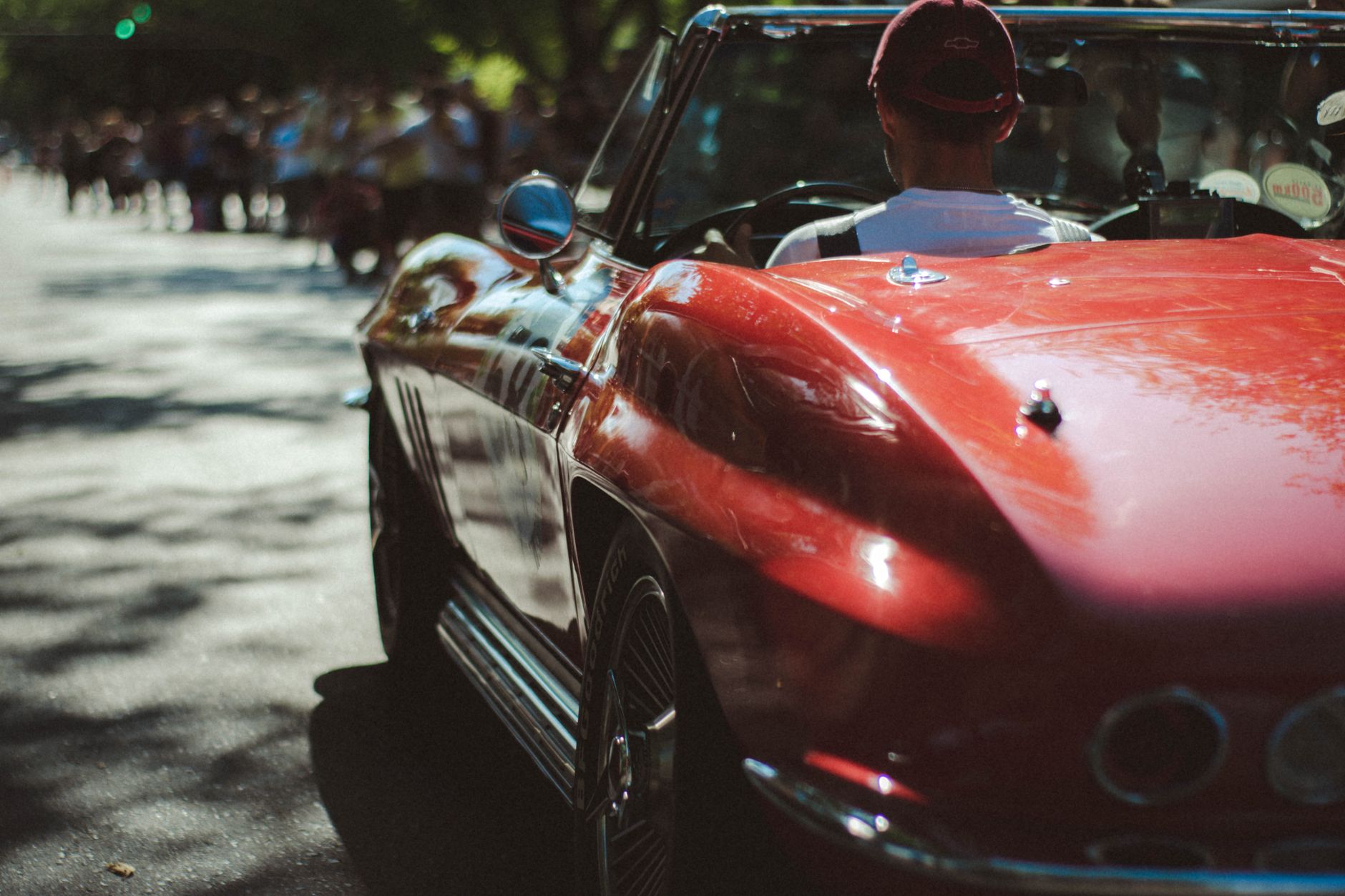
He walked me back to the bay one more time, and there she was. My grandfather’s Corvette. My Corvette. Rally red, exactly as promised, engine turning over clean the second Peter fired it up to show me it had been kept in perfect running order the whole time it sat waiting for the truth to catch up.
“Your granddad would’ve liked how you handled this,” Peter said, wiping his hands on a shop rag. “Firm. Fair. No theater. That’s soldier’s work, cleaning up a mess like this without burning the whole field down.”
Driving home
I signed the corrected title in the DMV office in Harrisonburg on a Thursday morning, my name the only one on the line where an owner’s signature goes, exactly the way my grandfather had set it up seventeen years before he’d ever have imagined I’d need the protection. The clerk didn’t know what the moment meant to me. She just stamped it and slid it across the counter and told me to have a nice day, and I said thank you and meant it more than she could have known.
I drove the Corvette back to Millbrook myself, top down, the Shenandoah Valley rolling green and gold on either side of Route 11 the way it does every summer whether anybody’s paying attention or not. I passed the feed store with its chalkboard sign. I passed the VFW hall where I’d go two nights later to sit with men and women who understood, without needing it explained, exactly what it means to come home and find out the ground under you has shifted while you were gone. I passed the diner where the waitress who’s worked there since I was in high school still calls me hon and slides me a free slice of pie when she sees the uniform.
I pulled into my parents’ driveway and backed the Corvette into the exact spot where it had sat empty six weeks earlier, and for a moment I just sat there in the driver’s seat with the engine ticking as it cooled, my hand resting on a wheel that had once felt like a nine year old’s daydream and now felt like something else entirely. Earned. Defended. Mine, in every sense a word can mean that.
My mother came out onto the porch while I sat there. She didn’t say anything at first, just stood with her arms crossed against the evening chill, watching me the way you watch something you’re not sure you’re still allowed to be close to.
“I know sorry doesn’t fix it,” she finally said. “I don’t expect it to.”
“No,” I agreed. “It doesn’t. But it’s a start, and starts count for something.”
Things between us aren’t what they were before I deployed the first time, and I’ve made my peace with that. Some trust, once it’s been signed away in someone else’s handwriting, doesn’t come back whole no matter how many mortgages get taken out or how many notarized letters get written. But my parents call now, and they mean it when they ask how I’m doing, not as a formality before asking me for something, but because the ledger they used to keep in their heads, the one where my absence was worth less than my brother’s comfort, finally got torn up the day I refused to let a forged signature decide who I was.
Andrew and I talk more now than we ever did growing up. He’s working steady at a auto parts warehouse outside Staunton, paying his own way for the first time in his life, and last month he asked me, almost shy about it, if I’d teach him some of what Grandpa Walt taught me about engines. I said yes. Some things, once you’ve paid for them honestly, are worth passing on.
The Corvette lives in that garage now, under the same canvas cover my grandfather used to keep the weather off it, and some Saturday afternoons I still catch myself standing in the doorway just looking at it, the way I used to as a kid, feeling the particular kind of quiet that only comes after you’ve fought for something and actually won.
I spent seven years overseas learning that the hardest thing about combat isn’t the danger, it’s the discipline it takes to stay steady when everything around you is trying to knock you off balance. I didn’t know until I came home that the same discipline would be exactly what I needed to survive the people who were supposed to have kept me steady all along.
My grandfather told me once, wrench in hand, grease on his knuckles, that a car like that doesn’t owe anybody anything. It just needs somebody who won’t quit on it.
Turns out neither do I.