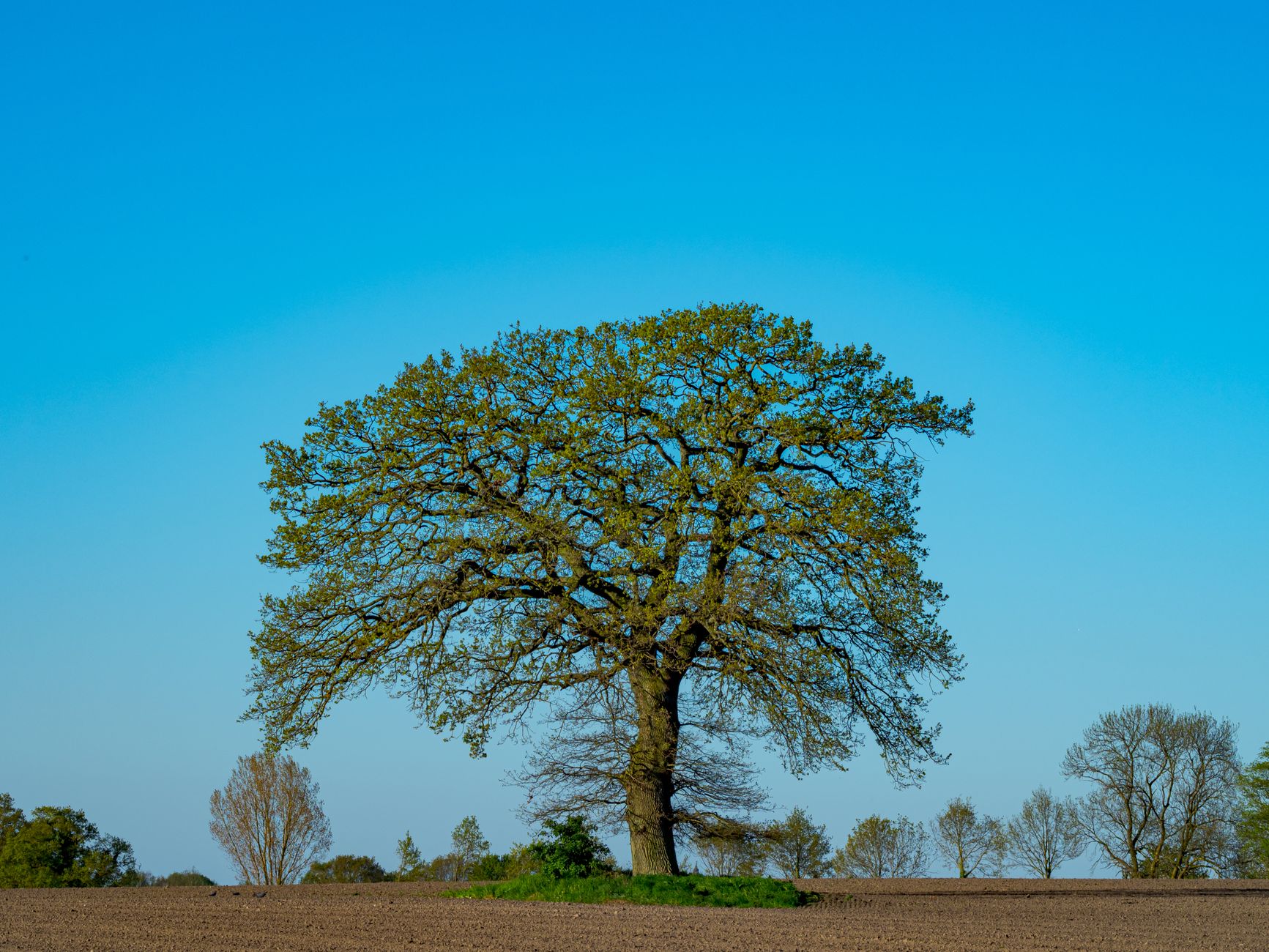
The Oak My Neighbor Tried to Kill
Ostrow Fenn stood at his fence line with a grin he didn’t bother to hide, watching a four-man crew rope off the eighty-year-old oak my grandfather planted the week he came home from the war, and when I walked over and asked him straight to his face if he’d poisoned it, he laughed and said, “Trees die. Prove it was me.”
I am forty-two years old. I have worked this ground outside Bolivar, Tennessee since I was old enough to walk a row behind my father. That oak took one summer to die. It took a lab in Nashville six weeks to tell us why, and I had the report folded in my back pocket when I asked him the question.
The crew had a bucket truck backed up under what was left of the crown, and there wasn’t a green leaf on it anywhere, bark peeling off the south side in long gray strips like sunburned skin. Somebody had already cut down the old rope swing and coiled it on the tailgate of my truck, out of respect, I guess, or just because it was in the way of the saws. My daughter Dulcie had tied that swing herself two summers back, from a length of hay-baling rope and a chunk of two-by-four, and she’d spent the whole week before asking me why we couldn’t just wait until fall, like maybe the tree would come back if we gave it enough time. I didn’t have a good answer for a nine-year-old. I still don’t, not one I could say out loud to her.
The tree had stood eighty feet tall at its peak, a canopy that threw shade across half our yard and half of Fenn’s gravel lot on the other side of the property line, which I have come to understand was the entire problem, start to finish.
I stood in my own yard and watched four men with chainsaws take apart something that took eight decades to grow. It took them four hours. I stayed for all of it, because somebody in this family owed that tree the courtesy of being watched on its way down, and my grandfather wasn’t alive anymore to do it himself.
Fenn watched too, from his side, sipping coffee out of a paper cup with his venue’s logo printed on it in green script, Hatchie Bend Weddings, like the whole thing was a mild inconvenience he was waiting out on his lunch break. Every so often one of the crew would call out to the others over the saw noise, and every time a big section of limb came down, the ground shook a little, and I felt it in my boots.
“Nice of you to come watch,” I said to him, the first thing I’d said since I’d walked over.
“It’s my parking lot that’s been under that thing for seven years,” he said. “Figured I’d enjoy the view.”
That’s when I asked him the question I’d been carrying around for six weeks, ever since the lab in Nashville sent back an answer I hadn’t wanted and wasn’t surprised by either.
“Did you poison my grandfather’s tree, Ostrow?”
He laughed, an easy, unbothered sound, like I’d told a joke that wasn’t quite funny enough to earn a real laugh but was worth acknowledging anyway. “Trees die,” he said. “Prove it was me.”
I didn’t say anything back right away. I just stood there and watched the last of the big limbs come down, and I thought about how a man says a thing like that only when he believes there’s nothing on the other side of it, no paper trail, no witness, nothing but a dead tree and a grieving neighbor with no proof but a feeling. I let him believe that a little while longer. I had a report in my pocket that said otherwise, and I wasn’t ready to spend it yet, not standing in sawdust with the crew still working.
My grandfather planted that oak in April of 1946, the week he came home from the Pacific. He was twenty-two years old. He had a duffel bag, a discharge paper, and not much else, and the first thing he did on this land, before he built the house, before he dug the well, before he ever asked my grandmother to marry him, was walk the property line with a burlap-wrapped sapling under his arm and set it in the ground at the corner post.
He told my father, and my father told me, that he planted it there on purpose. Not by the house, where it would have made more sense for shade. Right on the line. He said a man could argue about a boundary for forty years with a lawyer and a surveyor and a stack of paper, or he could put a tree on that line and let time settle the question for him. A tree grows exactly where you put it and it stays there. Paper gets lost, or challenged, or reinterpreted by somebody with a reason to reinterpret it. A tree that’s stood in the same spot for eighty years is its own kind of deed, he used to say, and nobody ever successfully argued with one.
My grandmother used to set a folding chair under it most summer evenings and shell peas into a bowl in her lap, and there is still a faint bald patch in the grass where those chair legs sat for forty years running. My father married my mother in its shade, a small ceremony with folding chairs borrowed from the Baptist church his family belonged to, and there’s a photograph of the two of them standing under it that still hangs in my mother’s hallway. I learned to climb on its low south branch before I ever learned to ride a bicycle, and I broke my wrist falling out of it at nine years old and climbed right back up two weeks after the cast came off, because that’s what you did with that tree. You didn’t stay away from it just because it had hurt you once.
And now Dulcie has grown up exactly the way I did. She has a rope swing and a spot at the base of the trunk where she keeps a rusted coffee can full of the acorns she likes best, the ones with the deepest green caps, because she told me once, dead serious, that those are the ones that grow into good trees. She has strong opinions about which acorns are worth saving. I don’t know where she got that from. I like to think she got it from a great-grandfather she never met, by way of a tree that raised three generations of this family without a single one of us noticing we were being raised by it.
Three generations measured our lives against that oak without ever saying so out loud. It was just there, the way weather is there, the way the county road is there. You don’t think to be grateful for a thing like that until somebody takes it from you on purpose.
Ostrow Fenn bought the sixty acres next to ours about seven years ago. He came out from Memphis, according to what he told people at the feed store, looking to build something out here in the country where land was cheap and the view was better than anything he could get in the city. What he built was a wedding and event barn he named Hatchie Bend Weddings: a gravel parking lot graded flat and wide, string lights running post to post across the yard, an in-ground pool for bridal parties to use for photographs, a walk-in cooler for the catering, and a bank of solar panels bolted to the south slope of the barn roof to help offset what it cost to run all of it through a Tennessee summer.
The trouble, from his side of the fence, was that my grandfather’s oak sat almost exactly on the line between our two places, closer to his lot than to my own house, and its western canopy, the biggest limbs, the ones that had been reaching outward and downward for eighty years, hung a good thirty feet over what became his gravel lot and the shallow end of his pool. Every autumn it dropped leaves and acorns across cars parked for wedding receptions. Every spring it dropped a fine yellow dust of pollen across the pool water that his groundskeeper had to skim before every event. And depending on the season and the hour, its shade fell across the south end of his barn roof for a good part of the afternoon, right where his solar array sat, cutting into what those panels could generate during exactly the hours a wedding venue draws the heaviest load.
He asked me, that first year, to let his own crew take it down. He offered five thousand dollars cash and made it sound like he was doing us both a favor, like I was the one holding something back from the both of us by refusing.
I told him no. I told him what that tree was, who planted it and why and what it had shaded through three generations. I don’t know if he heard a word of it, or if he just filed the whole conversation away as an obstacle to be dealt with some other way, later, on his own schedule.
The second year he came back with twelve thousand dollars. I told him no again, same as before, and this time I told him not to ask a third time, because the answer wasn’t going to change no matter what number he landed on.
The third year he stopped offering money and started talking about liability instead. He brought up limbs falling on a bride’s car, or worse, on a guest, and how a landowner can be held responsible for hazard limbs overhanging a neighbor’s property regardless of which side of the line the trunk itself sits on. He had a fair point about the overhang, if nothing else he said, so I hired a tree service out of Jackson and had them cut back everything crossing the property line, a full thirty feet of canopy on the western side, taken down clean to a vertical plane right at the survey stakes. It cost me close to three thousand dollars, and it left the tree looking lopsided for a season or two, all its remaining weight thrown to our side of the line, but I told myself it settled the matter. I told Fenn as much, standing at the fence the day the crew finished.
It didn’t settle anything, not for him. A tree can look uneven after a hard pruning like that, all its canopy thrown one direction, but he still had eighty feet of bare trunk and the shadow it threw across his lot every afternoon no matter which way the remaining branches pointed. That October, after a wedding where I gather the light fell wrong for whatever photographs his clients wanted, he sent me a text I still have saved on my phone. It said the tree still needed to go, one way or another, and that he’d make it happen. At the time I read it as one more round of pressure from a man who didn’t like hearing no. I didn’t understand yet exactly what he meant by it, or how literally he intended to make it happen.
The oak leafed out fine that following spring, same as it had every spring of its life, full and green by the second week of April.
Dulcie was the one who noticed it first, in the second week of June. She came in from playing under the tree with her tin of favorite acorns and said, “Daddy, the tree looks sick on Mr. Fenn’s side.” I walked back out with her and saw exactly what she meant. A whole wedge of the crown, maybe a third of it, on the section directly facing Fenn’s lot, had gone the color of an old dollar bill, curling at the edges, weeks before any leaf on that tree had any business turning color. The rest of the crown was still deep summer green. It looked like somebody had colored in one slice of the tree with a different crayon and left the rest alone.
I told myself it was early oak wilt, or borers, or root damage from decades of mowers and weed trimmers working too close to the base. I called the county extension office, and the agent who came out walked the drip line twice and admitted she wasn’t sure what she was looking at. Oak wilt shows up more randomly across a whole stand of trees, she told me, not sectioned off cleanly on one side of a single tree like somebody had drawn a line down the middle of it. She recommended I get a certified arborist out before the tree lost any more of its canopy.
By the second week of July, the yellow wedge had spread until it covered close to half the crown, and the bark at the base of the trunk, on the property-line side, had started splitting in long vertical seams, weeping something dark that hadn’t been there in June. There was also a ring of dead grass around the base of the trunk on that same side, a rough circle maybe four feet across, the grass gone gray and brittle in a shape that had nothing to do with shade or drought or foot traffic, because the grass six inches outside that ring, and the grass on the far side of the trunk toward my own house, was still healthy and green.
By the second week of August, the whole crown was bare. Every leaf on that tree went from green to yellow to a hard curled brown, and then to nothing at all, over the span of nine weeks. Eighty years, and it took one summer.
My wife found me standing under it one evening in late August, just looking up through what was left of the branches at a sky that had never had that much room to show through before. She didn’t say anything comforting, because there wasn’t anything comforting to say. She just stood there with me a while, and then she said, “Something did this. Trees don’t just die like that, not all at once, not in one season, not eighty years in.” I told her I was starting to think the same thing, and that I intended to find out for certain before I let anybody near that trunk with a saw.
Halvard had cabled a split leader on that same oak back in 1994, the summer before I started high school. He was younger then, close to my grandfather’s age but with better knees, and he still keeps a photograph from that visit in a binder in his truck: the tree at maybe fifty feet, half the size it would eventually reach, with a steel cable running between two major limbs to keep a storm-cracked union from splitting the whole tree in half. He’d been back out to look at it three or four more times over the following decades, once after a lightning strike that scarred but didn’t kill it, once or twice just because my grandfather liked having him check on it the way some men keep a doctor they trust for no reason they could ever fully explain to anybody else.
I called him the day after the extension agent left, and he drove up from Jackson two days after that. He walked the same drip line she had, slower, and stood a long time looking at that ring of dead grass before he said a word.
“That’s not oak wilt,” he said finally. “Oak wilt doesn’t kill grass at the roots in a perfect ring like that. Disease doesn’t work that clean. Something did this on purpose, or something got poured here that had no business being poured here.”
He explained it the way he’d explain it to anybody who wasn’t in his line of work. Fungal disease moves through a tree’s own vascular system in a pattern that follows the tree’s plumbing, branch to branch, and it doesn’t reach down into the soil and kill grass roots in a tidy circle around the base. Borers leave a different signature under the bark entirely, a tunneling pattern, not a chemical scald. Drought stresses a whole tree evenly, canopy-wide, not one clean-edged wedge of it while the rest stays green. What he was looking at, the sectioned dieback on one side only, the bark splitting low on the trunk, and especially that dead ring of grass sitting exactly at the soil line on the property-line side, looked to him like something had been applied straight to the ground, something that moved up through the root system from below.
“I want to take soil samples,” he said. “Right here at the base on Fenn’s side. Out at the drip line, same side. And a control sample from thirty feet out on your side of the yard, where nothing’s showing any stress at all. If I’m wrong, the lab will tell us that too, and we’ll go looking for some other answer.”
He came back two days later with a soil probe and took six core samples in small resealable bags, each one labeled by hand with a location and a depth, working slow and careful the way I imagine he’d worked every job of his career. He drove the samples to a plant and soil diagnostics lab in Nashville himself rather than trust them to the mail, and then there was nothing left to do but wait.
Six weeks is a long stretch of time to wait for an answer when the thing you’re waiting on is already dead. The tree finished dying somewhere inside that window, the last stubborn green giving out sometime in early September, and I went ahead and scheduled the removal crew, because a bare, brittle eighty-foot oak standing thirty feet from a wedding barn’s parking lot is exactly the hazard Fenn had been warning me about for three years running, except now it was real, and now, if I was right, it was his own doing.
Dulcie asked me almost every day that fall if the lab had called yet. She’d taken to visiting the tree in the evenings the way you’d visit somebody in a hospital, standing at the base with her tin of acorns like she was keeping the last of it company.
The report came on a Tuesday. Halvard drove it up to the house himself instead of mailing it or sending it over email, which told me something before I’d read a single word of it.
It named tebuthiuron, a soil-active herbicide sold commercially under names like Spike, used for clearing brush and unwanted woody growth along fence lines and utility rights-of-way. It isn’t something you spray on leaves. It’s applied dry or mixed into a slurry and put directly onto the soil around a plant’s root zone, and it works its way down through the ground and back up through the roots slowly enough that a tree can look perfectly healthy for two or three months before any of the damage shows up in the leaves. The lab measured it at just over forty parts per million in the soil within three feet of the trunk, on the property-line side, the same side as the dead grass ring and the sectioned dieback. The control sample, thirty feet out on my side of the yard, came back with no detectable trace of it at all.
Halvard walked me through what that meant, sitting at my kitchen table with the report spread out between us. If tebuthiuron had drifted onto our property from some field being sprayed for brush control somewhere in the area, a real possibility with a lot of herbicides, it would show up as a low, even residue spread across a wide stretch of ground, maybe heavier on one side depending on which way the wind had been blowing that week, but it would never produce a sharp, concentrated spike confined to one small radius around a single trunk with nothing detectable a short distance away in any direction. What the samples showed instead was a hot spot, tight and specific. Something had been poured, not sprayed, directly onto the ground at the base of that tree, on the side facing Fenn’s lot, sometime in the early spring before the leaves came out, giving the chemical the two or three months it needed to travel up through the roots and begin killing the canopy right on the schedule we’d watched play out that June, July, and August.
“Somebody knew what they were doing,” Halvard said. “This isn’t drift. This isn’t an accident. Somebody stood right at that spot and poured this into the ground on purpose, and they picked the side of the tree that would do the most good for whoever wanted the shade gone.”
I sat there a long moment looking out my kitchen window at that ring of dead grass, thirty yards off, on the exact side of the trunk that faced Fenn’s gravel lot, and I thought about four words on a phone screen from the previous October. One way or another.
I had that report folded in my back pocket the whole day the removal crew worked, which is the only reason I walked to the fence line and asked Ostrow Fenn the question outright instead of letting the day pass in silence the way I might have a year before.
After he laughed and told me trees die, prove it was me, I let a beat go by, and then I took the report out of my pocket, unfolded it, and held it up so he could see the letterhead if nothing else.
“I’ve got a lab report here that says forty parts per million of tebuthiuron, poured at the base of that tree, on your side, about three months before it started dying,” I said. “Nothing at all on my side of the yard. Nobody sprays a field that precisely by accident, Ostrow.”
“Herbicide drifts,” he said, though his voice had lost some of the ease it had carried a minute earlier. “Everybody around here sprays something for something. Could’ve come from anywhere. I’m no chemist, and neither are you.”
“Funny thing about drift,” I said. “It doesn’t leave a bald ring in the grass the exact size and shape of a man standing at the base of a tree with a jug in his hand.”
He didn’t have an answer for that one. He finished his coffee, dropped the cup in a trash barrel by his own fence post, and walked back toward his barn without another word. I let him go. I already knew exactly where I was taking that report next.
I took it first to the Hardeman County Sheriff’s Office, where a deputy who’d grown up two roads over and knew good and well whose oak that was took it seriously enough to start asking around on his own time. He drove out to Bolivar Farmers Co-op, the only supplier within twenty miles that carries a restricted-use herbicide like tebuthiuron, and asked the manager to pull the purchase log for the months leading up to the dieback.
Ostrow Fenn had special-ordered two jugs of it that April, about ten weeks before Dulcie first noticed the yellow wedge of leaves. A wedding venue with a mowed lawn and a gravel parking lot has no honest use for a brush-clearing herbicide meant for fence lines and power rights-of-way. The young man who’d rung up the special order remembered it clearly, not because the product itself was unusual to sell around here, but because Fenn had asked him, while he waited on the order to come in, what would take out a big tree without leaving an obvious mess behind. It was an odd enough question that the clerk had mentioned it to his manager at the time, weeks before anyone came around asking about it, which is exactly the kind of small detail that holds up in a courthouse.
I gave the deputy the text message too, the one from the October before. One way or another. I’d kept it on my phone without ever expecting to need it for anything.
I hired an attorney out of Jackson, a woman who’d handled a couple of property disputes for farmers in the county before and didn’t flinch at the size of the business on the other side of the case. Tennessee law allows for treble damages against anyone who cuts down, girdles, or otherwise destroys another person’s tree without the owner’s consent, and Halvard put together a formal appraisal using the trunk formula method arborists use to value a tree of real size, age, and species, factoring in trunk diameter, its condition before it was poisoned, and what a tree like that adds to a property’s overall value. He came back with a base valuation of just over seventeen thousand dollars, which under the statute meant Fenn was looking at more than fifty thousand dollars in exposure, on top of whatever it would cost him to defend himself at trial with the words poisoned his neighbor’s eighty-year-old oak sitting right next to the name of his wedding venue in the local paper.
He fought it for about six weeks through his own attorney. Then his lawyer called mine and asked to talk settlement.
I won’t say I came away with everything I wanted out of that conversation, because no amount of money grows a tree back to eighty years in one season, but I got the trebled valuation, I got my legal and lab fees covered in full, and I got the whole thing entered into the public record at the county courthouse, where anyone doing business with Hatchie Bend Weddings can find it if they go looking for it, same as I can. Fenn never apologized, not once, not even after he signed. I hadn’t expected him to. A man who pours poison at the root of an eighty-year-old tree in the dark and then stands at a fence line laughing about proof isn’t the kind of man who turns around and says he’s sorry once the proof shows up anyway.
Here’s the part I didn’t know until the lab report came back and Halvard finally told me what else he’d done that day, and it’s made all the difference in how I feel about the way this ended.
The same afternoon he took those soil cores, before either of us had any idea what the lab would find, he’d also crouched down under what was left of the canopy and filled a five-gallon bucket with acorns, the good ones, he said, the ones that still had some green left in the cap even though the leaves above them had already started turning. He’d done tree work long enough to know that sometimes the only thing left to save is what a tree leaves behind on the ground before it goes, and he wasn’t about to let a specimen with eighty years of history run through a woodchipper without at least trying to carry a piece of it forward.
He potted up eleven of those acorns in his own greenhouse in Jackson and nursed them through that first winter. By the following spring, four had sprouted.
Dulcie and I drove out there on a Saturday in April, almost exactly eighty years to the season after my grandfather walked this same property line with a burlap-wrapped sapling under his arm, and we picked the strongest of the four, a foot-tall seedling with four true leaves already unfurled and a taproot Halvard said was already reaching further down than it had any business reaching at that size. We planted it a little further back from the line than the original had ever stood, my choice this time, close enough to mark the same corner of family history but no longer close enough for anybody’s shade to fall across anybody else’s parking lot ever again.
Dulcie tied a new length of rope to a stake set beside it, too small yet to hold a swing, more of a promise than a rope, and she keeps her tin of good acorns beside it now, the ones with the deepest green caps, same as she always has, because she says those are still the ones that grow into good trees.
My grandfather planted that oak eighty years ago to end an argument before it ever had the chance to start. It took his great-granddaughter and a five-gallon bucket to make sure the argument he never got to have anyway ended the right way in the end. Ostrow Fenn told me to prove it was him. I did. It’s on file at the county courthouse, it’s in the settlement he signed with his own hand, and it’s growing back a few feet off the line where I can see it from my kitchen window every single morning for however many years I’ve still got left to watch it grow.
This story is a dramatization. Names, characters, and details are invented, and any resemblance to real people or events is coincidental.