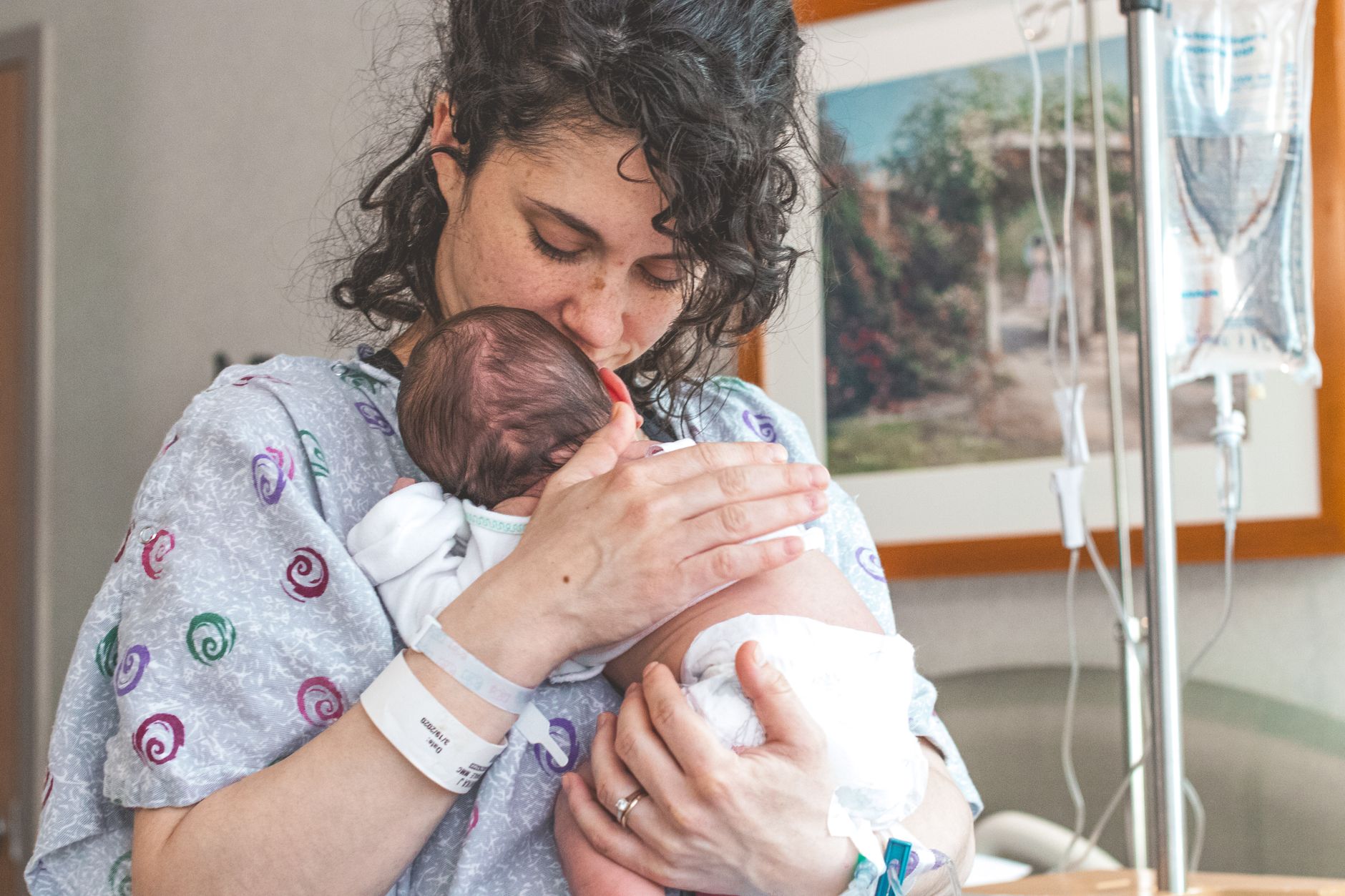
The Doctor Who Recognized My Son
I told the nurse a lie before I ever told her my name.
“Is your husband on the way?” she asked, clipboard against her hip, pen already clicking toward the intake form.
“Yes,” I said. “He should be here soon.”
I have thought about that lie more than almost anything else from that day, and that day held a great deal worth thinking about. It came out of me so easily, so practiced, that for a second I almost believed it myself. I had said some version of it to the woman who cut my hair, to the man who bagged my groceries, to my own mother on the phone twice a month. He’s just working a lot. He’s driving up this weekend. He sends his love. I had built an entire invisible husband out of borrowed sentences, and on the morning I walked into St. Jude’s Hospital to have my son, I brought him with me one last time because I did not yet know how to walk into a room as just myself, alone, and ask for help.
My name is Clara Miller. I was twenty-six years old, nine months pregnant, and completely by myself when I checked in at St. Jude’s on a cold Tuesday morning with a small suitcase, a sweater I’d had since college, and a silence I had gotten very good at carrying.
I want to tell you how I got there, because the getting there matters as much as what happened once the doors closed behind me. It is the reason the tears that fell later meant what they meant. It is the reason three lives came out of that hospital room changed, mine included, and mine maybe most of all.
Before
I met Logan Sterling at a wedding I almost didn’t go to. My cousin was marrying a man from two towns over, and I’d nearly begged off because I’d worked a double the night before and my feet still ached in my good shoes. Logan was standing by the drink table looking like he also would have rather been somewhere else, and when our eyes met over a tray of cheese cubes, he smiled like we were already in on the same joke.
He was easy to love. I want to say that plainly, because it is important to the rest of this story that you understand I was not foolish, not naive, not blind to red flags I chose to ignore. There were none. Logan called when he said he would call. He remembered that I hated cilantro and that my father had passed when I was nineteen and that I got quiet, not loud, when I was upset. He drove forty minutes each way to bring me soup when I had the flu. For a year and a half, loving him felt like the easiest thing I had ever done.
Then I got pregnant.
I found out on a Sunday and I told him on a Tuesday, because I wanted a day to sit with it myself first, to let it be only mine before it belonged to both of us. I made dinner. I remember exactly what I made, chicken and rice, because I have gone over that evening in my mind so many times that even the smell of that dish can still put me back in that kitchen. I told him at the table, and he went very still, and then he smiled in a way that didn’t reach his eyes and said, “That’s amazing, Clara. Wow.”
He left four hours later. Not in anger. That was the part that took me the longest to understand and the longest to forgive, if I have fully forgiven it even now. There was no fight. No slammed door, no raised voice, no ugly words I could point to later and say, see, he was cruel, he was bad, I was right to let him go. He packed a bag with the calm efficiency of a man who had rehearsed it, and he said something about needing space, needing to think, needing to be honest with me that he didn’t know if he could do this. And then he was gone, and the door clicked shut behind him so softly that for a moment I thought maybe he’d only stepped out for air.
He did not come back for air. He did not come back at all.
I cried for weeks. I want to be honest about that too, because there is a version of this story where the wronged woman is stoic from the first page, dry-eyed and dignified, and that was not me. I cried in the shower so the sound wouldn’t travel. I cried in my car in parking lots. I cried once, humiliatingly, in the cereal aisle of a grocery store, because I saw a father lifting his toddler up to reach a box on the top shelf and something in my chest simply broke open.
And then, somewhere around the fourth month, I stopped.
Not because the pain left. I want to be clear about that, because I think people who haven’t lived through something like this imagine grief as a a switch you flip, sad and then not sad, and it isn’t. I stopped crying because I ran out of places to put it. I had a baby coming. I had rent. I had a body that was changing every week in ways that scared and amazed me in equal measure, and somewhere in there I made a decision, quietly, without ceremony, that I was going to build a life sturdy enough to hold both of us even if it had to be built by one pair of hands.
The Diner
I rented a small room above a hardware store on the edge of town, the kind of place with a hot plate instead of a stove and a window that looked out over the alley, but it was clean and it was mine and the landlord, an older man named Pete who’d run the hardware store for thirty years, never once raised the rent even after he found out I was expecting and living alone. I’ve thought about Pete a lot since all this happened. Kindness rarely announces itself. It just quietly declines to make things worse.
I worked doubles at the Blue Plate Diner on Route 9, the kind of place with a laminated menu, bottomless coffee, and a regular crowd of retired farmers who came in every morning at six and left their tips in exact, careful stacks of quarters. I was on my feet twelve hours some days, my apron stretched tight over a belly that seemed to grow a little bigger every week, and I saved every dollar I could. Not for anything specific at first. Just because saving felt like the only form of control I had left.
The owner, a woman named Deb who had run that diner since before I was born, used to slide an extra biscuit onto my plate during my break and pretend she didn’t know she was doing it. “Eat,” she’d say, not looking at me, wiping down a counter that didn’t need wiping. Deb never asked about the father. She never asked why I never had a ride home, why no one ever came in to check on me, why I flinched, just barely, whenever the bell over the door rang and I looked up hoping, even after everything, that it might be him. She just kept sliding biscuits onto my plate, and some kindnesses don’t need to be spoken to be understood.
At night, in that small room above the hardware store, I would rest my hands on my stomach and talk to the child I hadn’t met yet. I didn’t have anyone else to talk to, not really, not about the things that mattered most, so those conversations became the center of my day. I would tell him about the diner, about Deb’s biscuits, about the farmers and their quarters and the way the light came through the window in the late afternoon. And every single night, without fail, I would end the same way.
“I’m here,” I’d whisper. “I’m not going anywhere.”
I said it to him and I said it to myself, because some nights I wasn’t entirely sure I believed it about either of us, and saying it out loud, again and again, was how I built the belief brick by brick until it finally held weight.
There was one evening, near the end of my seventh month, when one of the old farmers who came in every morning for coffee, a man named Harold who I don’t think had said more than a dozen words to me in two years beyond his order, stayed after his coffee was long finished and asked if I needed a ride anywhere that week. I told him no, that I was fine, the same automatic answer I gave everyone. He nodded like he expected that, set a folded twenty under his mug where I’d find it after he left, and said only, “For the baby,” before he put his cap back on and walked out into the parking lot. I cried in the walk-in cooler for ten minutes after that, quietly, the way I’d learned to cry by then, and then I went back out and refilled coffee for the next table because the shift wasn’t over and the rent wasn’t going to pay itself.
I called my mother twice a month, like I said, and I let her believe there was a man somewhere in the picture, off working, off thinking, off driving up this weekend. I don’t know exactly why I kept the lie going with her longer than with anyone else. Maybe because my mother had buried my father when I was nineteen and I couldn’t stand the idea of handing her one more thing to worry over. Maybe because saying it out loud to her made it feel less true that I was doing this entirely by myself. Either way, it meant that when labor finally came, there was no one to call. There was no one who knew to come.
Twelve Hours
Labor started early on a Tuesday, three weeks before my due date, with a tightening low in my back that I mistook for having slept wrong. By the time I understood what it was, the contractions were already eight minutes apart, and I called a cab because I did not own a car reliable enough to trust with a forty-minute drive to St. Jude’s, and because there was no one else to call who could have driven me.
The cab driver, an older man who didn’t ask questions, glanced at me twice in the rearview mirror and then, without a word, took the back roads that cut ten minutes off the drive.
I checked in around eight that morning. I lied to the nurse about my husband being on the way, and then I was wheeled to a room, and the next twelve hours are, even now, a blur of fluorescent light and pain that came in waves I didn’t think I could survive and somehow did, over and over, each one a little worse than the last. A nurse named Priya stayed with me through most of it. She held my hand through contractions that made me grip the bed rail so hard my knuckles went white, and at some point, hours in, exhausted and scared in a way I hadn’t let myself be scared in months, I heard myself whispering the only prayer I had left in me.
“Please. Let him be okay.”
I didn’t know yet it was a boy. I had chosen not to find out, wanting one surprise left in a nine months that had otherwise gone exactly the way I feared it would. But somewhere in the exhaustion and the pain, I had started calling the baby “him,” and I never once second-guessed it. Some things you just know before anyone tells you.
At 3:17 in the afternoon, after twelve hours that felt like both twelve minutes and twelve years, my son was born.
I heard him cry before I saw him, and I will never in my life forget that sound. It filled the room in a way that seemed too big for how small he was, and I sank back against the pillow with tears streaming down my face, but for the first time in seven months, they weren’t tears of heartbreak. They were relief. They were love, arriving all at once, so much of it that my body didn’t seem to have anywhere to put it but out through my eyes.
“Is he okay?” I asked, my voice cracked and small.
The nurse smiled as she wrapped him, quick and practiced and warm. “He’s perfect.”
They were just about to lay him in my arms, this tiny, furious, red-faced person I had built alone for nine months out of double shifts and biscuits and whispered promises in a room above a hardware store, when the doctor came in to check on us both.
Dr. Sterling
I hadn’t met him before that moment. My delivery had been handled by the on-call team and a midwife, and I only knew his name because it was stitched above the pocket of his white coat when he walked through the door. Dr. Richard Sterling. Later, a nurse would tell me he’d worked at St. Jude’s for over twenty years, a man known around the maternity ward for steady hands and a calm, unshakable manner that had talked more than one terrified mother through more than one hard night.
He glanced at my chart, the way doctors do, routine, unhurried. Then he looked at my son.
And he stopped.
I remember watching the color drain out of his face in real time, watching a man who I would later learn had never once lost his composure in front of a patient in over two decades of practice, go completely still, like something inside him had simply stopped working. His hand, holding the chart, began to tremble. And then, without a single word, his eyes filled with tears.
I didn’t understand it. For one terrible, plummeting second, I thought something was wrong with my son, that this steady, experienced doctor had seen something in that small red face that meant the twelve hours and the relief and the love flooding through me were about to be taken back. I actually reached for him then, some animal instinct in me deciding that whatever it was, I needed him in my arms immediately, safe, mine.
“Is something wrong?” I asked, and my voice came out higher and thinner than I meant it to.
Dr. Sterling didn’t answer right away. He set the chart down on the rolling table beside my bed with a hand that still wasn’t quite steady, and he looked at my son’s face again, longer this time, and something in his expression wasn’t fear. It was recognition. It was a man looking at something he had given up hope of ever seeing again.
“I’m sorry,” he finally said, his voice rough. “He’s perfectly healthy. I promise you that. It’s just.” He stopped. Started again. “Could I ask you the father’s name?”
It was such an odd question, coming from a doctor, coming at that moment, that for a second I almost didn’t answer it. But something in the way he asked, gentle and urgent at once, made me feel like the answer mattered more than I understood yet.
“Logan,” I said. “Logan Sterling.”
I watched him absorb it, watched the tears that were already standing in his eyes finally spill over, and I understood, before he said another word, why the name on the badge over his pocket had looked so familiar the whole time and I simply hadn’t let myself see it.
“He’s my son,” Dr. Sterling said. “Logan is my son. This is my grandson.”
What He Told Me
I want to tell you what came out over the next hour, because it came out slowly, in pieces, with a nurse quietly bringing Dr. Sterling a chair because his legs, by his own admission later, weren’t entirely trustworthy under him.
Richard Sterling and his son had not spoken in almost three years.
The falling out, as he explained it to me that afternoon and in more detail over the weeks that followed, had nothing to do with me, and everything to do with a wound between father and son that had been bleeding slowly long before I ever met Logan at that wedding. Richard’s wife, Logan’s mother, had died of a long illness when Logan was twenty-two, and in the two years after, father and son had grieved in ways that could not seem to occupy the same room. Richard had buried himself in work, in the hospital, in the steady, controllable rhythm of shifts and rounds and patients he could actually help. Logan had wanted his father present in a way Richard, by his own admission, hadn’t known how to be. There had been a final argument, ugly in the way only family arguments can be ugly, full of old wounds dressed up as new ones, and Logan had walked out of his father’s house and, for all practical purposes, out of his father’s life.
Richard had tried, in the beginning. Calls that went unanswered. A birthday card returned unopened. And eventually, the way these things sometimes go, trying had curdled into a kind of grieving silence, two men each convinced the other didn’t want to hear from him, each too proud or too hurt to be the one to find out for certain.
He had no idea Logan had been seeing anyone. He had no idea Logan had a son. He had no idea, sitting in that chair a nurse had brought him, that the woman in the hospital bed in front of him had spent the last seven months of her pregnancy entirely alone because his own son had walked out of a kitchen the same way he’d once walked out of his father’s house, quiet, controlled, no shouting, no proof anyone could point to and call it what it was.
“I am so sorry,” he said to me, more than once that afternoon, and I believed every time that he meant it, not as an apology for something he had done, but as a grief on my behalf, and on his own, for two people who had both been left standing in doorways watching the same man walk away.
I held my son through most of that conversation, and I remember looking down at his small sleeping face and understanding, for the first time, exactly what Dr. Sterling had seen the moment he walked into that room. My son had Logan’s exact mouth. He had, I would learn later when I finally saw an old photograph, Richard’s exact eyes at that same age. He was a small, unmistakable echo of two men who hadn’t spoken to each other in three years, and he had arrived in the world in a room where both of those men’s histories collided without either of them planning it.
The Next Few Weeks
I won’t pretend the following weeks were simple, because they weren’t. I had every reason to want nothing to do with anyone named Sterling, and for the first several days, I told Richard as much, gently but firmly, from a hospital bed and then from the small room above the hardware store where I brought my son home to a bassinet I’d bought secondhand and scrubbed clean myself.
But Richard Sterling did not disappear the way his son had. That was the difference that, slowly, over weeks and then months, rebuilt something in me I hadn’t realized had gone missing along with my trust in easy smiles at wedding receptions. He showed up, respectfully, at the times I said he could show up. He asked before he came. He brought groceries the first two times and then asked if that was something I wanted him to keep doing, rather than assuming, and when I said I’d rather he not, not yet, not until I knew what this was, he didn’t push. He simply came to see his grandson, sat in the one good chair in my small room, and let a baby who didn’t yet know any of the history wrap a tiny hand around his finger.
“I’m not here to replace what my son should have done,” he told me one afternoon, maybe a month in, watching the baby sleep in my arms. “I know that’s not mine to give you. I just don’t want to lose more time than I’ve already lost.”
I asked him, eventually, whether he’d told Logan.
He had. Two weeks after the birth, Richard had done what I understood, by then, had cost him more pride than he let on, and called his estranged son to tell him he had a child. I don’t know everything that was said in that conversation, because it wasn’t mine to know, but I know it took Logan four more days to work up the courage to call me directly.
I almost didn’t answer.
Logan
When Logan finally showed up, it was on a Sunday afternoon, standing at the bottom of the stairs that led up to my room above the hardware store, looking smaller somehow than I remembered him, and older, though it had only been eight months. He didn’t ask to come up. He asked if he could sit on the bottom step, and talk, and that I could tell him to leave any time I wanted and he would.
I let him talk.
He told me things I already half knew and things I didn’t. That he had panicked, the night I told him, in a way that had nothing to do with me and everything to do with watching his own mother spend two years dying in a house that had slowly filled with the particular silence of a marriage where two people had stopped knowing how to reach each other, and a father who had disappeared into work rather than face it. He told me he had convinced himself, in the space of that single evening, that he would become his father. Not the version of his father sitting a mile away in a house Logan hadn’t set foot in for three years, but the version from those two hardest years, the one who wasn’t there when it mattered.
“That’s not an excuse,” he said, and to his credit, he said it before I could. “I know it’s not an excuse. I left you to do something no one should have to do alone, and there’s no version of what I was scared of that makes that okay.”
I did not forgive him that afternoon. I want to be honest about that, because I think there’s a version of this story where the door swings open and everyone falls into each other’s arms and it’s tidy and it’s fast, and that isn’t what dignity actually looks like, not for me. I told him he could see his son. I told him that would be earned slowly, on a schedule I controlled, with no promises beyond that. I told him I was not the same woman he’d left in that kitchen, and that whatever we built from here, if we built anything at all, it would be built on what he did next, not on what he said on a set of stairs on a Sunday afternoon.
He agreed to every condition without argument. And then, for the better part of a year, he showed up to every single one of them.
The first time I let him hold Wesley, three weeks into that slow rebuilding, he sat down on the very edge of my one good chair like he was afraid the whole thing might tip over, and he held his son with both hands cupped underneath him the way you’d hold something you weren’t sure yet you were allowed to keep. Wesley did what he always did with anyone new, scrunched his whole face up like he was deciding whether to protest, and then didn’t. Logan didn’t say anything for a long time. He just looked down at that small face, the one that had undone his own father in a delivery room months earlier, and when he finally looked up at me, his eyes were wet in a way that reminded me, uncomfortably, of the story Richard had told me about that same room. Two Sterling men, an ocean of years apart, both undone by the same small face. “He looks like my mom,” Logan said, quiet, like it surprised him to notice it out loud. “Around the eyes.” It was the first time he’d mentioned her to me in all the months I’d known him, and I understood, watching him, that some of what he owed wasn’t only to me and to his son. It was to a grief he’d never finished carrying, and that carrying it alone for three years had cost him more than his pride.
Where We Are Now
My son is eight months old now, and he has his grandfather’s exact eyes and, I am told by everyone who meets him, his father’s exact stubborn refusal to fall asleep before he is entirely ready to. He has a name, one I chose myself, alone, in that small room above the hardware store, months before I knew any of what was coming: Wesley. Wesley Miller, though there is a version of the paperwork now, filed with both his parents’ consent, that carries the Sterling name too, should he ever want it when he’s old enough to decide for himself.
Richard Sterling still works at St. Jude’s, though he’s cut his hours back, and every Sunday, without fail, he drives out to see his grandson, usually with something in his hands he insists is small and never quite is. He and Logan speak now, most days, in the careful, deliberate way of two men rebuilding a bridge one board at a time, testing each one before they put their weight on it. I’ve watched them in the same room together, watched Richard reach out and steady his son’s hand the way he must have once steadied it when Logan was small, and I understand now that the tears I saw fall down a doctor’s face in a delivery room weren’t only about the grandson he never knew he had. They were about a second chance he had stopped believing he’d ever get, arriving in the one place he’d spent twenty years learning how to hold steady through anything.
I still work at the Blue Plate Diner some mornings, though less now. Deb still slides an extra biscuit onto my plate and still pretends she doesn’t know she’s doing it. Pete still hasn’t raised my rent. And Logan, my son’s father, is not the man I thought I was building a life with when I met him over a tray of cheese cubes at my cousin’s wedding, but he is, slowly and imperfectly and one earned Sunday at a time, becoming the man I hope Wesley grows up believing his father always was.
I don’t tell people my husband is on the way anymore. I don’t need to. I walked into that hospital alone, and in some ways that mattered most, I still am the one who did this. I built a life sturdy enough to hold both of us long before anyone named Sterling walked back into it, and that is the part of this story I am proudest of, the part that belongs entirely to me. Everything that came after, the reconciliation, the Sundays, the slow, careful rebuilding of a family that broke itself twice before it finally held, that’s a gift I didn’t ask for and didn’t expect. But the foundation it landed on, I poured myself, alone, one double shift and one whispered promise at a time.
I’m here. I’m not going anywhere. I still say it to Wesley some nights, out of habit more than fear now. And these days, when I say it, I finally, fully believe it, not because anyone came to rescue me, but because I never needed rescuing in the first place. I just needed, eventually, for the truth to catch up to the life I’d already built.