The Bill He Finally Stopped Paying
The mop was still wet from mopping up spilled cranberry sauce when my mother pushed it into my nine year old daughter’s hands.
“No one gets free meals in this house,” she said, loud enough for the whole dining room to hear. “If you want to eat, you’d better work for it.” Then she smiled, the same proud, satisfied smile she’d worn my entire life whenever she thought she was teaching somebody a lesson. “You eat without paying, so start cleaning.”
Lily just stood there. Nine years old, in the green dress her mother had ironed that afternoon, holding a mop that smelled like bleach and old dishwater, looking around the room for someone, anyone, to tell her this was a joke.
Nobody laughed. Nobody except my brother Grant, who leaned back in his chair at the head of the table, the seat my mother always saved for him, and let out a low chuckle like he’d just watched a decent sitcom bit. His daughter Paige, sixteen and already fluent in her grandmother’s cruelty, chimed in from across the table.
“That’s exactly what you deserve, Lily.”
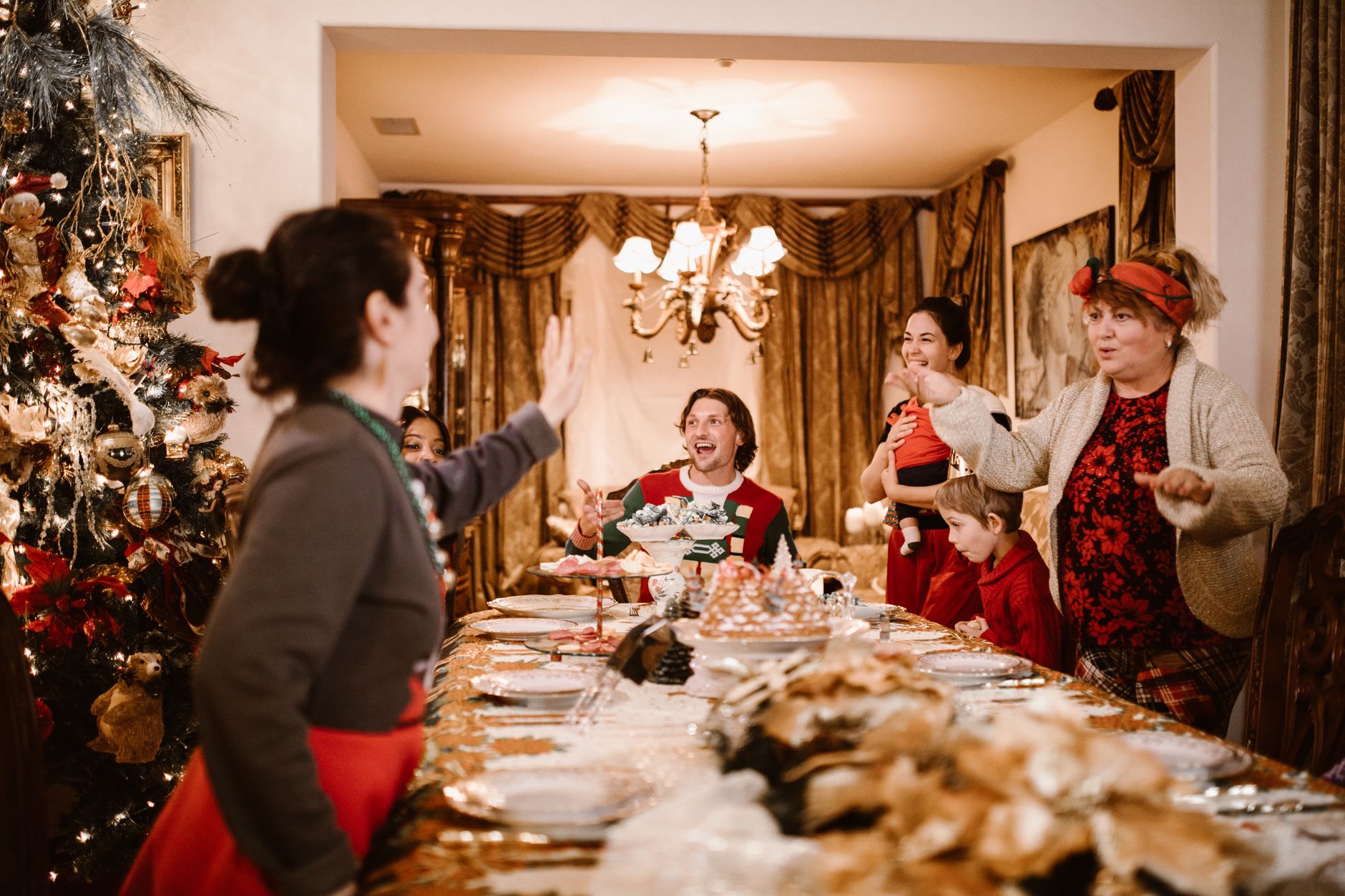
Twenty two people sat around that table and that adjoining one my mother rented folding chairs for every year. Aunts, uncles, cousins, my father at the far end where he always sat, quiet, present, useless in the specific way he had perfected over four decades of marriage. Twenty two witnesses to my daughter standing there with a mop in her hands and tears building behind her eyes, too confused and too polite to know if she was allowed to cry.
I want to tell you I stood up immediately. I didn’t. For maybe three full seconds, which felt like three minutes, I sat frozen at the far end of the table, in the spot my mother always put me and my wife, the spot closest to the kitchen so we’d be handy for refills, and I did the thing I had done for thirty four years. I calculated. I ran the numbers on how bad this actually was, whether it was worth the scene, whether there was a version of the next five minutes where I smoothed it over and we all got through dessert.
Then I looked at my wife, Elena, and her face told me there was no smoothing this over. And I looked at Lily’s face, and something in me that had been coiled tight since I was maybe six years old finally let go.
My name is Lucas. For thirty four years I was the invisible one in this family, the good one, the easy one, the one my mother liked to describe to her friends at church as “just so kind, he never worries about money,” which was her way of telling people I paid for things and didn’t complain about it. I paid the electric bill on my parents’ house, about three hundred dollars a month, every month, for six years. I paid for the family phone plan, six lines, my parents’ and my brother’s and his ex wife’s old line nobody ever canceled and Paige’s phone with the newest model every time Apple released one. I paid for the internet and the cable package with the sports tier my father watched and the premium movie channels my mother watched and never once thanked me for. I funded the big parties, the Fourth of July cookout with the rented tent, the Labor Day thing, and Christmas, always Christmas, the biggest one, the one where my mother invited everyone she’d ever met and I quietly handed over my card to the caterer three days beforehand and never mentioned it again.
And every year, at every one of those parties, my wife and I ended up in the corner. Not literally always the corner, but functionally the corner. The seats nobody fought over. The conversation nobody circled back to include us in. We paid for the room and we sat at its edges, and for thirty four years I told myself that was fine, that was just how my family was, that love in my house had never been loud, it had been useful, and I had decided a long time ago that useful was close enough.
I grew up watching my mother build a hierarchy out of her own children the way some parents build a garden, deciding early which plants got the sun. Grant was two years older than me and from the time I can remember anything, he was the one she pointed to. Grant made the varsity team. Grant had the girlfriend everyone liked. Grant, later, had the business that failed twice and got bailed out both times, first by my father’s retirement account and later, though nobody ever said this out loud at Christmas dinner, by me. I was the one who got told I was “so mature for my age,” which I understand now was just my mother’s way of saying I required less from her. I didn’t need managing. I managed myself, and eventually I managed everyone else too, because somewhere around fifteen I noticed that if I didn’t pay attention to what needed doing, nobody in that house did.
I carried that into my marriage without meaning to. Elena used to tell me, gently at first and then not so gently, that I treated my family’s needs like invoices due on the first of the month, automatic, non negotiable, something to just handle before anyone had to ask twice. She wasn’t wrong. I built a small contracting business up from nothing starting in my twenties, laying tile and running crews across three counties, and by the time Lily was born I was doing well enough that helping my parents felt less like a sacrifice and more like a habit I couldn’t break. My mother would mention, off hand, that the furnace was making a noise, or that the church was doing a fundraiser and it would be a shame if the Whitfield name wasn’t on the donor board, and I would quietly make it happen. She never had to ask twice. She rarely had to ask once.
“Lucas is too kind,” she told her sister at Easter two years ago, right in front of me, like I wasn’t a grown man standing there with a plate of ham in my hand. “He never worries about money.” I remember smiling because that’s what you do, and I remember Elena’s hand finding mine under the table and squeezing once, hard, which was her way of saying she heard it too and she hated it too and neither of us was going to say anything, because we never did.
So when my mother put that mop in Lily’s hands on Christmas Eve, in front of twenty two people, in a house whose lights and heat and Wi-Fi I was personally keeping on, something in the arithmetic finally broke.
I didn’t yell. I want to be honest about that because I think people expect a story like this to end in shouting, in somebody’s face turning red and a door slamming so hard a picture falls off the wall. That’s not what happened. I stood up slowly, walked the length of that dining room past my aunts and uncles who were suddenly very interested in their green bean casserole, and I took the mop out of my daughter’s hands. I didn’t grab it hard. I didn’t make a show of it. I just took it, the way you’d take something dangerous away from a child, and I let it fall to the hardwood floor, where it landed with a wet, flat slap that was somehow louder than anything anyone had said all night.
“We’re leaving,” I said. Just that. Two words, quiet, to Elena, who was already reaching for Lily’s coat.
My mother’s face did something complicated, offense and confusion fighting for space. “Oh, don’t be so dramatic, Lucas, it was a joke.”
“It didn’t sound like a joke to Lily,” I said, and I remember my voice was completely level, which surprised me more than it seemed to surprise anyone else. “It didn’t sound like a joke to me either.”
Grant said something behind me, something about how sensitive everyone was these days, and I didn’t turn around. Paige said nothing, which I noticed, because sixteen year olds usually can’t help themselves, and some small part of her must have understood that this particular joke had landed somewhere real.
My father caught my eye as we walked toward the door. He didn’t say anything. He never did. But he looked at me the way he’d looked at me a handful of times over the years, moments where I could tell some part of him wanted to stand up too and never quite managed it, and that night was no different. I felt the old flash of anger at him for that, and underneath it, something closer to pity, because I was starting to understand, right there with my hand on the doorknob, that my father had spent his whole marriage being exactly what I had spent my whole life becoming.
We got Lily’s coat on her in the front hall while my mother called after us that we were embarrassing ourselves, that this was a family holiday, that we’d regret making a scene. Lily was crying by then, not loud, just steady tears sliding down while she tried very hard to be brave about it, and I picked her up even though she’s nine and getting too big for it, and I carried her out to the car in twelve degree weather with my wife’s hand on my back the whole way.
Nobody came out after us. I remember that specifically, standing in the driveway strapping Lily into her booster seat, waiting almost against my will for a door to open behind me, for someone, my mother or my father or even Grant, to come out into the cold and say wait, come back, we’re sorry. Nobody did. The porch light stayed on and the door stayed shut and I could hear, faintly, the party resuming behind it, laughter picking back up like a scratch in a record that just needed the needle nudged forward.
We drove to the Hartwell Inn off Route 9, the only hotel in town with vacancies on Christmas Eve, and checked into a room with a heater that clanked and a window that looked out over the empty parking lot. Lily fell asleep fast, worn out from crying, still in her green dress because none of us had thought to pack a bag. Elena sat on the edge of the bed and finally let herself be angry, really angry, in the quiet, controlled way she gets angry, which is somehow more frightening than shouting.
“Thirty four years,” she said. “Thirty four years of paying for people who put a mop in our daughter’s hands and called it a joke.”
I didn’t have an answer for her that night. I sat in the one armchair by the window and watched snow start to come down over the parking lot and I thought about the word invisible, the word my mother had made me proud of for so long without either of us ever calling it what it was. I thought about every bill with my name on the account and my card on the file. I thought about how thoroughly, how completely, I had let myself be used, and how the terrible thing wasn’t even the mop. The terrible thing was that some part of me, watching Lily hold it, had recognized the moment. That was just what happened to the useful one in this family. It had simply never happened to a child before.
I didn’t sleep much. Somewhere around four in the morning, lying next to Elena with Lily curled between us in that narrow hotel bed, I stopped feeling sad about it and started feeling something else. Something cleaner. Something close to clarity.
Christmas morning came grey and quiet. My mother’s house was probably still asleep, the guests gone home, the leftover ham going cold in the refrigerator I had, three years earlier, personally paid to replace when the old one died two days before Thanksgiving. I got up before Elena and Lily were awake, made a cup of the terrible hotel coffee, and opened my laptop at the little desk by the window.
I want to explain what was actually on that screen, because it matters. It wasn’t some elaborate hacking operation. It was an account. My account, the one I’d opened years earlier under my own name because my mother didn’t trust “the internet people” and my father truly didn’t understand how a bill could arrive without a stamp on it. Every device the family used ran through it. My brother’s newest phone, upgraded eight months earlier the day after his old one supposedly “stopped working,” though I have my doubts. My father’s tablet, which he used mostly to watch fishing videos. My mother’s phone with the unlimited data plan she insisted she needed for reasons she never fully explained. The internet and the cable box with the sports package and the premium movie tier. Six devices. Six lines of dependence, all quietly billed to a card with my name embossed on it, every single month, for years, because I had never once said no.
I scrolled through the list slowly. I want to be honest that I felt something close to grief doing it, not because I was about to lose anything, but because I could see, laid out in a simple itemized column, exactly how long I had let this go on and exactly how little it had ever cost my family to let me.
I didn’t call anyone. I didn’t type out an angry message. Some lessons, I’ve come to believe, don’t need speeches attached to them. They just need to happen, quietly, and let the silence do the explaining.
“It’s time you all handle your own bills,” I said out loud to an empty hotel room, which probably sounds strange, but I needed to hear it in my own voice before I did it. I moved the cursor to the button at the bottom of the account page. Cancel Family Plan and Disconnect All.
A red warning box popped up. Are you sure you want to disconnect all six devices instantly? This will turn off all services.
I sat with my finger over the mouse for a moment, not out of doubt, but because I wanted to feel the weight of it fully before I did it. Then I let out a breath I felt like I’d been holding since I was about fifteen years old, and I clicked confirm.
I don’t know exactly what happened at my parents’ house in that instant, not really, but I’ve pieced together enough from what came after to picture it clearly. The television my father was probably watching, some Christmas morning parade rerun, would have gone dark mid broadcast. The Wi-Fi that Paige needed for whatever she was doing on her phone would have simply vanished. Any holiday call in progress, the kind my mother liked to make to her sister every Christmas morning to compare notes on gifts, would have dropped mid sentence, replaced by dead air. And when any of them reached for their phones to figure out what had happened, to call and demand an explanation, they would have found the screens dark, the signal gone, the devices they’d never once had to think about suddenly, completely, useless.
The silence in that hotel room, my daughter still sleeping, my wife stirring awake beside her, was the sweetest sound I had heard in years.
But that was only the start of it.
By noon, Elena’s phone, which I had of course kept on its own separate plan for exactly this reason, wouldn’t stop buzzing. Not calls from my mother, not yet. Texts first, a whole chain of them, increasingly frantic, from my aunt Carol, who had apparently been at my parents’ house that morning helping clean up from the party and had watched the whole thing unfold. Carol wanted to know if we knew anything about why the cable had gone out mid football game, why nobody’s phones would connect, whether it was some kind of area wide outage.
I let Elena answer that one. She told Carol the truth, plainly, without embellishment. Lucas paid for that service for six years. After what happened last night, he decided he was done.
The reaction from the wider family split almost immediately down a line I hadn’t expected. Some of my aunts and uncles, the ones who had sat quiet at that table and watched a nine year old handed a mop like it was nothing, suddenly discovered strong opinions about loyalty and family and how you don’t punish everyone for one bad joke. My uncle Ray, my father’s brother, called me directly that afternoon to tell me I was being childish, that Christmas was about forgiveness, and that I should think about how this looked.
“How it looks,” I told him, “is that a man stopped paying for services nobody ever thanked him for and everybody’s furious that the free ride ended on a holiday. I’m not interested in how it looks, Ray. I’m interested in how it’s been for thirty four years.”
He didn’t have much to say to that.
But Carol called back that evening, and her voice was different, quieter. She told me she’d been thinking about it all day, about every Christmas she could remember, and she couldn’t actually recall a single one where my mother hadn’t found some way to remind me, in front of everyone, how lucky the family was to have someone so generous, someone who never made a fuss. “I always thought that was a compliment,” Carol said. “I’m starting to think it was something else.”
That was the first crack. It wasn’t the last.
Two days after Christmas, I made the second call, the one that mattered more than the first. I phoned the venue that my mother had already booked for the Fourth of July party, the same rented pavilion by the lake we used every year, the one whose deposit I had put down back in October like I did every year, on my own card, without being asked, because that was simply what I did. I canceled it. I called the caterer my mother had already started emailing about menu options for the summer and told them the deposit would not be renewed and the account under my name should be closed. I called my parents’ insurance agent, the one who handled the umbrella policy I had quietly added to cover the pavilion liability and the extra vehicle my brother drove that was technically registered to my father, and I removed myself as the payer.
I want to be clear that I wasn’t trying to hurt anyone. I’ve turned that over in my mind more times than I can count since, lying awake some nights wondering if what I did was cruelty dressed up as boundaries. I don’t think it was, not anymore. I think for thirty four years I had confused paying for people with loving them, and loving myself, my wife, and my daughter with being ungrateful for the family I’d been given. What I did that week wasn’t revenge. It was closing accounts, one by one, that should never have been opened in my name to begin with.
My mother called me for the first time on December twenty seventh. I let it go to voicemail, not out of spite, but because I honestly didn’t trust myself yet to speak to her calmly, and I had promised myself, sitting in that hotel room on Christmas morning, that whatever I did going forward, I would do it without raising my voice, without becoming the version of angry that gives people something to point at later and say, see, he’s the unreasonable one.
Her voicemail was four minutes long. It moved through several distinct phases the way her arguments always did. First hurt, how could you do this to your own mother on Christmas. Then confusion, feigned, about whether this was some kind of billing mistake. Then, when neither of those worked on an answering machine that couldn’t respond, anger, real and unfiltered, about ungrateful children and how after everything she’d done for me, raising me, feeding me, this was how I repaid her.
I listened to it twice, sitting in my own kitchen back home, Lily doing homework at the counter a few feet away, oblivious, and then I did something I’m not sure I would have had the nerve to do a month earlier. I opened a spreadsheet.
It took me most of an evening. I went back through six years of bank statements, credit card records, the account portals for the phone company and the cable provider and the electric utility, and I built a plain, unemotional list. Every payment. Every month. The electric bill, three hundred and change, times seventy two months. The phone plan, six lines, compounding every time somebody upgraded a device I hadn’t been asked about in advance. The internet and cable. The Fourth of July deposits. The Christmas caterer, six years running. The insurance rider. A line item, near the bottom, for the eleven thousand dollars I had quietly wired my brother four years earlier when his second business failed and my mother had called me in tears asking if there was anything, anything at all, I could do, because she couldn’t bear to see her boy struggle.
The total, when I finished adding it, was just over one hundred and forty thousand dollars.
I didn’t send it to shame anyone, or at least that’s not the whole truth, because I won’t pretend there wasn’t some grim satisfaction in watching the number resolve at the bottom of that column. But mostly I sent it because I needed my mother to understand, in the flattest and most undeniable language I had, that what she called generosity had a name and a total, and that the ledger had simply, finally, closed. I emailed it to her with four sentences above it. Here is what I have paid for this family over six years. I am not asking for any of it back. I am telling you why I am done being the one who pays for a family that put a mop in my daughter’s hands and called it a lesson. I love you, and I am not doing this anymore.
She didn’t respond to the email. She showed up at my house instead, three days later, on a Tuesday evening in early January, standing on my porch in her good coat with an expression I recognized from childhood, the one she wore when she was about to explain, very reasonably, why I was wrong about something.
I let her in. Elena stood in the kitchen doorway, arms crossed, not hostile exactly, but present, making it clear I wasn’t alone in this. My mother sat on the edge of my couch, the same couch I had helped her pick out for her own living room two Christmases earlier, and she told me she was sorry if the mop thing had “come across badly.” Not sorry it happened. Sorry it came across badly, which is a very different sentence if you listen closely, and I have spent my whole life not listening closely enough.
“I want us to fix this,” she said. “Before things get worse than they already are.”
“What would fixing it look like to you?” I asked her, and I meant it as a real question, not a trap, though I could see on her face that she heard it as one.
She wanted the services back on. She said it plainly enough once I pushed, that Grant couldn’t afford his own phone bill right now, that the internet going out had been embarrassing when people asked, that the Fourth of July pavilion had been a tradition for eleven years and canceling it felt like erasing something that mattered to the whole family. She wanted, in short, for everything to go back exactly to where it had been, minus the specific unfortunate optics of a mop in a nine year old’s hands, which she was willing to call a mistake in tone if I was willing to call the last month a misunderstanding.
I told her no. Not loudly. I told her that I loved her, and that I would always love her, but that I was done being the family’s invisible wallet, done sitting in the corner at parties I paid for, done watching my daughter absorb the same lessons about her own worth that I had spent thirty four years absorbing without ever naming them. I told her that if she wanted a relationship with me, with Elena, with Lily, it would have to be one where none of us were required to earn our seat at her table with cash or chores. I told her that an apology to Lily, a real one, not a reasonable one, not one that started with “if,” would be the first step, and that everything else was a separate conversation for a separate day, one that had nothing to do with bills.
She left angry that night. I won’t pretend otherwise. She told me I was punishing her for one bad moment, that I was being cold, that this wasn’t the son she raised. I remember standing in my own front hall, the same kind of front hall we had walked out of on Christmas Eve, and telling her, as steadily as I could manage, that she was right about one thing. This wasn’t the son she raised. The son she raised would have apologized by now for making a scene. I wasn’t him anymore.
My father called two weeks later, on a weekday afternoon when he knew my mother would be at her church group. It was the longest conversation the two of us had had, just the two of us, in maybe a decade. He didn’t defend her. That surprised me more than almost anything else that winter. He told me he’d watched her build that hierarchy between me and Grant since we were boys and he’d never once said anything, because saying something had never once, in thirty six years of marriage, changed her mind about anything, and somewhere along the way he’d stopped trying. He told me he was ashamed of the mop. He said the words, I should have stood up, and he let them sit there without following them with an excuse, which was, in its own quiet way, the most honest thing my father had ever said to me.
I told him I understood why he hadn’t. I wasn’t sure, when I said it, if I fully meant it, but I’ve come to mean it more with time. Understanding isn’t the same as excusing. It’s just refusing to carry someone else’s failure as though it were your own.
Grant, for his part, never called at all. He sent one text, weeks later, asking if I could “spot him” for his phone bill until things settled down. I read it twice and didn’t answer, and that, more than the mop, more than the spreadsheet, more than any of it, was the moment I understood the shape of what had actually happened in my family for thirty four years. It had never really been about a mop, or a phone plan, or a pavilion deposit. It had been about who got asked to bleed quietly so everyone else could keep smiling in the family photos, and I had finally, at thirty four, put the knife down.
Spring came slow that year, the way it does out here, mud season stretching long before anything green showed itself. My mother tried one more time in April, a card in the mail, not an email this time, handwritten, which from her was itself a kind of admission that this mattered more than the usual gestures. She said she’d been thinking about what I said. She said she’d talked to a counselor at her church, which knowing my mother had probably taken real courage. She didn’t ask for the services back. She asked if she could take Lily to get ice cream, just the two of them, and if she could say something to her that she should have said in December.
I talked to Lily about it first, because it was her decision to make, not mine, and my daughter, who is braver and clearer eyed than I was at nine or honestly than I was at thirty three, said she’d go, but she wanted me to drive her and wait in the parking lot. I did. I watched through the window of the ice cream shop as my mother sat across from my daughter, and at some point Lily’s face changed, softened, and I understood that whatever my mother said in there, it had landed the way an apology is supposed to land, not perfectly, not erasing anything, but real enough to be received.
We didn’t go back to full Christmases at my mother’s house that next December. We’re not there yet, and I’ve stopped promising anyone, including myself, a timeline for when or if we will be. What we did instead was smaller. Elena and I hosted our own Christmas Eve that year, just us and Lily and my father, who came alone and stayed the whole evening, and who cried a little, quietly, in the kitchen when he thought no one was watching, holding a mug of coffee he didn’t drink. My mother came for two hours on Christmas Day itself, brought a gift for Lily that she’d clearly put real thought into, and left before dinner, which felt less like exile and more like the two of us finding, slowly, a size of relationship that didn’t require either of us to pretend.
I still think about that mop sometimes. Not with the sharp, hot anger I carried out of that dining room a year ago, but with something quieter now, something closer to gratitude, strange as that sounds. It took a nine year old standing in front of twenty two people with a bleach smelling mop in her hands to show me a pattern I had spent thirty four years too close to see. I don’t pay my family’s bills anymore. I pay for my own house, my own daughter’s future, the meals at my own table where nobody sits in a corner because there isn’t one, just one table, round, built for exactly the family who chose to be there.
The lights are still off at my parents’ old cable account. I never turned it back on. Some things, once you finally see them clearly, you don’t put back the way they were. You just walk forward, quieter now, into whatever comes next, carrying only what’s actually yours to carry.