The Second Phone In His Toolbox
I went out to Ropell’s garage on a Tuesday afternoon in the first week of June for nothing more than a three-quarter-inch wrench, to fix the hinge on our sagging porch screen door before the mosquitoes found their way in through the gap, and when I lifted the top tray of his rolling toolbox to get at the sockets underneath, I found a phone taped to the underside of the lid that was not his phone, and it was still warm.
I want to tell this the way it actually happened, in order, because for eight months I had trained myself to take things in order, to check my own math twice before I said it out loud, and I am not going to stop doing that now just because I finally have a reason to.
My name is Deana. I am thirty eight years old. I have lived outside Chanute, Kansas, on four acres off a county road since the week I married Ropell fourteen years ago, and for all fourteen of those years I have kept the books for his shop, Ropell’s Small Engine and Auto, which sits in the pole barn forty feet from our back door. I also keep books for the Chanute Farmers Co-op three mornings a week and for the Cut & Curl on Main Street, which is how I know numbers the way some women know recipes, by feel, by the place where a column stops adding up right even when every single entry in it looks innocent on its own.
That Tuesday I came home from the co-op at noon the way I always do. Ropell’s truck was gone. He had texted me at breakfast that a transmission job for a farmer out past Erie had run long and he needed to run to Wichita for a part the parts counter in town didn’t carry, and that he’d be back by six or seven. This was not unusual. It had, in fact, become the most usual thing in our marriage over the last eight months, though on that particular Tuesday I still did not understand that I was measuring a pattern instead of a coincidence.
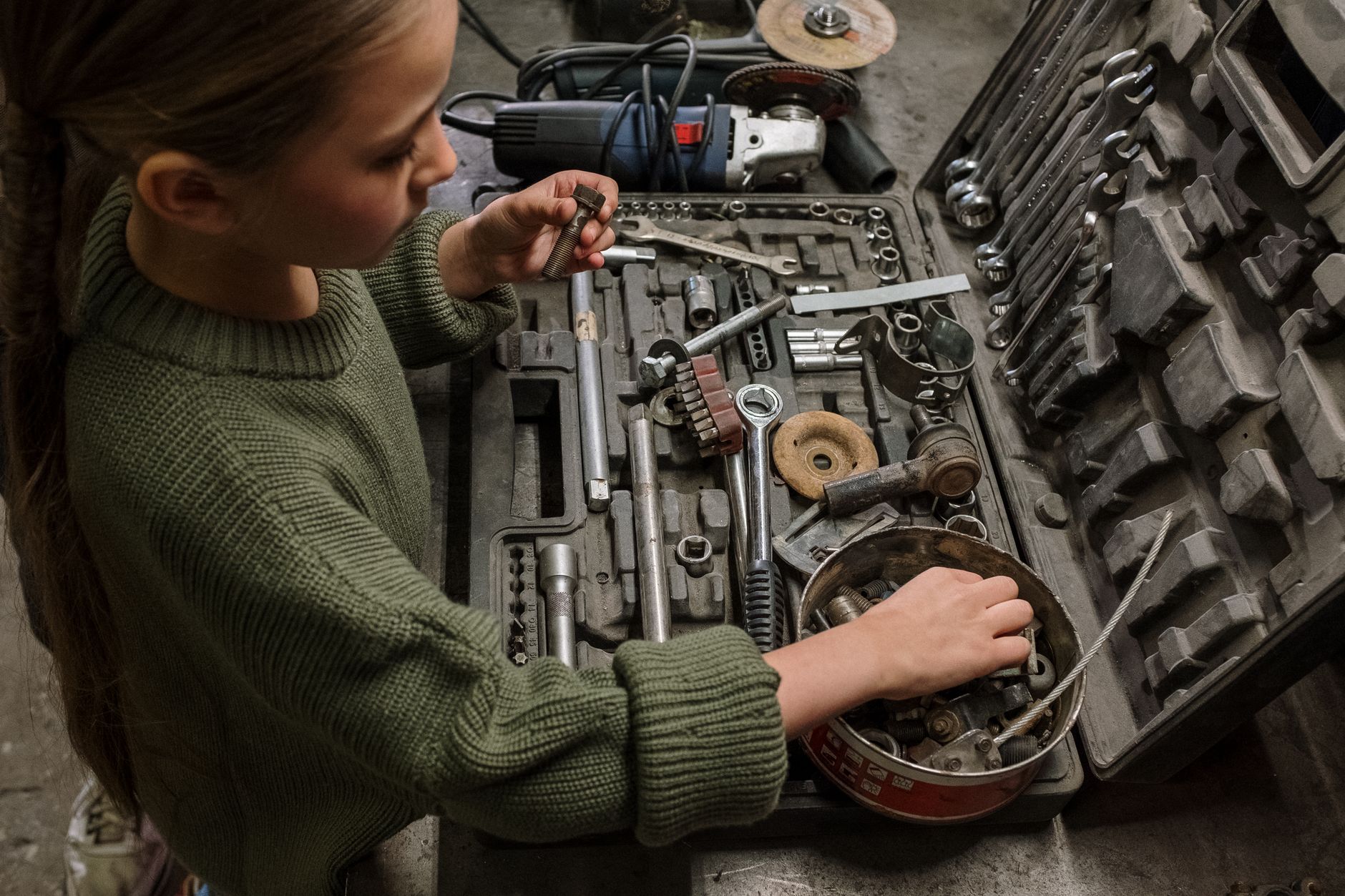
I needed the wrench because the wrenches in my own little toolbox in the kitchen closet, the cheap set Ropell had given me for Christmas years ago so I’d quit borrowing his, did not go up past a half inch, and the screen door hinge had a bolt on it that was bigger than that. So I walked out to the shop bay, rolled his big red Craftsman chest out from the wall where he keeps it, and popped the latches on the top box, the one that sits on top of the rolling cabinet and holds his ratchets and his sockets and the little tray of drill bits he is forever losing.
The tray sits on a shelf about halfway down inside that top box. To get to the sockets underneath it, you lift the tray straight up and out. I have done this a hundred times in fourteen years. I have never once had a reason to look at the underside of the lid above it, because why would you. A toolbox lid is just a lid. It is the ceiling of a small metal room where a man keeps things that turn bolts.
But the tray came out crooked that day, caught on something, and when I worked it free and looked up to see what had snagged it, I saw a shape under a strip of gray duct tape, pressed flat against the inside of the lid, about the size and thickness of a phone.
I stood there for a second not believing it was what it looked like. Then I peeled back one corner of the tape, and it was.
It was a phone. Black, no case, a screen protector with one corner lifted the way they get after a while. I do not know exactly what I expected in that half second before I touched it, maybe nothing, maybe I expected it to be something ordinary that a shop would have taped somewhere, an old phone used to run a shop radio or a diagnostic app. What I did not expect was for it to be warm. Not hot. Warm, the specific warm of a device that has been held in a hand and worked with fingers inside the last few minutes, the warm of something that has not had time yet to cool down to the temperature of a metal garage.
Ropell had left for Wichita, by his own text, over three hours before I got home. There was no version of that timeline where a phone taped inside his toolbox lid should still be warm from use, unless somebody very recently, within the last few minutes, had been sitting exactly where I was standing, holding it.
I want to be honest about what I felt in that moment, because I think it matters for what came after. I did not feel shocked. I felt something worse than shocked. I felt the terrible, sinking relief of a person who has just been handed proof of a thing she has spent eight months telling herself she was inventing.
The screen was locked, but the lock screen still showed the last notification, sitting there in gray letters above the clock, because whoever it was from had not opened it in a while and the phone had not been touched since, or so I thought until I remembered the warmth and understood that whoever had last touched this phone had touched it and then locked it and taped it back up in under an hour, maybe under ten minutes, and driven off, and I was standing in the spot where that had happened.
The notification was from a contact saved simply as “Sil.” It said: don’t stress about the anniversary thing, just tell her the transmission job ran long again. same as always. I’ll have the room till 6.
I read it three times standing in that garage with the tray still in my hand, and on the third reading I understood two things at once, and understanding them together is what actually broke something open in me, more than either one would have alone.
The first thing I understood was that Ropell was somewhere right now, not in Wichita, having an affair with a woman named Sil, in a room with a checkout time, on the same day he had told me he was chasing a transmission part.
The second thing I understood, the one that actually took my knees out from under me, was that this was not the first time. Same as always, she wrote. Same as always. Which meant there was a script. Which meant the excuse he had used on me at breakfast that morning, the exact excuse, transmission job running long, was not something he had come up with under pressure to explain where he was going. It was a line he had used before, so many times that the woman on the other end of that phone knew it by heart and could remind him of it the way you’d remind somebody of their own address.
And then I remembered the anniversary.
Fourteen years ago in October, Ropell and I got married in the fellowship hall of First Christian Church on a Saturday with a ham dinner after and my father walking me down an aisle he’d built himself out of two-by-fours and folding chairs three days before. Every October since, no matter how tight money got, we did something for it. Nothing fancy most years. A weekend at the Lake of the Ozarks twice, a night in Branson once, most years just a good dinner at the steakhouse in Iola and a drive out to look at the leaves change along the river road. It was ours. Fourteen years is not nothing in a county where half the marriages I grew up watching did not make it past ten.
Last October, our fourteenth, Ropell canceled two days before we were supposed to leave for the Lake of the Ozarks. A transmission job, he said, for a rancher out toward Fredonia, had run long, and if he didn’t finish it that weekend the man’s whole hay operation was down a truck for the fall, and I understood, because that is the kind of marriage I thought I had, one where a man’s word to a customer mattered and I could be a good sport about a canceled weekend for the sake of it.
I remember exactly what I did instead. I cooked a pork roast, and I put on the blue dress I’d bought for the trip anyway, and I lit the good candles, and Ropell came in from the shop at eight thirty smelling like solvent and looking wrung out, and he told me he was sorry, and he meant it, or he seemed to mean it, and I told him it was all right, because that is what you say when you love somebody and you believe them.
Standing in that garage eight months later with a stranger’s warm phone in my hand, I understood that the transmission job had probably run long that weekend too, just not the way I had pictured it.
I am going to walk through the rest of it the way I walked through it that afternoon, sitting on an overturned bucket in the shop with the door rolled halfway down so nobody driving the county road could see me, because once I let myself remember one thing, the others came up out of the ground like something I had buried too shallow.
November, I found a receipt in his coat pocket for a diner in Iola I had never heard him mention, on a day he told me he’d eaten a sandwich in the truck between jobs. He said he’d stopped in on a whim, that the counter girl talked his ear off, that it wasn’t worth bringing up.
December, the Thursday parts runs to Wichita started. Before that fall, Ropell almost never went to Wichita for parts. There is a supply house in Chanute and another in Iola, and between the two of them he’d gotten by for sixteen years of running that shop. Suddenly there was a specialty part, always specialty, that only the Wichita house carried, and it was almost always a Thursday, and it almost always took him from mid-morning until supper.
January, I hugged him hello after he came in from a Thursday run and there was perfume on the collar of his coveralls, sweet and floral, nothing like the shop smell of grease and gas that usually rode home with him. He said the parts counter was run by two sisters, sisters who hugged everybody, customers and drivers and each other, that it was just how they were.
February, our anniversary of a different kind, the day he’d proposed, fell on a Friday, and for thirteen years running he had written me a card himself, nothing store-bought inside it, just his own plain handwriting saying some version of thank you for putting up with me another year. That February he handed me a gift card in an envelope with nothing written on it at all, and said he’d been slammed and hadn’t had a minute, and I told him it was fine, and it was not fine, and I knew it was not fine, and I told myself I was being small about it anyway.
March, I found a book of matches from a place called the Lakeview Motor Inn off Highway 59 in the pocket of his work jacket while I was doing laundry. When I asked him about it, not accusing, just asking, the way you ask about a receipt, he said he’d pulled off the road to use a bathroom on a bad stomach day and grabbed the matches off the counter without thinking, and laughed about how disgusting motel bathrooms are on the highway, and I laughed along with him, because it is a funny thing to say if it is true.
April, doing the shop’s books at my own kitchen table the way I have done every month for fourteen years, I noticed the parts and supplies line running about four hundred dollars over what the job sheets accounted for. I chalked it up to the price of everything going up that spring, diesel and steel and everything else, and I did not chase it, because I did not want to find what I am about to tell you I found, and some part of me that I am not proud of already knew that.
Every single one of those things, on its own, has an innocent answer. That is the particular cruelty of the way it was done to me. A receipt is nothing. Perfume on a collar is nothing. A missed card is a busy season. A Thursday parts run is a business need. A book of matches is a bathroom stop. Eight small nothings, laid end to end over eight months, and every time I picked one up and turned it over in my hands, wondering, somebody handed me a perfectly reasonable place to set it back down. I did that. I set every single one of them back down. I told myself I was imagining a pattern where there was none, that I was the kind of wife who goes looking for trouble because she’s bored or because her own mother’s marriage taught her to expect the worst, and I am ashamed to tell you how good I got at talking myself out of my own eyes.
There was one person who never once told me to set it down. And I am ashamed of what I did to her too.
Odalene has cut my hair since we were fifteen years old, in her mother’s kitchen first and then, once she got her license, in the chair at the Cut & Curl on Main Street, the shop she bought outright the year her husband left her for a woman half his age and she decided, in her words, that she would rather own something than be owned by the memory of somebody who didn’t want her. I have kept her books for nine years. We have buried each other’s mothers. She was in the fellowship hall the day I married Ropell, standing up front in a dress the color of a robin’s egg, crying before the vows even started.
Back in December, Odalene had Sil in her chair.
I did not know that name meant anything yet, not for months, because Odalene never told me the name outright, not at first, only that a customer of hers, a woman she did not name, had said something about “her mechanic” in a tone Odalene did not like, warm and private in a way you don’t use about a man who just changes your oil. Odalene told me this over coffee at my own kitchen table in December, gently, the way you’d tell somebody there’s a wasp nest under their porch step, not to scare them, just so they know before they reach their hand somewhere they shouldn’t.
I told Ropell about it that same week. Not as an accusation. As a strange little thing my friend had said that had unsettled me, the way you’d mention anything odd to your own husband. And Ropell’s face did something I had never seen it do before, a kind of stillness that I told myself, at the time, was hurt. He said Odalene had been jealous and bitter since her marriage fell apart, that women like that can’t stand to see anybody else happy, that she’d probably invented the whole thing or twisted some customer’s harmless talk into something ugly because misery loves company. He said it calmly. He said it the way you say something you believe, or the way you say something you need somebody else to believe.
And I am ashamed to tell you that I let him talk me into doubting a woman who had never once, in twenty three years, given me a reason to doubt her, over a man I had known for sixteen. I did not cut Odalene off in one sharp motion. It was slower and, I think now, worse than that. I stopped booking my regular Friday appointment. I let her texts sit two days before I answered them, then three, then I just stopped answering some of them at all. When she called in February to ask if I wanted to come to the shop’s slow Sunday and get my hair done for free like we used to do for fun, I told her I was busy, and I was not busy. By April we had not spoken in two months, not really spoken, just the flat little exchanges you have with somebody you used to love easily and now have to work at loving from a distance you built yourself, brick by brick, out of loyalty to a man who was using that very loyalty as building material.
Standing in that garage in June with the warm phone in my hand, I understood, all the way down, that Odalene had not been jealous, and had not been bitter, and had not misheard a single word. Odalene had been the only person in my life who looked straight at what was happening to me and told me the truth, and I had chosen my husband’s version of her over eight months of my own eyes and one good friend’s plain warning, and I owed her an apology I did not know yet how I was going to have the nerve to give.
But first I had a day to get through, because Ropell was not due home until six or seven, and I had, for the first time in eight months, more hours in front of me than I knew what to do with, and a mind that was finally, finally, done doubting itself.
I did not smash anything. I want to say that plainly, because I know what people picture when they hear a story like this, a woman throwing a man’s tools across a shop floor, and that is not who I am and it is not what happened. I sat on that bucket for maybe ten minutes with my hands shaking, and then I did what I have done for a living for fourteen years when a number does not add up. I got organized.
The first thing I did was take pictures. I photographed the phone taped where it was, the tape, the angle, the tray that had caught on it, before I touched anything else, the way you’d photograph a scene you knew somebody was going to ask you about later and not believe unless you had it. Then I gently worked the tape loose the rest of the way, careful not to tear it, and I photographed both sides of the phone and the lock screen with that message still sitting on it. Then, because I am not a fool and I know how quickly a man can talk himself into believing he imagined something you clearly showed him, I did not put it back. I wrapped it in a dish towel and I carried it into the house and I put it in the bottom drawer of my own dresser, under a stack of winter sweaters Ropell has never once in fourteen years had a reason to go looking through.
Then I went to the filing cabinet in the little office off the shop, the one I set up myself the second year we were married because Ropell has never in his life kept a receipt on purpose, and I pulled the last eight months of the shop’s parts and supply invoices.
It took me an hour, sitting at that same kitchen table where I had once let him hand me an unwritten gift card and call it fine. There was a storage unit rental in Iola, eighty five dollars a month, that had started in November, logged in the books as “additional tool storage,” on a business that has never in sixteen years needed more storage than the pole barn we already own free and clear. There were four separate Visa gift card purchases since December, two hundred dollars each, coded as “customer appreciation,” on a small engine repair shop in Chanute, Kansas, that does not run a customer appreciation program and never has. There was a standing charge, every single Thursday since December, for fuel and a meal, coded to a job number that, when I pulled the actual invoice for that job, had been closed out and paid in full two weeks before some of those Thursday charges even started.
None of it was enormous money. That was almost the worst part. It was not a man draining our savings for a mistress in some dramatic way. It was small, steady, deniable, the same way the receipts and the perfume and the matches had been small and steady and deniable, run through a business account I had built the bookkeeping system for myself, hidden in plain sight inside coding I had taught him to use.
I called the bank next, not to move money in some frantic way, but because I am the kind of woman who checks her own footing before she takes the next step. Our personal savings, the account in both our names that we’d built slowly for a roof and a truck and someday retirement, was untouched. That steadied me more than almost anything else that day. Whatever Ropell had done, he had not done it with the money that was supposed to be our whole life together. He had done it with the shop’s money, and the shop’s books were mine, had been mine for fourteen years, and I understood sitting there that this gave me something I had not expected to have by lunchtime that day. It gave me ground to stand on.
I called an attorney in Chanute next, a woman who had handled a property line dispute for my parents years back, and I told her, plainly, what I had found, and she told me, just as plainly, to do exactly what I had already done. Photograph everything. Keep the phone. Do not confront him in a way that lets him get rid of anything before I had copies. Pull the business records I had legal access to as the shop’s bookkeeper and, she reminded me, as a woman whose own name was on the LLC’s founding paperwork from the year we started it, something I had signed as a formality fourteen years ago and had nearly forgotten mattered. She told me Kansas does not require me to prove fault to end a marriage, only that it is broken, but that what I had would matter a great deal in how the shop and its debts and its assets got divided, since none of what he’d spent had been spent on our marriage. She told me to come in Thursday morning. I told her I would.
Then I called Odalene.
She picked up on the second ring, which told me something, that she had kept her phone close in case I ever did. I did not lead with an apology, because I did not think I deserved to start there. I led with the truth. I told her I had found the phone. I told her the name on it was Sil. I heard her go quiet on the other end for a long moment, and then I heard her say, very softly, “Oh, honey. I have been waiting eight months for you to call me and tell me you finally believed your own self.”
She did not say I told you so. Twenty three years of friendship and she has never once said it to me, not that day and not since, though God knows she had earned the right. What she told me instead was that Sil drove a green Buick, that her husband hauls freight out of Kansas City three weeks out of every four, and that Odalene had, twice in the last two months, driving past the Lakeview Motor Inn on her way to the wholesale beauty supply in Iola on a Thursday afternoon, seen Ropell’s truck parked in the back row where the rooms don’t face the highway. She had not told me, she said, crying now, because she had already tried once and I had chosen him, and she did not know how to try again without losing me for good, and she had decided that when I was ready to see it, I would see it, and she would be there the day I did.
I told her I was sorry for two months of unanswered texts and a Friday appointment I let go cold and a friendship I let a man talk me out of trusting. She told me to come in Thursday, same as the lawyer, first thing, and she would fix my hair for free like we used to do on slow Sundays, and we would figure out the rest of it together the way we had figured out everything else since we were fifteen.
By five o’clock that afternoon I had a folder. Photographs of the phone and its screen. Copies of eight months of business invoices with the strange charges circled in red pen. The names of an attorney I had an appointment with in two days and a friend I was rebuilding a bridge to. I had not screamed. I had not thrown a single tool across that shop floor. I had done, in the space of one long June afternoon, exactly what I have done for a living for fourteen years, which is take a column of numbers that does not add up and find, patiently, where the error was hiding.
Ropell’s truck came up the drive at twenty past six.
I was sitting at the kitchen table when he came in, the folder closed in front of me, the dish towel bundle beside it. I had not decided to be calm. I had simply run out of anything else to be. Eight months of doubting my own eyes had worn the panic out of me somewhere along the way, and what was left, sitting at that table waiting for him, was something closer to a very old, very quiet, very finished kind of certainty.
He came in the back door the way he has come in for fourteen years, keys jingling, calling out that he’d grabbed a burger on the road and didn’t need supper, and he was three steps into the kitchen before he saw my face and stopped talking.
I did not raise my voice. I want that understood, because the version of this where I am screaming and throwing things is not the version that happened, and it is not the version I am proud of having lived. I unwrapped the dish towel and set the phone on the table between us, screen up, the message from Sil still sitting there in gray letters where I had photographed it that morning.
“I found this in your toolbox at noon,” I said. “It was still warm.”
I watched every excuse he has ever handed me in fourteen years pass across his face at once, and I watched him understand, in real time, that not one of them was going to work this time, because I was not asking him a question. I already knew the answer. I had spent the whole day proving it to myself in a way no amount of talking on his part was ever going to be able to undo.
“I’ve had all day,” I told him. “I’ve had a lawyer since noon and a friend I owe an apology to since two o’clock and eight months of receipts laid out on this table since four. I know about Sil. I know about the storage unit in Iola. I know the transmission job that ran long last October was a line she told you to use, because she typed it to you again this morning, and I have the picture.”
He tried, for a while, the way I imagine most men try, to find some angle where it was smaller than it was, or my fault somehow, or a mistake that could still be walked back if he just found the right combination of words. I let him talk himself all the way out, because I did not need to interrupt him. I had already decided, and there is a particular kind of quiet a person carries when they have already decided, that no amount of talking from the other side can crack.
I told him he was welcome to sleep in the shop office that night, on the cot he kept out there for late jobs, and every night after that until we had it sorted properly through my attorney, because I was done sharing a bed with a man whose second phone I had been carrying around warm in a dish towel all afternoon. I told him the shop’s books were staying exactly where they were, in my filing cabinet, in my name on the paperwork same as his, and that whatever came next would come through the lawyer, not through the kitchen table, because I no longer trusted a single word that came out of his mouth in that kitchen to be the truth and not a line somebody else had handed him to say.
He did not fight me on any of it that first night. I think some part of him had known, the way people always seem to know underneath, that the day he left his own second phone warm in that toolbox was the day the whole arrangement was always going to come down around him, and some tired part of him was almost relieved to stop having to remember which lie went with which Thursday.
It took until the following spring to finish all the way through, the way these things do in a county where the courthouse only sits certain days and lawyers on both sides need their time. Ropell moved his half of his tools, though not the toolbox itself, out to a rented bay behind the tractor supply on the edge of town, and started over there under his own name with about a third of the customers he used to have, because word moves through a county like ours the way it moved through Odalene’s chair, quietly, and then all at once. Sil’s husband, the freight driver, found out that same June, not from me, not from anything I did, but from the same quiet grapevine that runs under every small town on a road nobody thinks to watch, and I am told he did not take it any better than I did, though what happened in that marriage is not mine to tell.
I kept the shop. My attorney made sure of that, on the strength of eight months of invoices and a founding paperwork signature from fourteen years back that Ropell had never once imagined would matter. I brought on the two mechanics who had worked under him and liked me better anyway, renamed it Deana’s Small Engine and Auto, and set the same filing cabinet up in the same little office, because good bookkeeping does not care whose name is over the door. Odalene did my hair for free that whole first year, every Friday, no matter how busy the Cut & Curl got, and told me once, trimming my ends, that she had never once stopped believing I would call her back, she had just been waiting on my own eyes to catch up to what my gut already knew.
I still keep his old rolling Craftsman toolbox. I did not sell it and I did not throw it out. It sits against the same wall in the shop it always did, and the top tray still catches on the same little lip it always caught on, and some mornings I lift it out on my way to find a socket and I look up at the underside of that lid out of habit, at the clean gray metal where a strip of tape used to be, and there is nothing there now, and there never will be again, because it is my shop now and my name on the paper and my hand on the ratchet, and I do not keep anything taped where I cannot see it.
What I do keep, in the bottom drawer of a filing cabinet that has never once belonged to anyone but me, is a phone wrapped in a dish towel that I have never had a reason to unwrap since the day my attorney filed her copies of everything on it. Some days I think about getting rid of it. Most days I don’t. It is not a trophy and it is not a wound anymore either, it has settled into something quieter than both of those, a plain fact sitting in a drawer the way a closed ledger sits on a shelf once the year is done and reconciled and every column, finally, adds up.
I did not imagine any of it. Not one single month of it. I want every woman reading this who has ever been told, gently or otherwise, that she is imagining a pattern in her own marriage, to hear that as plainly as I am able to say it. Eight small nothings laid end to end were never nothing. They were a column that did not add up, and I am the only one who was ever going to be brave enough to go looking for where the error was hiding, because I am the one who built the books, and I am the one who finally, on an ordinary Tuesday in June, went looking for a wrench and found the truth instead, still warm, waiting for me exactly where he had left it.
This story is a dramatization. Names, characters, and details are invented, and any resemblance to real people or events is coincidental.