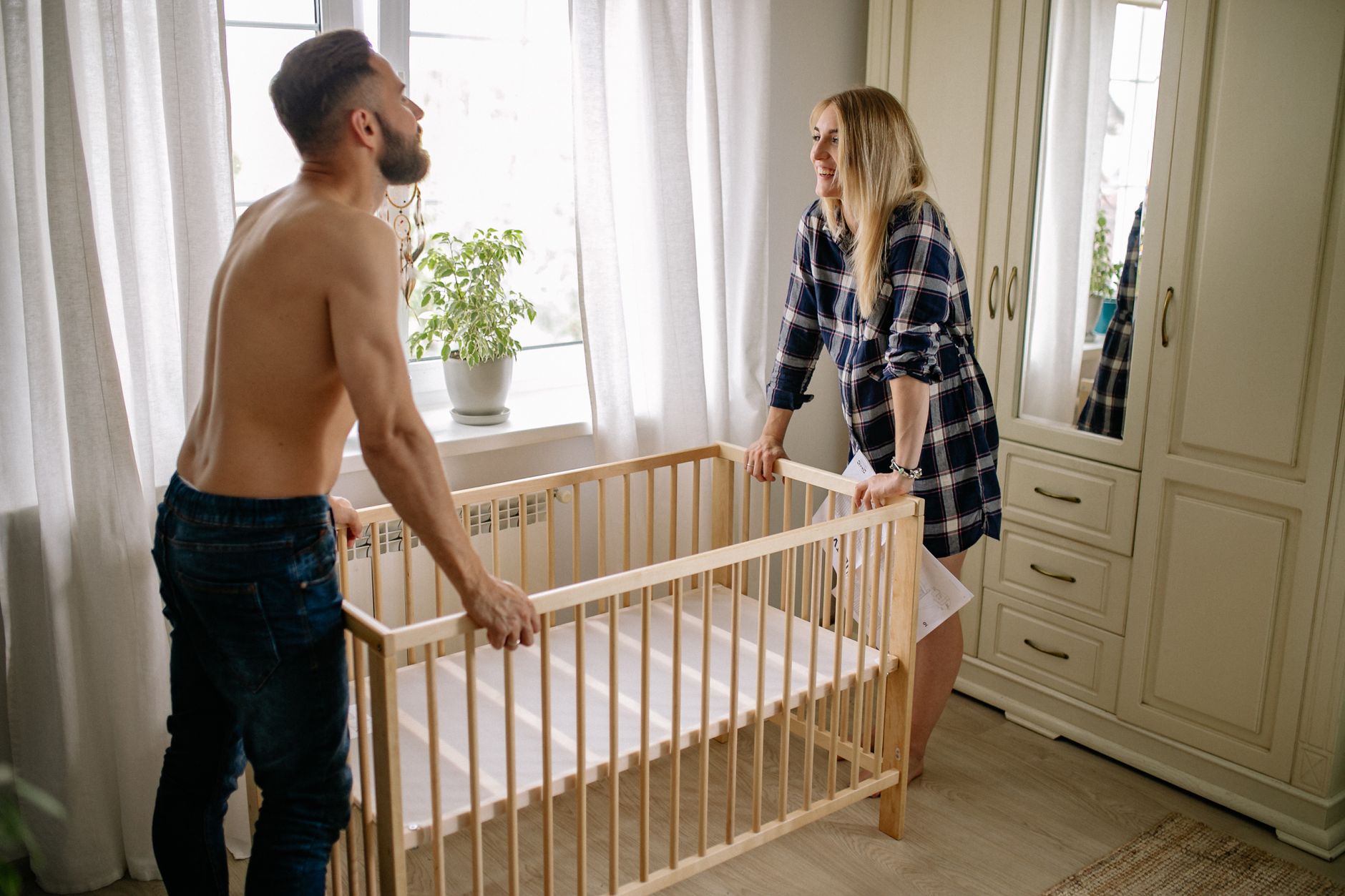
The Crib My Brother Almost Sold
My name is Ignacio Reyes. I am thirty one years old, I have lived in Dodge City, Kansas my whole life, and three weeks before my son was due to be born, I found the crib my father built for him listed for sale on a Facebook marketplace app, ninety dollars, cash only, pickup on Comanche Street.
I want to tell you how I found it, sitting on a folding chair on my lunch break at Cimarron Feed & Supply with wheat dust still on my forearms from unloading a truck, scrolling through baby listings because Perla had sent me a picture of a changing table that morning and said “see if anybody local has one cheaper.” I want to tell you what I saw in the third photo down, the one nobody else on this earth would have looked at twice. And I want to tell you about my father, a quiet man named Sixto Reyes who everybody in our family called Abuelo even before he was old, because that is a story too, and about my brother Rufino, who I did not speak to for eleven days after that lunch break, and about a girl named Perla who has more grace in her than any person I have ever known, because without her grace I do not think this story ends the way it ended.
My father came up from Zacatecas when he was nineteen, worked cattle outside of town for a few years, then got on at the rail yard, and somewhere in there taught himself to build furniture out of a stack of library books and a lot of ruined lumber. By the time I was old enough to remember anything, he had a shop behind the house on Avenue A, a low cinder block building he’d put a woodstove in himself, and half the furniture in every house on our block had come out of that shop at one point or another. Tables. Cradles for other people’s babies before he ever built one for his own grandchildren. A set of pews he built for St. Isidore’s Catholic Church for free, because the parish priest asked him and my father did not know how to say no to a church that had baptized both his sons.
He put a signature on everything he built, three stalks of wheat carved small into a corner where you’d have to know to look for it, bound together at the base with a little ribbon of wood he cut so thin it looked like it should snap and never did. He told me once, sanding a table leg in that shop with sawdust catching gold in the light from the one window, that he carved wheat because wheat was the first thing that ever fed this town, and because wheat only stands up when the stalks are bound together, and a family that comes apart from each other is a family that falls over in the first hard wind. I did not think much of it at the time. I was maybe sixteen. I think about it now more than I think about almost anything else he ever told me.
Everybody called him Abuelo, grandfather, even his own sons, even before there were any grandchildren at all, because my brother Rufino had been the one stuck holding a baby the whole reception at some cousin’s wedding party twenty some years back, pacing around bouncing somebody else’s infant while the mother danced, and my father had laughed so hard watching his oldest boy do it that he started calling Rufino “little grandpa” as a joke, and somehow the joke slid sideways onto my father himself, the way nicknames do in a family that talks over each other at every dinner, until everyone, even my mother, called him Abuelo full time, so completely that I had to think for a second, writing this, to even remember that his name was Sixto.
Rufino is four years older than me and we have never been easy with each other. I do not know how to explain it except to say that some brothers are built the same and some are built different, and Rufino and I were built different from the time we were boys. He liked engines and I liked wood. He liked to be first through a door and I liked to watch a room before I walked into it. Our father loved us both, I know that the way I know my own name, but he understood me easier, and I think Rufino felt that his whole life the way you feel a stone in your boot, small and constant and impossible to forget about even for an hour.
When my father died, a year and a half ago now, in November, it was Rufino who found him. A stroke, sudden, in the shop, on a Tuesday afternoon with the woodstove still going and a half sanded table leg still in the vise. Rufino had stopped by to borrow a ratchet set and instead found our father on the concrete floor, already gone, sawdust in his open eyes. Rufino called me from the shop doorway, and I could hear in his voice, even through the shock of it, a sound I had never heard my brother make before and have not heard since, not even in the worst of what came later. I do not think Rufino ever really left that doorway. I think some part of my brother has been standing in it for a year and a half, unable to walk all the way in or all the way out.
I found out Perla was pregnant four months after we buried our father. I remember standing in our kitchen holding the test, and the first thing I thought, before joy, before fear, was that I wanted to tell Abuelo, and then the second thing I thought was that I could not, and that second thought put me on the kitchen floor for a while, just sitting there with my back against the cabinet, Perla’s hand on my shoulder, both of us crying for a man who would never meet his grandson.
But my father had already started. That is the part I need you to understand, because it is the whole center of everything that happened after. Two winters before he died, before Perla and I were even married, my father had begun cutting cedar and black walnut in that shop, planing boards smooth in the evenings after his regular work, and when I asked him what he was building he told me, “Something for whichever one of my boys needs it first.” He would not say more than that. He worked on it slow, in pieces, over more than a year, and I would go by on Sunday afternoons after Mass at St. Isidore’s and sand alongside him for an hour or two, and I watched a crib come together board by board under his hands, cedar rails, a walnut headboard, and in the corner of that headboard, small enough that a stranger would never notice it, three stalks of wheat bound at the base.
He finished it four months before he died. I remember because he called me over specially, made me stand in front of it in the shop with the woodstove ticking, and he put his rough hand flat on the headboard and said, “This one’s not going in a house yet. This one waits until it’s needed.” I asked him whose it was for, mine or Rufino’s, because at that point neither Perla nor Rufino’s wife had announced anything, and my father just smiled the small smile he gave when he had decided not to answer a question, and said, “It’ll know its baby when the baby comes.” That was Abuelo. He built things and let them find their own way into the world in his own good time, the same patience he brought to a stubborn piece of walnut he brought to his own sons.
After he died, the crib stayed in the shop, because the shop stayed Rufino’s. That was the one piece of the estate nobody fought over out loud, though I will admit now, writing this, that some part of me minded more than I let on. Rufino had lived closest, had always been the one to mow the yard and fix the gutters, and when our mother, who had passed years before our father, left the little house on Avenue A to both of us jointly, Rufino was the one who moved into it, paid what taxes there were, kept the shop standing. I moved twelve minutes across town with Perla into a rented house near the fairgrounds, and I told myself the distance did not mean anything, that family is family no matter whose gravel driveway the toolshed sits on.
When Perla and I found out we were having a boy, at the twenty week appointment, I drove straight to Avenue A afterward, sat in Rufino’s kitchen, and told him. I watched his face do something complicated, happy and tight at the same time, and he said, “Congratulations, hermano,” and hugged me the stiff, quick way we hug, and I thought that was the end of it, that the crib would simply appear in our nursery when the time came the way I had always assumed it would, because our father had built it and said it would know its baby, and I was the one having the baby.
I did not know then that Rufino had lost his job at the packing plant off Highway 50 eleven weeks earlier. I did not know his hours had been cut and then cut to nothing in a round of layoffs that hit half the floor he worked, men he’d known fifteen years let go on a Friday with two weeks’ severance and a handshake. I did not know that his wife was also pregnant, further along than Perla by almost nothing, three weeks and some days ahead of us, due right around the same window I was counting down. I did not know any of it, because Rufino did not tell me, did not tell our mother’s sister who still lives two blocks from Avenue A, did not tell anyone, because that is the kind of man my brother is. He carries what’s heaviest alone and calls it strength, the same way our father carried his grief over leaving Zacatecas alone for thirty years before he ever spoke a word of it to either of us.
So there I was on my lunch break, wheat dust on my arms, scrolling a marketplace app for a cheap changing table, and there in the third photo of a listing titled “Solid wood baby crib, good condition, cash only, no delivery,” was a headboard I would know blindfolded. Cedar rails. Walnut headboard. And in the corner, small, easy to miss if you did not already know exactly where to look, three stalks of wheat bound at the base.
The listing had gone up two hours earlier. The seller’s name on the account was Rufino Reyes.
I sat there on that folding chair for I do not know how long, the wheat dust drying stiff on my arms, reading that listing over and over like the words might rearrange themselves into something that made sense. Ninety dollars. Cash only. Pickup on Comanche Street, which is Rufino’s street. My father’s hands were in every rail of that crib. My unborn son’s whole first bed was sitting in a stranger’s marketplace feed between a lawnmower and a set of bar stools, and my own brother had put it there.
I did not finish my shift. I told my manager at the counter I had a family emergency, which was not a lie, and I drove straight to Comanche Street with my heart going so hard I could feel it in my teeth.
Rufino was in the open garage when I pulled up, and the crib was sitting right there on the concrete beside a card table with a cash box on it, like he was fixing to run a yard sale out of his own grief. I got out of my truck already talking, already too loud for a residential street at two in the afternoon, and I will not pretend I came in gentle. I asked him what in God’s name he thought he was doing. I asked him if he had lost his mind. I told him that crib had our father’s hands in it, that it was not his to sell any more than it was mine, that Dad had built it for whichever grandchild needed it and I was the one three weeks out from needing it.
Rufino did not raise his voice back at me, which somehow made it worse. He stood there with his arms crossed, looking older than thirty five, looking like a man who had not slept well in longer than a week, and he said, “It’s just a crib, Nacho. Dad’s dead. Wood doesn’t keep him alive, and it doesn’t feed anybody either.”
I have known my brother my whole life and I do not think he has ever said anything to me that landed like that sentence landed. Wood doesn’t keep him alive. Like the crib was nothing. Like everything I remembered of Sunday afternoons sanding rails beside our father in that shop, everything that crib carried in its grain, was worth exactly ninety dollars and not one cent more to the man standing across from me.
I told him I would pay him for it myself, right there, whatever he wanted, more than ninety dollars if that was the trouble, and he said, flat, that a buyer was already coming by that evening and he wasn’t in the business of running an auction between his own family and a stranger’s cash. I did not understand that sentence either, not then. I thought it was pride, or spite, or some old wound between us finally coming up through the floor after thirty five years. I told him our father would be ashamed of him. I regret that sentence more than almost anything I have ever said out loud, because I watched it land on my brother’s face like a physical blow, and he did not answer it. He just turned around and walked back into the garage and started wiping down the crib rails with a rag, like I wasn’t standing there anymore, like I had already left.
I drove home and I could not tell you one detail of that drive. Perla met me at the door, eight months pregnant, moving slow and careful the way she’d started moving those last weeks, and she took one look at my face and did not ask me anything, just walked me to the couch and sat with me while I told her the whole thing, my voice breaking on parts of it I am not proud to admit broke.
She did not tell me Rufino was wrong. That is the first thing I want you to know about my wife. She let me be angry for a while, held my hand while I was angry, and then, once the worst of it had burned down some, she said, quiet, “Something’s not sitting right about this, Nacho. Rufino’s not a cruel man. He’s a proud one. Those aren’t the same thing, and you know that better than I do, you grew up with him.”
I did not want to hear it that night. I wanted my brother to simply be wrong, simply be selfish, because a simple villain is easier to be angry at than a complicated one. But I could not sleep, and around midnight I got up, sat at our kitchen table in the dark, and pulled the listing back up on my phone, mostly, I think, to look at that headboard one more time before some stranger from Comanche Street hauled it off into a life none of us would ever see again.
I zoomed into the third photo, the one with the crib framed in the garage doorway, and this time, instead of looking at the headboard, I made myself look at everything else in the frame. The workbench behind it. The pegboard on the far wall. I do not know what made me do it. Maybe it was Perla’s voice in my head, something’s not sitting right. Maybe it was just a man at midnight looking for any reason at all not to hate his own brother.
Pinned to that pegboard, half hidden behind a coil of extension cord, was a strip of ultrasound photos. And taped beside it, an appointment card from the women’s clinic in town, the kind they hand you at the front desk with your next visit written in blue pen. I zoomed further, my thumb and finger shaking a little on the glass, until I could make out the date written on that card. Three weeks after Perla’s due date. Almost the exact same window, just shifted, like an echo of my own countdown sitting quiet on my brother’s garage wall the whole time I’d been standing there yelling at him about wood.
And on the workbench itself, half covered by a rag, a single sheet of paper I recognized even blurred, because I had gotten the same kind of letter myself once, years back, from a job that didn’t work out. A termination notice, the packing plant’s letterhead across the top. I could not read the date from the photo, not clearly, but I did not need to. I understood, sitting alone at my kitchen table at midnight with my son three weeks from arriving, that my brother had lost his job, that his wife was carrying a baby of her own, due right on the heels of mine, and that he had not told a single person in our family any of it.
I did not sleep that night. I lay next to Perla with my hand on her belly, feeling our son move under my palm the way he did most nights those last weeks, and I thought about my brother standing in that garage that afternoon, arms crossed, telling me wood doesn’t keep anybody alive, and I understood for the first time that he had not been talking about our father at all. He had been talking about himself. About a man who had lost his job and could not bring himself to say the words out loud to his own family, who was three weeks from a baby with no paycheck coming in, who had looked at a crib worth more to him in memory than almost anything else his father ever built, and decided the memory was a luxury he could no longer carry.
I went to see him the next morning before his wife was awake, before I would have to say any of this in front of her too. He answered the door in the same clothes from the day before, like he hadn’t slept either, and when he saw my face he did not ask what I wanted. He just stepped back and let me in, and we stood in his kitchen, the same kitchen our mother used to make tamales in on Christmas Eve, and I told him what I had seen in the photo. The ultrasound. The appointment card. The letterhead on the workbench.
I watched something go out of my brother when I said it, some last piece of the wall he’d had up since the garage the day before, and he sat down hard at the kitchen table and put his head in his hands, and for a long moment he did not say anything at all.
“Fifteen years at that plant,” he finally said. “Fifteen years, and they let eighty of us go in one morning meeting. I didn’t tell anybody because I kept thinking I’d have something else lined up before it mattered, before anybody had to know. And then my wife told me she was pregnant, and I thought, okay, God’s testing me, fine, I’ll figure it out, I always figure it out. And then the due date came back three weeks after yours, and I did the math on formula and diapers and a hospital bill with no insurance behind it anymore, and I looked at that crib sitting in Dad’s shop, worth ninety dollars to somebody on the internet and worth nothing to me sitting there unused while my own kid’s got no bassinet at all, and I told myself, Nacho doesn’t need it, he’ll manage, he’s got a job that didn’t just disappear on him.”
I asked him why he didn’t just tell me. I asked him why, of all people, of all the family we had left, he decided the one thing he could not say out loud was that he needed help.
“Because you were always the one Dad understood easy,” Rufino said, and his voice cracked on it in a way I had not heard since we buried our father. “You and him in that shop every Sunday, sanding, talking, that whole language you two had that I never learned. I found him on that floor, Nacho. Me. Not you. I’ve been standing in that doorway for a year and a half wondering why God let it be me and not you, because you would have known what to say to him, and all I did was call 911 and watch him not breathe. And then I’m the one stuck with his whole shop, his whole life, sitting there every day reminding me I couldn’t even keep him alive long enough to say goodbye right, and now I can’t keep my own family fed either, and I looked at that crib and all I could think was, I am not the son who gets to keep nice things. I’m the son who loses them.”
I did not have words for a while after that. I just pulled a chair out and sat down across from my brother, the way I had not sat across from him, really sat with him, in longer than I want to admit, and I told him he was wrong about one thing at least. He had not lost our father through any fault of his own, and finding him on that floor was not a failure, it was a mercy, because it meant our father was not alone at the end, and I told him that if I had been the one to find him instead, I do not know that I would have handled it with any more grace than Rufino had. I told him I was sorry for what I’d said in the garage, about Dad being ashamed of him, because it was a lie, a cruel one, and I had known it was a lie even as it left my mouth.
We sat in that kitchen a long while, longer than I think either of us had sat still together since we were boys, and somewhere in there Rufino told me the rest of it, how he’d already taken the crib down off the marketplace app before I even showed up that morning, how he’d lain awake half the night after I left his garage, staring at the ceiling, hating himself for the whole plan, but too proud and too scared to call it off on his own without somebody giving him a reason that wasn’t just shame.
I told him about the second crib.
I have to explain this part carefully, because I did not understand it myself until that same week. In the back of my father’s shop, up in the low rafters where he kept lumber he wasn’t ready to use, there was a stack of matched cedar and walnut boards, cut to length, planed smooth, wrapped in an old moving blanket, that I had noticed once, years back, and asked him about. He’d told me, cryptic as always, “That one waits its turn.” I had assumed at the time it was scrap he was saving for some future table. I had forgotten about it entirely until I stood in that shop again with Rufino, three days after our kitchen conversation, and we pulled that blanket down together and found, cut and ready, every board needed to build a second crib, cedar rails and a walnut headboard blank, waiting fifteen years or two, however long it had actually been sitting up there, for a hand to finish it.
Our father, it turned out, had never built one crib meant for one grandchild. He had built one crib and prepared the makings of a second, quietly, without telling either of us which was for whom, because I think now that he understood something about his own sons that we did not yet understand about each other. He knew Rufino would need something to build with his hands someday, the same way building had always steadied Sixto himself through every hard year of his own life. And I think, though I cannot prove it and never will, that some part of him also knew that whichever son ran short, whichever one needed the reminder that he was not the son who loses things, would need it most in the exact kind of week we were standing in that shop.
We built the second crib together over the next two and a half weeks, most evenings after Rufino’s temp shift at the grain elevator, which he’d picked up the day after our kitchen conversation because I told him about an opening there and he actually let me tell him, actually let me help without flinching away from it. We worked under the same one window that used to catch the sawdust gold in the afternoons, and I will tell you that sanding cedar rails beside my brother, the two of us mostly quiet, occasionally laughing at something stupid one of us said, was as close to being back in that shop with our father as I have felt since the day we buried him. In the corner of the new headboard, where our father would have put it, Rufino carved three stalks of wheat bound at the base, a little rougher than Dad’s, a little uneven, because it was his first time carving anything in his life, and I told him it was perfect exactly the way it was, because a family that comes apart falls over in the first hard wind, and ours had come about as close to falling over as it ever had, and here we were, standing back up together over a pile of cedar shavings.
My mother’s sister put the word out at church without either of us asking her to, the way news moves through a small town whether you want it to or not, and by the following Sunday there was an envelope in the collection basket at St. Isidore’s with Rufino’s name on it and four hundred dollars inside and no note, and two of the men from his old shift at the plant showed up at the shop one evening with a case of diapers and a folding bassinet still in the box, and did not stay to be thanked, just set it inside the door and drove off. Rufino cried in front of me for the first time since our father’s funeral, standing in that garage with a stranger’s kindness in a cardboard box at his feet, and I did not say anything, just put my hand on his shoulder the way our father used to when words weren’t going to help.
My son was born on a Thursday morning in July, three weeks almost to the day after I found that listing, in the same hospital room where half the babies in this county get born, and Perla did the hardest, bravest thing I have ever watched a person do, and somewhere in the middle of all of it I stopped thinking about cribs or listings or anything at all except her face and then, an hour later, his. We brought him home two days later to a nursery with cedar rails and a walnut headboard our father built with his own two hands, three stalks of wheat carved into the corner, and I sat in the rocking chair Perla’s mother had given us and I put my hand flat on that headboard the way I used to watch my father do, and I told my son, quiet, that his abuelo had built this for him before he was ever a thought in anybody’s head, and that his tío had almost had to sell it out from under him, and that both of those things were true, and that the second one did not make his abuelo’s gift any less than it was, it just meant that love, in a family like ours, sometimes has to survive its own worst week before it gets to mean what it was always going to mean.
Rufino’s daughter was born five weeks later, a girl, healthy, loud from the first minute the way her father always was, and she came home to the second crib, the rougher one, the one with my brother’s uneven wheat stalks carved into the corner by hands that had never carved anything before and have not stopped since, because Rufino kept the shop running after that, started taking small commission work the way our father once had, a table here, a bookshelf there, enough to get his family through until something steadier came along, and steadier did come along, a foreman’s job out at the elevator by that fall, but I do not think my brother will ever fully set down the woodworking again now that he’s picked it back up. Some things, once you remember your hands still know how to hold them, do not let go easy.
I think about that midnight at my kitchen table more than I think about almost anything else from that whole year, the version of that night where I do not zoom into a photograph, where I let myself stay angry, where a stranger from Comanche Street drives off with my father’s crib in the back of a pickup and I never learn a single thing about what my brother was carrying alone. I do not know what would have happened to Rufino and his wife in that version. I do not know if the second crib ever comes down out of those rafters, or if it sits up there another fifteen years, or forever, waiting on a turn that never comes because nobody thought to look for it. I try not to spend too much time in that version. I have the real one instead, the one where my wife told me something’s not sitting right and was patient enough to let me get there on my own, the one where a ninety dollar marketplace listing turned out to be the thing that finally got my brother and me back into the same shop our father built us both in.
Two cribs stand in two houses now, three streets apart, both carrying the same three stalks of wheat, bound at the base the way my father always said a family had to be bound if it meant to stand up through a hard wind. I do not think either one of us ever really believed, when we were boys sweeping sawdust off that concrete floor for our father, that the wood itself would be the thing that taught us how to be brothers again. But I have stopped being surprised by what that man managed to build into everything he ever touched, long after his hands stopped moving, long after the shop went quiet the way it did on that Tuesday in November. He always said a board’s got a memory in it if you listen. I did not understand what he meant until the week I very nearly lost my brother and my son’s first bed on the same ninety dollar afternoon, and found, underneath both, the same patient man who had been quietly building for two grandchildren before either of us had told him a single thing about either one.
This story is a dramatization. Names, characters, and details are invented, and any resemblance to real people or events is coincidental.